# The 2024 Evolution of Autonomous Agents: Hardware Momentum, Advanced Tooling, Security, and Market Expansion
The autonomous agent ecosystem in 2024 is witnessing unprecedented growth, driven by rapid hardware innovations, sophisticated developer tooling, multimodal capabilities, and an increasing focus on security and interoperability. This year marks a pivotal juncture where technological advances, industry investments, and emerging standards converge to shape a resilient, scalable, and trustworthy autonomous infrastructure poised to transform enterprise, societal, and physical domains.
---
## Continued Hardware Momentum: Massive Investments and Breakthroughs in AI Chips
At the forefront of 2024’s landscape are significant advancements in AI hardware, fueling both inference and training capabilities essential for autonomous agents:
- **Venture capital and industry giants** are making substantial bets:
- **MatX**, an AI chip startup, raised **$500 million** in Series B funding led by a prominent fund associated with **Andrew Ng**. Their focus is on **LLM training chips** optimized for large-scale language models, addressing the critical need for efficient hardware to support increasingly complex models.
- **Taalas** has developed the **HC1** chip supporting **up to 17,000 tokens/sec** for real-time reasoning, especially in safety-critical sectors like aerospace and defense.
- **Meta** committed **$100 billion** in partnership with **AMD** to develop **custom hardware** tailored for large language models, emphasizing the importance of specialized chips for autonomous agent performance.
- Nvidia’s expansion, including the acquisition of **Illumex**, underscores a strategic push toward **hardware-software co-design**, ensuring that compute hardware aligns tightly with emerging AI models.
A notable industry trend is the concept of **“embedding large models directly into chips”** — often termed **“刻大模型进芯片”** — where **immutable, dedicated AI chips** encode models directly in silicon. This approach offers **low latency**, **energy efficiency**, and **enhanced robustness**. For instance, **Taalas** is pioneering **non-programmable AI chips**, embedding **unchangeable models** at the hardware level, which reduces attack surfaces and enhances reliability.
Recent experiments reveal that **scaling test-time compute** allows **smaller models (e.g., 4B parameters)** to **match the performance of larger counterparts like Gemini**. As industry observer **lvwerra** notes:
> *"It's wild that it's even possible to scale test-time compute so far that a 4B model can match Gemini..."*
This indicates that **hardware optimization** and **inference strategies** are making **cost-effective, high-performance solutions** increasingly feasible, even for resource-constrained deployments.
Additionally, the renewed demand for **inference compute** has sparked a resurgence in **CPU utilization** for AI workloads, as highlighted by recent industry reports such as **0225-AI推理引爆CPU**. This signals a broader shift where **traditional CPU architectures** are being repurposed to handle AI inference at scale, further diversifying hardware options.
---
## Advanced Developer Tooling and Multimodal Capabilities
The ecosystem’s sophistication is also driven by **next-generation tooling** and **multimodal models**:
- **Open-source operating systems** tailored for agent deployment have emerged, exemplified by the release of a **137,000-line Rust-based OS** designed explicitly for **agent runtime environments**. This aims to **standardize deployment**, **enhance security**, and **foster interoperability** across diverse systems.
- **SDKs and frameworks** such as **Strands Agents SDK** and **Software 3.1** empower developers to **build reusable, domain-specific autonomous agents** featuring **dependency management**, **scheduling**, and **monitoring**—crucial for enterprise-scale solutions.
- The proliferation of **open-source models** like **OPUS 4.6** and **GLM 5 / MINIMA** provides **transparent**, **customizable**, and **resilient alternatives** outside proprietary ecosystems.
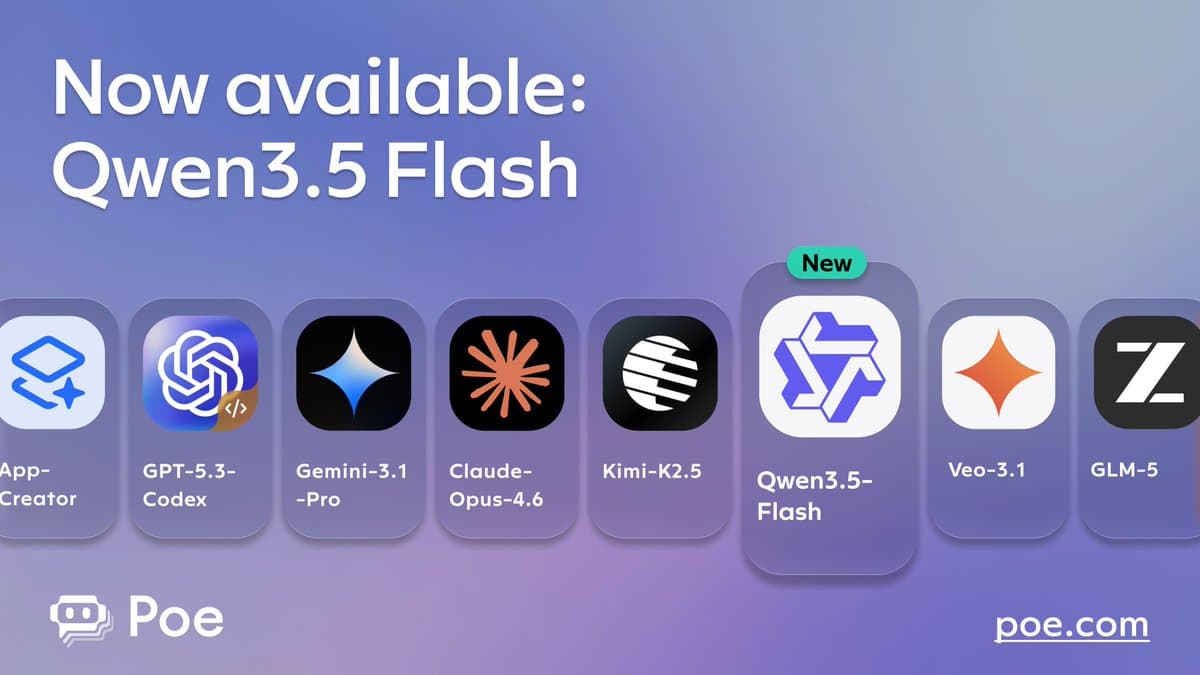
- **Multimodal and real-time models**, such as **Qwen3.5 Flash**, are pushing the envelope by enabling agents to process **text and images seamlessly** with **low latency**. Platforms like **Poe** now host these models, supporting **real-time interactions** in applications spanning **virtual assistants** to **interactive robotics**.
- Advances in **voice and TTS stacks**, exemplified by **Faster Qwen3TTS**, are making **voice-enabled agents** more natural, reliable, and suitable for **dynamic environments**.
### Auto-Memory and Persistent Capabilities
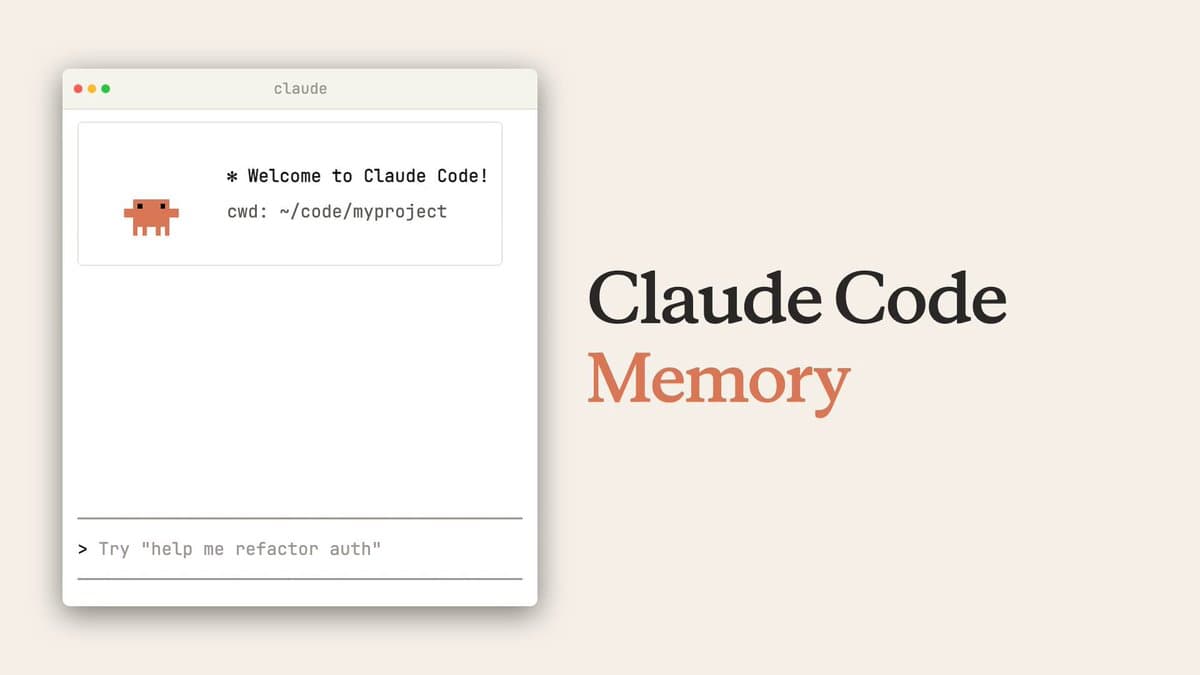
A breakthrough in **agent runtime features** is the support for **auto-memory**—notably in models like **Claude Code**. As **@omarsar0** highlights:
> *"Claude Code now supports auto-memory—this is huge!"*
This feature enables **agents to retain context and knowledge persistently**, allowing for **more coherent interactions** and **long-term reasoning**. Such capabilities are increasingly integrated into **CLIs and SDKs**, signaling a shift toward **long-term, memory-enabled autonomous systems**.
---
## Interoperability, Standards, and Trusted Ecosystems
Building a **trusted multi-agent ecosystem** hinges on **interoperability protocols** and **standardization efforts**:
- The **Model Context Protocol (MCP)** continues to evolve, enhancing **tool description** and **reasoning efficiency**.
- Industry-supported standards such as **Agent Data Protocol (ADP)** and **Agent Passport** emphasize **secure identity verification**, **behavior traceability**, and **trustworthy collaboration**.
- These protocols are critical for **scaling multi-agent systems**, enabling functionalities like **behavior auditing**, **regulatory compliance**, and **inter-agent trust**.
- As **ICLR 2026** approaches, these standards are expected to **formalize best practices** and accelerate **adoption across sectors**.
---
## Cross-Domain Deployment: From Virtual to Physical Robots
The integration of autonomous agents into **physical robots** and **industrial platforms** continues to accelerate:
- **Alphabet**’s collaboration with **Intrinsic** exemplifies embedding **Google’s Gemini platform** into **robotic systems**, enabling **perception, decision-making**, and **actuation** in real-world environments.
- Startups like **Skild AI** have secured **$60 million** in funding to develop **"robot brains"**, emphasizing **software-hardware convergence** for **autonomous physical systems**.
- These developments signal a future where **agent-driven physical automation** becomes more **pervasive and intelligent**.
---
## Rising Security, Governance, and Ethical Concerns
Despite technological progress, **security and ethical challenges** remain critical:
- Recent incidents involving **skill injection vulnerabilities**, such as **OpenClaw** and **KiloClaw**, reveal ongoing risks of **malicious skill embedding** and **side-channel exploits**.
- Attackers have exploited **script-based exfiltration mechanisms**, prompting organizations like **Google** to **tighten security protocols** and **limit access**.
- The deployment of **internal steering mechanisms**, inspired by **NeST-style controls**, is increasingly common to **monitor**, **contain**, and **audit** agent behaviors—especially important for **preventing malicious injections**.
- Societal concerns about **content manipulation** and **disinformation** are intensifying, exemplified by tools like **ZuckerBot**, which autonomously manages Facebook ad campaigns. These raise **regulatory** and **ethical questions** about **authenticity**, **misinformation**, and **regulation** of autonomous content generation.
---
## Current Status and Implications
**2024** stands as a **definitive year** where **hardware, tooling, standards, and security** coalesce to underpin a **robust autonomous agent ecosystem**:
- **Hardware innovations**, including **dedicated AI chips** and **model-embedded silicon**, are delivering **low-latency**, **energy-efficient inference**.
- The **ecosystem** is becoming increasingly **open**, **standardized**, and **interoperable**, with **community-driven protocols** like **MCP** and **Agent Passport** fostering **trustworthy collaboration**.
- **Multimodal interaction** is transitioning from experimental to mainstream, enabling agents to **perceive, reason, and act** across **text, images**, and **speech**.
- **Security frameworks** are evolving to **mitigate risks**, **detect vulnerabilities**, and **ensure responsible deployment**.
Looking ahead, these trends will power **next-generation autonomous agents** that are **scalable**, **secure**, and **ethically aligned**, transforming how humans and machines **collaborate across domains**.
---
## Notable Recent Developments
Adding to the landscape, several recent articles and initiatives highlight ongoing innovation:
- **Gushwork AI** raised **$9 million** in seed funding, focusing on **AI marketing agents** and **expanding operational capabilities**.
- The academic community continues exploring **efficient continual learning**, exemplified by research on **thalamically routed cortical columns** to improve **model adaptability**.
- Discussions around **agent business models** and **billing mechanisms** are gaining traction, as seen in media exploring **agent commercialization** and **subscription-based** services.
- Exciting new models like **Nano Banana 2**, with **pro-level capabilities and Flash speeds**, demonstrate the rapid pace of **model performance improvements**.
---
**In conclusion**, 2024 is shaping up as a watershed year where **hardware breakthroughs**, **tooling sophistication**, **security awareness**, and **standardization efforts** collectively enable a new era of **trustworthy, scalable, and versatile autonomous agents**—setting the stage for transformative impacts across industries and society.