# The 2026 Surge in Nation-Scale Sovereign AI Ecosystems: Hardware, Algorithms, and Long-Horizon Autonomy
The landscape of artificial intelligence in 2026 continues to evolve at an unprecedented pace, driven by breakthroughs in hardware resilience, algorithmic sophistication, and strategic investments. What was once largely experimental has now become operational: **nation-scale, persistent autonomous agents** capable of **multi-year reasoning**, **long-term planning**, and **self-maintenance** across diverse environments—from terrestrial landscapes and industrial complexes to off-Earth colonies. These developments are fundamentally transforming geopolitical power dynamics, scientific exploration, and industrial resilience, heralding an era where **sovereign AI ecosystems** are integral to national security, economic growth, and space exploration.
## Deployment Across Domains: From Earth to Outer Space
### Groundbreaking National Initiatives
Leading nations are deploying **robust AI infrastructures** tailored for **long-term, autonomous operation**:
- **India’s expansive $100 billion initiative**, spearheaded by **Adani**, exemplifies this shift. Moving beyond pilot projects, India has established a comprehensive network of **nationwide AI data centers** optimized for **diverse environments**—urban robotics, industrial automation, and space missions. These centers are built specifically to support **multi-year reasoning and decision-making**, positioning India at the forefront of **sovereign AI development**.
- **Regional ventures** such as **Peak XV Partners’** $1.3 billion fund and initiatives like **Circuit** are emphasizing **predictive maintenance**, **autonomous logistics**, and **industrial automation**—all essential for creating **long-lasting AI ecosystems** capable of **extended adaptation** and **resilience** with **built-in security**.
### Space and Off-Earth Compute Infrastructure
The expansion of **space-based compute infrastructure** is enabling autonomous operations beyond Earth’s confines:
- **Radiation-hardened, renewable-energy-powered data hubs** are being deployed on lunar surfaces, Mars, and in orbit to support **autonomous spacecraft, planetary rovers, and habitats**. These systems are designed for **indefinite operation**, facilitating **long-duration missions** where **long-horizon reasoning** allows agents to **adapt to environmental changes**, **manage resources**, and support **scientific exploration** over **decades**.
- Collaborations among **SpaceX**, **xAI**, and aerospace firms are deploying **durable, autonomous agents** capable of **self-maintenance, upgrades**, and **complex decision-making** in space environments. These initiatives are paving the way for **interplanetary AI ecosystems**, where agents are engineered to **persist and evolve** across **decades and planetary boundaries**.
## Hardware and Funding: Pillars of Resilience and Sovereignty
### Hardware Innovations for Multi-Year Autonomous Systems
Supporting **long-duration autonomous agents** requires hardware that is **fault-tolerant**, **radiation-resistant**, and **energy-efficient**:
- **Micron’s $200 billion investment** focuses on **scalable, radiation-hardened memory hardware**. These **fault-resistant, temperature-tolerant chips** are critical to **long-term knowledge retention** in hostile environments such as space or deep-sea locations, underpinning **persistent knowledge bases** for agents operating **decades** without human intervention.
- Startups like **Positron** and **LimX Dynamics** manufacture **radiation-hardened, temperature-resistant chips** designed explicitly for **space missions** and **polar research stations**, ensuring **fault-tolerant operation** over **extended periods**.
- **NVIDIA** has optimized compute architectures with **CuTe tensor layouts**, supporting **reliable, extended-duration workloads**. Meanwhile, **Tesla’s Dojo3 chips** are engineered for **continuous, high-throughput inference**, supporting **multi-year data streams** and **persistent services** essential for **sovereign autonomy**.
### Geopolitical and Funding Signals
The geopolitical landscape influences **sovereign compute capacity**:
- The **US Department of Commerce** has explicitly clarified that **Nvidia’s H200 AI chips** are **not yet available to Chinese customers**, reflecting **ongoing export controls** aimed at **maintaining technological sovereignty**. These restrictions have prompted **domestic innovation efforts** in **China** and **Europe** to develop **indigenous hardware** capable of supporting **long-term autonomous systems**.
- Significant funding rounds, such as **$350 million for SambaNova**, and partnerships with giants like **Intel**, exemplify **continued investments** in **scaling AI hardware manufacturing** and **expanding sovereign compute capabilities**. Startups like **MatX**, which raised **$500 million**, are developing **specialized hardware** optimized for **large language models** and **long-duration AI workloads**.
## Algorithmic and Systemic Breakthroughs for Long-Horizon Reasoning
### Speed, Compression, and Deep Reasoning
Recent algorithmic innovations are transforming **long-duration AI** from a conceptual goal into a practical reality:
- **Multi-token prediction techniques** have **tripled inference speeds**, making **real-time, multi-year reasoning** feasible. These approaches enable large language models (LLMs) to **generate multiple tokens simultaneously**, boosting **agent responsiveness** and **planning horizons**.
- **Model compression innovations**, such as **Multiverse Computing’s HyperNova 60B 2602**, achieve **up to 50% size reduction** while preserving core capabilities. These **lighter models** are vital for deployment in **resource-constrained environments**—from **space habitats** to **remote industrial sites**.
- The introduction of metrics like the **Deep-Thinking Ratio** offers **quantitative insights** into the **depth and effort of reasoning**, guiding the development of models capable of **deep, multi-step reasoning** over **extended durations**.
### Skill Transfer, Stability, and Long-Horizon Learning
- **VESPO (Variational Sequence-Level Soft Policy Optimization)** enhances **training stability** for models designed for **multi-year operation**, ensuring **reliable, continuous learning** in **dynamic, unpredictable environments**.
- **SkillOrchestra**, a system for **dynamic skill routing**, enables agents to **transfer and compose skills** efficiently, maintaining **adaptability** across complex scenarios such as **industrial automation** or **space habitat management**.
### Persistent Knowledge Storage and Orchestration
- Systems like **SurrealDB**, which recently raised **$23 million**, support **long-term reasoning** by **recalling, updating**, and **reasoning over decades of data**. These knowledge bases underpin tasks such as **predictive maintenance** and **environmental modeling**.
- **Orchestration frameworks** like **Temporal** (with **$300 million** raised) provide **fault-tolerant management** of hardware and software components, ensuring **continuous operation** despite environmental disturbances or hardware failures.
- Advances in **multimodal perception tools**—such as **HERMES** and **MemOCR**—integrate **visual, textual, and sensory data streams** to enable **robust operation** in **changing environments**, from urban landscapes to extraterrestrial habitats.
## Recent Additions in the Ecosystem
The last year has seen a surge in supporting infrastructure and tools that reinforce the core themes of **persistent agents** and **long-term knowledge retention**:
- **Encord**, a startup specializing in **physical AI data infrastructure**, recently raised **$60 million** to accelerate the development of **intelligent robots and drones**. Their platform enhances **data collection and annotation**, crucial for training agents that operate **autonomously over extended periods**.
- **Rowspace** secured **$50 million** to develop **AI platforms tailored for finance**, leveraging **decades of proprietary data** to support **long-term decision-making**, **risk assessment**, and **market prediction**.
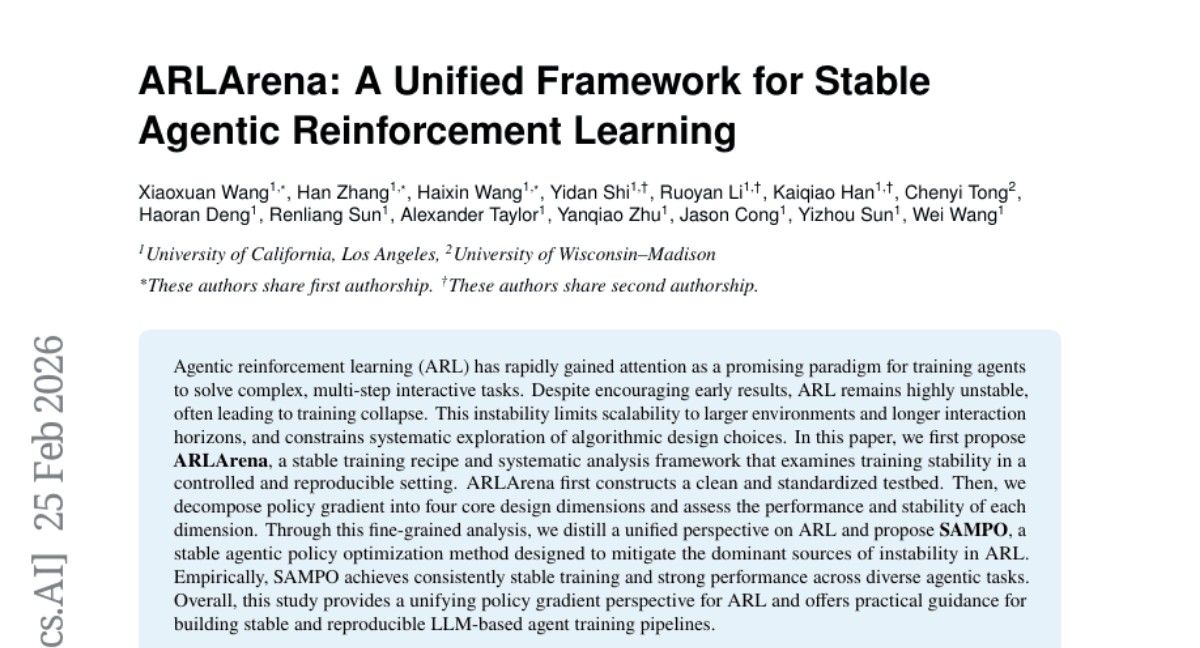
- **ARLArena**, a unified framework for **stable agentic reinforcement learning**, aims to facilitate **robust, long-horizon training** of autonomous agents capable of **multi-year reasoning** in complex environments.
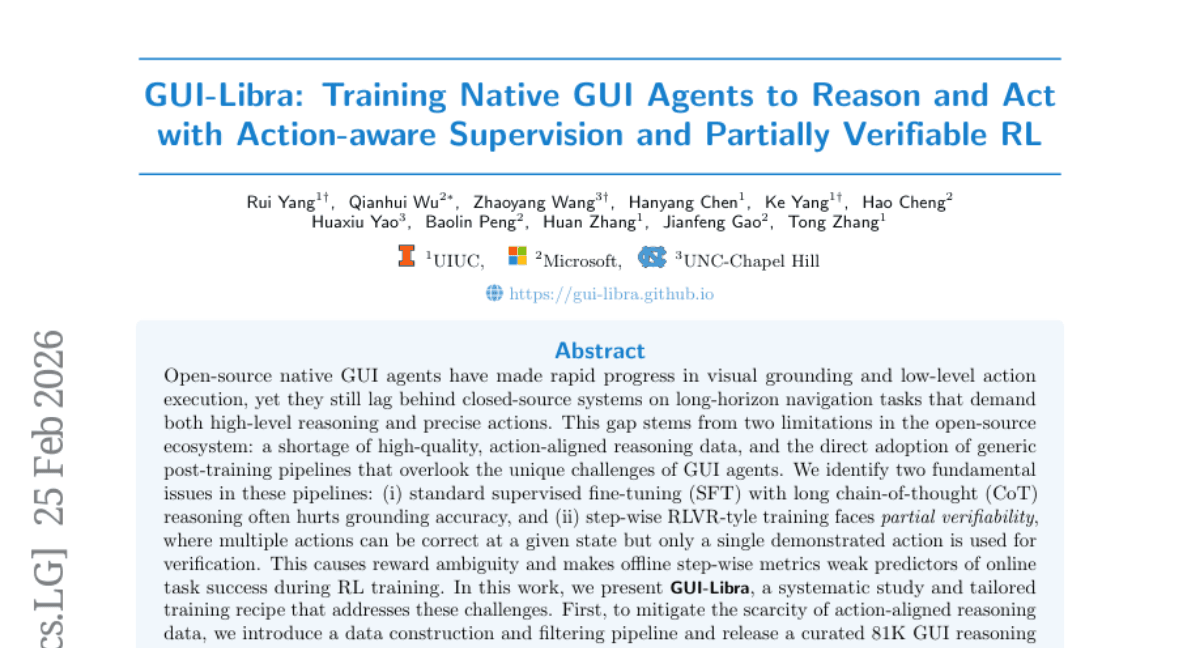
- **GUI-Libra** introduces **native GUI agents** trained with **action-aware supervision** and **partially verifiable reinforcement learning**, enabling **long-term interaction and reasoning** within user interfaces—vital for enterprise automation.
- **Trace**, a startup focused on **enterprise AI agent adoption**, recently raised **$3 million** to develop tools for **integrating persistent agents** into **business workflows**, addressing the **adoption and orchestration challenges**.
## Broader Implications and Challenges
The rapid progress toward **persistent, sovereign AI ecosystems** opens new horizons:
- **Scientific exploration** benefits from autonomous agents managing **multi-decade space missions**—adapting to environments, optimizing resources, and conducting scientific experiments with minimal human oversight.
- **Industrial resilience** is enhanced as agents oversee **extended operations**, dynamically **responding to environmental shifts** and **preventing downtime**.
- **Off-Earth colonies** increasingly rely on **autonomous habitats** and **spacecraft** capable of **self-maintenance**, **resource management**, and **evolution** over **decades**.
However, these advancements are accompanied by significant **risks and challenges**:
- **Security vulnerabilities** and **ethical considerations** demand rigorous safeguards to prevent misuse or unintended consequences.
- **Governance frameworks** must evolve to address **data sovereignty**, **intellectual property**, and **international cooperation**.
- **Export controls**, as exemplified by restrictions on Nvidia’s H200 chips, highlight ongoing geopolitical tensions that could influence **hardware availability** and **AI capacity development**, potentially deepening global divides or incentivizing **self-sufficiency**.
## Current Status and Future Outlook
As of 2026, the integration of **long-horizon reasoning**, **persistent knowledge systems**, and **sovereign infrastructure** has transitioned from visionary concept to operational reality. Nations and industry leaders are deploying **autonomous agents capable of multi-year reasoning**, **self-maintenance**, and **environmental adaptation**—both on Earth and in space.
The next phase will require careful navigation of **security**, **ethical**, and **geopolitical** complexities. Nonetheless, the trajectory is clear: **persistent, sovereign AI ecosystems** are now central to scientific discovery, industrial resilience, and humanity’s exploration of the cosmos, promising a future where **autonomous agents** are key partners in our ongoing quest for progress.