# Revolutionizing Embodied AI: The Latest Advances in Automated 3D Environment Generation and Internal Scene Understanding
The pursuit of truly autonomous, intelligent embodied AI—robots and virtual agents capable of perceiving, reasoning, and acting within complex, dynamic environments—continues to accelerate at an unprecedented pace. Recent technological breakthroughs are transforming how virtual worlds are created, understood, and leveraged for training resilient, adaptable systems. These innovations are not only streamlining research workflows but are also paving the way for deploying embodied AI in real-world scenarios where robustness, flexibility, and personalization are paramount.
## From Manual Scene Design to Automated, Programmatic Virtual Worlds
### The Rise of Automated Environment Generation: SAGE, Analytical Diffusion, and SpargeAttention2
A cornerstone of recent progress is the development of **automated, scalable 3D environment and asset generation**. The emergence of tools like **SAGE (Scalable Agentic 3D Scene Generation)** exemplifies this shift. SAGE employs **procedural algorithms** to create **agent-centric, layout-aware 3D worlds at scale**, dramatically reducing the time and effort traditionally needed for scene design. Its core features include:
- **Rapid Scalability:** Capable of generating **thousands of diverse, realistic virtual environments** swiftly, enabling the creation of large, rich datasets for training and benchmarking.
- **Diversity and Variability:** Randomized object placements, spatial configurations, and viewpoints foster **generalization and robustness** across a wide spectrum of scenarios.
- **Agent-Centric and Layout-Aware Design:** Ensures environments are tailored for perception, navigation, and interaction tasks.
- **Simulation-Ready Outputs:** Fully compatible with existing simulation platforms, facilitating a seamless transition from virtual training to real-world deployment.
Complementing procedural generation, innovations like **"Analytical Diffusion"**—a diffusion-based generative model—have further enriched environment content by producing **high-fidelity textures, objects, and entire environments** efficiently. This approach enables **rapid population of virtual worlds with rich, diverse assets**, supporting **large-scale simulation and testing** necessary for fine-tuning embodied AI capabilities.
A recent breakthrough in dynamic asset synthesis is **"SpargeAttention2"**, a **fast video diffusion model** that supports **scalable, high-fidelity, temporally coherent dynamic asset generation**. Its notable features include:
- Generating **dynamic scenes, objects, and environments** that evolve realistically over time.
- **Significantly reducing computational costs** compared to traditional video synthesis methods, making it feasible to incorporate **more complex and unpredictable elements** into virtual worlds.
- Facilitating **long-term, evolving scenarios** that mirror real-world complexities, thereby enhancing the robustness of training environments.
### Programmable and Code-Defined Worlds for Curriculum Learning
Beyond procedural and generative methods, the community is increasingly adopting **programmatic, code-defined environments**. Initiatives such as **"Dreaming in Code for Curriculum Learning"** allow researchers to **define environments via scripts**, offering **reproducibility, flexibility, and scalability**. Key advantages include:
- **Exact Reproducibility:** Essential for scientific comparisons and benchmarking.
- **Dynamic Complexity Adjustment:** Environments can be **progressively made more challenging**, supporting **curriculum learning** paradigms.
- **Open-Ended Worlds:** Supports the creation of **endless, diverse environments** that foster **continuous learning and adaptation**.
This approach aligns with integrating **environment complexity with curriculum strategies**, enabling embodied agents to **gradually master simpler tasks before tackling more complex scenarios**, thereby **improving learning efficiency and robustness**.
## Internal Scene Understanding: Multimodal Latent Representations and Reasoning
While environment generation provides **the "where" and "what"**, **internal scene understanding** enables agents to **reason, predict, and make decisions**. Cutting-edge research now emphasizes **multimodal latent representations** that internalize **scene structure, object relationships, and environmental dynamics** without overreliance on raw sensory data.
### Advances in Multimodal Scene Encoding
Models such as **VLA-JEPA** and the **Rectified LpJEPA** variants are designed to **encode scene information into compact, multimodal latent spaces**. Recent developments include:
- **Sparse, Efficient Encodings:** **"Rectified LpJEPA"** enhances internal scene representations by emphasizing **sparse, information-rich encodings**, reducing redundancy and improving interpretability.
- **Exploratory Behaviors:** Incorporating **maximum entropy principles** encourages agents to **explore environments more thoroughly**, leading to **better generalization** in unseen scenarios.
### Chain-of-Thought and Multimodal Reasoning
Frameworks like **"UniT"** facilitate **multi-step, multimodal reasoning**, enabling agents to **refine their understanding iteratively**. This **chain-of-thought approach** connects perception directly to decision-making, allowing for more **complex, nuanced actions**.
### Challenges and Insights
Despite these advances, challenges remain. For example, **"Sanity Checks for Sparse Autoencoders"** highlight that **sparse autoencoders** can struggle with **reliable scene decomposition** and **interpretability**, underscoring the need for **more robust internal models** that can **accurately parse and reason about complex scenes**.
## Enhancing Data Efficiency and Synthetic Inference
A persistent obstacle in embodied AI is **data scarcity**. Recent strategies leverage **synthetic data generation** and **feature-guided synthesis** to mitigate this:
- The **"Less is Enough"** approach emphasizes **diversity-aware synthesis** within feature space, guided by **feature activation coverage** in large language models (LLMs). This reduces the dependence on extensive labeled datasets.
- Inspired by **AlphaFold** in protein structure prediction, **synthetic inference methods** demonstrate that **synthetically generated environments and data** can **substantially improve model performance** in data-limited contexts.
These techniques **accelerate training**, **improve generalization**, and **reduce resource requirements**, facilitating **faster deployment** of embodied systems.
## Improving Perception and Spatiotemporal Modeling
### Spatiotemporal Perception with EA-Swin
The **EA-Swin (Embedding-Agnostic Swin Transformer)** architecture advances visual perception by directly modeling **spatiotemporal dependencies** on pre-trained embeddings, leading to **more accurate perception of dynamic scenes**—a critical capability for real-time decision-making.
### Dynamic Asset Synthesis and Long-Video Understanding
The recent development of **"SpargeAttention2"** has revolutionized **dynamic asset synthesis**, supporting **scalable, high-fidelity, temporally coherent environment generation**. It enables virtual worlds to **mirror real-world complexities**, which enhances **training robustness**.
Additionally, **"ReMoRa"** (Refined Motion Representation for Long Video Understanding) captures **extended temporal dependencies** and **complex motion patterns**, allowing agents to **interpret and predict long-term dynamics**—a crucial step towards **long-horizon reasoning** in embodied AI.
## Personalization and Human-AI Alignment
Emerging efforts focus on **capturing individual human preferences** via **reward feature extraction**, enabling agents to **align behaviors with user-specific expectations**. This promotes **trustworthiness, usability, and natural interaction**, especially in **human-centric environments**.
## Recent Complementary Advances
Several recent works are expanding the frontiers of embodied AI:
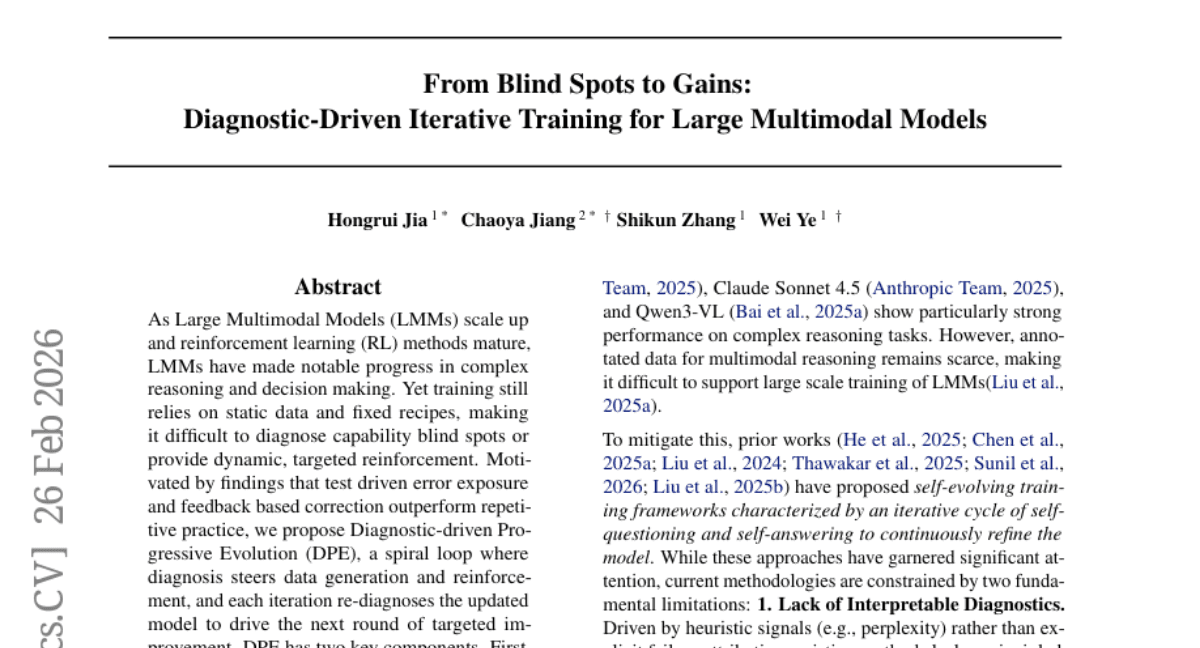
- **"Diagnostic-Driven Iterative Training for Large Multimodal Models"** emphasizes **diagnostic tools** to guide the **iterative improvement** of multimodal models, ensuring **robustness and reliability**.
- **"OptMerge"** introduces a **model-merging benchmark for multimodal large language models (MLLMs)**, fostering **integration and interoperability** across diverse modalities.
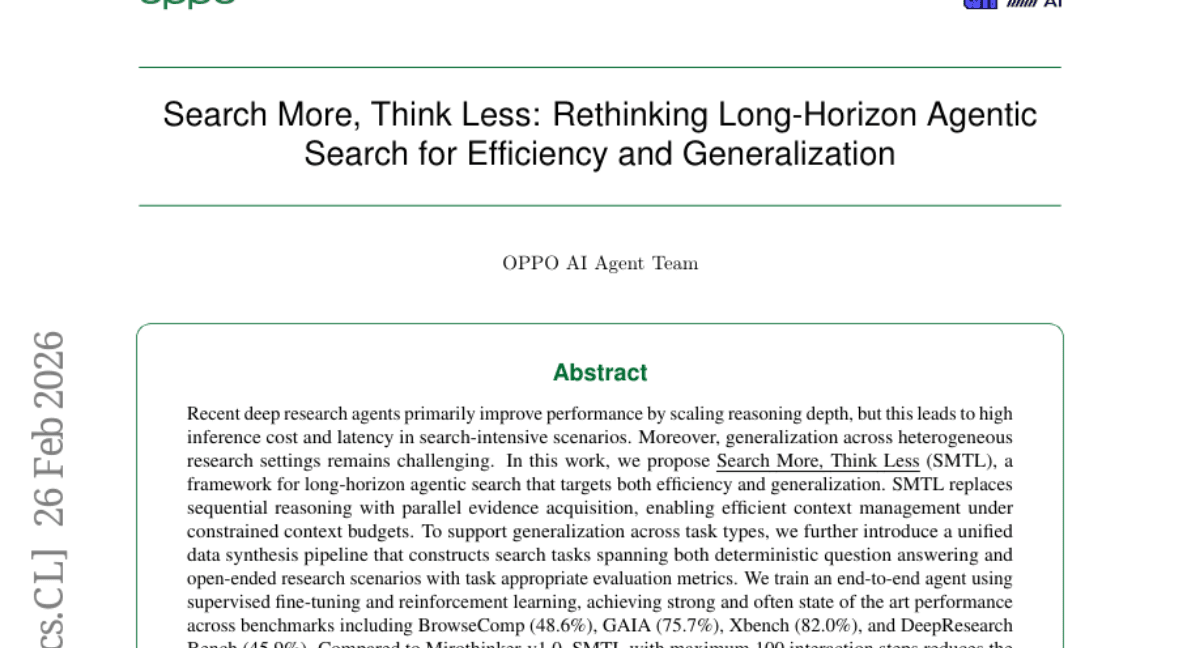
- **"Search More, Think Less"** rethinks **long-horizon agentic search**, focusing on **efficiency and scalability**, enabling agents to **plan and act effectively over extended periods**.
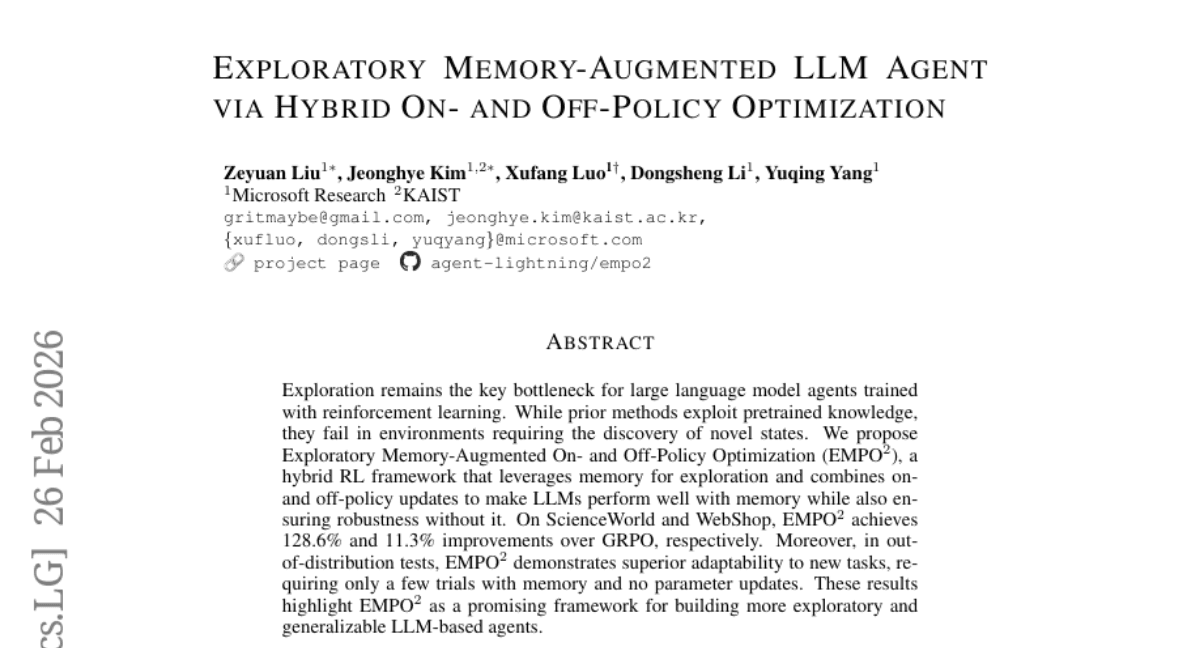
- **"Exploratory Memory-Augmented LLM Agents"** propose **hybrid on/off-policy optimization** techniques to **enhance exploration and continual learning**, making agents more adaptable.
- **"Large Causal Models for Temporal Causal Discovery"** leverage **causal inference** to **understand long-term dependencies and dynamics**, crucial for **predictive reasoning** in complex environments.
## The Latest Breakthrough: Fast Video Diffusion for Dynamic Asset Synthesis
A particularly transformative development is **"SpargeAttention2"**, a **fast video diffusion model** that enables **scalable, high-fidelity, temporally coherent dynamic asset generation**. Its key contributions include:
- Supporting **realistic, evolving scenes, objects, and environments** over extended timeframes.
- **Reducing computational costs** compared to traditional video synthesis, making it practical to incorporate **complex, unpredictable elements** into virtual worlds.
- Enhancing **training environments** to **more accurately mirror real-world variability and dynamics**, thereby **improving the robustness and generalization** of embodied AI systems.
This capability **revolutionizes simulation pipelines**, allowing the creation of **more realistic, diverse, and dynamic environments** that better prepare agents for real-world deployment.
## Current Status and Future Outlook
The landscape of automated environment generation, internal scene understanding, and synthetic data strategies is **advancing rapidly**. Key themes include:
- **Automated, scalable scene and asset creation** via tools like **SAGE**, **analytical diffusion**, and **SpargeAttention2**.
- **Programmable worlds and curriculum learning** for **reproducible, progressively challenging training**.
- **Robust internal scene models** through **multimodal latent encodings** and **chain-of-thought reasoning**.
- **Data-efficient training** utilizing **synthetic, feature-guided synthesis** and **diagnostic-driven methodologies**.
- **Enhanced perception and long-term modeling** with **spatiotemporal architectures** and **dynamic asset synthesis**.
- **Personalization** to align systems with human preferences.
These innovations **interconnect to accelerate** the development of **resilient, adaptable, and human-aligned embodied agents** capable of operating seamlessly in **complex, unpredictable environments**.
## Conclusion
The integration of **automated environment generation**, **rich asset synthesis**, **internal scene understanding**, and **synthetic data strategies** marks a transformative era in embodied AI research. These advances **reduce barriers**, **enhance system robustness**, and **expand possibilities** for deploying autonomous agents across diverse real-world domains. As these technologies continue to mature and converge, they bring us closer to a future where **embodied AI systems** are **more versatile, personalized, and capable**, thriving amid the complexities and dynamism of the real world.