# The Evolution of Customizable, Role-Based Conversational AI: NVIDIA’s Ecosystem and Industry Advancements Reach New Heights
The field of conversational AI is accelerating at an unprecedented pace, driven by a convergence of innovative hardware, sophisticated software ecosystems, and strategic industry investments. From role-specific virtual assistants to edge devices capable of running complex models locally, the landscape is transforming into a highly versatile, secure, and natural form of human-machine interaction. Building upon NVIDIA’s pioneering **PersonaPlex** platform, recent developments—along with key industry moves—are establishing a new standard for **trustworthy, customizable, and persistent AI agents** that seamlessly operate across devices and environments.
---
## NVIDIA’s PersonaPlex: Advancing Role-Based, Full-Duplex, and Emotionally Expressive Voice Agents
At the core of this evolution is **NVIDIA’s PersonaPlex** ecosystem, which continues to innovate in delivering **multi-turn, role-specific conversational AI** with remarkable capabilities:
- **Full-Duplex Voice Interaction**: AI agents can **talk and listen simultaneously**, enabling **lifelike dialogues** that sustain **context**, **emotion**, and **natural flow**. This is critical for applications like **virtual customer support**, **digital companions**, and **enterprise assistants**, where **emotional expressiveness** and **context coherence** foster **trust** and **engagement**.
- **Role and Persona Customization**: Developers now have tools to design **distinct personas**—from **friendly helpers** to **specialized enterprise agents**—embodying **specific roles and personalities**. This **deep customization** ensures AI responses are **appropriate and consistent**, enhancing **long-term user trust**.
- **Emotionally Expressive Speech Synthesis**: Real-time **Text-to-Speech (TTS)** and **Speech-to-Text (STT)** systems produce **nuanced, emotionally relevant speech**, making interactions **more natural** and **human-like**.
- **Agent Passport Security Framework**: An **innovative cryptographic identity verification system**, akin to OAuth, secures AI interactions by guaranteeing **security, transparency, and authenticity**. This is especially crucial in **healthcare**, **finance**, and **enterprise sectors**, where **trust** and **data security** are non-negotiable.
Recent demonstrations showcase AI agents capable of **sustaining long, coherent conversations** with **distinct roles and personalities**, illustrating how **PersonaPlex** is setting a new **standard for role-specific, trustworthy interaction** that can dynamically adapt to user needs.
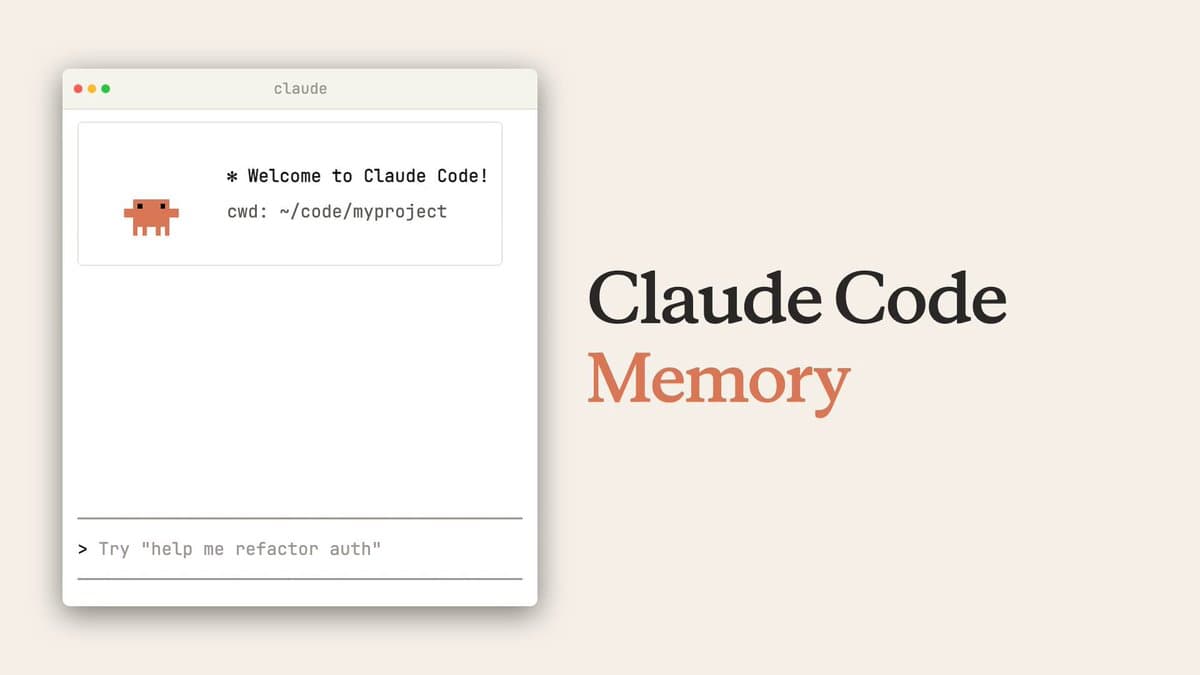
**Additionally**, NVIDIA has integrated **persistent memory capabilities**, exemplified by **DeltaMemory**, enabling AI agents to **remember prior interactions** across sessions—addressing a longstanding challenge in maintaining **contextual continuity**. The recent support for **Claude Code’s auto-memory** further enhances **agent self-updating and long-term engagement**, making these systems more reliable and human-like.
---
## Hardware Innovations and Strategic Industry Investments Make Edge AI Ubiquitous
The hardware landscape is experiencing a **renaissance**, significantly lowering the barrier to deploying **large language models (LLMs)** and **AI inference** **outside** traditional cloud environments:
- **Custom Silicon and Printed-on-Silicon Models**:
- **Taalas’ HC1 chip** exemplifies cutting-edge **hardwired Llama 3.1 8B** processing, capable of **nearly 17,000 tokens/sec**, enabling **near real-time inference** on **low-power chips** suitable for **edge devices** like smartphones and IoT sensors.
- The innovative process of **printing models directly into silicon**—demonstrated by Taalas—permits **local, inference-only chips** that operate **without external memory**, drastically **reducing latency, cost, and energy consumption**. These chips are now feasible on microcontrollers with as little as **888 KB RAM**, opening avenues for **privacy-preserving AI** in **wearables**, **industrial sensors**, and **smart devices**.
- **Global Funding and Supply Chain Expansion**:
- **SK Hynix** is scaling **AI-specific memory chip production**, meeting surging demand.
- **BOS Semiconductors** secured **$60.2 million** in Series-A funding to develop **next-generation AI chips** targeting **automotive and edge markets**.
- **SambaNova** raised **$350 million**, collaborating with **Intel** to challenge NVIDIA’s dominance in **AI hardware**.
- European and Asian startups like **Axelera AI** and **MatX** attracted over **$250 million** and **$500 million**, respectively, illustrating a **geopolitical push** to develop **specialized AI hardware** for **scaling edge and data center AI**.
This **global investment surge** fosters a **more resilient and diversified supply chain**, accelerating **hardware accessibility** and **innovation** at all scales—from **cloud data centers** to **embedded edge devices**.
---
## Pushing the Limits: Running Advanced Models on Constrained Devices
A notable breakthrough in **edge AI** is the ability to run **powerful AI models** on **legacy hardware** and **constrained microcontrollers**:
- The **"Happy Zelda"** project demonstrates an AI running on a **Nintendo 64** with just **4MB RAM** and a **93MHz processor**, achieving **privacy-preserving inference** on **outdated hardware**—a compelling example of **democratizing AI** without reliance on cloud infrastructure.
- **Microcontrollers** supporting **local AI inference**—such as **wearables**, **IoT sensors**, and **smart home devices**—are now capable of **low-latency, privacy-preserving operations**, reducing dependence on internet connectivity and **enhancing security**.
This evolution **democratizes AI access**, making **powerful, local AI** available across **everyday devices** and **legacy hardware**.
---
## Software Ecosystem and Trust Frameworks: Securing and Enhancing AI Deployments
Concurrent with hardware advances, the **software ecosystem** is rapidly evolving to support **trustworthy, scalable, and persistent AI**:
- **On-Device AI Assistants**: Leading companies like **Apple** are improving **privacy-centric assistants** that operate **entirely locally**, aligning with **data sovereignty** trends.
- **Deployment & Orchestration Platforms**:
- **AgentRuntime** and **Tensorlake** enable **scalable deployment** of **multi-agent systems** suitable for **enterprise environments**.
- **OpenAI’s Codex 5.3** accelerates **agentic code generation**, facilitating **rapid customization**.
- **Security and Trust Enhancements**:
- The **Agent Passport** framework provides **cryptographic identity verification**, ensuring **secure, transparent interactions**.
- **Solid** secured **$20 million** to improve **AI robustness** and **adversarial resistance**.
- **Local transcription tools** like **trnscrb** support **privacy-preserving, real-time transcription** across multiple communication platforms such as **Zoom**, **Teams**, and **FaceTime**.
- **Self-Improving and Multi-Model Ecosystems**:
- **Cursor**’s latest updates allow **AI agents to self-test and debug**, fostering **self-improvement**.
- The **Perplexity Computer** platform now supports **19 models**, with **auto-generated live components**, enabling **dynamic model switching** and **multi-role, multi-modal** AI assistants.
**Recent innovations** include:
- **Claude Code’s support for auto-memory**, which allows **AI systems** to **remember information across sessions**—a crucial feature for **long-term, context-aware interactions**.
- **Anthropic’s acquisition of Vercept**, a Seattle-based startup specializing in **"computer-use" AI**, signals a focus on **enhanced agent capabilities** for **human-computer collaboration**.
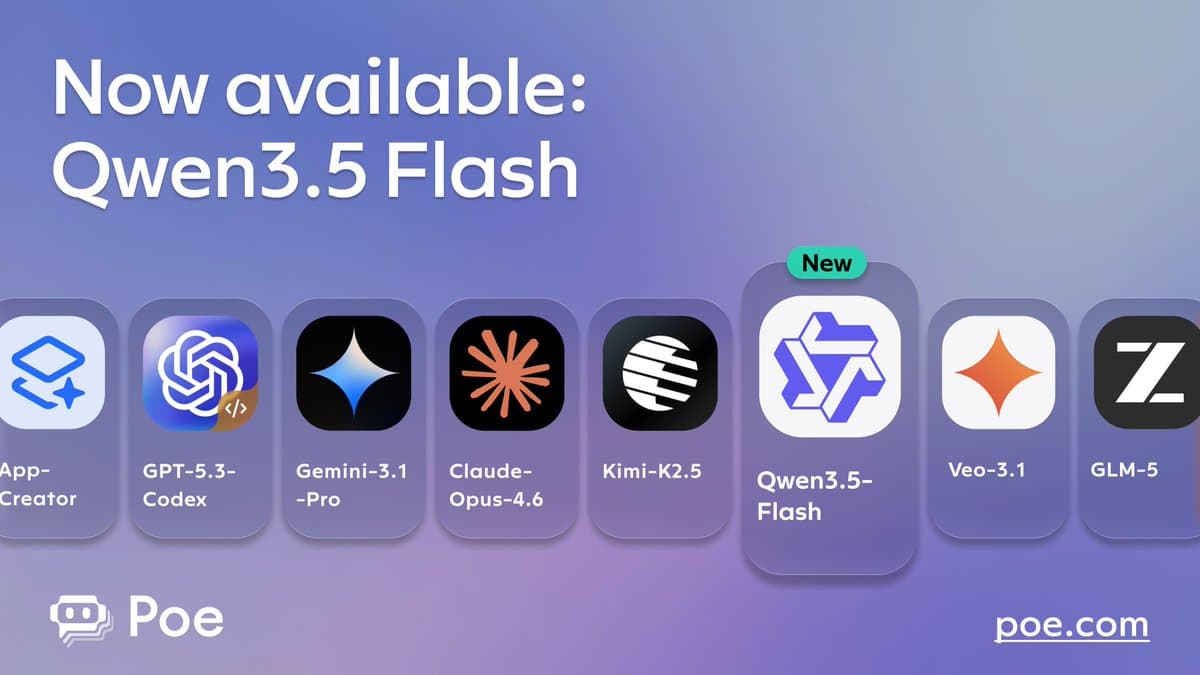
- The **Qwen3.5 Flash** multimodal model, now **live on Poe**, offers **fast processing of text and images**, facilitating **real-time multimodal AI applications**.
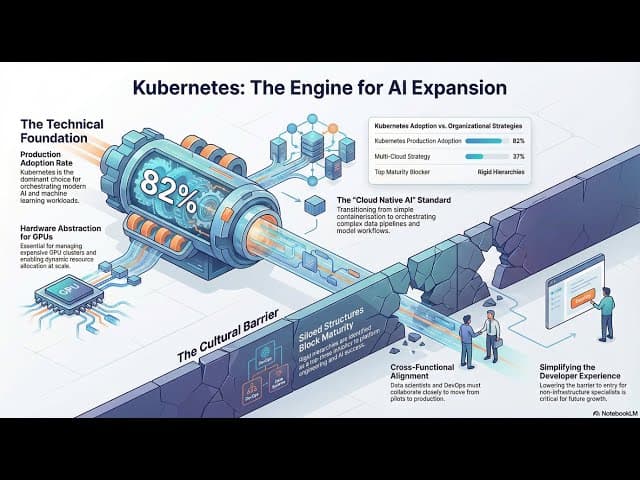
- The adoption of **Kubernetes-as-infrastructure** for **scalable, cloud-native AI deployment** further accelerates **large-scale, reliable AI service management**.
---
## Cutting-Edge Voice and Memory Technologies
The **voice interaction** and **memory management** domains are seeing groundbreaking advancements:
- **Qwen3.5 Flash** is a **fast, efficient multimodal model** that processes **text and images** at **speed** suitable for **real-time applications**.
- **DeltaMemory** is emerging as the **fastest cognitive memory** for AI agents, **addressing** the challenge of **session forgetfulness** by enabling **persistent, long-term memory**—crucial for **trustworthy, continuous engagement**.
- **Faster Qwen3TTS** synthesizes **realistic speech** at **4x real-time**, vastly **reducing latency** and **improving voice quality**, supporting more **natural voice agents**.
- **Zavi AI** introduces a **Voice-to-Action OS** that allows **voice commands** to **type**, **edit**, **see**, and **execute actions** across **multiple platforms**—iOS, Android, macOS, Windows, and Linux—bringing **voice-controlled automation** into daily workflows.
- Industry figures like **@reinerpope** and **@Tim_Dettmers** are developing **high-throughput inference hardware** capable of **on-device, real-time AI at massive scale**, further lowering **deployment barriers**.
---
## Industry Implications and Future Outlook
The current landscape signals a **paradigm shift** toward **trustworthy, role-specific, and highly personalized AI agents** capable of **multi-turn, context-aware conversations** with **security and privacy** embedded at every level. The **edge AI revolution**, powered by **low-power chips**, **printed-on-silicon models**, and **resource-efficient inference**, is **democratizing AI access** and **preserving user privacy**—a key concern in today’s digital environment.
Major players such as **MatX**, raising **$500 million**, and **Profitmind**, with **$9 million**, exemplify **significant investment** fueling **hardware and software innovation**. The integration of **auto-memory**, **multimodality**, and **scalable orchestration platforms** like **Kubernetes** ensures that **AI systems** become **more reliable, persistent, and versatile**.
---
## **In Summary**
The future of **conversational AI** is **more natural, role-specific, secure, and accessible** than ever before. From **lifelike voice agents** embodying **distinct personas** to **edge devices** capable of **local, privacy-preserving inference**, each technological stride brings us closer to **trustworthy, human-like AI companions** integrated into every facet of daily life.
**NVIDIA’s ecosystem** remains at the forefront of this transformation, supported by **global hardware investments**, **software ecosystems**, and **trust frameworks** that collectively unlock **new horizons**. As these innovations mature, AI is poised to become an **integral, trustworthy partner**—enhancing our capabilities, safeguarding our privacy, and transforming human-machine collaboration into a seamless, natural experience.
The **journey continues**, promising a future where **role-based, persistent, and secure AI** feels as **natural and trustworthy** as human conversation—empowering us to achieve **more** with intelligent, personalized assistance tailored precisely to our needs.