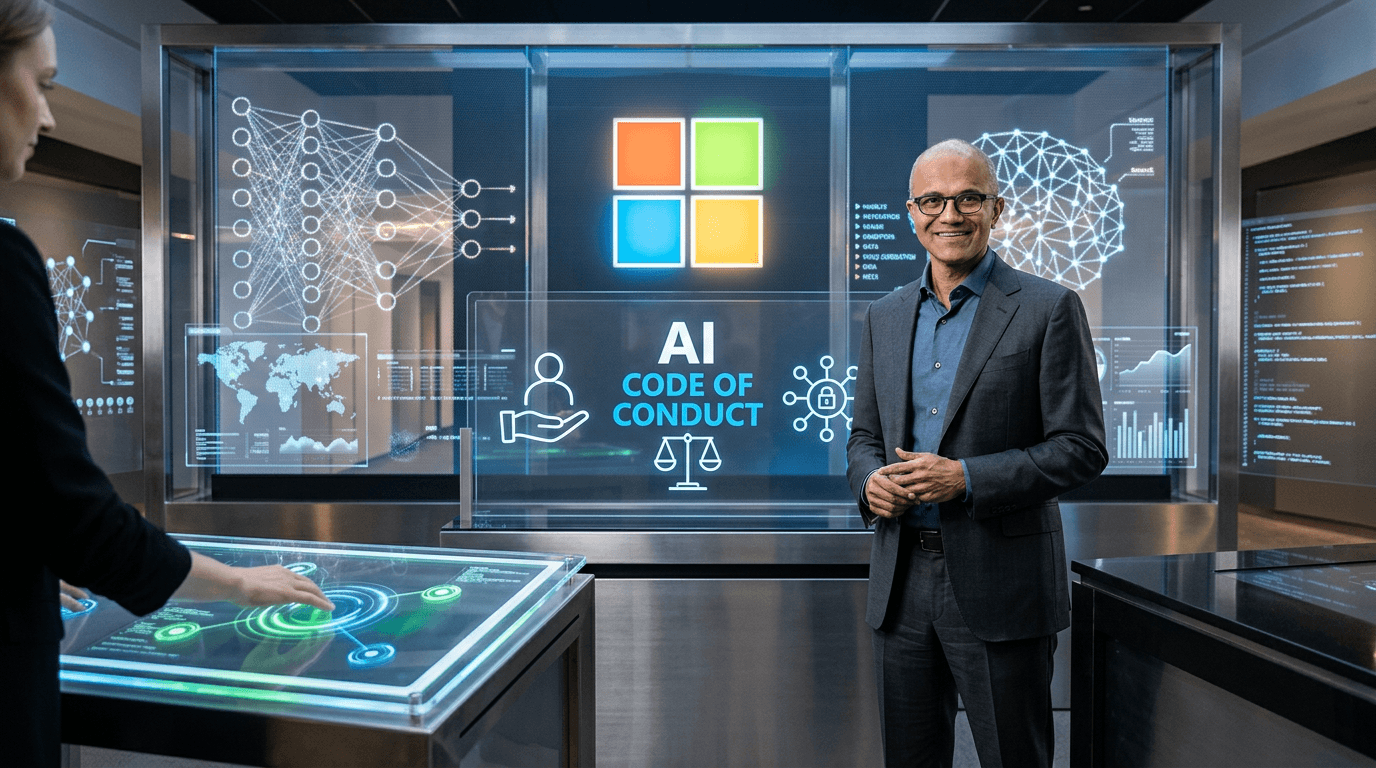
Microsoft’s agentic AI platform continues to solidify its position as the cornerstone of the **autonomous enterprise**, evolving from pioneering innovation to a fully production-ready, enterprise-grade ecosystem. As Microsoft advances toward its mid-2027 vision of broad agentic AI adoption, recent developments deepen the platform’s technological maturity, commercial reach, and security rigor — even as leadership candidly acknowledges the challenges and strategic recalibrations ahead.
---
## Accelerating Toward a Multi-Model Autonomous AI Future
Building on the transformative momentum from Ignite 2025 through early 2026, Microsoft has unveiled key strategic shifts articulated by CEO Satya Nadella, signaling a pragmatic evolution in the company’s AI approach:
- **Model Overhang Risk Awareness**: Nadella recently flagged the risk that AI model development may outpace real-world impact and enterprise adoption, cautioning that “the industry remains in the early stages of a long journey.” This underscores Microsoft’s recognition that scaling autonomous AI responsibly requires measured pacing, robust governance, and alignment with tangible business value.
- **Shift to a Multi-Model Organizational Strategy**: Reflecting this, Microsoft has quietly reorganized its AI leadership and development teams to emphasize a diverse portfolio of AI models beyond the OpenAI partnership. This multi-model strategy aims to enhance innovation breadth, reduce dependency risks, and better tailor AI capabilities to complex, varied enterprise requirements.
This strategic recalibration aligns with the company’s broader **agentic AI roadmap**: delivering a **scalable, sovereign, and secure autonomous AI platform** while managing growth expectations and operational realities.
---
## Production-Ready MAI Model Family and Hybrid Sovereign Deployments
The **Microsoft AI (MAI) model family** remains the foundation of this roadmap, now fully production-ready and enriched with new capabilities:
- **MAI-Voice-1 GA** continues to enable enterprises to embed **naturalistic, multimodal voice intelligence** into agents, expanding use cases from voice-driven customer engagement to hands-free industrial workflows.
- The core **MAI-1 model** advances in preview, offering improved hybrid reasoning and task-specific tuning for diverse enterprise workloads.
- **Hybrid Sovereign Deployment** capabilities have matured, allowing MAI models to operate seamlessly across on-premises, edge, and sovereign clouds—crucial for compliance-heavy sectors like finance and healthcare.
- **Persistent Managed Memory**, integrated via the Foundry Agent Service, empowers agents with continuous, evolving context, overcoming earlier limitations of short-term memory and enabling richer, multi-session autonomy.
- **Copilot Studio and Azure AI Foundry Integration** deepen, providing enterprises with granular control over agent customization, governance, lifecycle management, and policy enforcement.
CTO Kevin Scott reiterated, _“The MAI family stands as a mature, enterprise-grade AI foundation, empowering organizations to own their AI journey with confidence, sovereignty, and at scale.”_
---
## Platform and Infrastructure Enhancements: Persistent Memory, Observability, and Sovereign Edge Computing
Microsoft’s agentic AI platform has seen critical upgrades to support complex, secure, and transparent autonomous operations:
- **Foundry Agent Service’s Managed Memory** now supports dynamic context updates triggered by operational events, improving agent responsiveness and trustworthiness.
- **Copilot Studio’s Model Context Protocol (MCP)** enhancements deliver fine-grained access controls, lifecycle hooks, and real-time observability dashboards, enabling governance teams to monitor agent decisions and user interactions with unprecedented clarity.
- **Azure AI Foundry GA** solidifies its role as the governance, compliance, and lifecycle management plane, integrating policy enforcement and auditing at enterprise scale.
Infrastructure expansions have also been significant:
- The **Azure AI Supercluster** has grown to include new data centers in India, South America, and additional European regions, extending geographic sovereignty and improving latency.
- Collaboration with NVIDIA has yielded **custom AI accelerators** optimized specifically for agentic AI workloads, enhancing throughput and energy efficiency under demanding enterprise concurrency.
- The launch of **Foundry Local on-device inference** enables enterprises to run MAI and select GPT models securely at the edge or on-premises, supporting sovereignty, low latency, and disconnected scenarios critical for regulated industries and remote environments.
This hybrid cloud and edge infrastructure strategy provides enterprises with flexible, compliant, and performant deployment options.
---
## Advanced Security Posture: Defense-in-Depth for Autonomous Agent Ecosystems
To address the unique risks of autonomous, multi-agent environments, Microsoft has developed a comprehensive, layered security framework:
- A novel **OWASP-inspired threat taxonomy** identifies emerging risks such as agent collusion, supply chain vulnerabilities, and adversarial prompt injections, guiding systematic threat analysis and mitigation.
- **AI-Powered Security Agents** autonomously monitor agent workflows for anomalous or malicious behavior, enabling real-time containment and remediation.
- **Cryptographically Verifiable Agent Identities**, integrated with Azure IAM and zero-trust security architectures, prevent impersonation and unauthorized escalation within autonomous ecosystems.
- The **Azure SRE Agent Initiative** pioneers context engineering techniques that dynamically construct secure prompt environments balancing flexibility with stringent safety controls.
- Microsoft published the operational security playbook, _“From Prompt Injection to Tool Hijacking: A Defense-in-Depth Blueprint for AI Agents on Azure,”_ providing enterprises with actionable guidance for securing autonomous AI at scale.
Together, these innovations create a resilient security posture that enables enterprises to deploy autonomous agents confidently in sensitive and regulated environments.
---
## Commercial Innovation and Ecosystem Expansion: Per-Agent Pricing, Vertical Growth, and Deep Windows Integration
Microsoft’s commercial strategy continues to accelerate agentic AI adoption through refined monetization models and ecosystem expansion:
- The **Per-Agent Pricing Model**, having transitioned from pilot to mainstream, ties licensing transparently to active autonomous agent counts, facilitating predictable budgeting and incentivizing responsible scaling.
- Vertical industry adoption is broadening, with targeted solutions in:
- **Financial Services**: Automating compliance, fraud detection, and customer analytics.
- **Healthcare**: Enhancing clinical decision support, patient engagement, and operational workflows.
- **Manufacturing**: Driving supply chain optimization, predictive maintenance, and quality control.
- **Managed Service Providers (MSPs)** are increasingly embedding agentic AI into verticalized offerings, accelerating reach into mid-market and enterprise segments.
- A major milestone is the **deep integration of agentic AI into Windows 12 and Windows 12 Pro**, embedding autonomous agents directly into billions of desktops worldwide. This drives hybrid cloud-edge AI capabilities on end-user devices, supports new monetization pathways tied to productivity and security workflows, and marks Microsoft’s vision of agentic AI as a ubiquitous computing element.
- **Dynamics 365 Autonomous Agent deployments**, especially in Order-to-Cash (O2C) automation, demonstrate practical efficiency gains by streamlining complex finance and supply chain processes.
This commercial momentum aligns with Microsoft’s ambitious “Billionaire Bet on AI Monetization,” leveraging proprietary MAI models, OpenAI GPT innovations, and Azure’s scalable infrastructure.
---
## Strategic Signals and Leadership Outlook
CEO Satya Nadella’s recent remarks and organizational changes provide important context for Microsoft’s evolving AI strategy:
> “While AI has tremendous potential, we must be mindful of the risk that model development outpaces real-world impact. This requires discipline, governance, and a multi-model approach to meet diverse enterprise needs.” — Satya Nadella
Microsoft’s AI leadership realignment reflects a deliberate shift toward a **multi-model future** that balances OpenAI partnerships with proprietary and third-party AI models, fostering innovation diversity and reducing dependency risks.
This strategic posture emphasizes **transparent evaluation, iterative innovation, and customer-centric excellence** as pillars for sustainable autonomous AI adoption.
---
## Enterprise Adoption Best Practices: Charting a Sustainable Agentic AI Journey
Industry experts, including the iAvva AI report, continue to highlight critical success factors for enterprises embarking on autonomous AI deployments:
- **Executive Sponsorship and Cross-Functional Alignment**: Leadership engagement across product, engineering, security, and customer success is vital to sustain momentum and resolve challenges.
- **Phased Onboarding and Continuous Feedback Loops**: Iterative rollouts help manage complexity, integrate user input, and accelerate time-to-value.
- **Transparent Communication on Pricing, Security, and Performance**: Clear visibility fosters trust and enables effective governance.
- **Security and Compliance Maturity**: Prioritizing these domains is essential, especially in regulated sectors adopting autonomous agents.
Enterprises embracing these disciplined approaches are best positioned to harness agentic AI’s transformative potential while managing operational and strategic risks.
---
## Current Status and The Road Ahead
As of mid-2027, Microsoft’s agentic AI platform stands as a **robust, scalable, and secure foundation** for the autonomous enterprise:
- A **production-ready MAI model family** supporting hybrid sovereignty, multimodal interaction, and persistent managed memory.
- Integrated governance and lifecycle management through **Copilot Studio MCP** and **Azure AI Foundry**.
- Expanded global infrastructure with **Azure AI Supercluster** and **Foundry Local on-device inference** for sovereignty and low latency.
- A comprehensive **defense-in-depth security framework** tailored to autonomous agent ecosystems.
- A dynamic commercial ecosystem featuring per-agent economics, vertical industry expansion, MSP engagement, and deep Windows 12 and Dynamics 365 integration.
Under Satya Nadella’s leadership, Microsoft remains committed to **transparent, methodical innovation and customer-centric execution**. While recognizing challenges such as potential model overhang, the company’s multi-model strategy and disciplined scaling approach position it to lead the next phase of autonomous AI innovation—transforming emerging technologies into pervasive business value and operational transformation.
Microsoft’s journey from early prototypes to a governed, sovereign autonomous AI platform illustrates the critical interplay of operational rigor, hybrid cloud strategy, and ecosystem collaboration necessary to realize the future of intelligent enterprise computing. The embedding of agentic AI into Windows and Dynamics 365 further anchors this vision, making autonomous AI a seamless, integral part of enterprise workflows at scale.