# Embodied and Multi-Agent Systems in 2026: A Year of Standardization, Innovation, and Expanding Capabilities
The year 2026 has firmly established itself as a pivotal milestone in the evolution of embodied and multi-agent AI systems. Driven by a convergence of rigorous standardization, innovative modeling breakthroughs, enhanced safety measures, and novel reasoning frameworks, this epoch has propelled autonomous agents toward unprecedented levels of reliability, interpretability, and scalability. These advancements are not only expanding the frontiers of long-term reasoning and multi-agent collaboration but are also laying the groundwork for safe, real-world deployment across diverse domains.
---
## 1. Standardization and Tooling: Building a Trustworthy Foundation
A defining characteristic of 2026 has been the community’s concerted effort to establish **standardized evaluation protocols and open platforms** that foster **comparability**, **reproducibility**, and **safety validation**.
- **Agent Data Protocol (ADP):** Debuted at **ICLR 2026**, ADP provides a **unified schema and interaction protocol** that harmonizes datasets, simulation environments, and evaluation tools. By addressing previous issues of **data variability and opacity**, ADP enables consistent measurement of critical metrics such as **behavioral stability**, **robustness**, and **safety**, thereby enhancing transparency and benchmarking reliability.
- **Specialized Benchmarks:** The community has introduced comprehensive benchmarks like:
- **ResearchGym:** Emphasizing **end-to-end reasoning** and **higher cognitive tasks**.
- **MIND:** Focused on **long-horizon environment modeling**.
- **BiManiBench:** Targeting **bimanual manipulation**, essential for **industrial robotics**.
These benchmarks now incorporate **safety** and **interpretability metrics**, embedding trustworthiness into their evaluation criteria.
- **Open Simulation Platforms:** Nvidia’s **DreamDojo** exemplifies the push toward accessible, high-fidelity simulation environments. Since its launch in early 2026, DreamDojo has **democratized access** to scalable simulation and training pipelines, streamlining **simulation-to-real transfer** and accelerating research-industrial collaborations. Nvidia’s vision that “**DreamDojo bridges the gap between research breakthroughs and real-world deployment**” has catalyzed widespread adoption.
---
## 2. Breakthroughs in World and Video Models: Enabling Complex Scene Understanding
2026 has witnessed a **surge of modeling innovations** that significantly enhance **long-term scene understanding**, **causal inference**, and **multi-entity reasoning**—all vital for autonomous agents navigating dynamic environments.
- **ViewRope:** Employs **rotary position embeddings** to encode **spatial relations**, supporting models to **maintain scene consistency** over extended periods. This advancement improves **object tracking** and **scene dynamics comprehension**, critical for applications like **space exploration** and **autonomous navigation in complex terrains**.
- **Causal-JEPA:** Extends **masked joint embedding prediction** with **object-level latent interventions**, markedly boosting **causal reasoning** about **inter-object interactions**. Such capabilities are essential in **robotic debris management** and **complex assembly tasks**, where understanding **long-term object relations** influences decision-making.
- **P4D (Perceptual 4D):** Provides **view-aware, compressed spatiotemporal scene representations**, enabling **real-time perception** and **predictive scene understanding**. P4D allows agents to **anticipate future states** and **plan proactively** amid uncertainty, facilitating **safe autonomous navigation**.
- **Factored Latent Action World Models:** Decompose environment dynamics into **independent factors**, improving **video generation fidelity** and **scalability**, which benefits **multi-robot coordination** and **multi-agent collaboration**.
- **4D-RGPT:** Supports **long-term scene prediction**, underpinning **long-horizon planning** and **decision-making**—crucial for complex, extended tasks.
- **Diffusion-based Scene Synthesis:** Enables **high-fidelity, real-time scene generation**, significantly enhancing **virtual environment creation** for training and **simulation-to-reality transfer**.
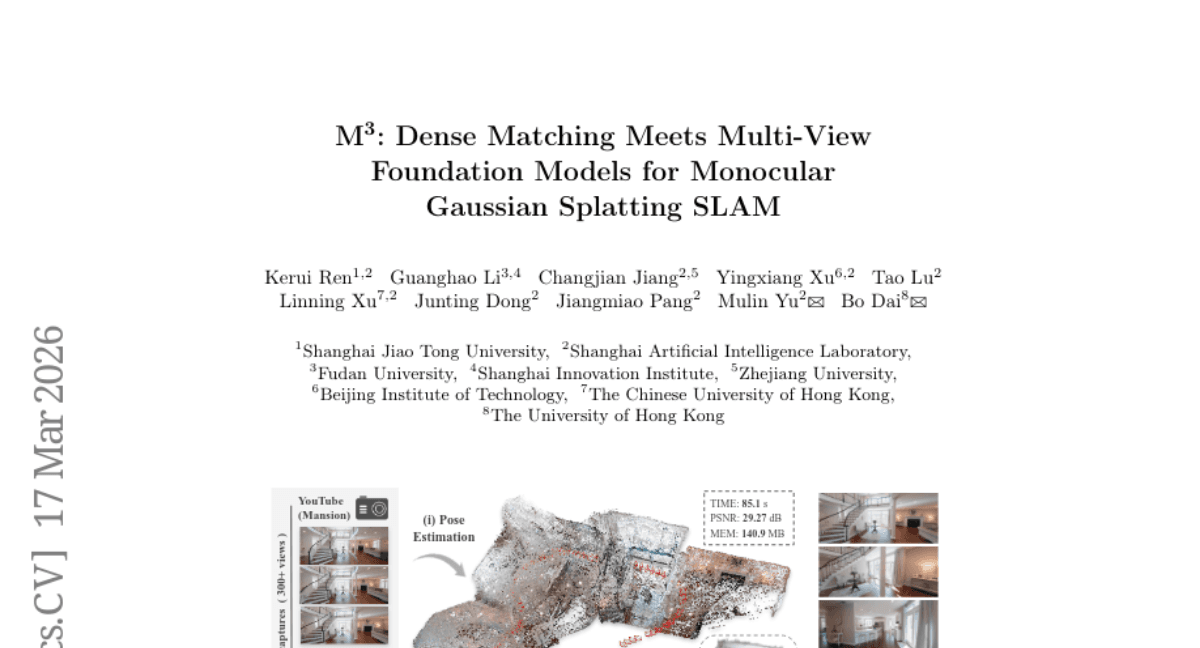
- **4RC (4D Reconstruction):** A **fully feed-forward monocular 4D reconstruction model** that offers **efficient, high-accuracy scene capture**. As highlighted by **@Scobleizer**, **4RC** provides a **unified framework** for **real-time 4D scene reconstruction**, reducing computational costs and enabling **faster, scalable scene understanding** critical for **autonomous vehicles** and **robotic inspections**.
In addition, innovative **training strategies** such as **Rolling Sink** and **titled Long-Range Reasoning Modules (tttLRM)** have been developed to **bridge the gap** between **limited-horizon training** and **open-ended testing**, fostering **robust long-term reasoning** and **generalization**. Despite these advances, challenges persist in achieving **comprehensive physical understanding**, especially in **egocentric multi-object rearrangement** and **spatial reasoning within dynamic, real-time scenarios**.
---
## 3. Trust, Safety, and Interpretability: Progress and Persistent Gaps
As embodied systems become more capable, **trustworthiness** increasingly depends on **interpretability** and **perception robustness**.
- **Visualization and Debugging Tools:** **LatentLens** and **TensorLens** now allow **deep inspection** of internal representations, aiding **debugging**, **trust assessment**, and **regulatory compliance**.
- **Perception Correction and Safety Frameworks:** **REFINE**, an **RL-based perception correction system**, detects and **corrects perception manipulations**, thwarting **visual memory injection attacks** and ensuring **system integrity**. Complementing this, **Spider-Sense** predicts **potential failures early**, enabling operators to **preempt catastrophic outcomes**.
- **Robustness Against Attacks:** Factored latent models explicitly encode environment interactions, **reducing susceptibility** to adversarial perturbations, even under **noisy or manipulated inputs**.
However, a critical insight from experts like **@drfeifei** underscores an ongoing **significant gap**: **current Vision-Language Models (VLMs)** and **Multimodal Large Language Models (MLLMs)** **lack a deep, physical understanding** of the environment from videos. As **@drfeifei** states, “**VLMs/MLLMs do NOT yet understand the physical world from videos**,” highlighting a persistent challenge vital for **safe deployment** in **real-world, safety-critical systems**.
---
## 4. Hierarchical Multi-Modal Reasoning and Cross-Embodiment Transfer
Integration of **multi-modal reasoning** within **hierarchical multi-agent architectures** has resulted in **more resilient and scalable systems**.
- **UniT:** Combines vision, language, and other modalities within a **multistep reasoning framework**, supporting **complex planning**.
- **AOrchestra** and **Prism:** Enable **long-term coordination** using **spectral-aware attention** and **recursive SkillRL**, managing **satellite constellations** and **collaborative robotic teams** effectively.
- **Cord:** Introduces a **hierarchical agent tree architecture**, promoting **scalability** and **fault tolerance**, demonstrating how **agent trees** can handle **complex multi-agent tasks** with **improved adaptability**.
- **TactAlign:** Facilitates **cross-embodiment tactile policy transfer**, allowing robots to **imitate tactile demonstrations** across different hardware platforms, thus **significantly enhancing learning efficiency** and **dexterity**.
Emerging concepts such as **language-action pretraining (LAP)** further bolster **cross-embodiment capabilities**, enabling agents to **seamlessly transfer learned behaviors** across diverse physical forms.
---
## 5. Scene Understanding, Generation, and Predictive Modeling for Deployment
Robust **scene understanding** and **generation tools** are central to practical deployment.
- **4D-RGPT** and **Diffusion Scene Synthesis:** Enable **predictive scene modeling** and **virtual environment creation**, supporting **planning** and **training**.
- **Geometry-Aware Encodings:** Like **ViewRope**, ensure **long-term scene stability** and **contextual coherence**, supporting **long-duration operations**.
- **PerpetualWonder:** As showcased by **@Scobleizer** at **CVPR 2026**, **PerpetualWonder** represents a **major breakthrough** in **interactive 4D scene generation**. It facilitates **long-horizon, dynamic environment editing**, **real-time interaction**, and **environmental consistency**, addressing longstanding limitations in scene modeling for **interactive robotics** and **virtual environment management**.
- **4RC:** Continues to be a core tool for **efficient, real-time 4D scene capture**, vital for **autonomous navigation** and **interactive systems**.
---
## 6. New Frontiers: Reinforcement Learning and Multimodal Content Creation
2026 has seen the emergence of **PyVision-RL**, a framework for **training open agentic vision models via reinforcement learning**. This approach aims to **align perception with goal-directed decision-making**, moving beyond traditional supervised learning toward **adaptive, interaction-based learning**. As **@NaveenGRao** notes, “**We’re able to build non-linear dynamical systems that are steerable to be able to reason and control complex environments**,” highlighting the potential for **steerable dynamics** to enhance **planning**, **multi-agent coordination**, and **long-horizon control**.
Complementing this, **SkyReels-V4** advances **multimodal video-audio generation, inpainting, and editing**, enabling **high-fidelity, interactive content creation**. This not only benefits **virtual environment synthesis** and **media augmentation** but also opens new avenues for **robotic perception**, **training data generation**, and **human-AI interaction**.
---
## 7. Persistent Challenges and Future Directions
Despite the remarkable progress, several **core challenges** continue to shape the research agenda:
- **Deep Physical Grounding:** Current systems **lack profound understanding** of **complex physical interactions**, especially in **dynamic, egocentric multi-object scenarios**.
- **Causal and Long-Horizon Reasoning:** Achieving **robust, scalable causal inference** remains elusive but is critical for **autonomous, safe decision-making**.
- **Perception Robustness:** While tools like **REFINE**, **LatentLens**, and **Spider-Sense** enhance defenses, **adversarial vulnerabilities** and **perception manipulations** threaten system integrity.
A recent notable development is **Naveen G. Rao’s** work on **steerable nonlinear dynamical systems**, which **connects to world-model control** and **enables improved steerable dynamics** for planning and multi-agent coordination. Rao emphasizes that **building non-linear, steerable systems** is key to **flexible, adaptive control** in complex environments—a promising direction to address current limitations.
---
## **Current Status and Broader Implications**
The landscape of **embodied and multi-agent AI in 2026** reflects a **maturing ecosystem** characterized by:
- **Standardized benchmarks** (ADP, ResearchGym, MIND, BiManiBench) and **open simulation platforms** (DreamDojo).
- **Innovative modeling techniques** (ViewRope, Causal-JEPA, P4D, 4D-RGPT, 4RC, Diffusion Scene Synthesis, PerpetualWonder).
- **Enhanced safety and interpretability tools** (LatentLens, TensorLens, REFINE, Spider-Sense).
- **Hierarchical, multi-modal reasoning frameworks** (Cord, TactAlign, LAP, AOrchestra, Prism).
- The rise of **RL-driven agentic perception models** (**PyVision-RL**) and **multimodal content creation** (**SkyReels-V4**).
- The integration of **steerable nonlinear dynamical systems** (**N2**) into the control paradigm, connecting world-model control with **adaptive, steerable dynamics**.
While these innovations are transformative, **deepening physical grounding**, **scaling causal and long-horizon reasoning**, and **hardened perception systems** remain priorities for the future.
---
## **Implications and Outlook**
The advancements of 2026 demonstrate a **rapidly evolving ecosystem** where **standardization**, **modeling breakthroughs**, and **trustworthy safety mechanisms** coalesce to support **real-world, autonomous deployment**. The focus on **long-horizon reasoning**, **physical understanding**, and **system resilience** will be crucial for **trustworthy, safe, and scalable embodied agents**.
Looking ahead, these developments suggest a future where **agents can perceive, reason, collaborate, and adapt** across complex, unpredictable environments—bringing us closer to realizing **truly intelligent, embodied systems** seamlessly integrated into daily life, industry, and exploration. The trajectory of 2026 will be remembered as a foundational year that set the stage for **trustworthy autonomous agents** capable of **safe operation at scale**.
---
## **Summary**
In sum, 2026 has solidified its place as a landmark year in embodied and multi-agent AI, offering a rich tapestry of **standardization efforts**, **modeling innovations**, and **safety advancements**. While significant progress has been made, the journey toward **deep physical understanding**, **causal reasoning**, and **robust perception** continues, guiding future research toward **more capable, reliable, and safe autonomous systems**.