# Reinforcement, Training Stability, Long-Horizon Reasoning, and Skill Composition for Large Language Model Agents: The Latest Frontiers
The rapid evolution of artificial intelligence continues to redefine what autonomous agents can accomplish, especially as breakthroughs in reinforcement learning (RL), hardware efficiency, multimodal perception, robotics, multi-agent collaboration, and scientific reasoning converge. These advances are not only expanding the capabilities of AI systems to reason and act over extended timeframes but are also laying a foundation for truly reliable, safe, and scalable autonomous agents capable of complex long-horizon tasks. This article synthesizes recent developments, emphasizing how these interconnected innovations are shaping the future of intelligent, reasoning-driven AI.
## Reinforcement Learning and Stability: Unlocking Long-Horizon Coherence and Modular Skill Building
Achieving **coherent, stable reasoning across hundreds or thousands of decision steps** remains a core challenge in autonomous AI development. Recent innovations have made significant progress:
- **REFINE** (Reinforced Fast Weights) has introduced *predictive dependency modeling*, enabling models to *maintain context coherence* over extended sequences, crucial for scientific research, navigation, and complex problem-solving tasks.
- **Forge** advances *robust on-policy RL algorithms* that strike a balance between *computational efficiency* and *performance over long horizons*, supporting agents in dynamic, real-world environments.
- **SkillRL** and **Composition-RL** focus on *hierarchical skill discovery* and *modular policy composition*. These methods allow models to *recursively develop*, *combine*, and *transfer reasoning modules*, facilitating *scalability* and *adaptability* in increasingly complex tasks.
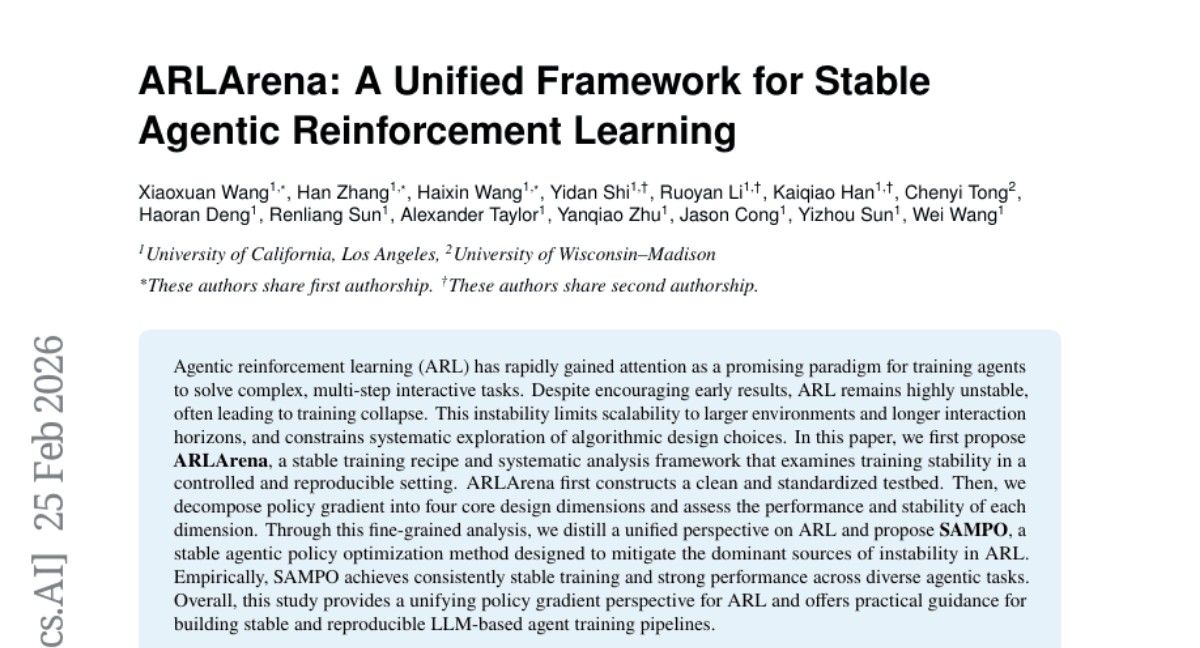
- The recent emergence of **ARLArena**—a *Unified Framework for Stable Agentic Reinforcement Learning*—integrates these stability mechanisms with *goal-directed, multi-task RL*, fostering **more reliable and long-term reasoning** in multi-task settings. Its comprehensive architecture is generating active interest within the research community, promising to accelerate the deployment of **robust autonomous agents**.
- **STAPO** (Stabilizing Reinforcement Learning by Silencing Spurious Tokens) continues to improve **model reliability** by reducing the influence of misleading tokens, a critical feature for high-stakes applications such as space robotics, healthcare, and autonomous transportation.
These advances collectively support **deep, stable, and long-horizon reasoning**, enabling AI systems to produce **scientific insights**, undertake **autonomous decision-making**, and solve **multi-step problems** with unprecedented consistency.
## Hardware and Efficiency Breakthroughs: Bridging Research and Real-World Deployment
Progress in reasoning capabilities needs to be complemented by hardware innovations that make deployment feasible at scale:
- **COMPOT** (Comprehensive Orthogonal Transformer Compression) employs *sparse orthogonal matrices* to *compress transformer architectures* *without retraining*, leading to substantial reductions in *latency* and *energy consumption*. This makes large models more accessible for *edge devices* and *embedded systems*.
- Advanced *quantization techniques*, including **FP8** and *sub-4-bit representations*, paired with *trainable sparse attention mechanisms* like **SpargeAttention2**, facilitate *real-time inference* on resource-constrained hardware, paving the way for **long-horizon autonomous reasoning** in diverse environments.
- Nvidia's **DreamDojo**, introduced in early 2026, exemplifies *hardware-software co-design* targeting robotic systems. It offers *datasets*, *training frameworks*, and *benchmarks* that significantly *accelerate sim-to-real transfer*, effectively *closing the gap* between simulation and physical deployment.
- **Emerging model-to-silicon approaches**, such as integrating models directly into specialized hardware, are set to dramatically **increase token throughput**. As **@LinusEkenstam** highlighted, "adding this to silicon that burns the model into the chip" can elevate token processing speeds from approximately **17,000 tokens/sec to over 51,000 tokens/sec**, drastically reducing inference latency and energy costs. Such innovations will **enable real-time reasoning** at unprecedented scales, making large, capable models practical for embedded, mobile, and distributed systems.
- **Memory management improvements** have achieved *up to an 8-fold reduction* in reasoning costs, further enhancing scalability and sustainability, especially in resource-limited settings.
These hardware advancements are critical in transforming research breakthroughs into **widely deployable autonomous agents** capable of **long-term reasoning** and **complex task execution**.
## Multimodal Perception and Long-Context Understanding: Expanding Sensory and Cognitive Horizons
Real-world environments are inherently multimodal and dynamic, demanding AI systems that can **integrate visual, linguistic, auditory, and sensor data** over **extended contexts**:
- **Long Context Models (LCMs)** and **Recursive Language Models** now support *reasoning across thousands of tokens* without degradation, facilitating *scientific analysis*, *navigation*, and *space environment understanding*.
- **ViewRope**, a *geometry-aware positional encoding*, ensures *spatial and temporal consistency* in video-based models, supporting *robot navigation* and *space exploration* tasks that require understanding complex scenes over time.
- **UniT** enables *iterative multimodal reasoning*, combining *vision*, *language*, and *sensor data*—a vital capability for *multi-modal scientific experiments* and *robust perception* in complex scenarios.
- Scene understanding has been significantly enhanced by models like **Causal-JEPA** and **Factored Latent Action World Models**, which facilitate *causal reasoning at the object level* and support *multi-agent planning*.
- A **groundbreaking development** is **4RC** (4D Reconstruction), a *fully feed-forward framework* capable of *monocular 4D scene reconstruction*. Demonstrated at **CVPR2026** and widely shared on social media by @Scobleizer, **4RC** unifies *spatial* and *temporal data* into an *efficient pipeline* for *real-time 3D + 4D scene understanding*, significantly improving perception accuracy in *dynamic environments*.
- Complementary tools like **Rolling Sink** and the **Very Big Video Reasoning Suite** extend *long-horizon perception*, while *test-time training* approaches like **tttLRM** facilitate *autoregressive 3D reconstruction* over extended contexts.
These perceptual systems enable AI agents to **perceive, interpret, and reason about** complex, dynamic environments—forming the foundation for **autonomous navigation**, **space exploration**, and **scientific discovery**.
## Robotics and Generalization: From Simulation to Reality
Robotics research is increasingly leveraging **latent-space dreaming**—a technique where models *simulate hypothetical experiences* *without physical interaction*—to improve *generalization* and *robustness*:
- The concept of **robots dreaming in latent space** is gaining traction, allowing systems to *generate diverse scenarios* that enhance *learning efficiency*.
- **TOPReward** introduces a *token probability-based reward signal* that functions as a *zero-shot reward predictor*, aligning *language model token likelihoods* with *robotic behaviors*. This approach enables *self-assessment* and *behavior optimization* *without explicit reward engineering*.
- **EgoPush**, a *multi-object rearrangement system*, demonstrates *end-to-end egocentric manipulation* in *cluttered environments*, advancing *autonomous dexterity*.
- **SARAH** (Spatially-Aware Recurrent Action Hub) employs *causal transformers* to *predict real-time spatial motions* of humans and agents, supporting *multi-agent interaction* and *collision avoidance*.
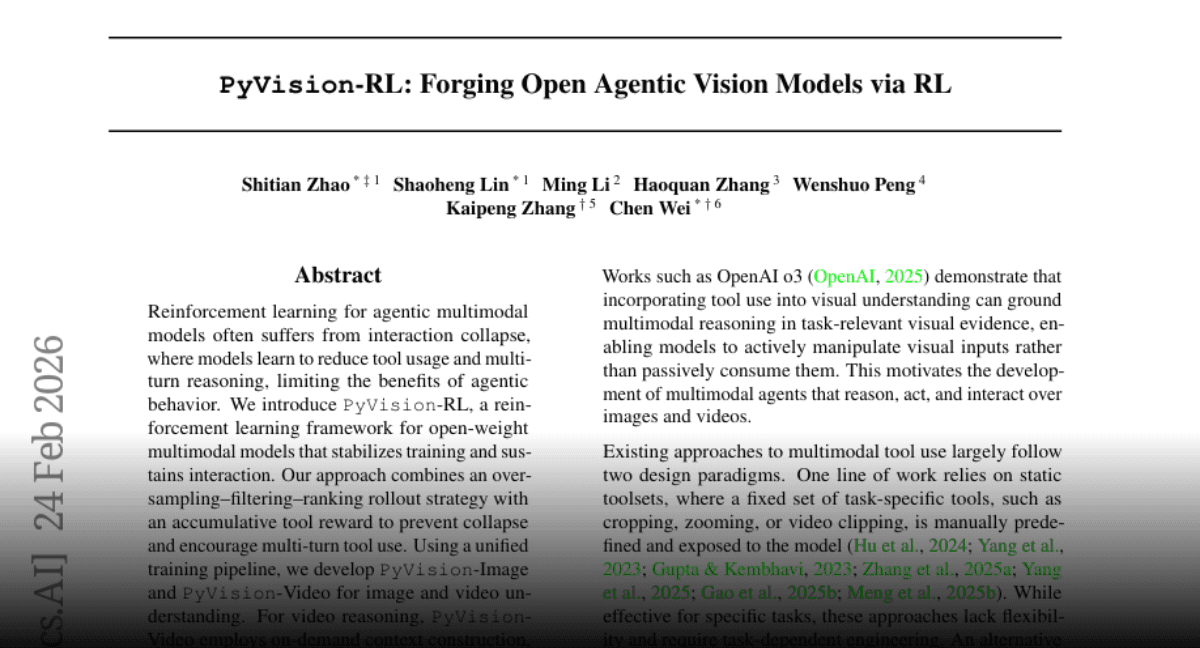
- The **PyVision-RL** framework emphasizes *goal-directed perception* and *adaptive feature extraction*, training *embodied AI systems* capable of *long-term perception-action cycles*.
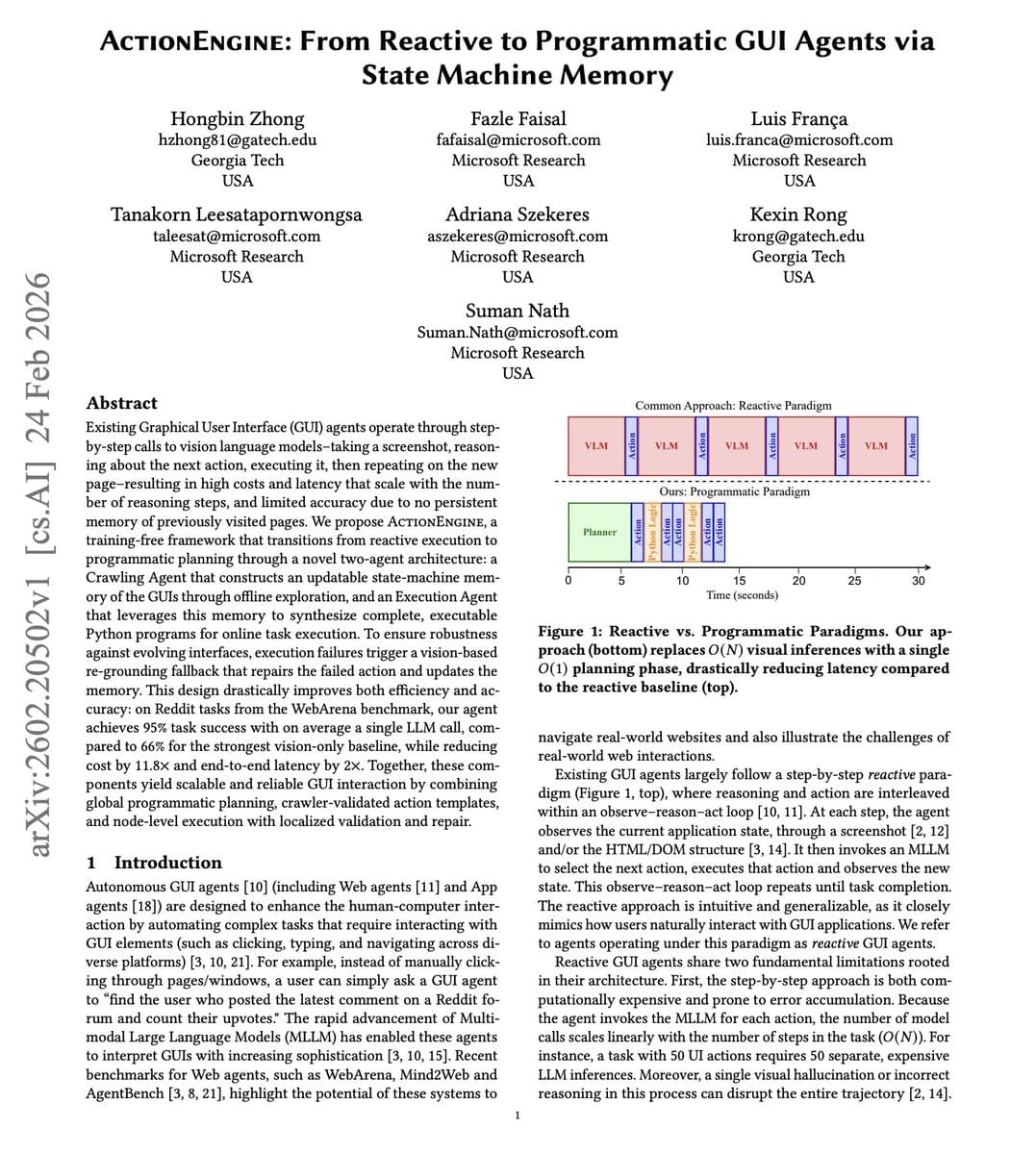
- A **noteworthy recent innovation** is **GUI-Libra**, a *framework for training native GUI agents*. As detailed in a repost from Georgia Tech and Microsoft Research, **GUI-Libra** endows agents with *action-aware supervision* and *partially verifiable RL*, enabling *interactive reasoning* and *task automation* within complex graphical user interfaces. This marks a vital step toward **autonomous software agents** capable of *system management* and *digital task execution*.
## Multi-Agent Systems, Standards, and Safety: Building Trustworthy Collaboration
Progress toward **scalable, cooperative AI systems** hinges on *standardization*, *algorithm discovery*, and *safety protocols*:
- **AlphaEvolve** employs *evolutionary coding* within LLMs to *generate and optimize multi-agent algorithms*, fostering *self-improving cooperation* and *adaptive collaboration*.
- The **Agent Data Protocol (ADP)**, recently adopted at **ICLR 2026**, establishes *standardized data sharing and evaluation protocols*, promoting *interoperability* and *trustworthiness* across multi-agent ecosystems.
- The **Cord** framework structures *hierarchical multi-agent systems* into *coordinating trees*, facilitating *multi-level communication*, *resource management*, and *distributed decision-making*. Its robustness has garnered widespread community interest, exemplified by over **63 points on Hacker News**.
- **Safety frameworks** such as **GRPO** and **ASTRA** provide *mathematically grounded guarantees*, essential for *space missions*, *healthcare*, and *autonomous driving*. **LatentLens** offers *visualization tools* that interpret *reasoning pathways*, enhancing *trust and transparency*. Additionally, **Neuron Selective Tuning (NeST)** enables *safety-critical neuron fine-tuning* *without retraining*, striking a balance between *performance* and *safety*.
These efforts are cultivating **trustworthy, cooperative AI** capable of *long-term collaboration* in complex, real-world environments.
## Autonomous Scientific Reasoning: AI as a Research Partner
A **noteworthy recent milestone** is **"Aletheia"**, an AI system demonstrating *independent engagement with research-level mathematics*. It excels at *complex proof discovery*, *conjecture generation*, and *deep mathematical reasoning*, evidenced by a compelling 2-minute 25-second YouTube presentation. This signals a **paradigm shift**: AI systems are transitioning from *tools* to *active research partners*, capable of *long-horizon scientific reasoning*, *hypothesis formulation*, and *problem-solving* across disciplines. Such capabilities hint at a future where AI accelerates *scientific breakthroughs* in physics, biology, mathematics, and beyond.
## Persistent Challenges and Future Directions
Despite remarkable progress, several **persistent challenges** remain:
- **Physical reasoning gaps** in *Visual Language Models (VLMs)* and *Multi-Modal Large Language Models (MLLMs)* hinder *dynamic manipulation* and *interaction*.
- *Sim-to-real transfer* continues to be difficult, even with tools like **DreamDojo** and **EgoPush**, emphasizing the need for **better generalization** and *robust adaptation* techniques.
- **Spatiotemporal causal prediction** requires more sophisticated models to support *safe*, *adaptive*, *long-term multi-agent interactions*.
- Hardware bottlenecks, including the integration of *specialized accelerators*, *photonic*, and *quantum hardware*, are critical for scaling models and ensuring robustness.
- Techniques such as **test-time training** (*tttLRM*) and *rolling training methods* (*Rolling Sink*) are crucial for bridging the gap between *training environments* and *long-horizon deployment*.
- The recent push toward **model-to-silicon hardware integration**, exemplified by *burning models directly into chips*, promises to **revolutionize token throughput**, enabling *real-time reasoning at scales previously unattainable*. As **@LinusEkenstam** notes, this approach can dramatically **increase token processing speeds**, facilitating *instantaneous reasoning* in embedded systems.
Addressing these challenges is essential for **realizing autonomous AI agents** capable of **long-term reasoning**, **physical interaction**, and **collaborative decision-making** at scale.
## Conclusion: Toward an Autonomous, Reasoning-Driven Future
The past year has showcased a **remarkable convergence of breakthroughs** across multiple fronts—reinforcement learning stability, hardware efficiency, multimodal perception, robotics, multi-agent collaboration, and scientific reasoning. These advances are transforming AI from tools that perform isolated tasks into **autonomous, reasoning partners** capable of navigating complex environments, engaging in scientific discovery, and collaborating safely with humans.
Projects like **ARLArena**, **GUI-Libra**, and **Aletheia** exemplify this trajectory, illustrating AI systems that **reason and act over long horizons**, **operate reliably**, and **contribute to scientific progress**. The integration of innovative hardware approaches, such as *burning models into chips* for massively increased token throughput, signals a future where **real-time, long-horizon reasoning** becomes routine.
As hardware architectures evolve and models mature, we are approaching a **new era of autonomous agents**—not just tools but active contributors capable of **driving discovery, innovation, and societal advancement** across disciplines. The journey forward holds promise for **scaling intelligence** in ways that support a safer, more capable, and more insightful AI-driven future.