# Building, Orchestrating, and Shipping Production-Grade AI Agents in 2026: The Latest Developments
The enterprise AI landscape of 2026 continues to accelerate in maturity, sophistication, and pervasiveness. AI agents are no longer confined to experimental labs or isolated prototypes; they are now fundamental, mission-critical components embedded deeply within organizational workflows across industries. Recent innovations have propelled these autonomous systems to new heights—enabling them to manage complex operations, maintain persistent long-term memory, produce structured API-ready data, and operate securely across diverse environments.
This article synthesizes the latest advancements, highlighting key developments that are shaping the future of production-grade AI agents.
---
## Persistent Memory and Long-Term Context: From Session Loss to Continuous Awareness
One of the most transformative trends in 2026 is the evolution of memory management within AI agents. Earlier models often struggled with maintaining context across sessions, limiting their usefulness in long-term, evolving tasks. Recent breakthroughs have introduced **robust persistent memory layers** that empower AI systems to remember previous interactions indefinitely, enabling **truly ongoing and adaptive engagement**.
### Embedding Memory into Claude Code
A notable example is the introduction of **embedding memory layers** such as **Mem0**, a memory layer specifically designed for AI applications. As detailed in the DEV Community, **Mem0 acts as a dedicated memory server**, allowing Claude-based systems to **store and retrieve contextual data seamlessly**. This approach **eliminates session loss**, providing **persistent long-term memory** that supports complex, multi-turn interactions and continuous learning.
### Auto-Memory Support in Claude Code
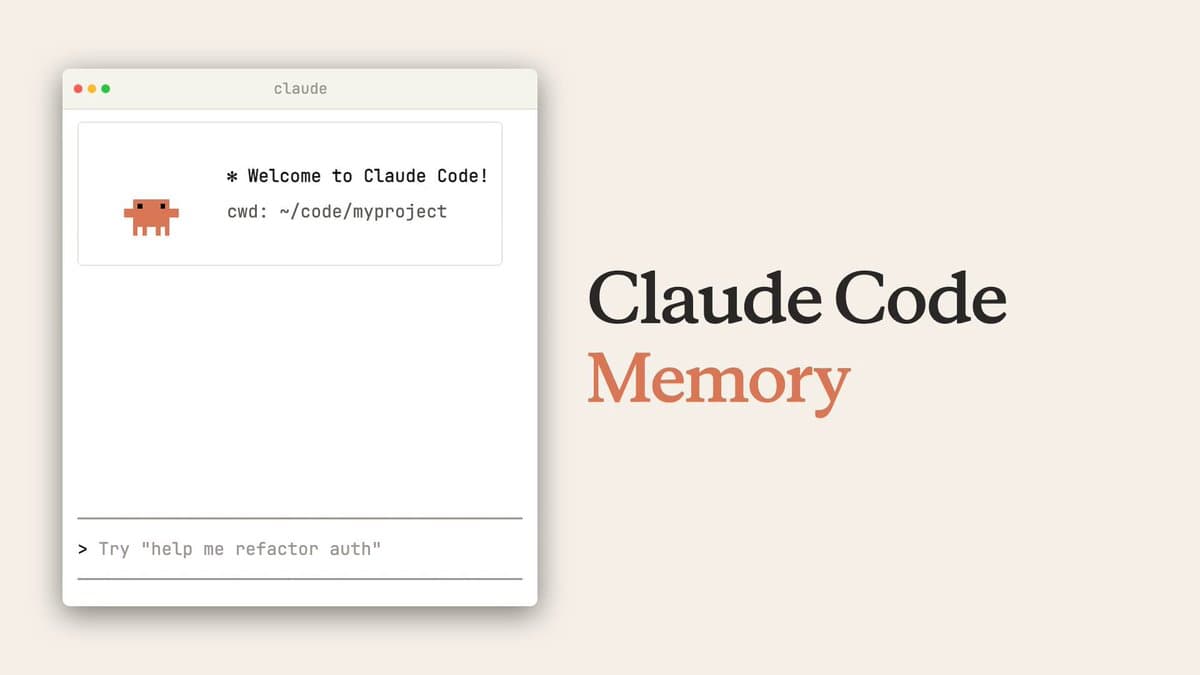
Further amplifying this capability, **@omarsar0** announced that **Claude Code now supports auto-memory features**. This development means that **Claude can autonomously manage its memory**, dynamically deciding what information to retain or forget, reducing manual overhead and ensuring **contextual continuity over extended periods**. As @trq212 highlights, this **auto-memory feature** is a **game-changer**, enabling **more natural, sustained conversations** and **long-term project management**.
### Community-Led Memory Solutions
The ecosystem also sees innovative community-driven solutions, such as **Embedding Memory into Claude Code** projects, which **integrate external memory layers**—like **Mem0**—with **custom implementations**. These systems **augment Claude’s native capabilities**, offering organizations **tailored memory architectures** suited to their specific workflows.
---
## Turning AI into Structured, API-Ready Data
Beyond conversation and contextual awareness, a critical requirement for enterprise AI agents is the ability to **produce structured, machine-readable outputs** that can be directly integrated into workflows and systems.
A recent demonstration titled **"Claude API: Turn AI Into Structured, API-Ready Data (Not Just Chat)"** showcases how **Claude’s API** can **generate highly structured data formats**—such as JSON, XML, or custom schemas—**from natural language prompts**. This capability **transforms AI from a chat interface to a data producer**, enabling applications like **automated report generation**, **data extraction**, and **system integration**.
Using such structured outputs, **AI agents** can **feed information directly into enterprise databases**, **trigger downstream processes**, or **compose API calls** for further automation. This **structured-data paradigm** marks a significant step toward **fully autonomous, integrable AI systems** capable of **serving as active participants within complex enterprise ecosystems**.
---
## Continued Strengths in Agent Orchestration, Security, and Self-Hosting
While these memory and structured-output innovations are groundbreaking, the foundational components that support enterprise AI—**orchestration platforms, security frameworks, and self-hosting options**—remain central.
### Orchestration and Multi-Cloud Inference Routing
Platforms like **Kilo Gateway** continue to offer **unified inference APIs**, intelligently routing requests across **multi-cloud environments** and **self-hosted models**. **Taalas’ HC1** platform delivers **real-time inference speeds up to 17,000 tokens per second**, supporting **interactive decision-making** at enterprise scale. **Amazon Bedrock’s AgentCore** manages **secure external API integrations** with over **6,700 APIs**, ensuring **scalability and security** in diverse operational contexts.
### Self-Hosting and Data Sovereignty
The sector emphasizes **self-hosted models** for **privacy-sensitive industries**. Examples include **Qwen 3.5**, which powers applications at **just 9 cents per query**, offering **full control over deployment environments**, and **GLM-5 744B**, an **offline, open-weight model** suitable for regulatory sectors. Open-source projects like **Barongsai** provide **customizable, privately hosted AI search solutions**, reinforcing data sovereignty.
### Browser-Based, Offline Models
The advent of **TranslateGemma 4B**, which **runs entirely in the browser using WebGPU**, exemplifies how **offline, privacy-preserving AI** is becoming accessible. It supports **completely offline operation**, reducing reliance on external servers, and broadening deployment possibilities across various devices and security levels.
---
## Advanced Frameworks and Automation Tools
The ecosystem continues to evolve with **multi-agent orchestration frameworks**, **self-improving systems**, and **voice/action operating systems**:
- **Multi-Agent Frameworks:** Combining **Copilot Studio**, **Microsoft’s Agent Framework**, and **Azure AI** enables enterprises to **scale multi-agent workflows** that coordinate complex tasks autonomously.
- **Evolutionary Optimization:** Frameworks like **GigaEvo** leverage **LLMs combined with evolutionary algorithms** to **automatically tune and improve systems**, paving the way for **self-optimizing autonomous agents**.
- **Voice and Action Operating Systems:** **Zavi AI** introduces a **Voice to Action OS**, capable of **typing, editing, seeing, and acting** across platforms including **iOS, Android, Mac, Windows, and Linux**, empowering **voice-driven automation**.
- **Agent Skill Testing and Performance Optimization:** Tools like **Tessl** facilitate **evaluation and refinement** of agent skills, enabling faster deployment and **more reliable AI agents**.
### Speed, Communication, and Memory Enhancements
- **Real-time APIs** from OpenAI and GPT variants support **instantaneous agent communication**, essential for **AI-powered phone calls and live interactions**.
- **Faster TTS solutions like Qwen3TTS** enable **high-quality, real-time speech synthesis**, enhancing **natural dialogue**.
- **API Data Integration:** Tools such as **API Pick** supply **comprehensive data APIs** for **email validation, phone lookup**, and more, streamlining **agent data ingestion**.
- **Persistent Cognitive Memory:** **DeltaMemory** offers **fast, persistent memory modules** that allow agents to **remember and learn across sessions**, significantly boosting **long-term autonomy**.
### Open-Source Operating Systems
Projects like **Threads** aim to provide **robust OS frameworks** for **agent management**, **skill orchestration**, and **system stability**, fostering **scalable and reliable autonomous systems**.
---
## Security and Control in Autonomous AI Ecosystems
Security remains paramount as AI agents become more autonomous and integrated:
- **Private GPU Access:** Partnerships like **Tailscale and LM Studio** introduce **‘LM Link’**, enabling **encrypted, peer-to-peer remote GPU access**, safeguarding **development and deployment environments**.
- **Remote and Multi-Platform Control:** **Anthropic’s Remote Control** allows **Claude Code** to be operated **from mobile devices**, extending **agent management** to **remote locations**.
- **Multi-Agent Coordination:** Frameworks such as **Agent Team Manager** facilitate **scalable, secure coordination** of large agent teams, ensuring **operational integrity**.
---
## Current Status and Future Directions
The AI agent ecosystem in 2026 is **dynamic, interconnected, and rapidly advancing**. Enterprises leverage **scalable orchestration**, **self-hosted models**, **structured data generation**, and **persistent memory** to **build, manage, and deploy** **mission-critical AI agents** confidently. The emergence of **browser-based models** and **community-driven open-source projects** democratizes access, reducing barriers and fueling innovation.
**Self-improving frameworks** like **GigaEvo** exemplify the move toward **autonomous systems capable of iterative self-optimization**, promising **more resilient, adaptive agents** in the future. Innovations in **security**, such as **encrypted remote GPU access**, and **multi-platform control** mechanisms, address **privacy and operational concerns**.
In sum, organizations now operate within a **comprehensive AI ecosystem** that offers **robust, secure, and versatile tools** to **build, orchestrate, and ship** **production-grade AI agents**. This foundation not only transforms current enterprise workflows but also sets the stage for **more autonomous, self-improving, and trustworthy AI systems**—paving the way for a new era of enterprise automation and innovation.