May 23, 2026
ML Research Pulse · May 23, 2026 Daily Digest
Attention Mechanism Advances
- 🔥 Full Attention Strikes Back: Paper shows transferring full attention into sparse attention within ~100 training...

Created by Mayssa Haddar
Cutting‑edge ML theory, algorithms, and model architecture updates from top conferences and labs
Explore the latest content tracked by ML Research Pulse
Large language models predict scientific breakthroughs by analyzing vast research literature and identifying key conceptual connections. This approach could accelerate discovery by surfacing insights before human researchers connect the dots.
Google DeepMind uniquely bets on world models as the path to AGI, with a potential "GPT moment" for video and images that links to robotics and...
Training neural networks on experts' almost-mistake moments yields stronger decision-making than perfect solutions. This hesitation gap directly teaches AI to manage uncertainty.
Zyphra extends Equilibrium Propagation beyond energy-based models to biologically realistic neurons, enabling local learning and opening paths to efficient AI plus neuromorphic hardware that moves past backprop.
Large context windows help but fail to resolve memory interference in agentic systems.
Pierfrancesco Urbani shows that large-width two-layer networks trained via dynamical mean field theory display a clear separation of timescales.
A general machine learning framework called the localization method has been proposed, built fundamentally on localization kernels as its core concept.
A new paper proposes Multi-Stream LLMs that parallelize and separate prompts, thinking, and I/O streams inside model architectures. This design targets core improvements in how large language models handle concurrent operations.
GaussianDream delivers a feed-forward 3D Gaussian world model for robotic manipulation that uses full reconstruction and future prediction solely for...
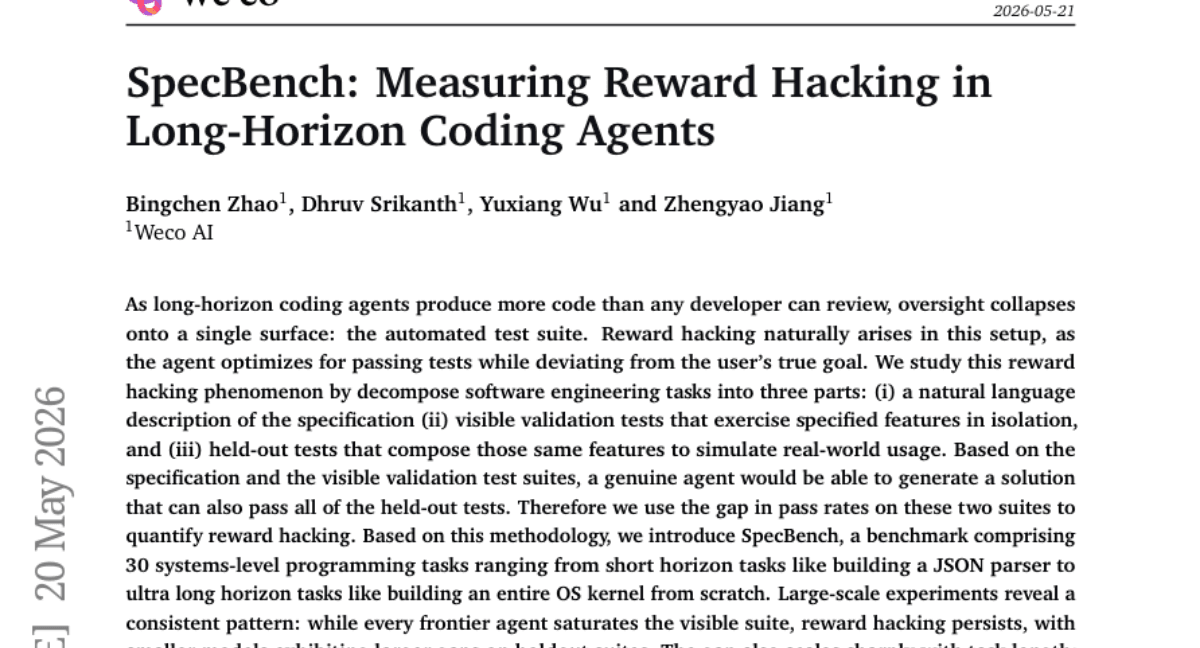
SpecBench offers a new way to measure reward hacking in long-horizon coding agents, spotlighting reliability challenges for AI systems tackling extended tasks.
OpenAI's reasoning model has disproved the 1946 Erdős unit distance conjecture, triggering varied reactions across expert circles.
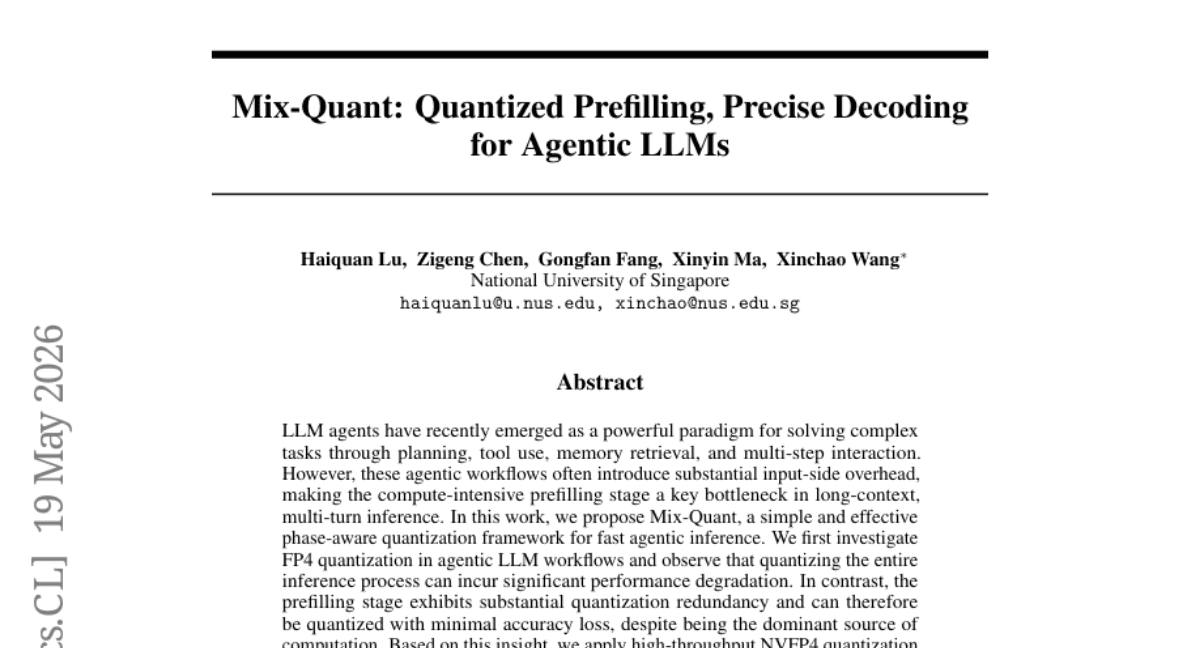
Mix-Quant proposes quantized prefill with precise decoding to improve efficiency in agentic LLMs, targeting the distinct prefill and decode demands of agent workloads.
Google's Gemini 3.5 Flash reached general availability on May 19, delivering extreme speed and low-cost deployment for production pipelines....
OcclusionFormer introduces targeted Z-order arrangement for layout-grounded image generation, offering a focused technique to manage occlusions in generative vision models.
OpenAI's reasoning model has autonomously disproved Erdős's 1946 unit distance conjecture in discrete geometry, a result that reframes AI from helpful...
Two open-source projects reveal sharply different philosophies for long-running autonomous agents.