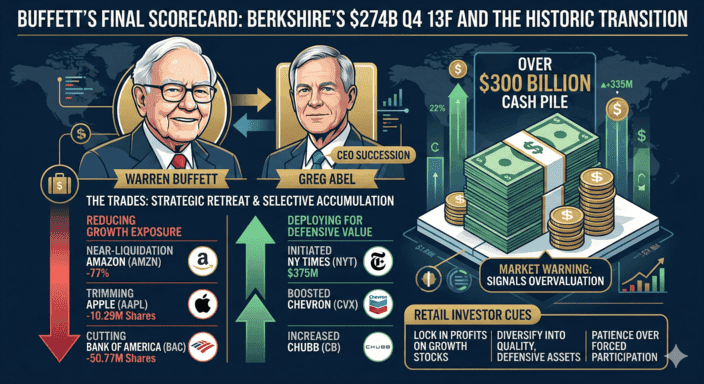
Berkshire Hathaway’s capital allocation strategy in 2024 continues to command attention as a definitive example of disciplined, patient value investing amid significant leadership transition and economic uncertainty. With a colossal cash hoard exceeding $300 billion, Berkshire’s approach to deploying—and deliberately withholding—capital remains a masterclass in balancing strategic flexibility with rigorous valuation discipline. Recent developments, including the company’s Q4 earnings report and the first shareholder letters from Greg Abel and Ajit Jain, provide deeper insight into how Berkshire is navigating the complexities of insurance market volatility, evolving capital deployment priorities, and a new era of stewardship.
---
### The $300 Billion Cash Hoard: Berkshire’s Strategic Bedrock
Berkshire’s massive cash reserve remains **a cornerstone of its enduring competitive advantage**. Far from being idle, this liquidity serves as a war chest that:
- **Empowers patient capital deployment**, allowing Berkshire to wait for opportunities that meet its stringent intrinsic value standards.
- **Supports selective acquisitions and investments**, avoiding the temptation to chase overheated or speculative markets.
- **Provides a buffer against volatility**, especially critical given recent insurance underwriting challenges and economic headwinds.
This steadfast commitment to holding significant cash reflects a philosophy inherited from Warren Buffett and Charlie Munger—favoring capital preservation and value over short-term gains or market timing.
---
### Q4 2023 Earnings: Profit Pressures Amid Insurance Challenges
Berkshire’s Q4 earnings, released at the end of February 2024, highlighted a **30% decline in operating earnings**, largely due to pressures in the insurance segment:
- The company recorded **notable writedowns**, including an other-than-temporary impairment related to Kraft Heinz investments, contributing to a reduction in investment gains.
- Insurance underwriting results were **adversely affected by elevated claims and challenging market conditions**, reducing the float generation that typically funds Berkshire’s investments.
- Despite these headwinds, the company’s strong cash position provided a vital cushion, underscoring the wisdom of maintaining liquidity amid cyclical insurance volatility.
This earnings snapshot reinforces the cyclical nature of Berkshire’s insurance operations and the importance of conservative underwriting and capital management.
---
### Greg Abel’s Inaugural Shareholder Letter: Prudence and Respect for Legacy
Greg Abel’s first shareholder letter, widely awaited by investors, struck a tone of **continuity blended with operational clarity**:
- Abel paid tribute to Warren Buffett’s legacy, acknowledging the foundational principles of **patient, value-driven capital allocation**.
- He underscored **prudence and discipline** as the guiding principles across Berkshire’s diverse portfolio, emphasizing risk management and capital preservation.
- Abel articulated a **clear framework for share repurchases**, stating that Berkshire will only buy back shares when prices are meaningfully below intrinsic value, reinforcing Buffett’s historic caution but now with more explicit guardrails.
- The letter’s straightforward, operational style reflects Abel’s background running Berkshire’s utilities and energy units, signaling a more pragmatic, business-focused communication approach.
Abel’s message reassures investors that while leadership has changed, Berkshire’s capital allocation philosophy remains rooted in long-term value creation without radical strategic shifts.
---
### Ajit Jain’s Perspective: Insurance Discipline Amid Market Headwinds
Ajit Jain’s first shareholder letter complements Abel’s by focusing on Berkshire’s insurance operations:
- Jain reiterated a commitment to **disciplined underwriting** and careful risk selection, acknowledging the tougher insurance market environment.
- He emphasized **patience in capital deployment**, whether through internal reinvestment or acquisitions, aligning with broader corporate prudence.
- Jain also supported the cautious use of **share repurchases** as a tool to enhance shareholder value when the stock price offers a margin of safety.
His letter highlights the insurance float’s critical role as a source of patient capital and the ongoing need to adapt underwriting strategies to shifting market dynamics and inflationary pressures.
---
### Share Buybacks: Tactical Use of Capital With a Value Lens
Both Abel and Jain reaffirmed the **strategic role of share repurchases** as a complement to acquisitions:
- Berkshire continues to be **prepared to accelerate buybacks** if the market price dips sufficiently below intrinsic value.
- Buybacks are not viewed as a substitute for large-scale acquisitions but as an **opportunistic capital deployment tool** when suitable deals are scarce.
- This approach reflects a balance between **capital preservation and shareholder value enhancement**, avoiding ill-timed buybacks in overheated markets.
Recent commentary and trading patterns suggest Berkshire remains disciplined on repurchases, waiting for clear valuation opportunities before committing significant capital.
---
### Reflecting on Past Lessons: Capital Discipline Amid Uncertainty
Berkshire’s cautious stance on capital deployment echoes lessons from recent history:
- Buffett’s decision to **exit airline stocks during the pandemic** exemplified the discipline to withhold capital amid structural uncertainty, even at the expense of short-term gains.
- This mindset persists as Berkshire navigates elevated insurance claim costs and macroeconomic uncertainties, reinforcing a “wait for the right opportunity” approach.
- The company’s **measured response to market volatility** highlights a core value investing tenet: never compromise on price or quality for the sake of activity.
---
### Market and Investor Takeaways: Emulating Berkshire’s Discipline
Investors and market followers looking to mirror Berkshire’s capital allocation philosophy can focus on:
- **ETFs and funds emphasizing high-quality, durable businesses** with strong cash flows and prudent capital management.
- Monitoring Berkshire’s **buyback activity and portfolio changes** to glean insights into market valuation and sector opportunities.
- Embracing a **long-term, value-oriented investment horizon** aligned with Berkshire’s patient capital deployment ethos.
Berkshire’s moves often serve as a bellwether for broader value investing trends, making its capital allocation decisions especially instructive.
---
### Looking Ahead: Berkshire’s Capital Allocation as a Barometer for Value Investing in 2024
The combination of a gargantuan cash reserve, leadership transition, and operational challenges positions Berkshire as a unique lens through which to view disciplined capital allocation:
- The **cash hoard remains a strategic foundation**, enabling Berkshire to act decisively but selectively.
- Pressure on insurance earnings underscores the **volatile nature of one of Berkshire’s core businesses**, necessitating ongoing underwriting discipline.
- Leadership under Greg Abel and Ajit Jain suggests a **steady continuation of Buffett’s principles**, albeit with more explicit operational guardrails and communication style.
- Investors should watch for **incremental increases in share buybacks**, opportunistic M&A targets, and gradual adjustments in underwriting posture as the company adapts to market realities.
In sum, Berkshire Hathaway’s approach to deploying (and withholding) its massive cash reserves in 2024 embodies a philosophy of **steady stewardship amid change**—a model of value investing resilience that remains highly relevant in today’s complex financial environment. As the company navigates uncertain insurance markets and a changing economic landscape, its capital allocation decisions will continue to provide vital signals for investors and corporate managers alike.