# The 2025–26 Enterprise AI Revolution: Multimodal Foundations, Embodied Agents, and the Path to Safe, Stable Deployment
The AI landscape of 2025–26 is undergoing a transformative revolution, driven by an unprecedented convergence of **domain-specific multimodal foundation models**, **large-scale open-source world models**, and **embodied AI systems**. This evolution is not only expanding technical capabilities but also emphasizing **robust safety**, **interoperability**, and **ethical deployment**—fundamentals critical for enterprise adoption at scale. Recent innovations have pushed the boundaries of what AI systems can perceive, reason, and act upon, heralding a new era where intelligent agents are more capable, adaptable, and trustworthy than ever before.
## Converging Foundations: From Domain Specialization to Generalist World Models
A defining characteristic of this period is the **integration of enterprise-tuned multimodal models** with **generalist open-source world models**. This synergy allows systems to perform **complex reasoning**, **perception**, and **interaction** across diverse environments, enabling applications that range from healthcare diagnostics to industrial automation.
- **Healthcare & Genomics**:
- The emergence of **Med-Gemini** exemplifies this integration. Trained on extensive biomedical datasets, Med-Gemini is capable of **biological reasoning**, supporting **diagnosis**, **personalized treatment planning**, and **early disease detection**. Its capacity to synthesize **neuroimaging**, **genetic data**, and **clinical records** accelerates **drug discovery** and enhances **clinical decision-making**.
- Complementing this, datasets like **MEETI**, a multimodal ECG collection from MIMIC-IV-ECG, provide rich signals, images, and interpretive features that enable models to perform **comprehensive cardiovascular analysis**—a vital step toward **automated, reliable diagnostics**.
- In cellular biology, AI systems are helping researchers **visualize gene expression patterns** and **understand cancer origins**, leading to **predictive diagnostics** and **personalized medicine**.
- **Robotics & Embodied AI**:
- Open-source initiatives like **DreamDojo**—a **generalist robot world model**—leverage billions of human activity videos, endowing robots with **multi-task reasoning** and **adaptive interaction** capabilities. Industry observers note DreamDojo’s potential to revolutionize **automated logistics**, **manufacturing**, and **service robots** by grounding perception in **real-world dynamics**, supporting **long-term planning** and **robust manipulation**.
- **Virtual Learning Assistants (VLA)**:
- Systems such as **VLA-2025** now operate as **context-aware virtual agents**, seamlessly understanding speech, visual cues, and text simultaneously. These agents are transforming **enterprise communication**, **decision support**, and **collaborative workflows** by providing **multi-modal, real-time assistance**.
## Breakthroughs in Scene Understanding, 3D Reconstruction, and Planning
Understanding complex environments has advanced significantly through **generative scene understanding** and **3D environment reconstruction**:
- **SeeThrough3D** introduces **occlusion-aware scene synthesis**, enabling the creation of **realistic, consistent 3D environments** even under partial visibility—crucial for **AR/VR**, **robot perception**, and **simulation**.
- **CoPE-VideoLM** employs **codec primitives** for **efficient, 3D-aware video understanding**, facilitating **long-horizon planning** in dynamic scenes.
- **tttLRM** (test-time training language models) advances **autoregressive 3D reconstruction**, allowing agents to **comprehend and adapt** to **rapidly changing or unstructured environments**.
These tools enable **long-term strategic planning** and **real-time decision-making**, essential for autonomous systems operating in complex spatial-temporal contexts.
## Integrating Vision, Language, and Action: Embodied Agents and World-Guided Control
The fusion of perception, reasoning, and control has led to the development of **powerful embodied agents**:
- **Open-source vision-language-action models**, like **ABot-M0** and **Xiaomi-Robotics-0**, employ **hierarchical control architectures** combined with **large-scale pretraining** to support **multi-task, real-time operations**.
- **K-Search** introduces **co-evolving intrinsic world models** that generate **context-aware kernels**, enhancing **robustness**, **explainability**, and **adaptability**.
- The **GigaBrain-0.5M** system exemplifies **multimodal internal representations** managing **multi-object interactions**, underpinning **safe and reliable decision-making** in complex environments.
- **World guidance** techniques, increasingly articulated in recent literature, utilize **world modeling in condition space** to optimize **action generation**, further improving **planning accuracy** and **environmental adaptability**.
## Generative Scene and Environment Modeling: Perception Meets Creativity
Recent models emphasize **perception**, **generative scene understanding**, and **dynamic environment modeling**:
- **UniWeTok** unifies **multimodal representations** across **text**, **images**, and **videos**, enabling agents to **reason seamlessly** across modalities.
- **SeeThrough3D** and **CoPE-VideoLM** significantly improve **real-time environment interpretation**, facilitating **autonomous manipulation** and **interaction**.
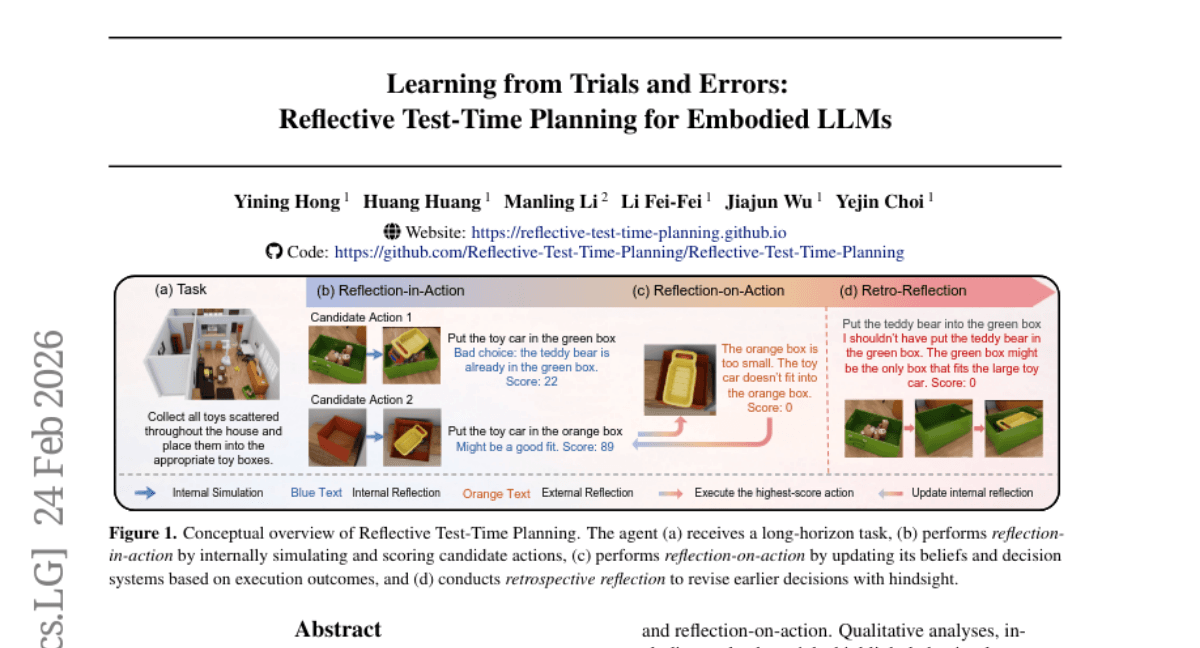
- **Reflective, test-time planning** mechanisms allow models to **dynamically evaluate and refine strategies**, enhancing **robustness** amid environmental uncertainties.
These advancements support **long-horizon reasoning** and **adaptive behaviors**, vital for deploying AI in unstructured or rapidly changing environments.
## Safety, Robustness, and Security in Deployment
Ensuring safety remains a cornerstone of enterprise AI deployment:
- **Reward-free learning** approaches like **TOPReward** leverage **token probabilities** as **zero-shot reward signals**, reducing reliance on manually engineered rewards and minimizing bias.
- **RoboCurate** employs **action-verified neural trajectories** to **diversify training data**, improving **generalization** and **resilience**.
- **Neuron Selective Tuning (NeST)** facilitates **targeted safety tuning** by **adapting critical safety neurons** without retraining entire models.
- The discovery of **backdoors** in multimodal contrastive models (e.g., **Stealthy Backdoors**) underscores ongoing security concerns, prompting the development of **robust defenses**, **model transparency**, and **verification protocols**.
## Ecosystem Standardization: Protocols, Tooling, and Benchmarks
Scaling these advanced systems demands **interoperability** and **trustworthy evaluation**:
- The **Agent Data Protocol (ADP)**, adopted at **ICLR 2026**, provides a **standard format** for **multi-agent communication**, fostering **scalable** and **transparent ecosystems**.
- Platforms like **OpenAI Frontier** and **Cord** facilitate **agent orchestration**, enabling **multi-agent workflows** and **enterprise deployment**.
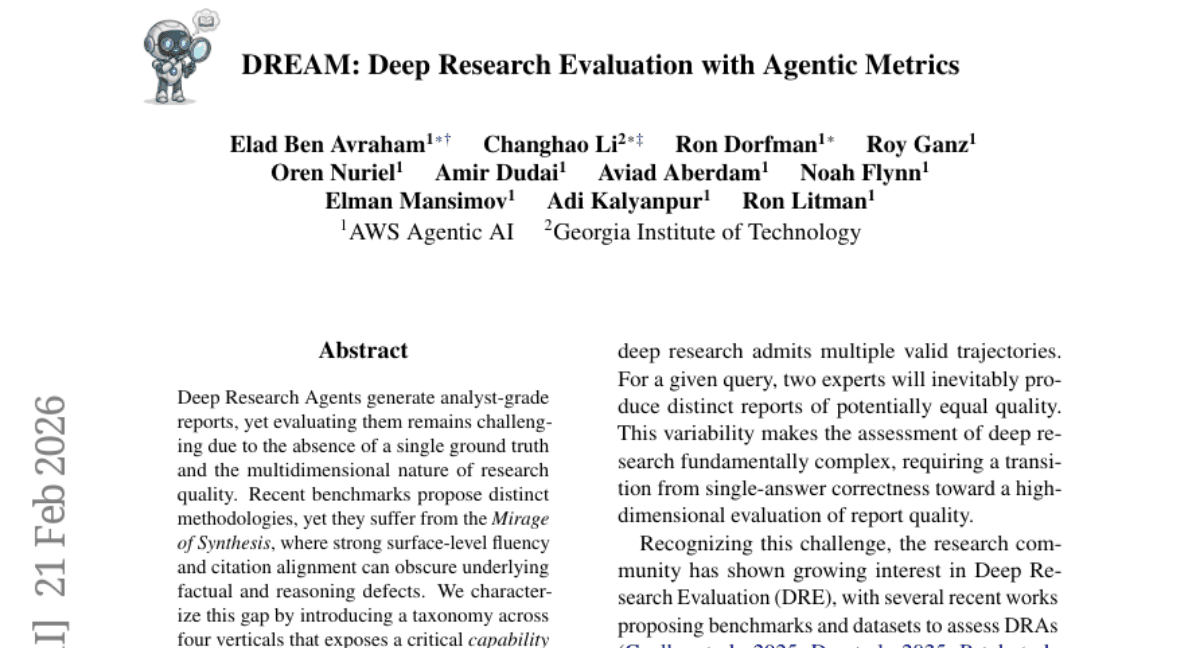
- Benchmarks such as **DREAM** and **SAW-Bench** assess **reasoning**, **planning**, and **situational awareness**, establishing **trustworthy metrics** for embodied AI systems.
## Domain-Specific Datasets and Ethical Considerations
Progress is bolstered by specialized datasets:
- **Healthcare and genomics** benefit from datasets like **MEETI**, supporting **diagnostics** and **personalized medicine**.
- **Cell biology AI** visualizes gene expression and cellular mechanisms, aiding **research** and **disease prediction**.
- **Enterprise AI** companies, exemplified by **Anthropic’s Claude** acquiring **@Vercept_ai**, are enhancing **enterprise-specific capabilities**, including **automated document processing** and **workflow automation**.
Ethical deployment remains paramount as models become more capable; recent work emphasizes **fairness-aware modeling** and **multimodal survival analysis** to ensure equitable healthcare outcomes.
---
### Current Status and Future Outlook
The developments of 2025–26 mark a **paradigm shift** towards **trustworthy, scalable, and stable enterprise AI systems**. The integration of **multi-modal perception**, **world modeling**, **embodied reasoning**, and **safety mechanisms** forms a comprehensive ecosystem poised to **transform industries**.
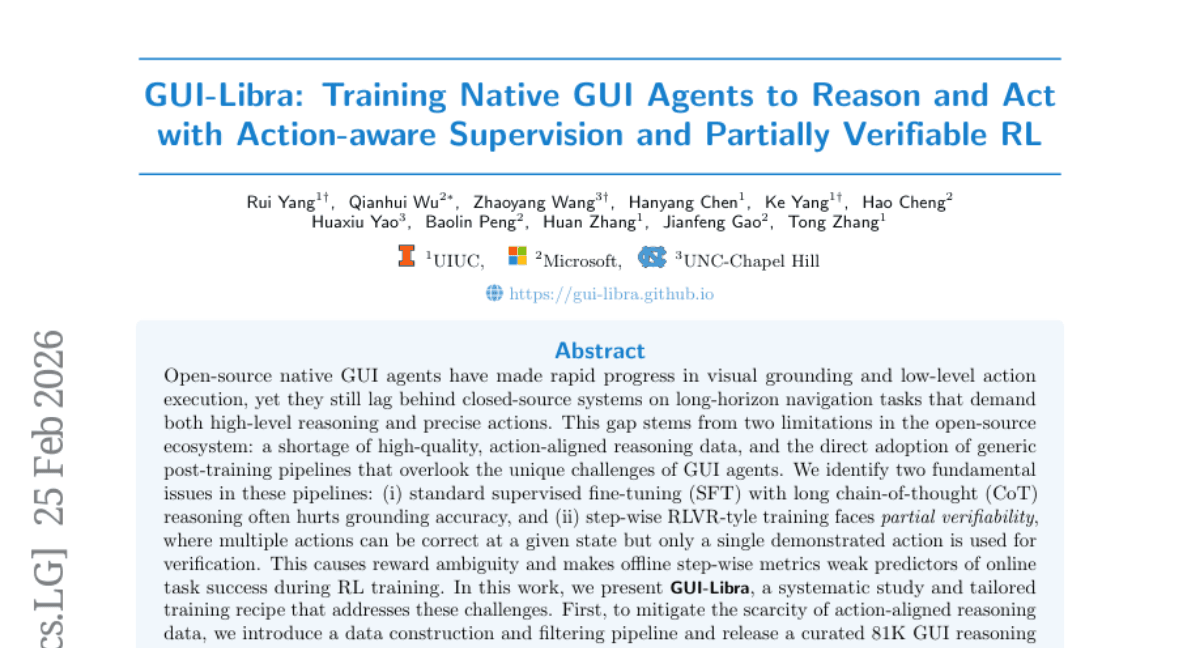
- **Stability and verifiability** are now central, with frameworks like **GUI-Libra** enabling **partially verifiable reinforcement learning** in real-world applications.
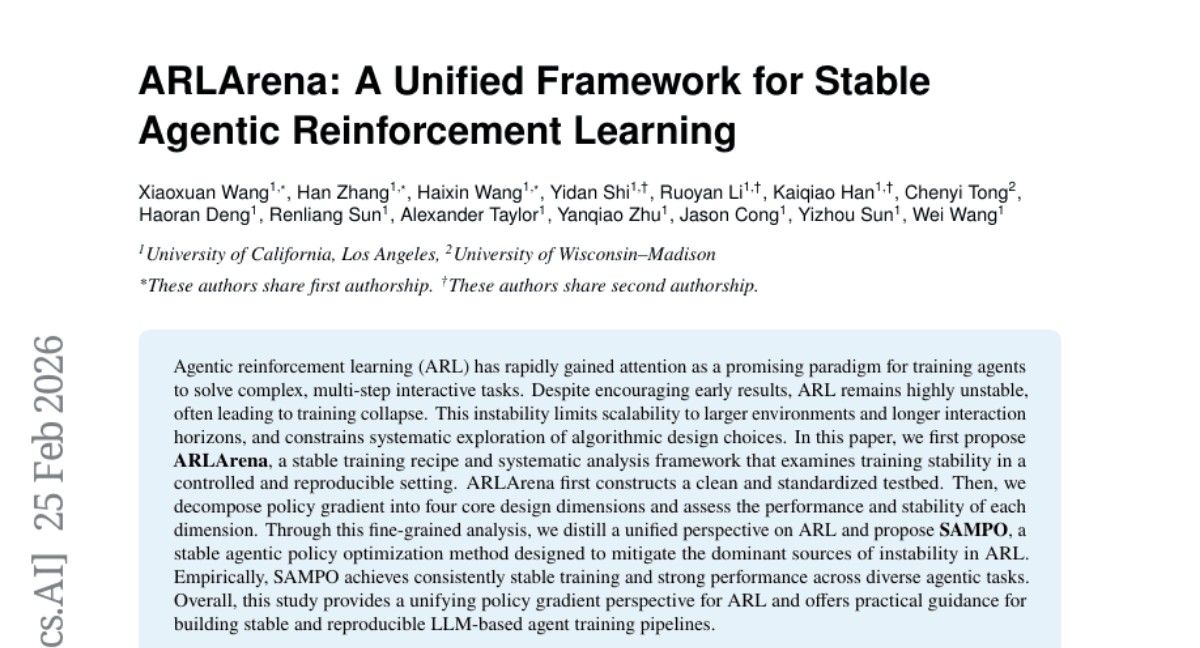
- **Agentic RL frameworks** such as **ARLArena** promote **stable, multi-agent training**, essential for **complex multi-robot collaborations** and **enterprise workflows**.
- The emphasis on **fairness**, **security**, and **robustness** ensures responsible deployment, building trust with users and stakeholders.
As these technologies mature, they will **drive innovation** across sectors, delivering **autonomous, intelligent agents** that are **aligned with human values**, **safe in operation**, and **scalable at enterprise levels**—ushering in the true era of **trustworthy AI**.