# Reinforcement Learning in Cyber Defence, IIoT, and Security: The 2026 Evolution and Future Frontiers
The year 2026 marks a pivotal evolution in the deployment of reinforcement learning (RL) within cybersecurity, industrial control systems, and critical infrastructure protection. As interconnected systems become increasingly complex, and adversaries employ more sophisticated tactics, the importance of autonomous, trustworthy, and resilient cyber defence mechanisms has surged. Recent breakthroughs have elevated RL from a mere optimization tool to a foundational technology that underpins **safety-assured**, **explainable**, and **adaptively intelligent** security solutions capable of countering evolving threats.
---
## Converging Safety, Explainability, and Formal Guarantees in Critical Environments
In sectors such as power grids, transportation networks, manufacturing plants, and other safety-critical environments, ensuring operational safety under malicious or unforeseen conditions is paramount. Significant progress has been made in embedding **formal safety guarantees** directly into RL frameworks.
One notable approach involves **Hamilton-Jacobi reachability certification**, a rigorous mathematical method for verifying the safe operational boundaries of autonomous policies. This technique provides **certified assurances** that RL agents will adhere to safety constraints, even amid malicious disruptions or unforeseen scenarios. Such formal guarantees are essential when failures could lead to catastrophic consequences, such as widespread power outages or transportation failures.
Complementing safety assurances, **robust reward pipelines** like **LENS (Less Noise, More Voice)** have been developed to enhance trustworthiness. These pipelines are designed to withstand **data poisoning** and **adversarial manipulations**, ensuring that learned policies remain resilient and resistant to malicious interference. This resilience is critical in security applications where adversaries actively seek to corrupt learning signals.
**Explainability** and **human alignment** have become central themes. Cutting-edge techniques now enable RL agents to generate **interpretable decision rationales**, fostering operator trust and regulatory compliance. Moreover, **learning from human feedback**—integrating expert judgments into training—ensures autonomous policies align with organizational policies and ethical standards, enhancing **human-AI collaboration**.
A groundbreaking development is the advent of **attack–defender co-evolutionary RL architectures**, which simulate an ongoing arms race. These models enable defensive policies to **adaptively anticipate and counter** evolving attack strategies, mirroring real-world cyber conflict dynamics. Such **co-evolutionary systems** foster **proactive threat mitigation**, shifting the paradigm from reactive responses to strategic anticipation.
---
## Enhancing Stability, Robustness, and Benchmarking in Complex Environments
Training RL agents reliably in cybersecurity contexts remains challenging due to environmental noise, sparse data, and limited feedback signals. To address these issues, researchers have introduced advanced techniques:
- **Online Causal Kalman Filtering** manages high-variance importance sampling, leading to **more stable and consistent policy updates**.
- **Benchmarking platforms** like **ARLBench** provide standardized environments tailored for security scenarios, enabling **rigorous testing**, **hyperparameter tuning**, and **comparative analysis**.
- **Forget Keyword Imitation**, inspired by biochemical processes, stabilizes **long reasoning chains** in RL, particularly beneficial for **multi-step decision-making** in complex threat environments.
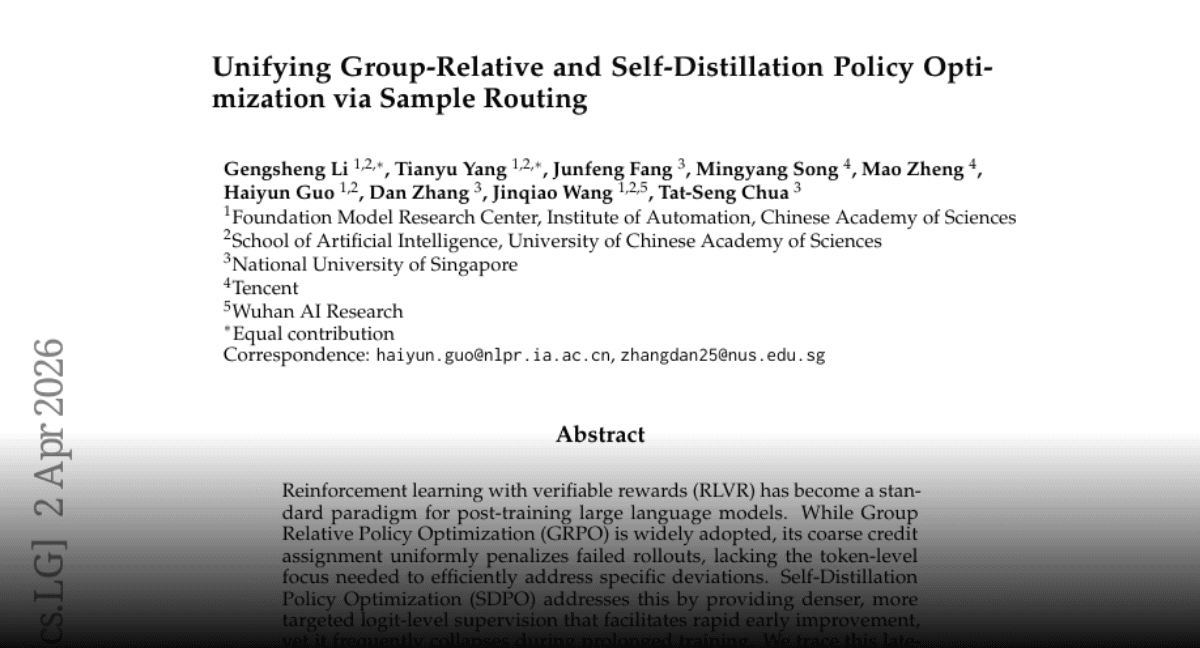
- Techniques such as **Positive–Negative Pairing** and **Self-Distillation (SDPO)** leverage paired benign and malicious samples to enhance **discrimination** and **training stability**. Self-feedback loops further bolster **robustness**.
- Borrowing from NLP, **prompting and weighting techniques** reinforce **trustworthy autonomous decision-making**, increasing agent confidence and interpretability.
These innovations collectively **strengthen RL systems' resilience** against environmental uncertainties and adversarial manipulations, ensuring dependable operation in critical cybersecurity applications.
---
## Long-Term Adaptability and Complex Reasoning: Meta-Learning, Federated RL, and LLM Integration
The dynamic nature of cyber threats demands RL systems capable of **long-term adaptation** and **complex reasoning**. Recent advancements include:
- **Meta-experience and continual learning** mechanisms enable agents to **generalize from past encounters**, supporting **lifelong learning** crucial for staying ahead of emerging threats.
- **Federated and personalized RL** approaches facilitate **distributed training across multiple IIoT nodes**, preserving **privacy** and achieving **linear speedups** without compromising customization or security.
- Integration of **Large Language Models (LLMs)** with RL has been transformative. Architectures like **iGRPO (internal Guided Reinforcement Policy Optimization)** utilize **self-feedback** from LLMs to **critically assess and refine policies**, significantly improving performance in **long-horizon, multi-turn reasoning tasks**.
For example, **"iGRPO: Self-Feedback-Driven LLM Reasoning"** demonstrates how **LLMs** can **distill complex security strategies** and **refine autonomous policies**, especially in scenarios involving **extended reasoning chains**. These systems enhance **contextual understanding** and **decision refinement**, which are essential for defending against **multi-stage, sophisticated cyber attacks**.
Additional innovations such as **Calibrate-Then-Act**, which introduces **cost-aware exploration**, enable agents to **balance resource expenditure** with operational threat levels, leading to **more prudent decision-making** in resource-constrained environments. **Self-evolving agents** like **Agent0** exemplify **zero-data learning** and **autonomous evolution**, incorporating **tool-assisted reasoning** to stay ahead of adversaries in highly volatile threat landscapes.
---
## Multi-Agent Co-evolution and Virtual Simulation Environments
To anticipate adversaries' tactics and **simulate complex attack-defense interactions**, researchers have developed **Agent World Models**—virtual environments where **defense and attack strategies co-evolve**.
Platforms such as **MARLadona** facilitate **multi-agent reinforcement learning (MARL)**, fostering **cooperative and adversarial interactions** in **safe, simulated settings**. These environments enable **scenario testing**, **adversarial training**, and **rapid iteration** without risking real-world systems.
Recent innovations include **Nvidia DreamDojo**, an **open-source high-fidelity virtual world model** that allows autonomous agents and robots to **learn from extensive datasets of human behaviors**. DreamDojo captures **intricate interactions** in realistic scenarios, providing a **rich sandbox** for developing and testing **cyber defence strategies** against sophisticated attackers. Such tools are vital in **building resilient, adaptive policies** grounded in **realistic, complex scenarios**.
---
## Systems and Hardware Innovations for Practical Deployment
Transitioning RL solutions from research to operational environments requires overcoming systemic constraints through **hardware acceleration** and **edge computing**:
- **Neuromorphic computing** and **optical processors** emerge as **key enablers** for **low-latency, energy-efficient inference** at the network edge—crucial for **real-time autonomous cyber defence**.
- **Synaptic transistor-based spiking hardware** offers **high-speed, low-power processing**, suitable for **resource-constrained environments**.
- **Channel-State-Aware Deep RL** policies dynamically adapt based on **network conditions**, enhancing **resilience** and **response times** in operational settings.
- Recent developments include **native C++ RL architectures**, exemplified by the **GRU, ICM, and TBPTT** models, which facilitate **high-performance, low-overhead implementations** suitable for deployment in embedded or industrial hardware.
These technological advances ensure RL frameworks are **scalable**, **practical**, and **deployable** in real infrastructures, addressing latency, power, and resource constraints.
---
## Control & Industrial Relevance: RL for IIoT and Industrial Control Security
Applying RL to **industrial control systems** and **IIoT** environments introduces **specialized control methods** tailored to sector-specific requirements.
Recent research highlights **Reinforcement Learning-based control via Y-wise Affine Neural Networks (YANNs)**, as detailed in recent publications, demonstrating **robust control policies** capable of handling **uncertain, noisy, and adversarial conditions** typical in industrial settings. These control architectures enable **autonomous regulation** of critical processes, improving **security**, **efficiency**, and **fault tolerance**.
The integration of RL with **industrial protocols** and **sensor networks** paves the way for **self-healing, adaptive control systems** that can **detect anomalies**, **respond to cyber intrusions**, and **maintain operational safety**—all vital for safeguarding **critical infrastructure**.
---
## Best Practices and Future Outlook
The progression toward trustworthy RL deployment in cybersecurity hinges on **robust reward process modeling**, **formal safety guarantees**, and **multi-agent cooperation**. Recent articles emphasize the importance of **reproducible benchmarks** and **transparent frameworks** to accelerate innovation.
Key initiatives include **faster, reproducible world-modeling research**, emphasizing **standardized datasets**, **benchmarking platforms** like ARLBench, and **scalable simulation environments** such as DreamDojo. These efforts foster **collaborative progress** and facilitate **rigorous validation** of autonomous security systems.
Additionally, the integration of **formal safety mechanisms**—such as Hamilton-Jacobi reachability—and **verifiable reward pipelines** ensures **trustworthy deployment**. The convergence of **hardware advancements**, **explainable RL**, and **multi-agent co-evolution** forms the backbone of **next-generation cyber defence strategies**.
---
## Current Status and Implications
By 2026, RL has matured into a **comprehensive ecosystem** that blends **formal safety verification**, **explainability**, **long-term reasoning**, and **hardware acceleration** to meet the demanding needs of cyber defence and IIoT security. The latest innovations include:
- **Safety-certified policies** verified via reachability analysis
- **Verifiable, resilient reward pipelines** resistant to manipulation
- **Long-horizon, continual learning architectures** like **KLong** and **SAGE-RL**
- **LLM-guided self-refinement** systems such as **iGRPO** and **Calibrate-Then‑Act**
- **Self-evolving, zero-data agents** exemplified by **Agent0**
- **Distributed federated RL** for privacy-preserving, environment-specific learning
- **Multi-agent co-evolution frameworks** like **MARLadona** and high-fidelity simulators such as **DreamDojo**
This integrated landscape ensures **autonomous cyber defence systems** are **not only intelligent but also trustworthy, adaptable, and resilient**. They are capable of **anticipating emerging threats**, **adapting strategies in real-time**, and **collaborating across diverse agents and environments**—building a robust shield for tomorrow’s interconnected infrastructures.
---
## Recent Articles and Innovations
Recent publications reinforce these trajectories. For instance:
- **"Deep Dive: Native C++ Reinforcement Learning | GRU, ICM & TBPTT Architecture"** highlights **high-performance, low-overhead RL implementations** suitable for deployment.
- The article **"Reinforcement learning-based control via Y-wise Affine Neural Networks (YANNs)"** demonstrates **robust control policies** tailored for industrial environments, emphasizing **security and operational resilience**.
- The emergence of **self-correcting autonomous research agents**—combining **RL**, **tool use**, and **multi-agent AI**—points toward **automated, continuous policy refinement**.
These developments underscore the importance of **trustworthy, scalable, and adaptive RL systems** in safeguarding the complex, interconnected systems of the future.
---
## Conclusion
The landscape of 2026 reveals that reinforcement learning has transitioned into a **holistic, safety-aware, and hardware-accelerated paradigm**, revolutionizing cyber defence and IIoT security. Through **formal safety guarantees**, **explainability**, **long-term reasoning**, and **multi-agent cooperation**, RL systems are now **anticipating, adapting**, and **defending** against the most advanced cyber threats. As the ecosystem continues to evolve, integrating cutting-edge simulation, hardware innovations, and explainability, autonomous cyber defence is poised to become **more trustworthy**, **resilient**, and **effective**—ensuring the security of critical infrastructures in an increasingly interconnected world.