# The 2026 Vibe Coding Revolution: From Playful Demos to Industry-Scale Infrastructure — Updated with New Developments
The year 2026 marks an extraordinary turning point in the evolution of vibe coding, elevating it from simple community experiments and playful prototypes to a foundational infrastructure that accelerates software development across industries worldwide. Central to this transformation are **powerful models like MiniMax M2.1**, integrated within a burgeoning multi-modal ecosystem that includes **Claude 2.7.6**, **GPT 5.3**, **Google’s Antigravity**, and advanced security and layout frameworks. This convergence is empowering developers—from hobbyists to global enterprises—to prototype, debug, and deploy with unprecedented speed, flexibility, and security.
---
## The Rise of MiniMax M2.1 and the Multi-Model Ecosystem as the Foundation
At the heart of this revolution is **MiniMax M2.1**, a high-performance, versatile AI model that has become the backbone of modern vibe coding workflows. Recent demonstrations like **"Casual Coding with MiniMax M2.1"** showcase how developers can **assemble fully functional, deployment-ready projects in under 30 minutes**, thanks to its intuitive interface and robust capabilities. Key features include:
- **Natural language prompts** that interpret human intent into working code, lowering barriers for users of all skill levels.
- **Integrated real-time debugging tools** that provide instant feedback, enabling rapid iteration.
- **Automated prototyping workflows** that drastically reduce development cycles—from weeks to hours.
Complementing MiniMax is a **growing multi-model ecosystem** supporting **specialized workflows** across design, logic, UI, and visual assets. Developers can **fluidly switch between models**—using **Claude** for UI design, **GPT** for complex logic, and **Antigravity** for graphics—enabling **multi-modal collaboration** that seamlessly blends text, code, images, and interactive elements. This synergy accelerates iteration and broadens the scope of vibe coding applications.
Recent projects exemplify this ecosystem’s power:
- The **"Build 2-3x Faster Websites with Claude Code or Antigravity (using Astro)"** demo demonstrates how even non-experts can prototype high-quality websites within hours.
- The **"Vibe Coding Native Apps with Claude"** project rapidly generates **SwiftUI and TDD-based iOS applications** in mere minutes, further blurring the lines between design and implementation.
This rapid technological maturation confirms that **vibe coding has transitioned from experimental novelty to an industry-standard workflow**, adopted widely across sectors—from startups to multinational corporations—leading to **shorter product cycles and heightened organizational agility**.
---
## From Playful Demos to Industry-Grade Solutions
What once was confined to community demos like **"I'm Trying to Vibe Code My Entire Job"** has now become **a core development paradigm**. Major milestones include:
- **Automated workflows** that democratize development for freelancers and small teams. For example, **"I'm Trying to Vibe Code My Entire Job"** showcases MiniMax automating repetitive tasks, enabling **reliable automation at scale**.
- **Instant prototyping breakthroughs** such as **"I Built a Portfolio in 10 Minutes with Google Antigravity,"** which produces **production-ready results in minutes**.
- **Rapid deployment tutorials**, exemplified by projects like **"Accountability App,"** launched in a few hours, drastically reducing traditional cycle times.
- Manu Arora’s **remarkable 41-minute vibe-coded, AI-driven project** underscores the **speed and scalability** now accessible through vibe workflows.
Beyond development speed, vibe coding is expanding into **creative storytelling and multi-purpose applications**. Innovations like **"Vibe-Coded Slide Decks"** are transforming presentation creation by enabling **interactive, dynamically responsive slides**, further cementing vibe coding as a **cross-domain tool** that accelerates prototyping, content creation, and education.
This ongoing evolution signals a **paradigm shift**: vibe coding is no longer just a playful novelty but a **robust, enterprise-ready infrastructure** that fosters **innovation, reduces costs**, and **democratizes software creation** across industries.
---
## Industry Validation, Recognition, and Market Dynamics
Confidence in vibe coding’s disruptive potential continues to grow, with industry leaders and analysts emphasizing its transformative impact:
> *"We built it in just six hours, and now we’re deploying it to production—that kind of rapid, vibe-driven workflow is reshaping what it means to create software."* — **The Aboard Podcast**
Market data further underscores this momentum:
- The **DataCamp report** titled **"Vibe Coding and the Rise of the Non-Developer Builder"** highlights how vibe coding democratizes software development, empowering **artists, educators, entrepreneurs**, and hobbyists to **build, automate, and innovate** without traditional coding skills.
- Forecasts from **PVS-Studio** predict a surge of **innovations fueled by accessible AI workflows**, transforming sectors such as education, healthcare, and creative arts.
- The **$80 million acquisition of "Base44,"** a vibe coding startup, just 500 days after its founding, exemplifies **robust investor confidence** and rapid market expansion.
- Platforms like **"MiniMax Agent Desktop"** now offer **cost-effective AI assistants**, democratizing AI-powered development for **individuals and small teams**.
- The release of **"Vibe Coding with GPT 5.3 Codex"** introduces **more nuanced, context-aware code generation**, expanding AI’s role in complex development tasks.
- Industry standards continue to evolve, exemplified by **Interop 2025**, led by **Nicole Sullivan**, establishing benchmarks for **interoperability, security, and seamless workflows** across large-scale ecosystems.
---
## Emerging Risks, Security Challenges, and Governance
As vibe coding becomes ubiquitous, **new risks and governance challenges** have emerged, prompting proactive responses:
### Security Vulnerabilities
Early 2026 saw the disclosure of a **Chrome zero-day vulnerability**, with **Google’s advisory** describing it as **"Exploit available for a new Chrome zero-day vulnerability."** Malicious actors are actively exploiting **AI-generated code or browser workflows**, raising alarms about **security in AI-assisted environments**. These incidents emphasize the importance of **rigorous security practices**, including sandboxing, validation, and vigilant monitoring.
### Intellectual Property and Ethical Concerns
An influential article titled **"Companies Will Not Vibe Code Their Internal Tools to ..."** warns organizations about **IP rights, licensing, and code provenance issues**. AI models often **reproduce or adapt existing code**, creating **licensing and attribution challenges**. Establishing **clear protocols for attribution, licensing, and provenance** is essential for **legal safety and trust**.
### UI Resilience and Accessibility
Browser updates like **Safari TP 237** and **Chrome 146 Beta** have introduced **advanced CSS and DOM enhancements**, such as **worker-threaded animations** and **improved accessibility features**. These are vital for **AI-generated interfaces** that need to be **resilient, cross-compatible, and accessible** for all users.
### Operational Risks and Outages
A recent incident involving **Amazon AWS outages** was reportedly caused by **AI coding assistant misconfigurations**. A trending YouTube video, **"Amazon AWS Outages Caused By Their Own AI Agent?!"** (17:28, 15,167 views), details how an AI managing cloud infrastructure **misconfigured critical services**, leading to widespread disruptions. This highlights **serious operational vulnerabilities** and the pressing need for **oversight, safeguards, and fallback mechanisms**.
### Frameworks for Security and Governance: StepSecurity
In response, **StepSecurity** has emerged as a **comprehensive security framework** designed to **detect vulnerabilities, monitor AI workflows in real-time, and enforce compliance**, ensuring **safe, resilient development environments**.
---
## Advances in Frontend and CSS for Resilient AI Interfaces
Modern browsers and CSS features underpin **robust, high-performance AI interfaces**:
- **Safari TP 237** enhances **CSS, accessibility, and DOM handling**, supporting **consistent AI-driven UI development**.
- **Chrome 146 Beta** introduces **worker-threaded animations**, enabling **CSS animations within Web Workers**—reducing main-thread load and delivering **smooth, responsive interactions**.
- **CSS container queries** (from **Tailwind CSS v4**) support **responsive, AI-designed layouts** that adapt dynamically to container size, essential for **adaptive interfaces**.
- **CSS variables** facilitate **dynamic theming** and **real-time UI adjustments**, allowing AI-generated interfaces to **personalize based on user context or preferences**.
- Practical UI components, like **"HTML & CSS Cookie Popup,"** demonstrate **modern, accessible UI elements** crucial for **user consent and compliance** in AI-driven web applications.
---
## New Developments: Security and Layout Innovations
Two recent articles highlight cutting-edge CSS and layout techniques:
### **"An Exploit … in CSS?!"**
This article discusses the **discovery of a CSS-based security vulnerability**, stressing the importance of **browser security updates** and **proper validation techniques**. Users are advised to **check their browsers against current vulnerabilities** via provided tables, emphasizing the need for **continuous security vigilance** in an AI-enabled web ecosystem.
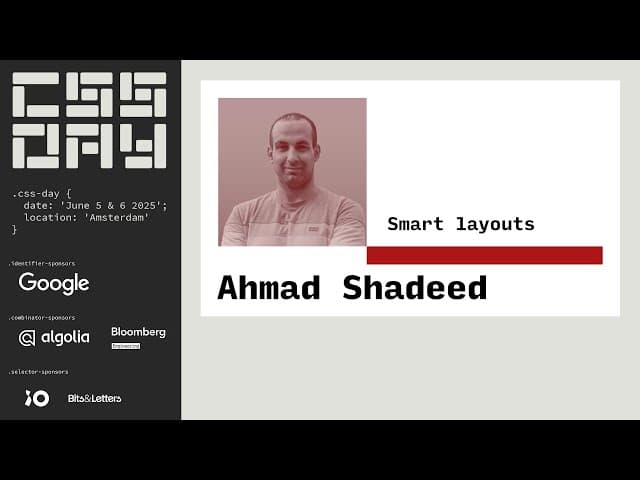
### **"Smart Layouts - Ahmad Shadeed - CSS Day 2025"**
This comprehensive session showcases **advanced CSS techniques** for **responsive, adaptive interfaces**. Using innovations like **container queries** and **dynamic layout algorithms**, developers can craft **flexible, AI-designed UIs** that respond intelligently to content and device constraints. The talk underscores **modern best practices** for building **secure, maintainable, and scalable frontend interfaces**.
---
## Ensuring Maintainability: Testing, Documentation, and Licensing
As AI-generated code becomes more prevalent, **maintainability and trustworthiness** are critical:
- **Thorough documentation**, **version control**, and **security audits** are now standard.
- **Clear attribution and licensing protocols** safeguard organizations from legal infringements and foster transparency.
- **Modular design and refactoring** promote **long-term code health**.
- Community tools like **"Stop Vibe Coding"**—which **scan, audit, and correct AI-generated code**—are increasingly vital for **security and reliability**.
---
## The Emergence of Vibe Testing and Validation
Complementing vibe development, a **new wave of AI-powered testing tools** is gaining prominence:
> **"Vibe Testing vs Vibe Coding: How AI is Breaking Product Development"** highlights that **automated AI testing** is essential for verifying **robustness, security, and compliance**. While vibe coding accelerates creation, **vibe testing** ensures **quality and safety**, significantly reducing costly post-deployment fixes.
---
## Broader Technological and Design Trends
The ecosystem continues to evolve through innovations like:
- **Reusable layout patterns**, such as **"8 Grid & Flexbox Patterns I Use in Every Project,"** promote **consistent, responsive designs**.
- **Responsive CSS features**, including **@container scroll-state** and **container queries**, support **dynamic, AI-driven interfaces**.
- **CSS variables** enable **real-time theming**, allowing AI systems to **personalize user experiences**.
- **SVG and raster graphics strategies**, inspired by resources like **"Loading Smarter,"** optimize **visual fidelity and performance**.
---
## Controlling Large Language Models (LLMs) and Ensuring Safe AI Workflows
Effective governance over AI models remains essential. An insightful article, **"How to vibe-code an SEO tool without losing control of your LLM,"** offers best practices:
- Use **explicit prompts** and **control tokens** to guide AI responses.
- Implement **continuous monitoring and validation** of outputs.
- Enforce **usage tracking** and **attribution protocols** to ensure transparency and compliance.
- Limit model capabilities to prevent **unintended behaviors**, fostering safe, predictable AI assistance.
Establishing **robust governance frameworks** is vital for **trustworthy, ethical AI integration** into vibe workflows.
---
## Current Status and Future Outlook
### Recent Developments
- **Firefox 148.0** now integrates **native AI controls**, empowering users to **manage generative AI features directly within the browser**, enhancing **security and transparency**.
- A **CSS-based x86 emulator** demonstrates **browser-based virtualization** using **CSS techniques**, opening new avenues for **education and experimentation**.
- The narrative of **grassroots innovation** persists with **"The Freemium App Is Dying,"** illustrating how **AI coding tools** enable hobbyists and small creators to **build fully functional apps** without costly tools.
- Security incidents, such as the **Orchids vibe coding platform zero-click exploit**, underscore the importance of **ongoing security vigilance**.
### Implications for the Ecosystem
Today, **vibe coding** sits at the intersection of **speed, democratization, and technological sophistication**. Its evolution from playful demos to **enterprise-grade infrastructure** heralds a future where **coding becomes faster, more accessible, and more creative**. Success depends on **security, governance, and maintainability** to ensure sustainability.
**Key takeaways:**
- The fusion of **powerful models** like **MiniMax M2.1**, **Claude**, **GPT**, and **Antigravity** continues to push boundaries.
- **Browser advancements** (Safari TP 237, Chrome 146, Firefox 148) and **CSS innovations** underpin resilient, high-performance AI interfaces.
- **Security frameworks** such as **StepSecurity** and standards from **Interop 2025** support safe large-scale deployments.
- **Community tools** and **clear licensing protocols** foster trust and long-term viability.
- The ecosystem’s expansion into **personal productivity, education, creative storytelling, and automation** signals an inclusive, democratized future.
As AI-assisted workflows deepen their reach, **responsible governance, security, and community standards** will be crucial. The ongoing developments promise a future where **coding is faster, more accessible, and more creative**, unlocking **endless possibilities** for creators, organizations, and society at large.
---
## Additional Resources and Recent Demos
- **"A Complete Guide to Bookmarklets"** offers insights into lightweight browser automations, vital for vibe coding workflows.
- The **"I Let AI Build My Entire App — 4 Hour Vibe Coding Masterclass"** provides practical step-by-step guidance.
- The **"Vibe Coding Just Got a MASSIVE Upgrade (FREE)"** video showcases latest features.
- Newly released resources include:
- **AI Masterclass:** a comprehensive course for aspiring vibe coders.
- **Upgrade demos:** illustrating recent enhancements.
- **Bookmarklet tutorials:** demonstrating quick automation techniques.
---
# Conclusion
The 2026 vibe coding landscape exemplifies rapid technological, cultural, and operational shifts—propelling from playful prototypes to **robust, scalable, and democratized development ecosystems**. This acceleration unlocks boundless potential for innovation and creativity but also underscores the importance of **security, governance, and maintainability**. As the ecosystem continues to evolve, **balancing progress with responsibility** will be essential to keep vibe coding a **trustworthy, empowering tool** for all.
The integration of **powerful models**, **advanced browser features**, **security frameworks**, and **community-driven standards** suggests that by the end of 2026, vibe coding will be firmly established as a **cornerstone of modern software development—faster, more inclusive, and more innovative than ever before**.