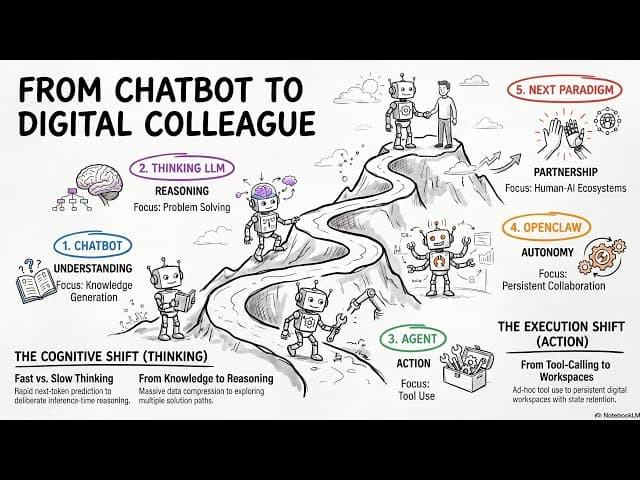
# The 2024 Revolution in Autonomous AI Agents: Tools, Security, Collaboration, Scientific Breakthroughs, and Societal Implications — Updated and Expanded
The year 2024 marks a watershed moment in the evolution of autonomous AI agents, transitioning from narrowly focused systems toward reasoning-capable, trustworthy, and scalable entities that can operate independently over extended periods. Building on rapid technological advances from prior years, recent breakthroughs across tooling ecosystems, security protocols, multi-agent collaboration, perception, scientific reasoning, and societal oversight are collectively transforming AI into dependable partners capable of complex, long-term autonomous functions. These developments are poised to revolutionize industries such as healthcare, scientific research, robotics, finance, and infrastructure, while also raising critical questions about safety, ethics, and societal impact.
This comprehensive update synthesizes the latest innovations, their strategic significance, and the emergent trajectory toward dependable, intelligent, and integrated AI agents.
---
## Building Robust Ecosystems and Fortifying Security
A defining feature of 2024 is the maturation of **modular, scalable AI ecosystems** designed for secure and seamless deployment of autonomous agents at scale. Platforms like **OpenClaw** exemplify this trend, offering **interoperable architectures** that support **multi-language compatibility**, **multi-tool integration**, and **built-in safety protocols**. These ecosystems provide foundational infrastructure enabling diverse agents to address complex, real-world challenges across sectors.
**Leadership and security advancements** have been pivotal. Recently, **Peter Steinberger** was appointed by OpenAI to lead **next-generation autonomous agent initiatives** within OpenClaw, focusing on **tool integration**, **interoperability standards**, and **security enhancements** to facilitate **safe, large-scale deployment**.
On the security front, the community introduced **SecureClaw**, an **OWASP-aligned open-source plugin** tailored for OpenClaw systems, integrating:
- **Vulnerability detection** for attack vectors
- **Data integrity protections** against tampering
- **Defense mechanisms** against adversarial exploits
Such tools are crucial in **sensitive domains** like healthcare, finance, and critical infrastructure, where **trustworthiness** and **privacy** are non-negotiable. Recent research underscores the importance of **auditing AI outputs** to identify **training data leaks** and **model fingerprinting**, which pose **privacy risks**. Consequently, **privacy-preserving techniques** and **robust auditability frameworks** are actively under development to reinforce trust.
Additional notable developments include:
- The strategic acquisition of **Vercept** by **Anthropic**, aiming to **scale Claude’s computing capacity** and **enhance model robustness**.
- Advances in **agent context management**, exemplified by **Intuit**, which explores **dynamic, adaptive context retention** to support **long-term reasoning** and **multi-turn interactions**.
**Implication:** These tooling and security innovations **fortify trust**, **support scalability**, and **protect sensitive data**, laying the groundwork for **widespread adoption** of autonomous systems in **critical societal sectors**.
---
## Standards, Multi-Agent Collaboration, and Long-Horizon Reasoning
A central theme of 2024 is the development of **interoperability standards** and **multi-agent collaboration frameworks**. The **Model Command Protocol (MCP)** exemplifies a **unified communication standard** that enables **heterogeneous agents and tools** to **coordinate seamlessly**. MCP facilitates **complex workflows**, **multi-agent reasoning**, and **task delegation**, empowering systems to **collaborate effectively** in domains such as **scientific research**, **industrial automation**, and **real-world problem-solving**.
Research innovations like **In-Context Co-Player Inference** enable **multi-agent cooperation within shared environments**, allowing agents to **delegate tasks**, **adopt adaptive strategies**, and **operate synergistically**—significantly **enhancing reasoning depth** and **scalability** for **long-horizon, multi-faceted tasks**.
Furthermore, **persistent memory architectures**—such as **Google’s "OneContext" initiative**—utilize **filesystems, Git repositories, and graph structures** to **maintain reasoning coherence** across multiple sessions. These systems empower AI models like **Claude** and **Codex** to **recall prior interactions**, **build upon previous knowledge**, and **support long-term autonomy**. Recent work from **Intuit** emphasizes **dynamic context management**, aiming to **optimize memory usage** and **improve reasoning over extended periods**, making agents **more resilient** and **adaptable**.
**Implication:** The establishment of **interoperability standards** and **advanced context management** **foster collaborative, long-horizon reasoning**, which is critical for **scientific discovery**, **industrial automation**, and **complex decision-making**.
---
## Scientific Discovery and Model Stability Breakthroughs
AI’s role as a scientific partner has dramatically expanded in 2024. Autonomous agents are now **generating hypotheses**, **proving theorems**, and **reasoning independently**, thus **accelerating progress across disciplines**.
Key advances include:
- **DeepMind’s autonomous mathematics agents**, which **reason deeply** and **produce novel insights**, accelerating research in **mathematics** and **physics**.
- The **"Features as Rewards"** framework, which provides **scalable supervision** and enhances **interpretability** and **learning efficiency** in complex environments.
- The **"Basin Repair"** technique, designed to **stabilize neural networks** by **repairing model basins**, which analysts believe can **unlock human-like reasoning** and **improve model robustness**, bringing us closer to **Artificial General Intelligence (AGI)**.
### Insights into Internal Cognition
A groundbreaking study titled **"How AI 'Grokks' Reality | Geometry of Insight Explained"** offers a **geometric perspective** on how **large language models** **internalize complex concepts**. This work sheds light on **internal cognition**, **interpretability**, and **controllability**, all essential for **building trustworthy AI**.
**Significance:** These scientific breakthroughs **accelerate knowledge discovery**, **hypothesis generation**, and **long-term reasoning**, paving the way toward **autonomous agents capable of independent scientific inquiry**.
---
## Vision, Perception, and Robotics: Expanding Operational Environments
Recent innovations have significantly enhanced AI’s **perception** and **spatial reasoning** capabilities, especially in **robotics**:
- **"Decoding as Optimisation on the Probability Simplex"** transforms **sampling-based decoding** into **deterministic optimization problems**, yielding **more controlled and accurate generation**.
- **"JAEGER"** (Joint 3D Audio-Visual Grounding and Reasoning) enables **multi-modal understanding** in **simulated physical environments**, supporting **spatial reasoning** and **perception in complex settings**.
Additional advancements include:
- **"NoLan"**: a technique that dynamically **suppresses language priors** to **mitigate object hallucinations** in vision-language models, reducing false object predictions.
- **"RoboCurate"**: leverages **action-verified neural trajectories** to **improve robotic learning robustness** and **diversity**.
- **"World Guidance"**: emphasizes **comprehensive environment modeling** to inform **action planning**.
- **"TOPReward"**: utilizes **token probability distributions** as **hidden reward signals** to support **zero-shot adaptation**.
- **"Large Video Reasoning Suite"**: offers a **multimodal platform** for **temporal reasoning** over **dynamic video data**.
- **"tttLRM"**: supports **long-context 3D environment reconstruction** via **test-time training**, critical for **autonomous navigation**.
**Implication:** These advances **broaden AI’s operational scope** into **real-world environments**, supporting **autonomous robots**, **augmented reality**, and **spatial planning** with **enhanced perception and reasoning**.
---
## Improving Evaluation, Steering, and Explainability
Ensuring **reliability**, **transparency**, and **human control** remains a priority. Recent progress includes:
- **SkillRL**: a **recursive skill-augmented reinforcement learning** approach that fosters **long-term skill development** and **robust generalization**.
- **Fast Value Tracking**: accelerates **value estimation** in reinforcement learning, supporting **more stable and scalable training**.
- **Gradual Interventions** and **Property Gradients**: techniques that **trace decision pathways**, making AI **more interpretable** and **controllable**.
In healthcare, **clinical benchmark evaluations**—published in *npj Digital Medicine*—demonstrate that **LLM-based medical agents** can **perform complex diagnosis and decision tasks** safely and with **interpretability**, which is critical for **trust** and **regulatory approval**.
**Monitoring and Steering:** Initiatives like **"Toward universal steering and monitoring"** aim to **understand and control** AI’s **internal knowledge representations**, which is essential for **predictability** and **preventing undesired behaviors** in **highly autonomous agents**.
**Implication:** These tools **strengthen trustworthiness**, **regulatory compliance**, and **public confidence** in AI systems.
---
## Cutting-Edge Techniques in Decoding and Spatial Reasoning
Recent publications exemplify **progress in decision-making and spatial understanding**:
- **"Decoding as Optimisation on the Probability Simplex"** converts **sampling-based decoding** into a **structured optimization problem**, enabling **more precise and controllable outputs**.
- **"JAEGER"** supports **joint 3D audio-visual grounding** and **reasoning**, boosting **multi-modal perception** in **simulated environments**.
Other notable research includes:
- **"Learning Cross-View Object Correspondence"**: enhances **multi-view spatial understanding**.
- **"RoboCurate"**: improves **diversity and robustness** in robotic trajectories.
- **"SimVLA"**: advances **visual-language manipulation** for **multimodal interaction**.
- **"tttLRM"**: supports **long-context 3D environment reconstruction** for **autonomous navigation** via **test-time learning**.
**Implication:** These innovations **expand AI’s applicability** into **real-world scenarios**, supporting **autonomous systems**, **AR/VR**, and **dynamic spatial reasoning**.
---
## Societal Implications, Ethics, and Governance
The rapid pace of technological growth underscores the necessity of **ethical standards**, **transparency**, and **regulatory oversight**. Studies—including those in *Nature Machine Intelligence*—highlight that **LLM-assisted peer review** can **improve quality** but also **introduce risks** of **bias** and **over-reliance**.
A provocative paper titled **"AI Agents, Ghost Students, and the Crisis of Verified Presence"** discusses **"ghost students"**—digital surrogates that **masquerade as human participants**—raising concerns for **education**, **research integrity**, and **public trust**.
**Key societal considerations include:**
- As AI agents **gain autonomy** and **reasoning abilities**, **ethical deployment** and **human oversight** are critical.
- **Transparency tools**, such as **explainability modules** and **steering frameworks**, are vital for **building trust**.
- Safeguards around **privacy**, **security**, and **alignment** with societal values must evolve rapidly.
**Implication:** Responsible AI deployment necessitates **ongoing oversight**, **updating governance frameworks**, and **engaging the public** to ensure AI benefits society without undermining ethical standards.
---
## Current Status and Future Outlook
The developments of 2024 herald a **paradigm shift** where **tool ecosystems**, **security frameworks**, **scientific reasoning**, and **explainability techniques** converge to produce **trustworthy, scalable autonomous agents**. These agents **reason**, **discover**, and **collaborate** at levels approaching or surpassing human expertise, promising **transformational societal impacts**.
**Key insights include:**
- **Enhanced capabilities** enable AI agents to **hypothesize**, **reason**, and **collaborate** over **long horizons**.
- **Security and safety tools** like **SecureClaw**, **audit frameworks**, and **privacy-preserving methods** **fortify trust**.
- **Interpretability methods**—including **geometric insights**, **Basin Repair**, and **property gradients**—make AI **more transparent** and **controllable**.
- **Scientific breakthroughs** such as **Basin Repair** and **Features as Rewards** accelerate **discovery** and **model stability**, advancing toward **cognitive autonomy**.
- Integration of **perception**, **spatial reasoning**, and **robotics techniques** **broadens AI’s operational scope**, supporting **autonomous robots**, **AR/VR**, and **spatial planning** with **improved perception and reasoning**.
**Looking ahead**, **ethical deployment**, **human oversight**, and **regulatory frameworks** will be essential. The overarching trend in 2024 shows **autonomous AI agents transitioning from experimental prototypes to dependable, reasoning partners**—poised to **revolutionize society**.
---
## In Summary
The AI landscape of 2024 is characterized by **remarkable technological innovation** and **growing societal awareness**. As agents become **more capable**, **trustworthy**, and **aligned with human values**, their **potential to transform society** grows exponentially. Achieving **ethical deployment**, **robust safety**, and **transparent decision-making** is not just aspirational but imperative. The future is unfolding today—where **AI agents** serve as **trusted collaborators**, **scientific explorers**, and **societal stewards**—a future already taking shape in 2024.
---
### Recent Notable Articles in 2024
- **@_akhaliq: LAP (Language-Action Pre-Training)**: Demonstrates **zero-shot cross-embodiment transfer**, enabling models trained in one environment to **adapt seamlessly to others**. [Read more](https://t.co/YTxNABdwr)
- **@omarsar0: Intuit AI Research**: Explores how **agent performance** depends on **context management**, **learning efficiency**, and **environmental understanding**.
- **Anthropic acquires Vercept**: Strategic move to **enhance Claude’s computing capabilities** for **more scalable and efficient AI systems**.
- **Perceived Political Bias in LLMs**: Studies show that **perceived bias** diminishes **persuasion effectiveness**, emphasizing the need for **bias mitigation**.
- **Small models, big insights into vision**: Highlights how **compact models** can achieve **robust visual understanding**, enabling **efficient deployment**.
- **@_akhaliq: Xray-Visual Models**: Scaling vision models on **industry-scale data** to **improve robustness** and **real-world applicability**.
- **World Guidance**: Focuses on **world modeling** in **condition space** to support **more effective action generation**.
- **Model Context Protocol (MCP)**: Efforts to **improve agent efficiency** through **augmented, clearer tool descriptions**.
- **ARLArena**: Presents a **unified framework** for **stable agentic reinforcement learning**, supporting **long-term autonomous behavior**.
- **GUI-Libra**: Develops **native GUI agents** capable of **reasoning and acting** with **action-aware supervision** and **partially verifiable RL**.
- **JAEGER**: Enables **joint 3D audio-visual grounding and reasoning** in **simulated environments**.
- **NoLan**: Proposes **dynamic suppression** of language priors to **mitigate hallucinations** in vision-language models.
- **RoboCurate**: Uses **action-verified neural trajectories** to **improve robotic learning robustness and diversity**.
- **Large Video Reasoning Suite**: Provides a **comprehensive multimodal platform** for **temporal reasoning** within **dynamic scenes**.
- **tttLRM**: Supports **long-context 3D environment reconstruction** via **test-time learning**, key for **autonomous navigation**.
---
## Final Reflection
The **2024 AI revolution** exemplifies a **holistic convergence** of **technological innovation**, **security**, **scientific insight**, and **societal responsibility**. As **autonomous agents** become **more capable**, **trustworthy**, and **aligned with human values**, their **potential to transform society** is immense. Ensuring **ethical deployment**, **robust safety measures**, and **transparent decision-making** remains a shared priority. The trajectory clearly indicates that **AI agents** are shifting from experimental prototypes to **trusted collaborators**, **scientific partners**, and **societal stewards**—a future actively unfolding this very year.