23 min ago
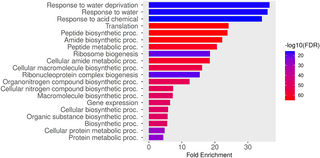
Multi-Omics Integration Beats DL for Small Rice Drought Datasets
- Random Forest led with recall 0.67 and AUC-ROC 0.87 under nested CV, outperforming XGBoost, 1D-CNN and MLP
- Transcriptomic plus proteomic features...

Created by Collin Laird
Cutting edge research on model architectures, training methods, optimization, scaling and benchmarks
Explore the latest content tracked by ML Breakthroughs Digest
Can adaptive model mixtures overcome the performance plateau of conventional GNNs without relying on increasingly complex architectures?
Direct pixel-space training with overlapping local attention windows lets DiT models handle compression themselves, reaching 32x32 token reduction...
Few-shot learning lets models adapt to new classes from just 1-5 labeled examples by leveraging prior knowledge from related tasks.
Self-attention in mixed views creates contextual shift, so per-patch source labels become imprecise targets that tie detectors to known generators....
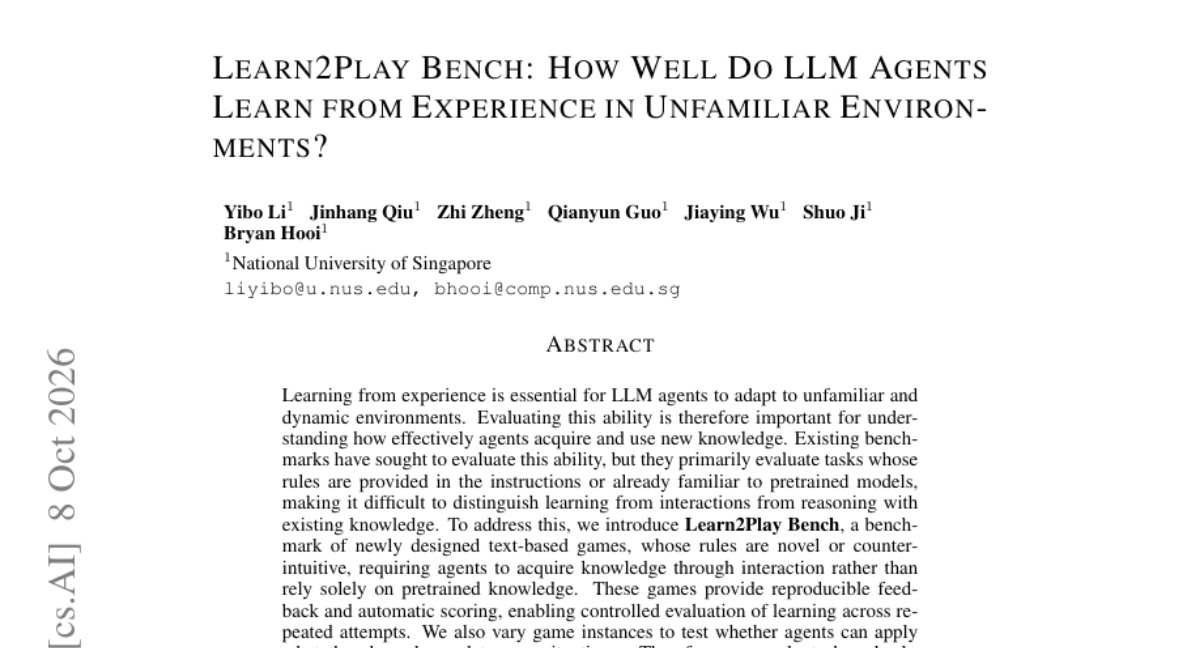
Learn2Play Bench introduces text-based games with novel or counterintuitive rules to test if agents acquire knowledge through interaction rather than...
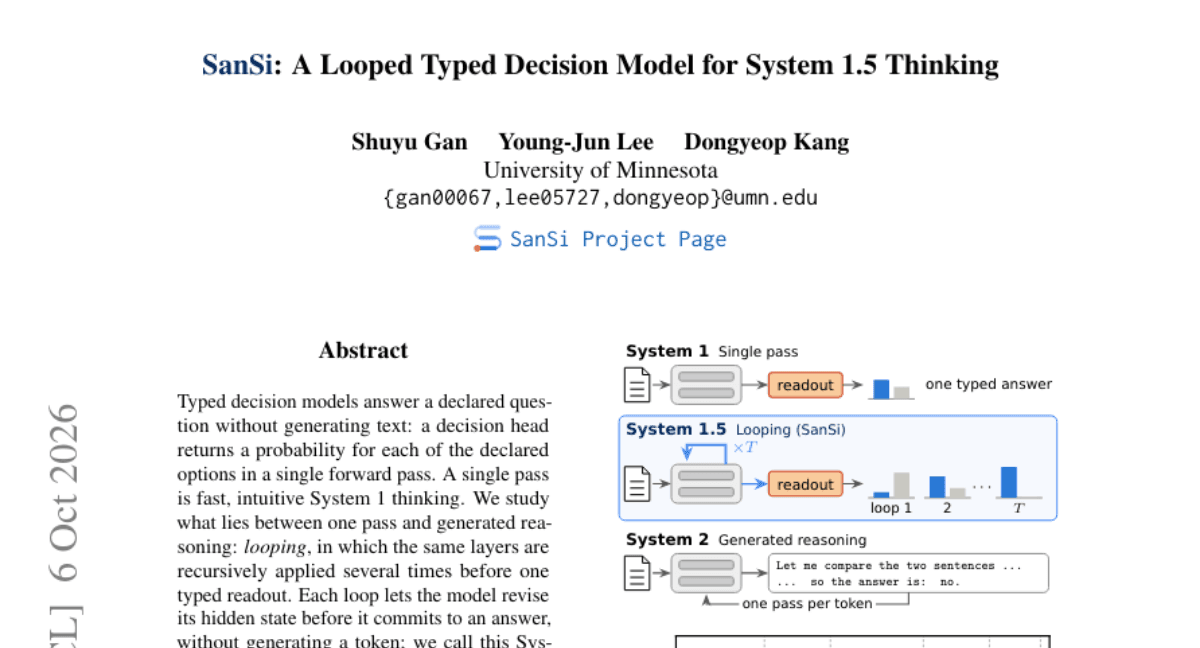
SanSi turns looped language models into typed decision systems that revise hidden states across multiple passes before outputting option...
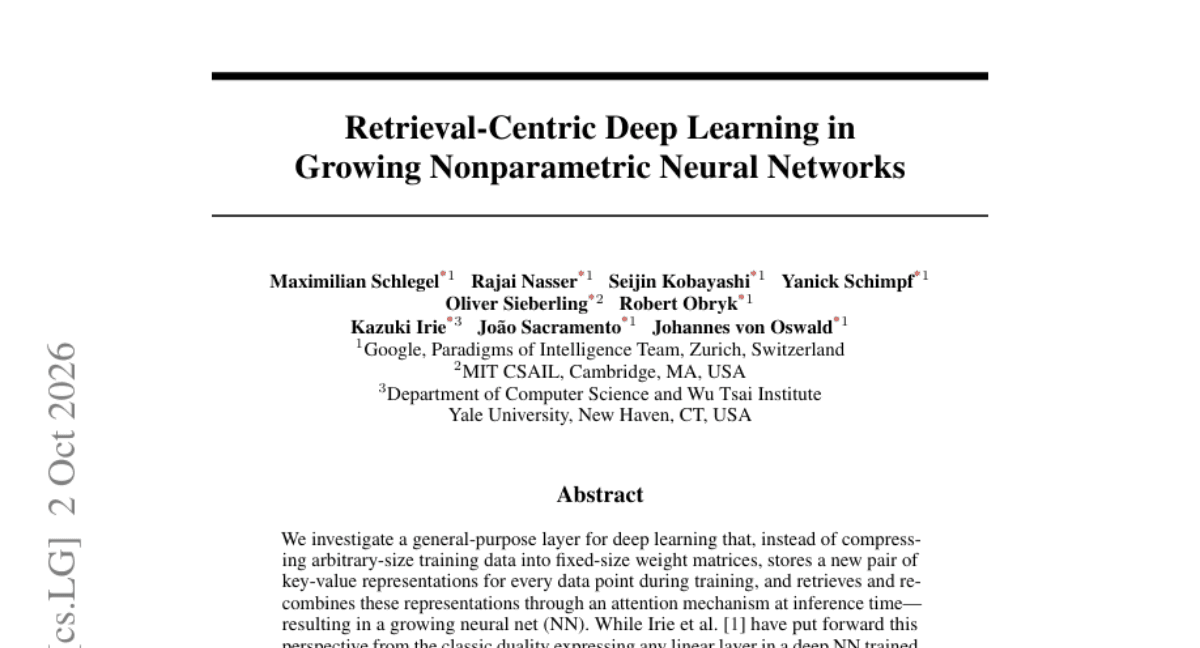
Gradient-trained linear layers operate as key-value memories storing every training datapoint plus initial weights, with outputs produced by...
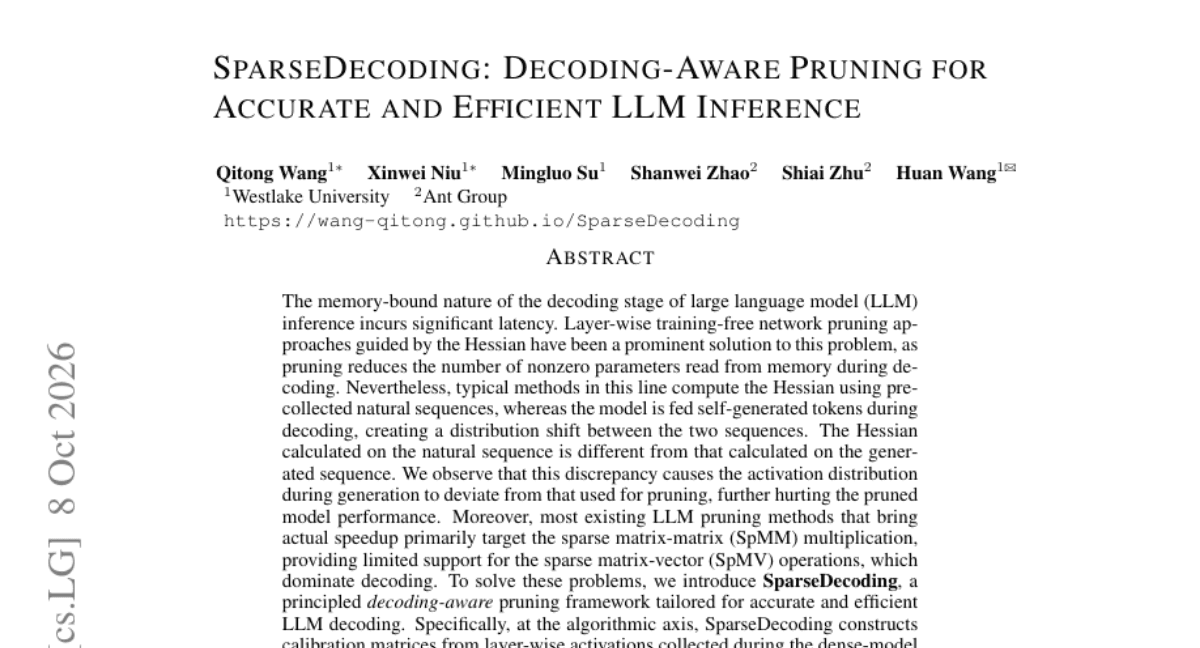
Inference efficiency research is shifting from generic compression to methods that adapt to actual runtime conditions.
The reported failure of contrastive post-training in CLIP stems primarily from an overly large temperature hyperparameter, not insufficient negatives;...
LLMs' vector representations are organized to implicitly realize symbolic structures like role-filler bindings, enabling behavior equivalent to...
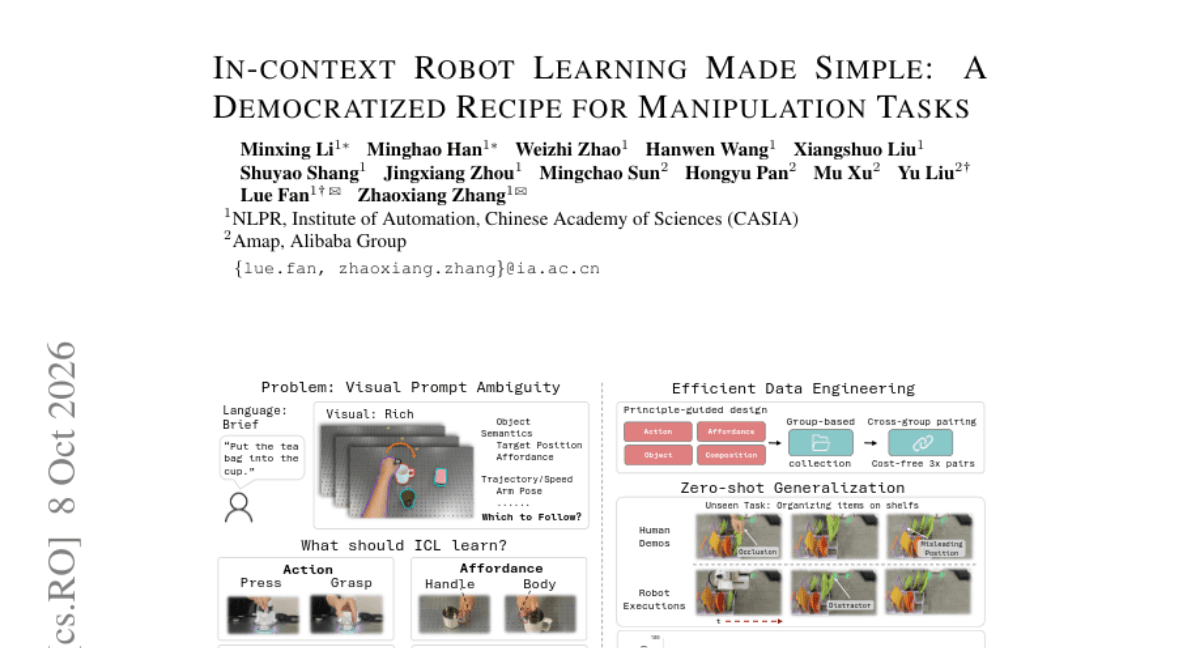
SimpleICL shows visual demonstrations alone can teach robots new manipulation tasks effectively in both simulation and real environments. The...
LeAVJEPA uses one shared encoder for self-supervised learning from sound and vision without class labels. Dropping either modality still lets audio and video converge on a common representation.
For long-horizon agents, Evidence-Grounded Behavior Graphs (EBG) group source-linked evidence into behaviors and organize them into graphs, helping...
BehaviorBench evaluates frontier models across 20 scenarios and four capabilities to measure understanding of human behavior, moving past traditional factual and task benchmarks toward social dynamics.
A new LRP framework performs learnable rank-one sensing at the UE and rank-one synthesis at the BS to exploit the low-rank multipath structure of...
G-MIXER introduces geodesic mixup-based implicit semantics as a training-free approach to zero-shot compositional image retrieval, contrasting recent methods that rely on MLLMs for generating target descriptions.
A new review examines CNNs, LSTMs, GRUs, ConvLSTMs, Transformers, and Graph Neural Networks, assessing their distinct roles in processing spatiotemporal data for ground deformation tasks.
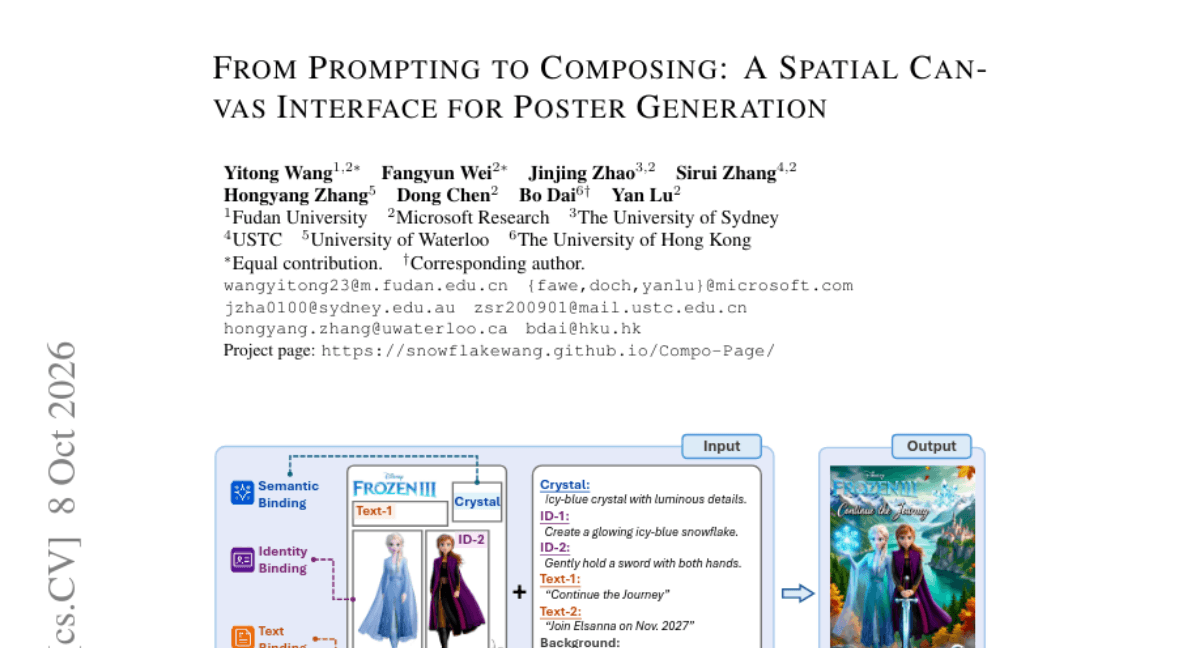
Three papers released the same day reveal a clear shift from text prompts to direct spatial interfaces.