# Open-Source Intel Tools Meet Evolving Threat Actor Tactics in 2026: A New Era of Cyber Defense
The cybersecurity landscape of 2026 is witnessing an unprecedented convergence of open-source intelligence (OSINT) tools, advanced vendor AI/ML platforms, and increasingly autonomous threat actor tactics. This synergy is fueling a new era where adversaries leverage automation, deepfake deception, supply chain compromises, and platform abuses at machine speed, challenging defenders to adapt with equally sophisticated, intelligence-driven strategies. The stakes have never been higher, demanding organizations to rethink their security paradigms and operational frameworks.
---
## The Escalation of Autonomous, AI-Powered Attacks
Threat actors are now harnessing **autonomous AI automation** to orchestrate attacks that are **faster, stealthier, and more adaptable** than traditional methods:
- **Deepfake Social Engineering**: Recent high-profile incidents have demonstrated the use of **hyper-realistic deepfake videos and voice impersonations** targeting executives, trusted partners, and employees. These convincing impersonations have successfully duped victims into executing **fraudulent wire transfers** and divulging sensitive information, resulting in **multi-million-dollar losses**. Financial institutions and geopolitical organizations report **soaring success rates in spear-phishing attacks**, enabled by generative AI’s ability to craft convincing narratives and voices.
- **ML-Optimized Ransomware Campaigns**: Malicious groups employ **machine learning algorithms** to **analyze victim environments in real time**, enabling **environment-aware triggers** that maximize impact—such as targeting specific services or data sets. These campaigns utilize **polymorphic payloads** that **evolve constantly** to evade signature-based defenses, leading to **prolonged dwell times**, complex incident response scenarios, and significant operational disruptions.
- **Automated Vulnerability Exploitation & Lateral Movement**: AI-driven automation allows threat actors to **rapidly scan vast network landscapes**, **identify vulnerabilities**, **execute exploits autonomously**, and **establish persistent footholds** within hours or days—often **before traditional defenses can respond**. Notably, tools like **PeckBirdy** have **advanced** to exploit **trusted Windows components** such as **PowerShell** and other **Living Off The Land Binaries (LOLBins)**, effectively **evading detection**. Since 2023, campaigns linked to PeckBirdy have targeted **high-value sectors globally**, illustrating **complex operational tactics** and **stealth** that challenge existing security controls.
---
## Exploiting Trust & Zero-Day Vulnerabilities
Adversaries are refining attack techniques by **weaponizing trusted system components** and **exploiting zero-day vulnerabilities** with increasing sophistication:
- **Leveraging Signed Windows Components**: Attackers exploit **legitimate, signed Windows components**, including **PowerShell** and **driver modules**, to **execute malicious activities** while **bypassing signature-based defenses**. Recent campaigns have involved **signed drivers**—such as **legacy EnCase drivers**—used to **disable or evade endpoint detection and response (EDR)** solutions. These tactics turn **trusted infrastructure into attack amplifiers**, complicating detection.
- **LNK-Based Multi-Stage Campaigns**: Campaigns like **MoonPeak** target systems through **LNK files**—Windows shortcut files—that initiate **multi-stage infections**. These are especially prevalent in regions such as South Korea. By **exploiting trusted file artifacts**, attackers stay covert and **maintain persistence**, making traditional signature and heuristics less effective.
- **Zero-Day Exploits**: The recent disclosure of **CVE-2026-21509**, a critical vulnerability in **Microsoft Office**, exemplifies how **zero-day exploits** are being **weaponized** to **bypass defenses**. Malicious documents crafted to exploit this vulnerability silently execute payloads, underscoring the **urgent need for behavioral detection**, sandboxing, and **rapid patching**.
- **State-Sponsored & Supply Chain Attacks**: North Korean threat groups continue to leverage **malicious VSCode task files** and **faked fonts** to conduct **cyber-espionage** and **supply chain compromises**. Campaigns like **SyncFuture** deploy **automated malware** via **phishing** and **faked development artifacts**, illustrating how **automation accelerates attack complexity** and **attack surface expansion**.
---
## Infrastructure & Exploit Frameworks: Old Weapons, New Purposes
Disclosures reveal that **legacy signed drivers**, such as **EnCase drivers**, remain exploited **despite their age**, serving as **tools for EDR bypass**. These **trusted drivers** are exploited to **disable security solutions**, emphasizing the importance of **behavioral analytics** over sole reliance on signature validation.
Frameworks like **PeckBirdy** exemplify the **trend of exploiting trusted Windows components** to **cloak malicious activities**. The exploitation of **zero-day vulnerabilities** like **CVE-2026-21509** underscores the **urgent need for proactive detection strategies**, including **behavioral analytics** and **rapid patching**.
---
## New Threat Actor Techniques & Developer-Targeting Risks
Beyond traditional cyberespionage and ransomware, **developer-focused campaigns** are emerging as a significant threat vector:
- **Malicious Open-Source Repositories**: Attackers embed **malicious code within open-source repositories**, such as **Next.js**, that developers incorporate into production environments. These repositories are **weaponized** to deploy **backdoors**, **cryptojackers**, or **supply chain malware**, risking widespread compromise in organizations heavily reliant on open-source frameworks.
- **Supply Chain Automation Attacks**: Campaigns like **SyncFuture** exploit **faked fonts** and **malicious VSCode task files** to **inject malware during development or update cycles**. This automation-driven attack model **amplifies scope** and **attack sophistication**, enabling **rapid proliferation** of malicious payloads.
---
## Platform-Level Abuse & SaaS Automation Threats
A **notable development** in 2026 is the **exploitation of platform features**, especially **OAuth delegation**, **Power Platform automation**, and **SaaS workflows**:
- **OAuth & Delegated Permissions Exploits**: Malicious actors manipulate **OAuth delegated permissions** to **gain persistent, stealthy access** to organizational resources. These manipulations often **hide within legitimate workflows**, enabling **long-term persistence** and **lateral movement**.
- **Power Automate & Power Apps Abuse**: Attackers leverage **Power Automate** and **Power Apps** to **deploy malware**, **facilitate lateral movement**, or **maintain persistence**—often **disguised within normal automation processes**. Regular **audits** and **behavioral monitoring** of automation flows are now essential to **detect and prevent** such abuses.
---
## Advances in Defense: Telemetry, Detection, and Response
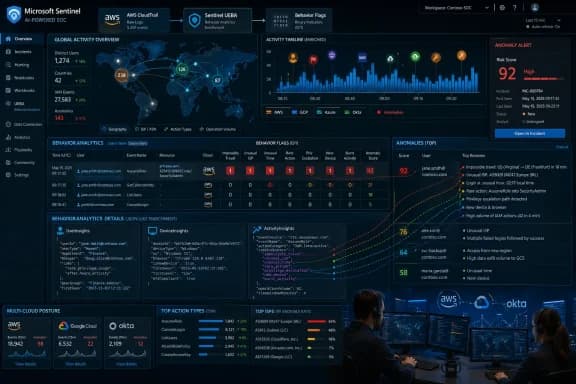
Counteracting these sophisticated threats necessitates **layered, telemetry-rich security architectures** that **integrate OSINT feeds with vendor AI/ML platforms** such as **Microsoft Defender XDR**, **Microsoft Sentinel**, and **Entra ID**:
- **Predictive & Behavioral Analytics**: By **correlating OSINT indicators** with **AI-driven models**, organizations can **detect early threat signals**—sometimes **before attack execution**—enabling **threat hunting** and **preemptive blocking**.
- **Rich Context & Situational Awareness**: Combining **global threat intelligence** with **deep behavioral analytics** enhances **accuracy**, **reduces false positives**, and accelerates **incident response** against **AI-enabled autonomous threats** operating at **machine speed**.
- **Automated, Rapid Response**: **AI orchestration** supports **swift containment and remediation**. Platforms like **Microsoft’s Defender XDR** now include **impact assessments** and **pattern recognition**, significantly **reducing response times**.
- **Graph-Based Attack Path Analysis**: The adoption of **graph analytics** enables visualization of **attack relationships**, **infrastructure connections**, and **behavioral patterns**, facilitating **discovery of complex attack paths** and **prioritization of defenses** against **self-optimizing AI adversaries**.
---
## Recent Enhancements & Practical Operational Insights
Recent updates significantly bolster organizations’ defenses:
- **Microsoft Defender for Endpoint** now supports **device control on macOS**, including **removable storage restrictions**, broadening cross-platform security coverage.
- The **"Behind the Scenes"** guide from JSOC emphasizes **comprehensive telemetry configuration**—covering **identities, endpoints, email, cloud activity**—to **maximize AI detection**.
- **Training & Upskilling Initiatives**: Programs like **"Learn Kusto Query Language (KQL) from Scratch"** empower analysts to **perform deep threat hunts**. Simultaneously, **Zero Trust** principles—such as **least privilege** and **conditional access**—remain foundational.
- **Multi-Cloud & SaaS Monitoring**: Deployment of **multi-cloud SIEMs** supported by **AI-driven analytics** and **rigorous IAM validation** enhances **early detection** of platform abuses, especially in **SAP workloads**.
- **Detection Engineering & ATT&CK Frameworks**: The latest **Security Detections MCP v1.4** introduces **AI-powered detection engineering** and previews the **MITRE ATT&CK Matrix for Cloud and Containers**, enabling **attack path identification** and **focused defense strategies**.
---
## International Collaboration & Disruption Efforts
Recognizing the global nature of the threat landscape, organizations like Microsoft and international partners have intensified **disruption operations**:
- Recent actions include the **takedown of RedVDS**, a platform involved in **stolen data sales**, **malicious hacking tools**, and **cybercrime infrastructure**. These efforts involve **server seizures**, **infrastructure interdiction**, and **dismantling threat groups**, aimed at **limiting AI-driven threat capabilities** and **disrupting financially motivated cybercriminal networks**.
---
## Addressing Platform Abuse & Shadow Copilots
**Platform abuse**, particularly **OAuth delegation** and **SaaS automation misuse**, remains a **growing concern**:
- Malicious actors manipulate **permissions** and **automation features** to **maintain access**, **execute malicious operations**, and **evade detection**.
**Countermeasures** include:
- **Continuous monitoring**
- **Governance policies**
- **Least-privilege access models**
- **Regular audits of automation flows**
- **Behavioral anomaly detection**
---
## Unlocking Graph-Based Security & Attack Path Analysis
**Graph analytics** have become **cornerstone technology** in 2026, enabling security teams to **visualize relationships** among **attack artifacts**, **infrastructure**, and **behavioral patterns**. Benefits include:
- **Discovery of complex attack paths**
- **Mapping multi-stage campaigns**
- **Prioritizing remediation efforts**
This approach is especially vital against **autonomous AI agents** executing **adaptive, multi-stage attacks**, providing **situational awareness** and **attack surface reduction**.
---
## Current Status & Strategic Implications
The **threat environment of 2026** underscores a **paradigm shift**: **defensive success depends on continuous, intelligence-driven approaches** that **combine community OSINT with vendor AI/ML capabilities**. Building a **resilient, adaptive security posture** involves:
- **Comprehensive telemetry coverage** across identities, endpoints, email, cloud, and SaaS platforms
- **Embedding threat intelligence** into security workflows for **early detection**
- **Upskilling analysts** in **KQL** and **behavioral analytics**
- **Applying Zero Trust principles**, including **least privilege** and **conditional access**
- **Monitoring SaaS automation flows** and **platform abuses** like **Shadow Copilots**
This environment **demands organizational agility, proactive collaboration**, and **technological innovation** to **thwart AI-powered, autonomous threats** now and into the future.
---
## The Role of Enhanced Telemetry & Ecosystem Expansion
A **key development** in 2026 is the expansion of **Microsoft Sentinel Data Lake**, which **aggregates and enriches telemetry** across the security ecosystem. This enables:
- **Deeper insights** into complex attack relationships
- **Enhanced AI workflows** for predictive analytics
- **Richer integrations** with third-party threat intelligence sources
- **Streamlined threat hunting** and **incident response**
By **centralizing data** and **facilitating advanced analytics**, organizations can **detect and respond to AI-driven threats** more effectively than ever before.
---
## Final Reflections
The integration of **open-source intelligence tools** with **vendor AI/ML platforms** has **revolutionized cybersecurity** in 2026. As adversaries deploy **automation**, **zero-day vulnerabilities**, and **platform abuses** at machine speed, defenders must **embrace continuous, intelligence-driven strategies**. This includes **holistic telemetry**, **graph-based attack analysis**, **proactive threat hunting**, and **international cooperation** to dismantle malicious infrastructure.
While challenges persist, organizations that **prioritize agility, collaboration, and technological mastery** will be best positioned to **remain resilient** against **AI-powered, autonomous threats**—securing their assets in this dynamic, high-stakes environment.
---
## Related Content
- **[From Reactive SOC to Predictive Defense: Inside Microsoft Sentinel’s Data Science Engine. EP 89](https://youtube.com/...)**
*Explores how Microsoft Sentinel’s Data Science Engine is revolutionizing security operations, enabling predictive analytics and early threat detection.*
---
*In summary,* the **fusion of open-source intelligence and advanced AI/ML defenses** is now **fundamental** to effective cybersecurity. As **attackers adopt automation, zero-day exploits, and platform abuses**, organizations must **evolve proactively**, leveraging **behavioral analytics**, **graph analytics**, and **comprehensive telemetry**. Only through **continuous innovation** and **collaborative intelligence sharing** can defenders **stay ahead of the AI-powered, autonomous threat landscape** of 2026 and beyond.