# The 2026 Convergence: Pioneering Large-Scale Autonomous Agents through Runtime, Hardware, and Ecosystem Innovation
The landscape of large-scale autonomous agents in 2026 has reached an unprecedented level of sophistication, driven by a synergistic wave of advancements across runtime platforms, edge hardware, memory systems, interoperability protocols, and safety frameworks. These developments are not only transforming how intelligent agents are built, deployed, and managed but are also establishing a resilient ecosystem capable of supporting **trustworthy, scalable, and long-term autonomous systems** that permeate sectors from industrial automation and enterprise AI to consumer services and societal infrastructure.
---
## Evolving Runtime Infrastructure and Persistent Memory for Long-Horizon Reasoning
At the core of this evolution are **next-generation runtime platforms** such as **AgentRuntime**, **AgentReady**, and **Tensorlake**, which are engineered to **enable agents to reason, plan, and operate over extended periods—spanning weeks or even months**—while maintaining **persistent knowledge bases**. This shift addresses longstanding bottlenecks in **context retention** and **cost efficiency**, enabling agents to perform **multi-step, long-term reasoning** with greater fidelity.
A notable recent innovation is **AgentReady**, a **drop-in proxy** that **reduces token costs by 40-60%**. By **simply swapping the `base_url`**, organizations can **access cost-efficient routing solutions** that facilitate **multi-step, persistent agent operations**. This development significantly **lowers barriers for deploying large-scale, reliable agents** in real-world applications, making complex autonomous behaviors more accessible across industries.
Complementing runtime advancements are **persistent memory solutions** such as **SurrealDB 3.0**, which recently secured **$23 million in Series A funding**. SurrealDB exemplifies a new class of **scalable, durable knowledge stores** capable of **overcoming traditional memory bottlenecks**. These systems enable **seamless retrieval, updating, and long-term storage** of agent knowledge, supporting **multi-week planning**, **contextual reasoning**, and **knowledge continuity**—crucial for hybrid reactive and strategic decision-making architectures that underpin large-scale autonomous agents.
---
## Hardware and Silicon Breakthroughs: Powering On-Device and Edge Intelligence
The movement toward **local inference hardware** continues to accelerate, dramatically reducing reliance on cloud infrastructure and enabling **privacy-preserving, low-latency AI**:
- **Taalas’ HC1 chips** now process **nearly 17,000 tokens per second** when running models like **Llama 3.1 8B**, empowering **real-time autonomous decision-making** in robotics, navigation, and edge AI applications. These chips **significantly cut latency**, **enhance privacy**, and support **mission-critical systems** requiring immediate responsiveness.
- **ZhipuAI’s GLM-5** represents **silicon-embedded large models** optimized for **local deployment**, enabling **secure, low-latency operation** even during **connectivity outages**. Such hardware is ideal for **industrial platforms**, **remote autonomous systems**, and **critical environments** where **security** and **connectivity constraints** are paramount.
The industry’s confidence in hardware evolution is reinforced by substantial investments:
- **MatX**, an **AI chip startup** challenging **Nvidia**, raised **$500 million** in Series B funding led by **Jane Street** and **Situ**, aiming to develop **specialized inference silicon** supporting **large models** and **scalable AI workloads**. This signals a **strong industry focus on edge hardware development**.
- **Union.ai** secured **$38.1 million in Series A** to **accelerate AI infrastructure development**, focusing on **orchestrating complex workflows** and **scaling autonomous agent operations**. Their platform aims to **lower barriers** for enterprises to **manage large multi-agent ecosystems** efficiently.
These investments underline a **trend toward dedicated inference and training silicon**, which is crucial for **supporting more sophisticated multi-agent systems** and **distributed AI architectures** that operate reliably at scale.
---
## Production-Ready Infrastructure and Workflow Orchestration
The transition from experimental to **production-level deployment** is exemplified by **advanced tools and platforms** that streamline **complex autonomous agent workflows**:
- **Google Labs’ Opal 2.0** introduces **smart agent steps**, **memory management**, and **dynamic routing** to support **interactive, multi-modal workflows**. Its **visual no-code builder** simplifies **designing robust AI pipelines**, making sophisticated agent systems accessible to non-experts.
- **KiloClaw** offers **managed hosting solutions** for **OpenClaw**, the **most popular open-source AI agent framework**. By **eliminating the need for dedicated hardware** like Mac Minis, it **democratizes self-hosted, scalable agent deployment** and **broadens enterprise infrastructure options**.
- **Mercury 2**, recognized as **the fastest reasoning AI model built for production**, demonstrates that **high-performance autonomous reasoning** is now feasible for **real-world applications**. Its deployment marks a milestone in **robust, high-throughput reasoning systems** suitable for mission-critical environments.
Recent funding, especially **Union.ai’s Series A**, further accelerates the development of **scalable orchestration platforms** that facilitate **managing large populations of agents**, **automating workflows**, and **integrating multi-agent systems** into existing enterprise infrastructures seamlessly.
---
## Managing Complexity: Developer Practices and Multi-Agent Orchestration
Handling **dozens or hundreds of autonomous agents**, such as multiple **Claude Code** instances or other large language models, presents operational challenges increasingly addressed through **best practices**:
- **Containerization** and **task management tools** ensure resource isolation and efficient scaling.
- **Dynamic orchestration frameworks** adapt deployment based on workload fluctuations.
- **Observability platforms** like **Datadog DASH 2026** provide **real-time insights**, **traceability**, and **anomaly detection**, vital for maintaining **performance** and **reliability** in complex environments.
The recent industry spotlight on **@chrisalbon’s** inquiry into **managing numerous Claude code agents** underscores the **urgent need for standardized orchestration patterns** and **robust operational tooling** to sustain **performance at enterprise scale**.
---
## Protocols, Standards, and Trust: Building Interoperability and Security
As autonomous agents become increasingly interconnected, **interoperability** and **trustworthiness** are critical:
- The **Agent Data Protocol (ADP)**, now **adopted into ICLR 2026**, offers a **standardized communication framework** that underpins **trustworthy multi-agent cooperation**. Its integration into frameworks like **LangChain** supports **secure, reliable data exchange** among **heterogeneous agents**.
- **Symplex**, an **open-source semantic negotiation protocol**, facilitates **dynamic negotiation** and **conflict resolution** among agents, supporting **scalable multi-agent ecosystems** suited for **industrial automation**, **defense**, and **enterprise AI**.
- **Trust-layer solutions** from **t54 Labs** are emerging to **further enhance security and trust**, especially in **sensitive applications** involving **multi-agent cooperation**.
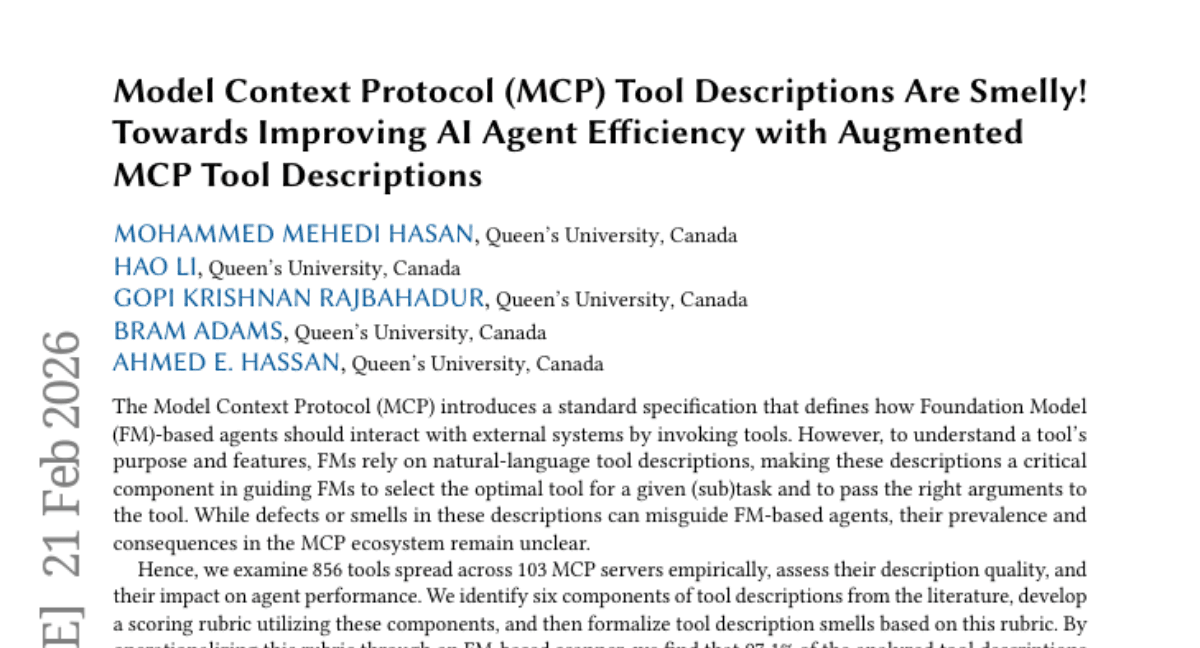
- The **Model Context Protocol (MCP)** has seen improvements in **tool description methodologies**, with ongoing efforts to **optimize agent efficiency** through **augmented MCP tool descriptions**, reducing **redundancy** and **clarifying interactions** in multi-agent systems.
These standards and protocols are foundational for **interoperability**, **security**, and **trust**, enabling **scalable, safe, and reliable autonomous systems**.
---
## Safety, Security, and Observability: Ensuring Trustworthy Autonomy
As agents take on roles involving **critical decision-making**, **safety and security** remain paramount:
- **Formal verification tools** like **TLA+** continue to provide **mathematical validation** of agent behaviors, helping **detect vulnerabilities** early in development.
- **Monitoring platforms** such as **Datadog DASH 2026** offer **real-time operational insights**, **traceability**, and **anomaly detection**, ensuring **performance stability**.
- **Runtime safety tools** like **CanaryAI** monitor **code-generation models** such as **Claude Code**, crucial for **high-stakes applications** where **erroneous outputs** could have severe consequences.
- There is ongoing research to **mitigate malicious exploits**, including **distillation attacks** that threaten **model integrity** and **user trust**. These efforts are essential to **maintain confidence** in autonomous systems and prevent **security breaches**.
---
## New Frontiers and Notable Developments
In addition to core technological advances, several **noteworthy initiatives and products** are shaping the ecosystem:
- **RLWRLD**, a startup focused on **scaling industrial robotics AI**, recently **raised $26 million in Seed 2 funding**, bringing total funding to **$41 million**. Their goal is to **scale AI-driven robotics solutions** in manufacturing and logistics, exemplifying the push toward **integrated autonomous systems** in industry.
- The concept of **remote-local model patterns**, exemplified by **Tailscale**, allows **local models** to run **on remote devices controlled** by operators, as if they were local. This approach **enhances security** and **flexibility**, enabling **enterprise-grade AI deployment** across distributed networks.
- **Rover by rtrvr.ai** introduces a **web-embedded AI agent** that can **turn websites into interactive agents** with a simple script tag, **taking actions for users** directly from web environments. This democratizes **web-level automation** and **interactive AI experiences**.
- **IronClaw**, an **open-source, secure alternative to OpenClaw**, addresses **security vulnerabilities** like prompt injections and credential theft. It offers **powerful, open-source infrastructure** for organizations seeking **trustworthy, self-hosted agent frameworks**.
- **Trace**, a new startup, has raised **$3 million** to **solve the AI agent adoption problem in enterprise**, focusing on **scalable deployment**, **workflow automation**, and **integration tools** that push autonomous agents into mainstream enterprise use.
- The development of **no-code automation UIs** such as **CodeWords UI** further lowers the barrier for **building and managing autonomous agents**, empowering **non-technical users** to design complex workflows and interactions visually.
---
## Current Status and Future Trajectory
The ecosystem in 2026 is characterized by a **mature convergence** of **runtime agility**, **edge hardware innovation**, **robust knowledge tooling**, **interoperability standards**, and **trust frameworks**. Industry giants like **Nvidia**, with a **$30 billion pledge to OpenAI**, alongside startups like **Cernel** (which recently raised **€4 million** for agentic commerce infrastructure), demonstrate **strong confidence** in the transformative potential of autonomous agents.
Looking ahead, several key directions are clear:
- **Edge hardware** will continue to evolve, enabling **more reasoning-capable, long-term multi-agent systems** with **local inference** and **robust memory architectures**.
- The expansion of **standardized communication and trust protocols** will **accelerate deployment** in **critical sectors**, embedding autonomous agents into **societal infrastructure**.
- **Investment in infrastructure**, **orchestration tools**, **safety measures**, and **knowledge tooling** will be vital in **scaling autonomous systems** while **maintaining robustness, security, and trust**.
In **summary**, 2026 marks a **pivotal year** where **runtime platforms**, **hardware breakthroughs**, **interoperability standards**, and **trust frameworks** are collectively forging a **new era of autonomous agents**—deeply integrated into every facet of industry and society, promising **trustworthy, scalable, and intelligent automation** on an unprecedented scale.