# Advancements in Long-Horizon LLM Agents: Integrating World Models, Benchmarking, and Safety Frameworks
The field of large language model (LLM) agents is undergoing a transformative evolution, driven by the integration of sophisticated world models, virtual environments, comprehensive benchmarking platforms, and safety mechanisms. These innovations are collectively pushing the boundaries of autonomous reasoning, persistent planning, cross-embodiment transfer, and trustworthy deployment, marking a significant step toward truly long-horizon, reasoning-driven AI systems.
## Integrating Object-Centric Causal World Models and 4D Virtual Environments
At the heart of these advancements are **object-centric causal world models** such as **Causal-JEPA**, which enable agents to perform **relational and causal reasoning** at the object level. By inferring physical laws, relational dynamics, and causal structures, these models support **long-term autonomous decision-making** and **explainability**, crucial for tasks requiring sustained reasoning, like scientific discovery or industrial monitoring.
Complementing this, **geometry-aware encodings** like **ViewRope** embed **spatial and temporal consistency** into learned representations. This enhancement improves **embodied navigation**, **robotic manipulation**, and **scientific simulations**, ensuring agents maintain an accurate understanding of their environment over extended periods.
A notable recent development is **Code2Worlds**, a framework that converts code into **dynamic 4D virtual worlds**. This approach enables **virtual prototyping**, **hypothesis testing**, and **simulation-to-real transfer**, significantly accelerating environment generation, reducing real-world risks, and fostering **safe testing environments** before deployment.
## Scaling Up: Benchmarking Platforms and Holistic Evaluation
To measure progress and ensure robustness, an ecosystem of **large-scale evaluation platforms** has emerged:
- **OdysseyArena** challenges agents to sustain **multi-hour to multi-day interactions**, demanding **long-term memory**, **strategic planning**, and **coherent reasoning**. Scenarios include assisting in scientific research and industrial monitoring.
- **WebWorld** offers a **simulated environment** trained on **over one million interactions**. Agents here perform **multi-step web navigation**, **information retrieval**, and **autonomous research**, testing their **context maintenance**, **multi-stage planning**, and **multi-modal data integration**.
- **SciAgentBench** and **SciAgentGym** focus on **scientific tool use**, enabling agents to **operate instruments**, **manage datasets**, and **conduct experiments autonomously**—crucial for **long-term scientific discovery**.
- **BrowseComp-V³** evaluates **multi-modal content understanding**, combining **visual** and **textual reasoning** to assess models' capabilities in **web browsing** and **content analysis** across multiple steps.
Supporting these platforms is the **DREAM framework** (Deep Research Evaluation with Agentic Metrics), which offers a **holistic, agent-centric assessment** of models' **research capabilities**, **hypothesis generation**, and **long-horizon planning**. This comprehensive evaluation approach guides the development of more capable and reliable agents.
## Advances in World Model Architectures for Interpretability and Multi-Modal Reasoning
Recent architectural innovations underpin these capabilities:
- **Causal-JEPA** extends masked joint embedding prediction to **object-centric representations**, fostering **relational reasoning** and **explainability**—key for debugging and scientific applications.
- **ViewRope** enhances **video world models** with **geometry-aware encodings**, ensuring **spatial-temporal fidelity**, essential for **robotics** and **dynamic environment modeling**.
- **UniT** facilitates **multimodal chain-of-thought reasoning**, allowing models to **iteratively refine hypotheses**, **correct errors**, and effectively **integrate diverse modalities**.
- **Ouro** employs **recursive, looped latent reasoning**, scaling inference capacity for **complex scientific tasks** and **multi-stage reasoning**.
These architectures support **persistent planning**, **multi-modal integration**, and **explainability**, forming the backbone of **long-horizon reasoning agents**.
## Enhancing Training Stability and Scalability
Training models capable of **extended interactions** faces challenges such as **instability** and **spurious token generation**. Innovations like **STAPO** (Silencing Rare Spurious Tokens) mitigate these issues by **suppressing misleading tokens**, resulting in **more accurate and reliable long-sequence reasoning**.
Similarly, **BAPO** (Batch Adaptation Policy Optimization) provides **sample-efficient off-policy reinforcement learning**, facilitating **scalable training**. Models like **GLM-5** incorporate **distributed reinforcement learning** and **diffusion techniques** (e.g., DICE), enabling **cost-effective, adaptive tuning** for **long-horizon tasks** while maintaining **performance stability**.
## Safety, Verification, and Robustness for Long-Horizon Operations
As agents operate over longer durations, **safety** and **trustworthiness** are critical. Frameworks such as **NeST** (Neuron Selective Tuning) offer **lightweight safety alignment** by **selectively tuning safety-critical neurons**. The **Zero-Trust Architecture** for **multi-component protocols** ensures **secure interactions** among multiple AI modules, preventing vulnerabilities during autonomous operations.
Recent research highlights the threat of **visual memory injection attacks**, which can **corrupt retrieval-augmented models**. In response, architectures now incorporate **robust memory management** and tools like **AlignTune**, designed to **detect and mitigate malicious manipulations**, thereby safeguarding **factual integrity** over extended interactions.
## Embodiment, Cross-Embodiment Transfer, and Scientific Automation
Progress in **embodied perception** has enabled **full-body human mesh recovery** with models like **SAM 3D Body**, supporting **virtual humans** and **robotic avatars** for **natural human-AI interactions**. Cross-embodiment techniques such as **LAP** (Language-Action Pre-Training) facilitate **zero-shot transfer** across diverse robots and tasks, drastically reducing retraining needs.
In scientific domains, **autonomous workflows** leverage **digital twins**, **automated experiment design**, and **instrument control** to **accelerate discovery cycles**, allowing models to **conduct long-term research**, **manage hypotheses**, and **refine strategies** over days or weeks.
## Recent Developments and Future Directions
Additional recent contributions further reinforce the trajectory toward robust, scalable, and safe long-horizon agents:
- **ARLArena** introduces a **unified framework for stable agentic reinforcement learning**, emphasizing **training stability** in complex environments.
- **GUI-Libra** focuses on **training native GUI agents** capable of **reasoning** and **acting** with **action-aware supervision** and **partial verifiability**, essential for **automated interface interaction**.
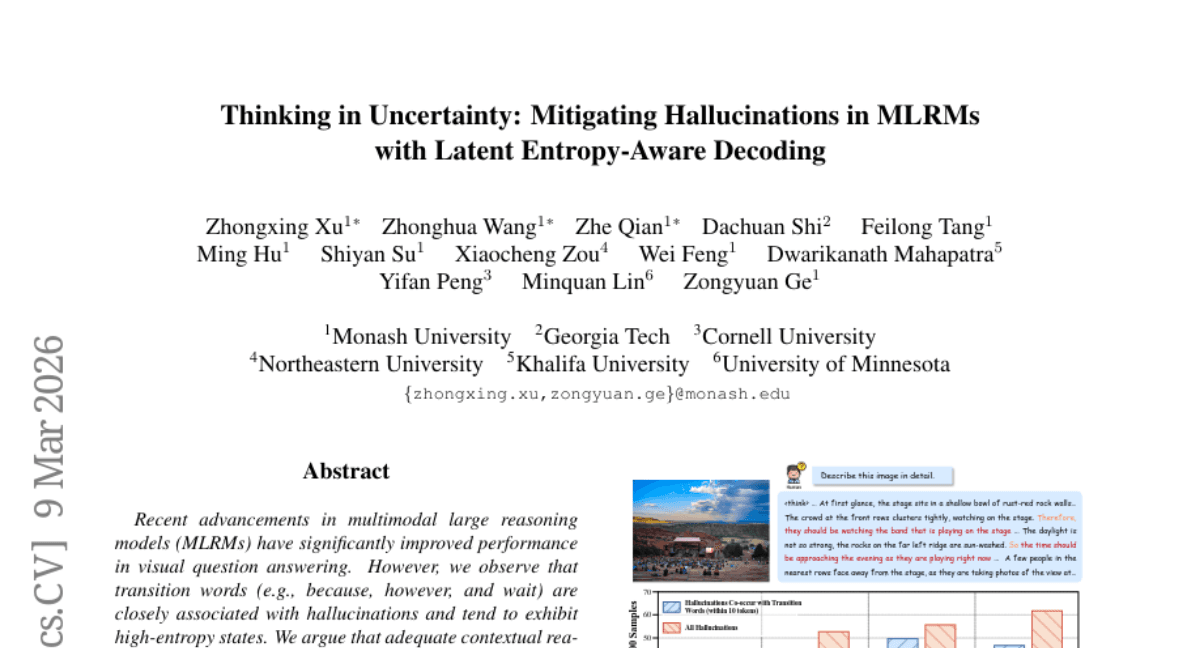
- **NoLan** addresses **object hallucinations** in vision-language models by **dynamically suppressing language priors**, improving **factual correctness**.
- **Model Context Protocol (MCP)** tool descriptions have been refined to improve **agent efficiency**, reducing **overhead** and enhancing **task execution**.
- Evaluative frameworks like **The Token Games** test language models' **reasoning abilities** through **puzzle duels**, providing nuanced insights into **multi-hop reasoning**.
- **SciCUEval** supplies **comprehensive scientific-context datasets** for evaluating **long-term reasoning** and **hypothesis testing**.
- **Test-time verification techniques** for **vision-language assistants (VLAs)** further improve **factual accuracy** and **trustworthiness** during extended interactions.
---
## **Conclusion**
The current landscape of long-horizon LLM agents is characterized by a **synergistic integration** of **world models**, **benchmarking**, **architectural innovations**, **training stability techniques**, and **safety frameworks**. These developments are transforming AI from reactive systems into **autonomous, reasoning, and safe collaborators** capable of **extended reasoning**, **cross-embodiment transfer**, and **scientific automation**.
As research continues to address remaining challenges—such as **robustness against adversarial memory attacks**, **scalable multi-modal reasoning**, and **trustworthy long-term deployment**—the vision of AI systems that seamlessly **collaborate with humans** over **extended durations** in complex domains becomes increasingly tangible. The future promises **more reliable**, **interpretable**, and **safe long-horizon agents** that can **tackle real-world challenges** across science, industry, and society.