# Advancements in Long-Context AI Reasoning: Architectural Innovations, Inference Optimization, and Emerging Long-Horizon Capabilities in 2026
The landscape of artificial intelligence in 2026 continues to undergo a remarkable transformation, driven by pioneering research and technological breakthroughs that enable models to **reason coherently over extended durations—spanning hours, days, or even longer**. This epoch marks a shift from traditional short-term, context-limited models to systems capable of **deep, sustained cognition**, fundamentally expanding their applicability across scientific, industrial, and societal domains.
This evolution is fueled by a **synergistic convergence** of **architectural innovations**, **memory routing strategies**, **latent reasoning frameworks**, and **inference-time optimizations**. Together, these advancements are breaking longstanding barriers, moving toward AI systems that **think, learn, and act continuously over extended periods** with reliability and interpretability.
---
## Architectural and Memory Routing Breakthroughs for Long-Horizon Coherence
One of the central challenges in long-horizon AI is **managing vast, diverse data streams** without losing focus or incurring prohibitive computational costs. Traditional transformer models, constrained by fixed context windows, struggle to maintain coherence over hours or days. Recent innovations have addressed this through **adaptive, intelligent routing, stabilization techniques, and scalable memory management**:
- **ThinkRouter**, a cutting-edge routing mechanism, employs **query-aware, dynamic resource allocation**. It selectively channels processing power toward **relevant data segments**, dramatically extending models’ ability to **maintain focus and coherence** over **minutes and hours** of interaction.
- **Attention sink modules**, championed by researchers such as @ylecun, serve as **long-term memory stabilizers**, preventing information decay and drift. These modules are particularly effective in tasks like **video analysis**, **dialogue systems**, and **scientific data streams**.
- **Sparse, learnable attention mechanisms**, like **SLA2**—which combines **spectral block-sparsity** with **learnable routing networks**—enable models to **focus attention efficiently** on scene-relevant regions. This is exemplified in systems like **Prism**, which facilitate **long-term scene understanding** in surveillance and scientific applications.
- **Resource management strategies**, including **tiered computational budgets** and **adaptive inference**, allow models to **prioritize complex reasoning segments** and process simpler parts shallowly, ensuring **scalability and efficiency** over extended periods.
Complementing these are **progressive disclosure techniques** and **neural tracking mechanisms** that **dynamically reveal pertinent information** while suppressing irrelevant data—mirroring human cognitive processes. These strategies foster **selective long-term context retention** and **multimodal reasoning**, enabling models to **navigate complex, multi-sensory streams** effectively.
---
## Inference-Time Innovations Enabling Near Real-Time Multi-Hour Processing
Achieving **multi-hour multimodal stream processing** in real-time remains a formidable challenge. Recent breakthroughs focus on **accelerating inference** and **reducing latency**:
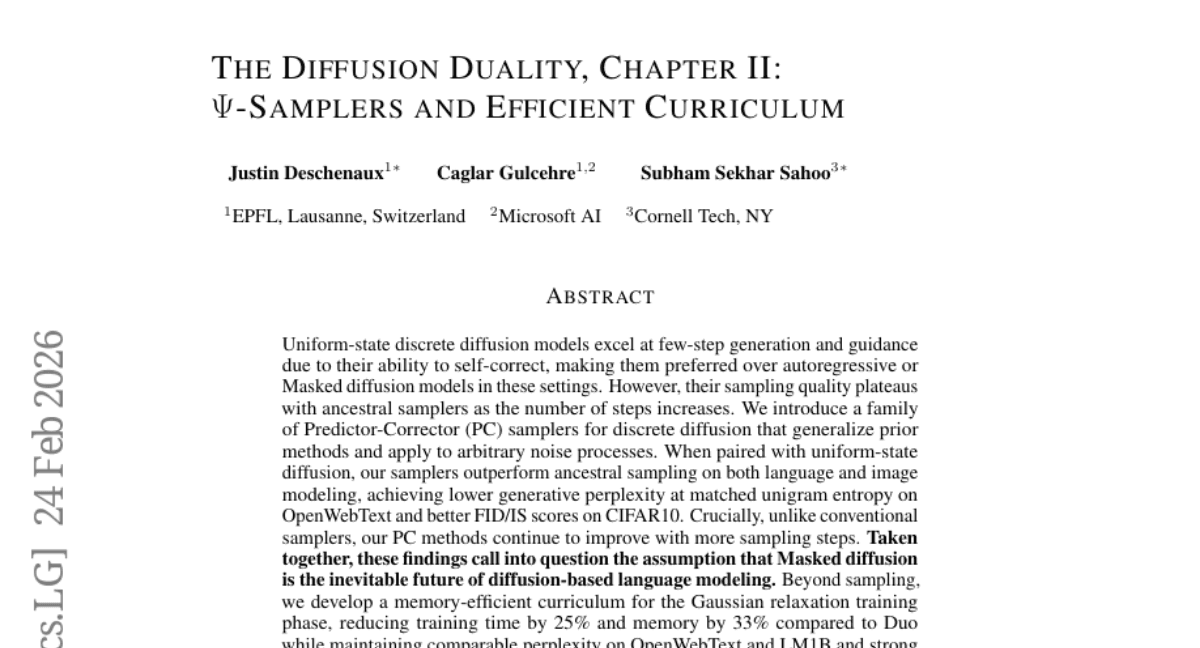
- **Ψ-samplers** and **adaptive curriculum strategies**, as detailed in **"The Diffusion Duality, Chapter II,"**, have **substantially decreased the number of diffusion steps** necessary for **high-quality denoising**, bringing **near-instant responsiveness** within reach.
- **Single-pass continuous denoising techniques** eliminate the iterative decoding bottleneck, allowing models to **maintain coherence across hours of data** without excessive computational overhead.
- The innovative **Step 3.5 Flash diffusion** combines **few-step diffusion inference** with **trajectory self-distillation**, enabling **instantaneous processing**—a critical enabler for **long-term reasoning in real time**.
- Underlying these are **theoretical frameworks** like the **Unified Latents (UL)** approach, which **regularizes representations** via **diffusion regularization**, ensuring **long-term stability** and **coherent information flow** over extended periods.
These inference optimizations are transforming previously impractical tasks into **viable real-time applications**, empowering AI agents to **reason, learn, and act continuously** over hours and days.
---
## Latent and Continuous Reasoning Paradigms for Deep, Long-Horizon Cognition
A **paradigm shift** has emerged from moving **away from discrete symbolic logic** toward **latent-space, continuous inference**:
- **FMLM** (**One-Step Latent Diffusion**) exemplifies **single-step denoising**, drastically reducing computation while supporting **multi-step reasoning over hours**.
- **Multilingual latent reasoning systems**, trained in **shared continuous spaces**, enable **cross-lingual, long-term inference** with **robust generalization** across diverse modalities and languages.
- The **Unified Latents** framework **jointly regularizes encoders and diffusion models**, fostering **long-horizon consistency** and **information coherence** across extended durations.
- **Adaptive reasoning paths**—which dynamically branch into deeper or wider inference processes based on task complexity—significantly **improve performance** on multifaceted, multi-day problem sets.
This **latent reasoning approach** underpins **scalable, resilient long-term cognition**, facilitating models that **think deeply, retain critical context, and evolve their understanding over days**.
---
## Memory Routing, Context Management, and Long-Term Context Preservation
Effective long-horizon reasoning hinges on **advanced context management techniques**:
- **Progressive disclosure** dynamically **reveals relevant information** over time, **balancing comprehensiveness and efficiency**.
- **Neural tracking mechanisms**, inspired by human cognition, **capture long-range cues**—linguistic, visual, relational—ensuring **critical information remains accessible**.
- **Object-centric scene understanding models**, such as **Causal-JEPA** and **ViewRope**, facilitate **causal and relational reasoning** in dynamic environments, which is essential for **autonomous systems operating over days**.
- To **maintain long-term context**, models employ **selective retention techniques**, prioritizing **pertinent data** while **discarding noise**. This approach ensures **robust, scalable memory management** that supports **multimodal streams** over extended durations.
These strategies forge **resilient, scalable frameworks** for **long-term context preservation**, essential for **autonomous reasoning in complex, real-world environments**.
---
## Recent Supplementary Advances and Emerging Trends
The ongoing research ecosystem has introduced notable innovations:
- **Explainable Attention for Long Video Analysis**: Recent work proposes **explainable deep learning frameworks** that leverage **interpretable attention mechanisms**, allowing models to **identify and justify focus areas** in lengthy videos—crucial for trustworthiness and debugging.
- **tttLRM (Temporal-Long Range Modeling)** unveiled at CVPR 2026 by Adobe and UPenn researchers, represents a **significant leap in long-range temporal modeling**. This approach **integrates temporal context across days**, enabling **robust long-term scene understanding** and **predictive reasoning**.
- **"Less is Enough"** demonstrates that **feature space synthesis** optimizes data processing efficiency, reducing computational needs without sacrificing performance.
- **"Zooming without Zooming"** employs **region-to-image distillation** methods for **fine-grained perception** without costly zoom operations, streamlining long-range visual reasoning.
- **Test-time training with KV binding** enhances **linear attention techniques**, further **reducing latency** and improving **scalability** at inference.
Moreover, **tool and benchmark improvements** are proliferating:
- **SciCUEval** introduces a **scientific context understanding benchmark**, assessing models' ability to **maintain scientific reasoning coherence over days**.
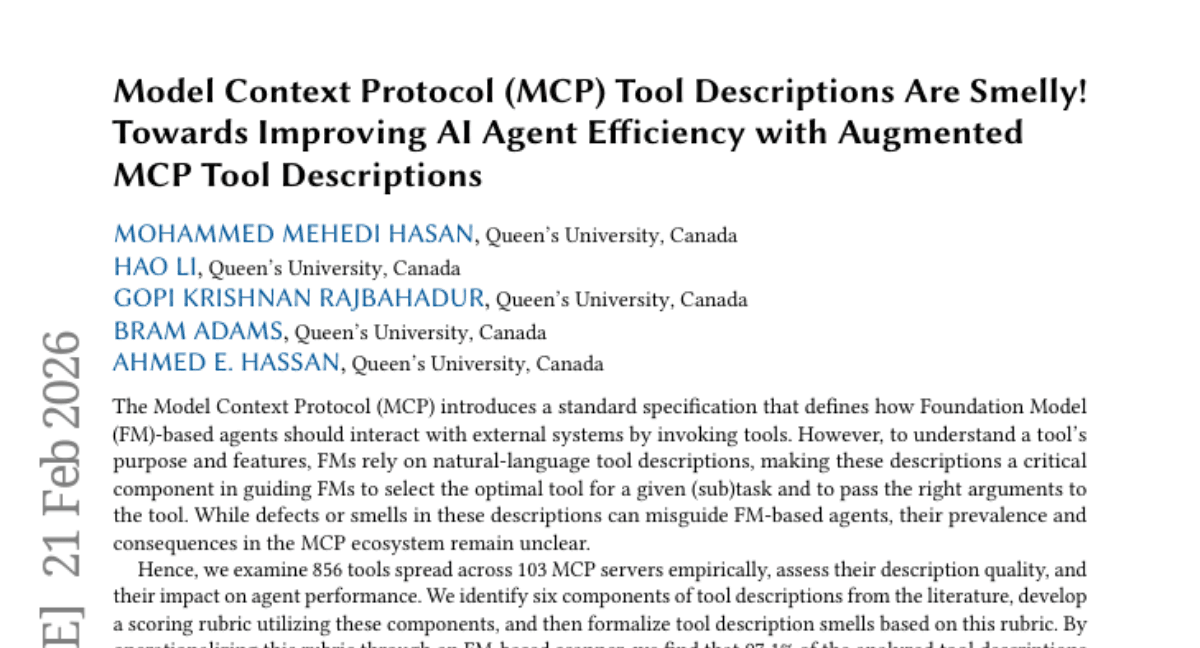
- **MCP Tool Fixes** and **enhanced context protocols** bolster **agent efficiency and reliability** during prolonged interactions.
---
## Future Directions and Implications
The trajectory established by these advancements points toward a future where **AI systems are capable of sustained, trustworthy reasoning**:
- **Refining diffusion samplers** like Ψ-samplers and **single-pass inference** methods will further **reduce latency**, making **multi-day reasoning in real time** a standard capability.
- **Enhanced verification and safety frameworks**, integrating **NeST (Neural Safety Techniques)** and **information geometry analysis**, will ensure **trustworthy long-term operation**.
- **Bias detection and mitigation tools**, tailored for extended contexts, will bolster **model fairness and reliability** during prolonged interactions.
The implications are profound:
- **Scientific research** models can process **multi-year data streams**, forming **long-term hypotheses**.
- **Autonomous agents**—from exploration rovers to industrial systems—can **maintain situational awareness** over **multi-day missions**.
- **Multimodal understanding** will become **more reliable and scalable**, supporting **human-like cognition** in AI.
---
## Conclusion
The convergence of **architectural ingenuity**, **memory routing**, **latent reasoning frameworks**, and **inference-time innovations** is **redefining the boundaries of AI cognition**. Today’s models can **reason coherently over hours and days**, **adapt dynamically** to complex multimodal streams, and do so **with efficiency and interpretability**.
This **long-term reasoning revolution** heralds a new era: AI systems that **think, learn, and operate continuously**—not just in fleeting moments but over **extended horizons**—paving the way for **trustworthy, autonomous, and deeply intelligent machines** capable of **deep understanding and sustained action** in the real world.