June 23, 2026
Frontier AI Insights · Jun 23 Daily Digest
World Foundation Model Advances
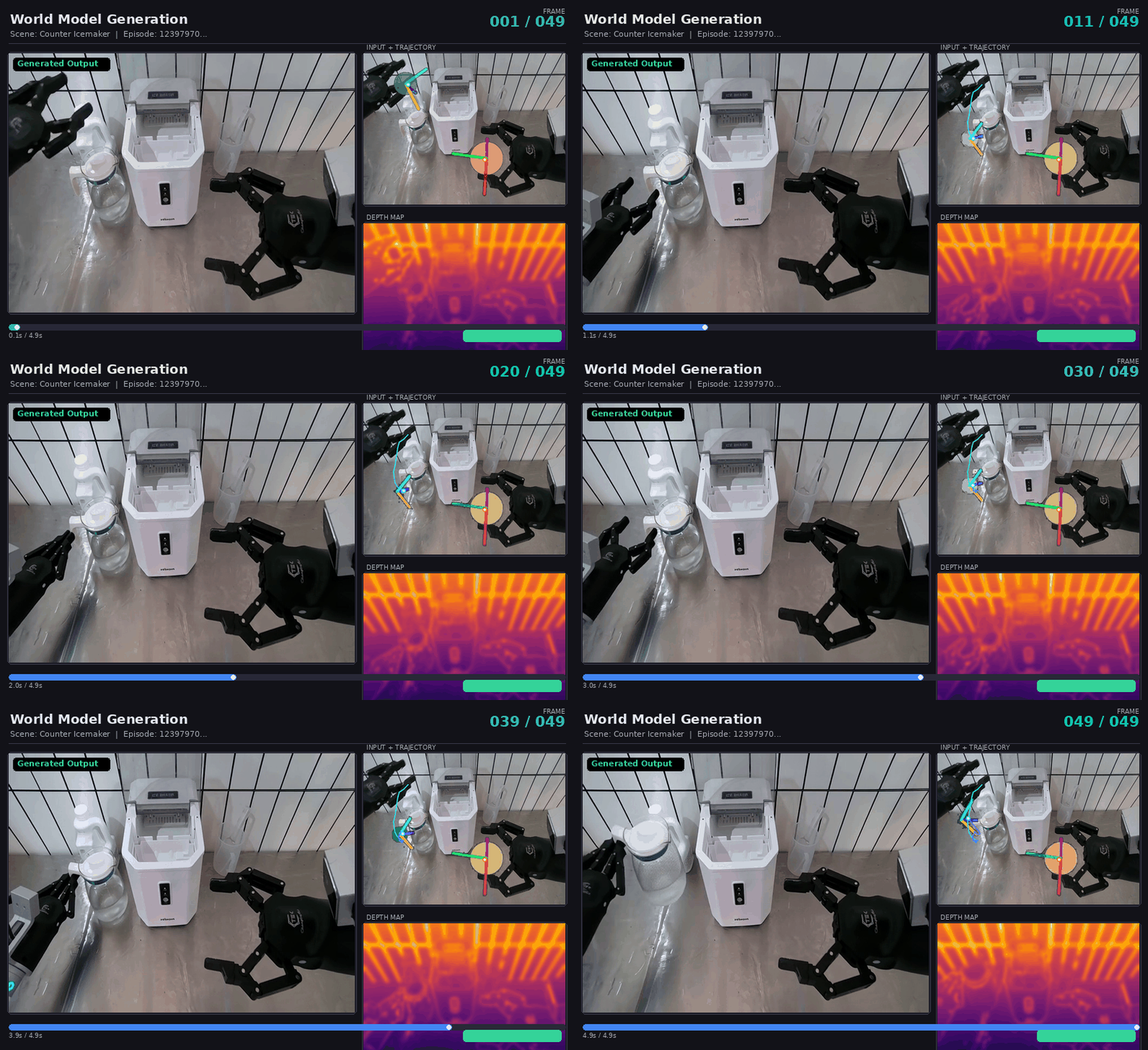
- 🔥 PAIWorld: PAIWorld introduces inter-view communication pathways and Latent 3D-REPA to enforce 3D consistency...

Created by Hydrangea10
Frontier AI research news on LLM architectures, training methods, and theory
Explore the latest content tracked by Frontier AI Insights
Current evidence often cannot distinguish whether apparent deception or shutdown resistance in models reflects true misalignment or simply role-play,...
Two critiques challenge core assumptions in world model design:
By embedding differential geometry into neural architectures, AI gains awareness of curves, surfaces, and continuous structures rather than isolated...
OmniAgent shifts video AI from passive frame-watching to an Observation-Thought-Action cycle, selectively gathering evidence while maintaining...
Noam Shazeer's departure hands OpenAI the co-author of the Transformer paper and inventor of Sparse MoE scaling as its new Lead for Architecture...
A new paper demonstrates an automated, verifiable method at scale to translate activity from monkey visual neurons into human language descriptions of triggering images.
A new survey examines model size, dataset size, and architectural designs across multimodal foundation model categories including Uni-MMFMs.
VibeThinker-3B hits 94.3 on AIME26 and 80.2 Pass@1 on LiveCodeBench v6, matching or beating flagship models like DeepSeek V3.2 and Gemini 3 Pro. Its...
Moral judgement capabilities in LLMs follow clear scaling relationships across 75 configurations spanning 0.27–1000B parameters, with direct implications for alignment research and ethical AI development.
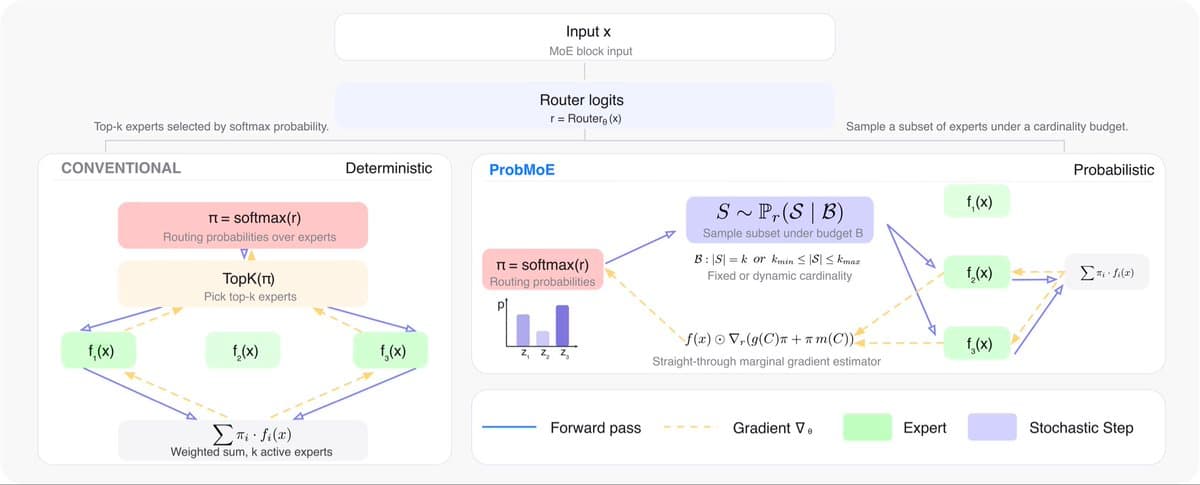
ProbMoE replaces hard top-k routing with probabilistic inference over expert subsets, delivering more informative gradients, greater exploration, and improved expert utilization in MoE models.
Two emerging strategies tackle core reliability gaps in LLM agents through structured reasoning and skill building.
Neuro-JEPA applies latent predictive objectives with a Mixture-of-Experts architecture to create a foundation model for multimodal brain MRI, extending the JEPA framework's reach into medical imaging domains.
Two new papers target core transformer bottlenecks in efficiency and training stability.
Two post-training methods target LLM alignment and efficiency through distinct routes.
Modern LLMs like Qwen3-Next, Kimi Linear, and Ling 2.5 are shifting to hybrid layers that replace most full attention with cheaper linear or recurrent...