# Record-Low U.S. Home Sales in 2025: Navigating Rates, Prices, and Emerging Stabilization
The U.S. housing market in 2025 has been marked by extraordinary challenges, with record-low sales, soaring mortgage rates, constrained supply, and a sluggish construction pipeline. Yet, recent developments suggest the sector may be approaching a turning point, with signs of cautious stabilization amid ongoing policy reforms, regional investments, technological innovation, and legal clarifications. Understanding these dynamics is critical as the market navigates toward potential recovery in 2026.
## The Depth of the Crisis: Factors Suppressing Market Activity
Throughout 2025, a convergence of structural economic and policy factors created a perfect storm for housing:
- **Home sales** plunged approximately **35% below 2022 levels**, making this one of the most stagnant periods in recent history.
- The **average 30-year fixed mortgage rate** hovered persistently high at around **7.5%**, severely limiting affordability and deterring many prospective buyers.
- **Median home prices** stabilized near **$430,000**, with notable regional variations:
- California and the Pacific Northwest continued to see prices reaching new heights.
- Conversely, areas like Michigan and parts of the Midwest faced elevated prices relative to incomes, further restricting first-time and lower-income buyers.
- **Listing activity** sharply declined as homeowners hesitated to sell amid economic uncertainty, leading to a tight inventory environment.
- **Permitting and construction activity** hit historic lows due to waning builder confidence and complex permitting processes, exacerbating the supply-demand imbalance that keeps prices elevated and stalls recovery efforts.
This environment has fostered a **self-reinforcing cycle**: low demand discourages new supply, inventories remain scarce, and prices stay elevated—deepening market stagnation and sidelining many potential buyers.
## Emerging Signs of Stabilization
Despite the bleak headline figures, recent data points to a potential bottoming:
- The **Mortgage Defect Index** has stabilized, indicating **fewer problematic loans** and **more disciplined underwriting standards**, which boost confidence in the credit environment.
- The **Pending Home Sales Index** experienced a **9.3% rebound** over recent months after a sharp decline late 2025, signaling **renewed buyer interest**.
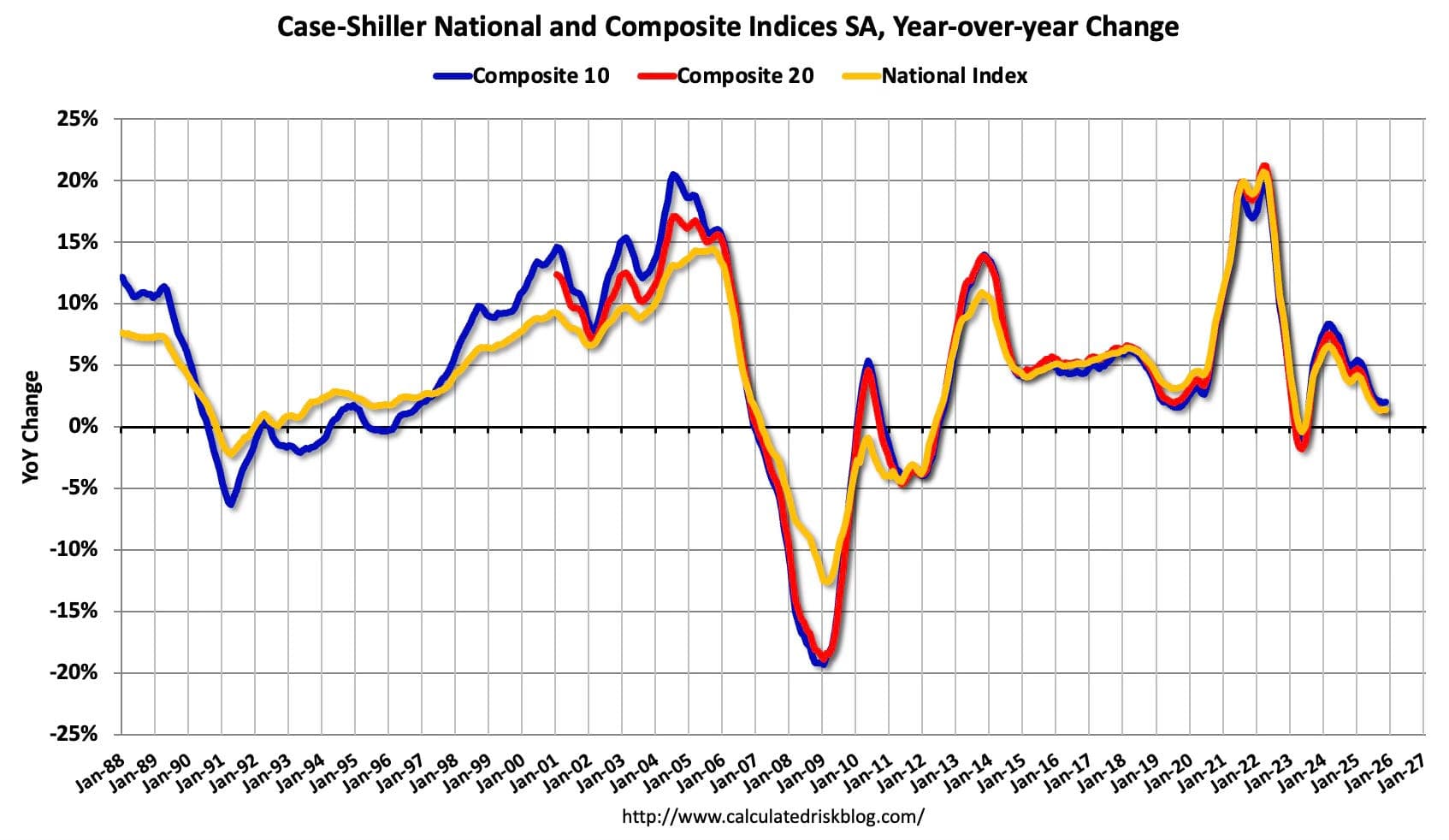
- The **Freddie Mac House Price Index** reported a **0.7% year-over-year increase in December**, marking **modest price gains** after months of stagnation or slight declines.
- The **Clear Capital Home Data Index (HDI®)** for January 2026 shows a **-0.6% quarter-over-quarter decline**, suggesting **less downward momentum** and a shift toward stabilization.
- The **National Association of Realtors (NAR)** Pending Home Sales Report for January reveals a **0.8% month-over-month decrease**, but with **regional variation**—notably gains in the Midwest and West contrasted with declines in the Northeast and South. This regional divergence hints at a **gradual, uneven recovery trajectory**.
- **Builder confidence** and **permitting activity** are showing regional upticks, indicating that **new construction could begin to increase** if these trends persist.
While **sales volume remains significantly below pre-pandemic levels**, these mixed signals collectively suggest the market is **bottoming out**, with cautious optimism for a **gradual recovery** in the months ahead.
## Policy Reforms and Local Initiatives: Laying Foundations for Recovery
In response to ongoing challenges, policymakers and regional leaders are enacting targeted reforms aimed at increasing supply and affordability:
- **Expansion of GSE MBS Capacity**: At the **Davos World Economic Forum**, discussions emphasized plans to **expand the capacity of government-sponsored enterprise (GSE) mortgage-backed securities (MBS)**. Advocates—including **former President Donald Trump**—argue this move could **improve liquidity**, **reduce mortgage costs**, and **broaden access**, thereby helping to **stabilize borrowing conditions** and **stimulate demand**.
- **Bipartisan Housing for the 21st Century Act**: Recently **passed in the House**, this legislation aims to:
- **Streamline permitting and zoning reforms** to accelerate supply growth.
- Offer **targeted subsidies and tax incentives** to improve affordability.
- Promote **sustainable, resilient development** aligned with environmental standards.
- **Regional Reforms in Michigan**:
- **Flint Township** has simplified permitting processes, exemplified by the approval of a **259-home development**, aiming to **unlock housing supply**.
- The **Richfield Road conversion project** in Genesee County is transforming Richfield Rd. into a **three-lane road** to **enhance mobility** and support increased housing development.
- The **Flint City Council** is actively addressing **water testing**, **grant funding**, and **water infrastructure upgrades**, which are vital for neighborhood stability and attracting residents.
- **FHA and Credit Policy Easing**: Industry advocates are urging policymakers to **lower FHA premiums**, **relax loan-related fees**, and **reduce or eliminate tri-merge credit reporting standards**, thereby **broadening credit access** for first-time and lower-income buyers.
- **Michigan’s Senior Tax Relief Proposal**: The state has introduced a **$90 million property tax relief initiative** aimed at seniors, designed to **reduce housing costs** and **help elderly residents remain in their homes longer**, fostering neighborhood stability and boosting local demand.
## Regional Development & Community Investment
Active regional projects and community investments continue to reshape neighborhoods:
- **Genesee County and Mundy Township** are advancing **large-scale residential and commercial developments**, supported by state funding, to **diversify supply** and **stimulate economic growth**.
- The **Charles Stewart Mott Foundation** announced a **$20 million investment** to **enhance parks and public spaces** across Flint, aiming to **improve neighborhood quality of life**, **attract residents**, and **revitalize communities**.
- Infrastructure upgrades, including **Richfield Rd. conversion** and **water system improvements**, are expected to **stabilize neighborhoods** and **encourage new residents**.
Recent articles emphasize ongoing regional revitalization efforts:
- State-backed projects are transforming historic properties in Montrose and Flint with significant funding, signaling a broader push toward neighborhood uplift and expanding housing options.
### Flint Water Rates and Community Engagement
Recent local developments highlight the interconnectedness of housing stability, utility affordability, and neighborhood health:
- The **Great Lakes Water Authority (GLWA)** announced **increases in water rates for Flint residents**, despite community protests and concerns over affordability amidst already high water costs. This increase occurs months after Flint was months away from paying more for its water supply, adding financial strain to homeowners and potentially impacting neighborhood stability.
- Meanwhile, Flint officials and community leaders continue to advocate for measures to **mitigate utility costs** and **support affordable living conditions**.
### Environmental and Quality-of-Life Initiatives
Efforts to improve neighborhood desirability include:
- The **relocated air monitoring station** at **Crossroads Village** now operational, providing critical data on local pollution levels. Such initiatives aim to **enhance environmental oversight**, **inform residents**, and **support healthier communities**, which are essential for attracting new residents and maintaining neighborhood stability.
## Industry and Technological Innovation: Restoring Confidence
The housing industry is increasingly leveraging **advanced technology** to address current bottlenecks and **restore confidence**:
- **AI-powered appraisal tools**, like **Restb.ai’s UAD 3.6 Compliance API**, are helping appraisers meet **Fannie Mae standards**, reducing delays and inspection costs.
- Platforms such as **LandGorilla’s Encompass** utilize **AI-driven processing** to facilitate **faster construction loan approvals** and **disbursements**, vital for stimulating new projects.
- **Analytics providers** like **ATTOM’s ResiShares** offer **real-time market insights**, enabling stakeholders to better understand **local conditions** and **trends**.
- The industry continues to emphasize **valuation integrity**, especially in light of recent **appraisal fraud allegations** against firms like **Cushman & Wakefield**. Industry leaders advocate for **modernized training**, **certification standards**, and **ethical practices**.
- **Regulatory measures**, including the **FINCEN Real Estate Reports** introduced for 2026, aim to **increase transparency** and **combat money laundering** in real estate transactions—adding oversight amid concerns over valuation fraud and market manipulation.
- **Michigan’s recent amendments to the Appraiser Board notice**—effective February 25, 2026—highlight **enhanced valuation standards**, **training requirements**, and **compliance protocols**, striving to **restore confidence** in property valuations during this critical recovery phase.
### Recent Industry Technology Advances
A notable development is **Class Valuation** becoming one of the early **Appraisal Management Companies (AMCs)** to gain **Collateral Underwriter (CU) access**. This move enhances **valuation accuracy and consistency** by leveraging Fannie Mae’s CU tool to **detect valuation anomalies**, **reduce fraud**, and **streamline workflows**. Such initiatives are expected to **boost confidence** and **support market stability**.
## Legal Landscape: Michigan Foreclosure Case at the Supreme Court
A significant legal event involves the **U.S. Supreme Court** scheduled to hear a **case impacting Michigan homeowners** who lost properties to tax foreclosure. The case examines whether **local government authorities** improperly foreclosed on properties, potentially violating homeowners’ rights.
**Implications include**:
- A **possible reversal or reform** of foreclosure procedures, which could **restore ownership rights** for many homeowners.
- Influence on **valuation and resale** of foreclosed properties, affecting local market dynamics.
- Establishing a **nationwide legal precedent**, especially in states with similar foreclosure laws.
Legal experts suggest that a **favorable ruling for homeowners** could lead to **increased legal challenges**, **financial restitution**, and **reforms in foreclosure practices**. Conversely, a **decision favoring local governments** might uphold current procedures but still prompt reforms to **better protect homeowner rights**. This case underscores the importance of **legal stability** in maintaining confidence and neighborhood stability.
## The Federal Register & Appraisal Data Collection
A recent notable development is the publication of the **Federal Register** notice titled:
> **Agency Information Collection Activities: Information Collection Renewal; Submission for OMB Review; Appraisals for Higher-Priced Mortgage Loans**
This notice pertains to **renewing data collection efforts** related to **appraisals for higher-priced mortgage loans**. The **OMB (Office of Management and Budget)** is reviewing these efforts to **enhance data quality**, ensure **transparency**, and **prevent appraisal fraud**, which is vital for the integrity of the housing market.
Such regulatory oversight aims to **strengthen appraisal standards**, **improve data accuracy**, and **restore confidence** in property valuations—especially crucial amid market uncertainties.
## Outlook for 2026: A Slow but Steady Path
Despite persistent challenges—**high mortgage rates**, **tight supply**, **valuation concerns**, and **legal uncertainties**—the combination of recent reforms, regional investments, technological advancements, and legal clarifications suggests the market is **approaching a stabilization phase**.
If these trends continue, **2026** could mark the beginning of a **gradual recovery**, characterized by:
- Increased **buyer confidence**
- A modest rebound in **new construction**
- Improved **affordability**
- Greater **neighborhood stability**
Monitoring upcoming economic indicators, including the **February 2026 Economic Weekly**, will be essential to gauge whether these positive signs persist and translate into tangible market improvement.
---
### **In Summary**
While 2025 has been a year of significant hardship—marked by record-low sales, high mortgage rates, and constrained supply—the momentum from recent policy initiatives, regional development projects, technological innovations, and legal clarifications offers hope for the future. These efforts are laying the groundwork for **a cautious but tangible stabilization** in the housing market. If sustained, 2026 may usher in a period of **gradual recovery**, making housing more accessible, affordable, and resilient—benefiting buyers, communities, and the broader economy alike.