# The 2026 Bootstrapped SaaS Landscape: Mastery, Ethical Innovation, and AI Orchestration at Scale – Updated and Expanded
The bootstrapped SaaS and digital product ecosystem of 2026 continues to exemplify resilience, sophistication, and a deepening mastery of AI-driven workflows. Building on foundational principles of disciplined growth, ethical AI deployment, community engagement, and resourcefulness, recent developments underscore that **successful bootstrapped businesses now thrive by orchestrating AI responsibly, maintaining tight unit economics, and fostering authentic relationships**. As the industry matures, it’s increasingly clear that **sustainable long-term growth hinges on a delicate balance of financial discipline, ethical AI practices, robust security, and flexible, developer- and user-friendly workflows**.
---
## Reinforcing Core Principles: Resourcefulness, Authenticity, Trust, and Security
Over the past year, a series of compelling case studies highlight how **resourcefulness, genuine relationships, community-driven engagement, and security** continue to serve as the backbone of scalable, sustainable bootstrapped SaaS success:
- **iLovePDF** has surpassed **one million users** primarily through **organic growth** and **trust-based relationships**. Their story—*"❤️How iLovePDF Built a Million-User SaaS Without Investors"*—demonstrates that **product quality and authentic engagement** outperform paid acquisition strategies. Their unwavering focus on **value delivery** and **trust-building** remains central to their success.
- **ADDA.io** has grown to **2.1 million users** entirely **without advertising or venture capital**. Their journey underscores the importance of **full ownership**, **transparent communication**, and **community-first strategies** that foster **resilient, scalable growth**. Their experience affirms that **trust and user-centricity** are sustainable, long-term growth drivers.
- **Trainual** achieved **$3.5 million in revenue** by **optimizing internal processes** and maintaining **customer-focused development**. Their example highlights that **operational efficiency** and **focused product-market fit** are fundamental for **bootstrapped expansion**.
- **Z-Image**, an AI-powered image generation startup, leverages **cost-effective freemium models**, offering **limited free generations** with optional premium plans. Their approach illustrates that **ethical, sustainable growth** in AI SaaS is achievable via **long-term revenue streams** and **responsible monetization**.
- **N1 (No-Code SaaS Builder)**: A standout involves an entrepreneur with no prior coding experience who built a fully functioning SaaS platform using **no-code tools combined with AI orchestration**. This case exemplifies how **non-technical founders** can **rapidly prototype and launch** digital products by leveraging **drag-and-drop builders, automation, and AI agents**, emphasizing **accessibility and democratization**.
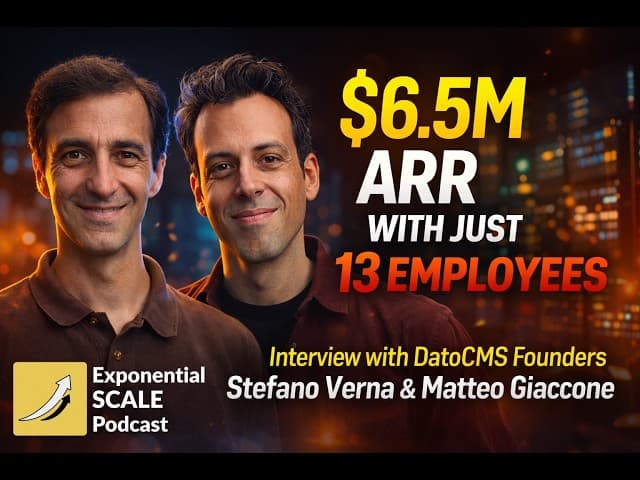
- **$6.5M ARR with a Small Team — The DatoCMS Example**: In a notable interview, DatoCMS—a content management platform—shared that they achieved **$6.5 million ARR with just about a dozen employees**. Their success underscores how **focused, bootstrapped growth** fueled by **efficient operations** and **customer-centric development** can scale profitably with modest teams. They highlighted their **revenue per employee (~$500K)** as a testament to **high operational leverage** achievable without external capital.
- **TxtCart**: An AI-powered SMS marketing platform, **TxtCart** has experienced rapid growth despite being bootstrapped. By offering **AI-enhanced personalization and automation** within a lean operational model, they’ve carved out a niche in **cost-effective, scalable SMS campaigns**. Their story underscores that **AI-driven vertical SaaS solutions** can thrive through **responsible monetization and community trust**.
### Key Takeaways:
- **Organic, community-led growth** remains the cornerstone.
- **Trust and product quality** outweigh aggressive paid marketing.
- **Full ownership and strategic flexibility** empower long-term control.
- **No-code and AI tools democratize SaaS creation**, enabling non-technical founders to launch and scale effectively.
- **Small, focused teams** can achieve significant ARR with disciplined operations.
---
## The Critical Role of Unit Economics, Ethical AI Deployment, and Security
In this mature ecosystem, **founders and investors** emphasize **core financial metrics** and **security frameworks** to ensure **profitability, resilience, and trustworthiness**:
- **Customer Acquisition Cost (CAC)**
- **Customer Lifetime Value (LTV)**
- **Churn Rate**
- **Payback Period**
- **Gross Margin**
**Weekly monitoring** of these indicators allows **agile decision-making** and **cost control**, helping startups **avoid waste** and **build sustainable growth engines**. Industry voices affirm that **"In bootstrapped SaaS, understanding your unit economics isn't optional—it's your lifeline."**
### Latest Development: Embedding Robust Identity, Access Controls, and Governance
A critical recent development is the **emergence of security and governance concerns in AI-enabled SaaS**, especially related to **OAuth and identity management**. The tool **OpenClaw** epitomizes this challenge:
> **"OpenClaw runs on an employee’s machine. But the access it creates lives inside Slack, Salesforce, Google Workspace, GitHub, and other business-critical platforms, raising significant security risks."**
This underscores a **growing vulnerability**: **AI orchestration tools that operate via personal or employee devices** can **accumulate access rights** across multiple enterprise platforms, risking **data breaches, unauthorized access, and compliance failures**.
To mitigate this, **founders must embed robust identity and access management (IAM)**, **multi-factor authentication (MFA)**, and **role-based permissions** into their AI workflows. **Security frameworks like StepSecurity** are increasingly vital—they help **address privacy, bias mitigation, and compliance**, building **trustworthy AI operations** essential for **long-term viability** and **user confidence**.
Recent evaluations of **OpenClaw** reveal notable security risks:
- **"OpenClaw runs on an employee’s machine. The access it creates lives inside Slack, Salesforce, Google Workspace, GitHub, and other business-critical platforms, raising significant security risks."**
- In contrast, **Perplexity Computer** offers a more turnkey experience, describing itself as aiming to be a **digital employee** with **integrated access management**. While **Perplexity** simplifies deployment, it’s crucial for users to **vet how these tools handle security** and **manage access rights**.
**The debate** around these orchestration tools centers on **security versus convenience**. Founders are increasingly evaluating **vendor trustworthiness**, **IAM integration capabilities**, and **security features** before deploying AI orchestration in sensitive environments.
---
## The Growing Ecosystem of AI-Driven Development and Orchestration
Recent innovations continue to emphasize **accessible, developer- and user-centric workflows**:
- **Vibe coding sessions**—where small teams or solo founders use **AI agents in low-code/no-code environments**—demonstrate **rapid prototyping**. These efforts can produce **working SaaS products within hours**, exemplifying the **power of AI orchestration** to **accelerate innovation**.
- **Anthropic’s "Remote Control"** empowers **mobile management** of AI agents, broadening **accessibility and flexibility** for remote or on-the-move teams.
- **Karpathy** emphasizes that **CLI interfaces** remain a **strategic platform**. **Legacy command-line environments** are **rich integration points** for **AI automation**, enabling **power users and automation specialists** to embed **AI agents into existing workflows seamlessly**.
### Recent advances include:
- **AI-driven pricing adjustments**, with companies **re-evaluating their models** to reflect **AI capabilities**, sometimes initiating **pricing resets** to better capture **AI-enhanced value**.
- The resource **"Is your SaaS AI-ready?"** stresses **evaluating infrastructure, security, and workflows** to ensure **smooth AI integration**.
- **Tutorials like "OnSpace AI"** showcase how **full SaaS products can be built solely using AI**, further **democratizing** rapid deployment and **lowering barriers** for solo founders and small teams.
- The emergence of **autonomous AI agents** raises provocative questions: **Will AI agents become the next CEOs?** The concept of **"The Rise of the Autonomous Company"** explores whether **AI-driven decision-making** will lead to **self-managing enterprises** in the near future.
---
## Practical Guidance for 2026 Bootstrapped SaaS Builders
To thrive amid these technological and market shifts, founders and teams should:
- **Embrace rapid prototyping techniques**, such as **vibe coding sessions**, to **test ideas and iterate quickly**.
- **Leverage no-code and AI orchestration tools** to **build MVPs and scale features** without extensive coding.
- **Utilize mobile AI management solutions** like **Remote Control** to **expand operational flexibility**.
- **Integrate CLI and terminal workflows** for **powerful automation and scripting**—especially for teams familiar with command-line environments.
- **Prioritize cost management** via tools like **AgentReady**, **StepSecurity**, and **Siteline** to **scale AI features affordably** and **maintain trust**.
- **Embed security and observability solutions** from the outset to **build user confidence** and **ensure regulatory compliance**.
- **Vet AI orchestration platforms** carefully, emphasizing **security features**, **IAM compatibility**, and **OAuth risk mitigation**. For example:
- **"OpenClaw’s approach"**—which involves running on employee devices and managing access across multiple platforms—requires **rigorous security review**.
- **Perplexity Computer** offers a more integrated approach but still necessitates **security evaluation**.
- **Convert existing WordPress plugins into SaaS offerings** by exploring **case studies like Melograno**, illustrating **how to bootstrap SaaS from familiar platforms**.
- **Implement governance and oversight** for autonomous agents, ensuring **transparency**, **bias mitigation**, and **compliance**.
---
## Current Status and Future Outlook
Today, **2026 SaaS** exemplifies **industry maturity**, characterized by **trust, disciplined economics, secure AI orchestration, and community-driven innovation**. Companies that **prioritize transparency, ethical AI deployment, and security** are establishing **resilient, long-term businesses** rooted in **integrity and mastery**.
The **trend toward democratization**—via **no-code platforms**, **mobile management**, **CLI automation**, and **security frameworks**—continues to accelerate, empowering **smaller teams and solo entrepreneurs** to **compete effectively** against larger, venture-backed players. This evolution underscores that **cost discipline, security, and transparent growth strategies** are essential for **sustainable success**.
As **Karpathy** noted, **legacy interfaces like CLI**, when combined with **powerful AI agents**, can **transform automation and productivity**, further democratizing **AI-driven innovation**.
---
## Final Reflection
The **2026 bootstrapped SaaS scene** is marked by a **blend of mastery, ethical AI practices, security, and community-driven innovation**. Success increasingly depends on **cost-effective AI orchestration, robust security, transparency, and responsible deployment**. **Founders and developers** who **leverage these tools and principles** are **shaping a trustworthy, resilient, and scalable digital economy**.
The **blueprint for long-term impact** remains clear: **discipline, integrity, and strategic AI deployment** are the keys to **lasting success**—and those committed to these principles will continue leading the way in **digital innovation**.
---
## Additional Resources and Practical Insights
- **"How a weekend session of vibe coding led to a fully-baked SaaS product"**—a practical case study illustrating rapid prototyping with AI agents ([YouTube](https://youtube.com/watch?v=XXXXXX)).
- **"Anthropic’s Remote Control"**—a mobile AI agent management tool broadening operational flexibility.
- **Karpathy’s insights on CLI as a strategic platform**—highlighting legacy interfaces as fertile ground for AI automation.
- **"Mato"**—a multi-agent terminal workspace enabling visualization and management of AI agents ([Hacker News](https://news.ycombinator.com/item?id=XXXXXX)).
- **"I Built a Full SaaS With Claude Code Max in 11 Minutes"**—a tutorial demonstrating rapid development ([YouTube](https://youtube.com/watch?v=XXXXXX)).
- **Financial benchmarks** like **SaaS Metrics School** help startups optimize growth and profitability.
- **Community forums and discussions** continue to explore **ecosystem positioning**, **agent preferences**, **security frameworks**, and **scaling strategies**.
---
## Implications and Conclusion
The **2026 bootstrapped SaaS ecosystem** showcases an industry where **discipline, mastery of AI orchestration, security, and ethical practices** form the core of enduring success. Smaller teams and solo entrepreneurs equipped with **no-code/low-code tools, AI management solutions, and strategic focus** are increasingly capable of **building impactful, scalable businesses** that rival larger, venture-backed competitors.
As the ecosystem evolves, **cost controls, security, and community trust** remain non-negotiable. Those who **prioritize transparency, responsible AI deployment**, and **continuous innovation** will secure a resilient position in the **future digital economy**. The era of democratized, AI-powered SaaS has truly arrived, promising a vibrant, accessible, and ethically grounded ecosystem for years to come.