# Apple’s Siri Overhaul Delayed Yet Again: Navigating Industry Advancements, Technical Hurdles, and Strategic Challenges
Apple’s much-anticipated plan to transform Siri into a cutting-edge, AI-powered assistant has encountered yet another postponement, underscoring the formidable challenges of integrating advanced generative AI within a privacy-first ecosystem. While the broader AI industry races ahead with innovative models, hardware breakthroughs, and multimodal capabilities, Apple remains cautious, emphasizing security, user trust, and technical feasibility. These persistent delays highlight the intricate balancing act between pioneering AI innovation and safeguarding user privacy.
## The Recurring Postponements and Underlying Challenges
Multiple sources confirm that **Apple has delayed its Siri overhaul again**, with no clear timeline for deployment. Despite ongoing internal efforts, several **interconnected hurdles** continue to impede progress:
- **Technical Barriers**: Deploying large language models (LLMs) across Apple's diverse device lineup remains complex. LLMs demand significant computational resources, which are difficult to reconcile with the limited processing power and energy constraints of older Apple devices, such as legacy iPhones and HomePods.
- **Hardware Limitations**: Devices with constrained hardware capabilities struggle to run sophisticated AI models efficiently and responsively, creating a bottleneck for on-device AI deployment.
- **Model Optimization Difficulties**: Achieving a balance between **low latency**, **responsiveness**, and **energy efficiency**—while maintaining high AI performance—requires advanced techniques like pruning, quantization, and knowledge distillation. These methods are still under active development and refinement.
- **Privacy-Preserving Training Complexities**: Apple’s unwavering commitment to user privacy—via federated learning, differential privacy, and secure data protocols—adds layers of complexity to training, testing, and deploying AI models. Ensuring security and privacy safeguards often slows down iteration cycles.
- **Security and Supply Chain Risks**: Recent incidents have raised alarms. For example, a breach involved malicious actors leveraging AI tools like Claude to exfiltrate **150GB of Mexican government data**, exposing vulnerabilities in AI-assisted data theft. Furthermore, supply chain threats, such as Worm attacks similar to the “Shai-Hulud” incident, threaten the integrity of Apple's AI development pipelines.
These factors collectively reinforce Apple’s **privacy-first, security-conscious strategy**, favoring meticulous, secure progress over rapid deployment. This approach contrasts sharply with competitors pushing ahead with increasingly capable AI assistants, further intensifying industry pressure.
## Industry Momentum and Technological Innovations Accelerating AI Capabilities
Despite Apple’s schedule uncertainties, the **AI industry continues to accelerate**, with notable models and hardware innovations:
- **Next-Generation Models**: Recent breakthroughs like **Gemini 3.1** outperform earlier models in scalability and real-world deployment readiness, signaling that powerful, adaptable AI solutions are becoming more accessible.
- **On-Device Inference Breakthroughs**: Advances demonstrate that **single-GPU inference setups**, such as **RTX 3090 with 24GB VRAM** utilizing NVMe direct I/O, are enabling **more efficient local AI processing**. This progress suggests that **on-device AI solutions** could become increasingly feasible, reducing reliance on cloud infrastructure.
- **Hardware Innovations**: Researchers are exploring **chip-level embedding of LLMs**, including approaches like **“printing” models directly onto hardware chips**. Recent discussions around **Taalas’ method** illustrate the potential for **massively streamlined AI integration**, dramatically minimizing latency and power consumption.
### Ecosystem Investments and Emerging Tools
- **Strategic Funding**:
- **European startup Axelera AI** secured an additional **$250 million** led by **Innovation Industries**, focusing on **chip-level AI acceleration**.
- **SambaNova** launched its **SN50 AI chip**, designed for large-model workloads, raising **$350 million** to expand its hardware ecosystem.
- **Development of Supportive Tools**:
- Startups like **Trace** raised **$3 million** to develop **enterprise AI agent platforms** emphasizing **privacy-preserving, practical AI tools**.
- Projects like **PyVision-RL** are exploring **reinforcement learning** in vision models and **multi-agent systems**, pointing toward future **autonomous, adaptable AI assistants**.
### Advances in Multimodal and Efficient AI Models
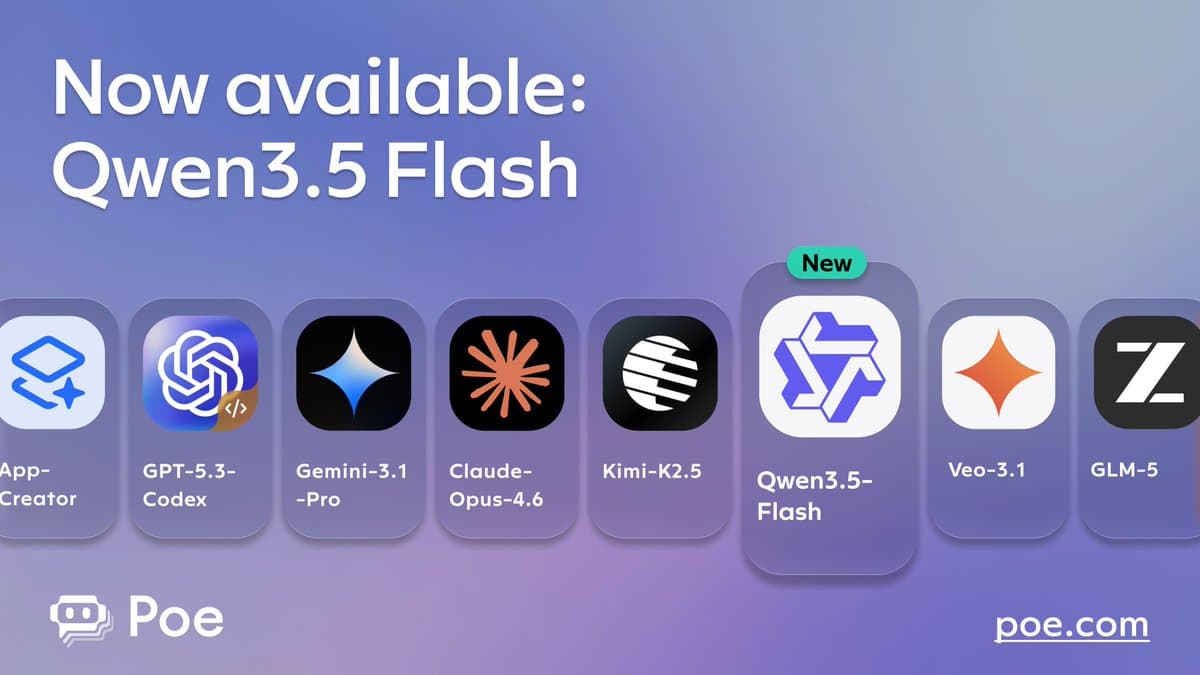
- **Qwen3.5 Flash**, a multimodal model capable of processing text and images, has recently gone live on **Poe**, exemplifying **faster, more resource-efficient AI** that handles complex, multi-sensory data streams. This development indicates a **shift toward multimodal AI solutions** that are both high-performance and resource-conscious.
## Broader Industry Developments and Strategic Signals
Further industry movements emphasize a focus on **scalable, efficient AI**:
- **Partnerships and Infrastructure**:
- AMD and **Nutanix** announced a **strategic alliance** to build **open, scalable enterprise AI platforms**, integrating hardware and software solutions for broader deployment.
- **Security and AI-Generated Code**:
- The rise of **AI-assisted coding** introduces **security risks**, with AI-generated code sometimes embedding **hardcoded vulnerabilities** or predictable patterns, increasing systemic security concerns.
- Similarly, **AI-generated passwords** may inadvertently embed **predictable vulnerabilities**, posing additional threats.
- **Scaling Test-Time Compute**:
- The AI community recognizes that **4-billion-parameter models**, when scaled with sufficient inference resources, can rival larger models like Gemini, making **local AI models** increasingly powerful and accessible.
## Strategic Implications and Future Pathways
The persistent delays, despite rapid technological progress, underscore key strategic considerations for Apple:
- **Competitive Pressure**: Rivals deploying **more capable AI features** threaten Apple’s leadership in personal assistants and voice interfaces.
- **User Trust and Expectations**: Continued postponements risk **eroding consumer confidence** in Siri’s future, especially as AI becomes central to daily digital interactions.
- **Balancing Privacy and Innovation**: As AI assistants evolve into channels for targeted advertising or commerce, **privacy remains both an asset and a challenge**. Integrating AI advancements while preserving core privacy principles is critical.
- **Differentiation Through Trust**: Apple’s **reputation for privacy-centric design** could serve as a **competitive advantage** if effectively embedded into future AI offerings.
### Potential Strategic Approaches
To speed up Siri’s development while maintaining privacy, Apple might consider:
- **Hybrid Architectures**: Combining **on-device AI processing** with **cloud-based computation** to optimize **responsiveness**, **privacy**, and **cost-efficiency**.
- **Hardware-Embedded Models**: Investing in **chip-level embedding of LLMs**, inspired by recent breakthroughs, to **reduce latency and energy consumption** dramatically.
- **Enhanced Trust & Safety Protocols**: Developing **verification frameworks** and **robust security measures** to **mitigate risks** stemming from malicious tampering or AI misbehavior.
## Current Status and Outlook
While a definitive timeline remains elusive, **industry trends point toward a promising future**:
- **Efficient models** like **Gemini 3.1** and advances in **single-GPU inference** make **on-device AI deployment increasingly practical**.
- **Hardware embedding solutions**, supported by recent investments, promise to **significantly reduce latency and power demands**.
- **Regional AI initiatives**, such as India’s plans for extensive data centers, suggest a **distributed, scalable AI infrastructure** capable of supporting local deployment at scale.
Apple’s ability to **harness these innovations**—through **model optimization**, **hardware breakthroughs**, and **trust-centric frameworks**—will be crucial in **accelerating Siri’s overhaul** while safeguarding its privacy principles. Success could **reaffirm Apple’s leadership** in private AI, whereas continued delays might allow competitors to gain an advantage.
## Implications for the AI Landscape and Trust in Generative AI
Industry voices emphasize that **trustworthiness and safety** are essential for sustainable AI deployment:
- **Gary Marcus** warns that **"Generative AI is NOT remotely reliable enough to make life or death decisions,"** highlighting the importance of **security and verification**.
- **Karpathy** stresses that **rapid AI evolution in programming** necessitates **robust safety frameworks**.
These perspectives reinforce that **trust, safety, and scalability** are foundational for AI’s future. Apple’s **privacy-first approach** uniquely positions it to lead responsibly—if it can effectively integrate these principles into its AI development pipeline.
## Final Thoughts
Apple’s repeated delays in its Siri AI overhaul exemplify the **delicate balance** between **technological innovation**, **privacy considerations**, and **security safeguards**. While industry momentum accelerates with models like Gemini and hardware breakthroughs, Apple’s cautious approach aims to ensure a **trustworthy, secure AI experience**.
**The coming months will be pivotal**. Success depends on Apple’s ability to **capitalize on emerging AI hardware and software innovations**, such as **chip-embedded LLMs**, **hybrid on-device/cloud systems**, and **trust-enhanced architectures**—all aligned with its core privacy values. Achieving this could **reassert Apple’s leadership** in private, intelligent personal assistants, while ongoing delays risk ceding ground to more agile competitors.
In this rapidly evolving landscape, **trust, safety, and scalability** remain paramount—values that will shape Apple’s strategic choices as it navigates the complex journey toward a smarter, more private Siri.
---
*This article synthesizes recent developments, including industry advancements like the successful deployment of multimodal models such as **Qwen3.5 Flash**, which processes both text and images efficiently, and breakthroughs in on-device AI inference. These innovations underscore a future where **local, efficient, and trustworthy AI solutions** become increasingly feasible, aligning with Apple’s strategic priorities.*