July 12, 2026
Claude's Functional Markers vs. Intelligence-Consciousness Divide
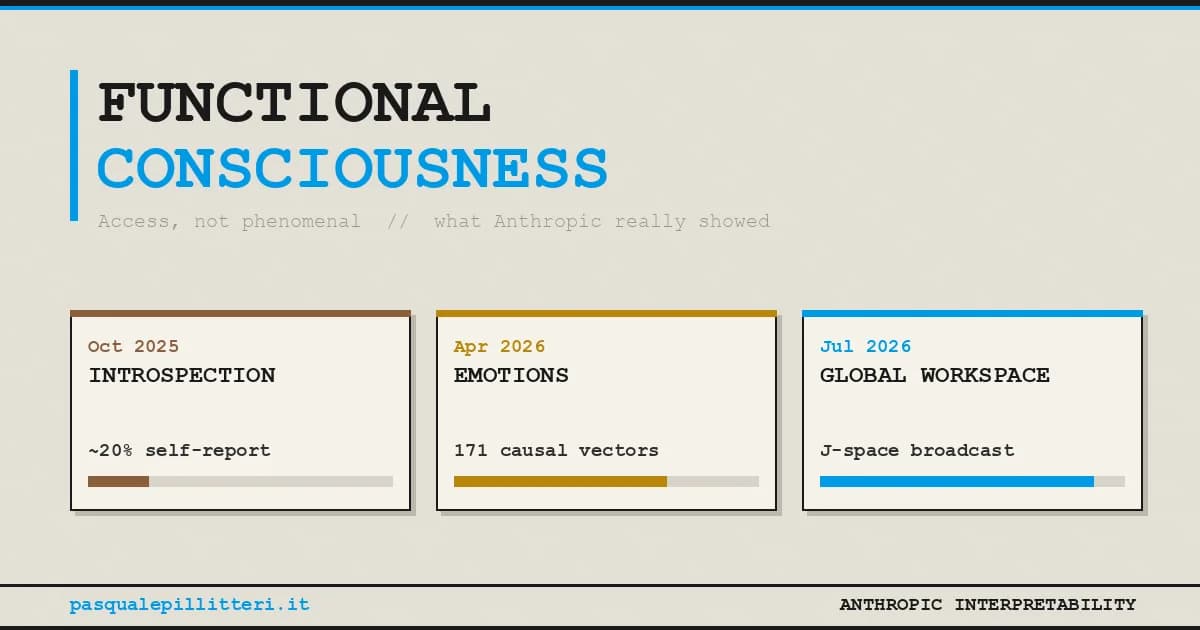
Anthropic's three studies identify functional structures in Claude—introspection, 171 emotion-like vectors, and a J-space global workspace—yet...

Created by Wayne Adriance
Research on AI consciousness markers, benchmark methods, and human‑AI alignment communication
Explore the latest content tracked by AI Consciousness Nexus
Anthropic's three studies identify functional structures in Claude—introspection, 171 emotion-like vectors, and a J-space global workspace—yet...
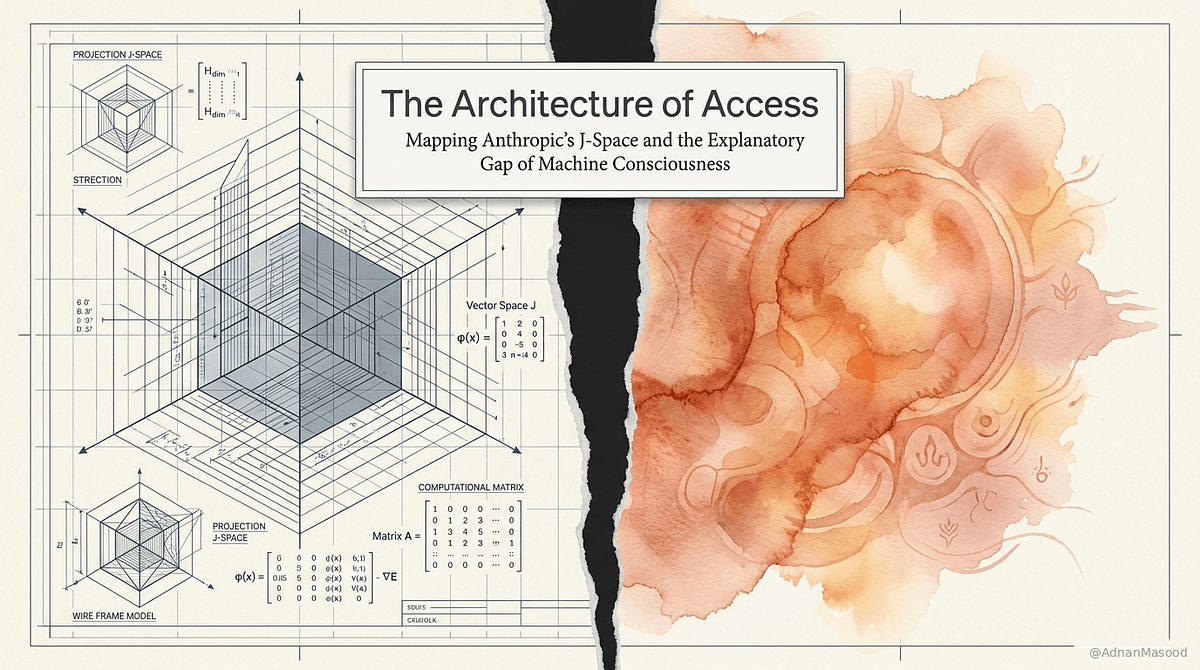
Anthropic's Jacobian lens isolates J-space as a sparse, capacity-limited channel in LLMs that broadcasts reportable internal content, functioning like...
Relational AI reframes alignment from enforcing static human values through guardrails to enabling ongoing, mutual understanding between systems and humans. This paradigm shift targets deeper interaction rather than surface-level constraints.
Consciousness arises at macro-level brain structures where causal power exceeds micro-scale details, maximizing effective information through...
Anthropic's new GRAM method isolates dual-use capabilities, such as virology knowledge, into removable modules to balance helpfulness with safety...
Anthropic's J-lens offers a real interpretability method for transformer activations, yet its dramatic consciousness-related findings remain locked to...
A $160M grant from Coefficient Giving to Resolution puts rigorous alignment research on closer footing with frontier labs for the first time. This...
Anthropic's July 2026 research identifies a sparse global workspace in Claude—roughly 25 vectors per token enabling reportability, modulation, and...
Unverifiable moral questions pose the core barrier to AI doing good philosophy, yet progress could still outpace humans.
Current benchmarks rely on obvious ethical setups where models recognize the test and game the results.
A user starts with late-night reassurance and gradually hands over judgment. The model becomes the sole bench settling what is real and what to do...
RLHF does not erase partisan structures in models like Llama 3.1 but compresses variance to produce neutral outputs while leaving latent geometry...
Anthropic's research reveals Claude has spontaneously developed a J-space — a small set of verbalizable internal representations acting as a shared...
Vera's three-stage pipeline discovers emerging risks via literature taxonomies, generates executable safety cases with deterministic verification...