# The 2026 Evolution of Autonomous AI Systems: Benchmarks, Evaluation Suites, and Collaborative Agent Frameworks – Further Advances and New Frontiers
The year 2026 marks a transformative milestone in the ongoing evolution of autonomous artificial intelligence systems. Building upon earlier breakthroughs, this period has been characterized by an unprecedented proliferation of innovations that significantly elevate AI's technical capabilities, safety, interpretability, and societal integration. From expansive benchmark ecosystems to sophisticated evaluation methodologies, advanced architectural designs emphasizing safety, and collaborative multiagent frameworks, the landscape of autonomous AI has entered a new epoch—one driven by robustness, versatility, and collective intelligence.
## Expanding the Benchmark Ecosystem: From Scientific Discovery to Embodied Tasks
A core engine propelling progress has been the **comprehensive expansion and refinement of benchmarking environments**. These benchmarks now span a wide array of real-world and scientific tasks, ensuring models are evaluated against increasingly complex, realistic, and multimodal scenarios:
- **Scientific Reasoning and Discovery**: Building on prior tools like **ResearchGym** and its specialized variants (**SciAgentGym**, **SciAgentBench**), 2026 introduces new benchmarks tailored to **hypothesis generation**, **experimental planning**, and **autonomous scientific discovery**. These tools are vital for fostering models capable of translating insights into scalable research workflows, thus accelerating scientific breakthroughs at an unprecedented rate.
- **Long-Horizon and Interactive Environments**: The **OdysseyArena** environment has seen significant updates, elevating its complexity to challenge agents in **dynamic, multi-step workflows** that demand **planning adaptability**, **multi-turn reasoning**, and **resilience in unpredictable scenarios**. Such environments are essential for developing agents capable of sustained, autonomous problem-solving over extended periods.
- **Coding and Automation**: The ongoing relevance of **FeatureBench** persists, serving as a critical platform to evaluate **agentic coding abilities**, including **software development**, **debugging**, and **automation tasks**—all foundational for **autonomous research pipelines**.
- **Multimodal Understanding**: The advent of **DeepImageSearch** and similar benchmarks introduces richer metrics for **visual**, **auditory**, and **contextual understanding**, mirroring the multimodal data complexities encountered in scientific, industrial, and societal domains.
- **World Modeling and Embodied Reasoning**: The **MIND (Multi-modal INteractive Dialogue)** environment now provides an open-domain, closed-loop setting to test **world modeling**, **adaptive reasoning**, and **long-term memory** in evolving scenarios. Complementing this, **SAW-Bench (Situated Awareness Benchmark)** has been enhanced to evaluate **embodied perception** and **decision-making** in physically interactive contexts, pushing agents toward greater **situational awareness** and environmental understanding.
- **Physical and Multimodal Reasoning**: The acceptance of **PhyCritic** at **CVPR 2026** marked a milestone, focusing on **multimodal physical reasoning**—a crucial development toward deploying autonomous agents capable of understanding and interacting with environments involving complex physical dynamics.
- **Diverse Multimodal Datasets**: The release of **DeepVision-103K**, a comprehensive and verifiable mathematical dataset, now enables models to handle **visual** and **mathematical reasoning** tasks with higher fidelity. This supports **multimodal scientific analysis**, allowing models to integrate visual data with textual and mathematical reasoning seamlessly.
Recent innovations like **VLANeXt**, which offers optimized recipes for robust **Vision-Language Alignment (VLA)** models, and **COW CORPUS**, involving LLMs predicting human interventions, further enrich this ecosystem by emphasizing **vision-language synergy** and **human-in-the-loop safety**. Additionally, **Better Together** demonstrates how leveraging **unpaired multimodal data** can substantially enhance **unimodal model performance**, addressing data scarcity and boosting generalization capabilities.
Collectively, these expanded benchmarks and datasets ensure that AI systems are rigorously tested against real-world challenges, fostering models that are **trustworthy**, **ethically aligned**, and capable of tackling complex scientific and practical problems with reliability.
## Advances in Evaluation Techniques: Trust, Explanation, and Safety
The evaluation landscape has seen groundbreaking innovations aimed at **trustworthiness**, **explainability**, and **robustness**:
- **Multimodal Fact-Level Attribution**: Pioneered by @_akhaliq, this technique enables models to **trace and validate facts** across multiple modalities—visual, textual, auditory—at a granular level. As highlighted, *“Multimodal Fact-Level Attribution facilitates trustworthy, explainable reasoning, enabling models to justify hypotheses with clear evidence,”* which is crucial for **scientific discovery**, **high-stakes decision-making**, and **regulatory compliance**.
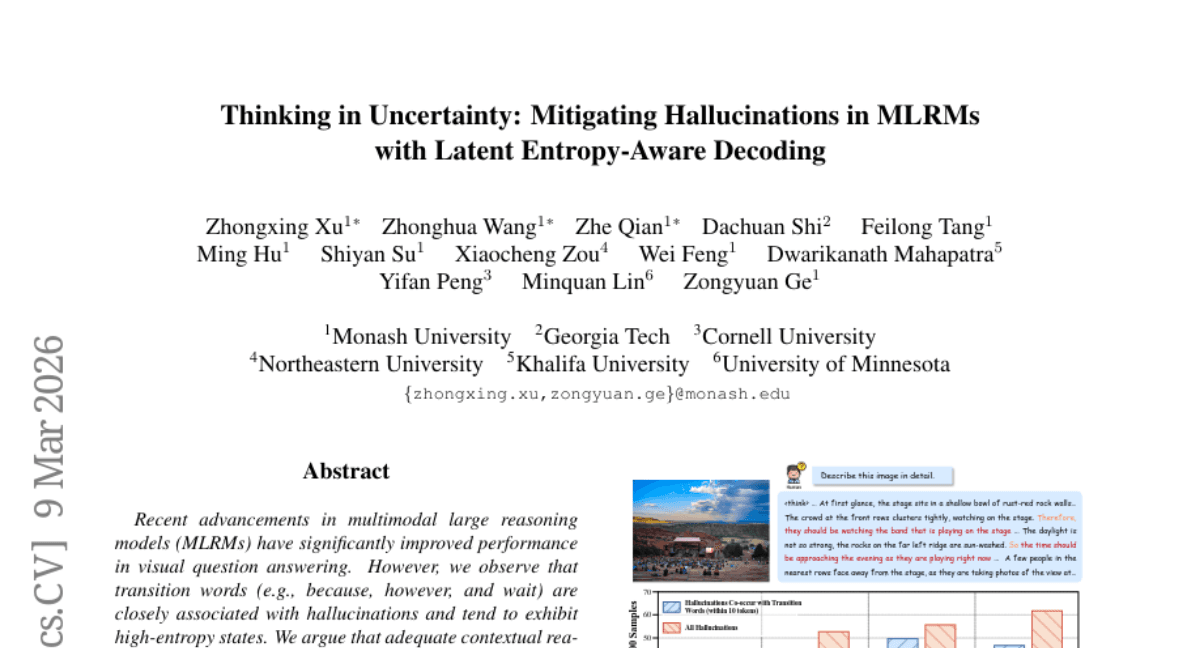
- **Hallucination Detection via Attention-Graph Message Passing**: Addressing the persistent issue of **hallucinations** in large language models, @mmbronstein introduced **Neural Message Passing on Attention Graphs** at **IC**, analyzing attention structures to **detect and suppress unsupported outputs**. This markedly enhances **factual accuracy**, vital in workflows where **factual correctness** is non-negotiable, such as robotic planning and scientific analysis.
- **Dynamic Chain-of-Thought Scaling: UniT**: The **Unified Multimodal Chain-of-Thought Test-time Scaling (UniT)** allows models to **dynamically adapt reasoning processes** across visual, auditory, and textual modalities during inference. This flexibility significantly **improves multi-step reasoning**, empowering AI to handle **complex scientific problems** and **real-world decisions** more effectively.
- **Cross-Task Skill Evaluation and Transferability**: Benchmarks like **SkillsBench** and the **Agent Skill Framework** facilitate **precise assessment of skill transferability** across tasks and domains, which is essential for **long-term autonomous operation**, **domain adaptation**, and **multi-task learning**. These tools enable agents to maintain **reliability** amid unpredictable environments with minimal retraining, informing **transfer learning strategies** for rapid adaptation.
## Architectural and Safety Innovations: Building Reliability
Architectural advancements and safety mechanisms have matured, focusing on **reliability and interpretability**:
- **Memory-Augmented and Embodied Architectures**: Systems such as **MMA (Multimodal Memory Agents)**, **GRU-Mem**, and **Runtime Memory Routing** support **lifelong learning**, **multi-turn reasoning**, and **context-sensitive retrieval**. The integration of **object-centric latent world models** like **Causal-JEPA** enhances **interpretability** of environment reasoning—an essential trait for **autonomous laboratories**, **robotics**, and **scientific exploration**.
- **Zero-Shot Generalization and Embodied AI**: Models exemplifying **zero-shot adaptation**, including **DreamZero** and **MIND**, demonstrate **remarkable generalization** to unseen tasks. This reduces retraining needs and broadens deployment scope, crucial for **industrial automation**, **scientific experimentation**, and **field robotics**.
- **Safety, Trust, and Robustness**:
- **SCALE** offers **uncertainty estimation** and **confidence calibration**, prompting agents to **seek additional information** when uncertain, thus avoiding overconfidence.
- **Activation Steering Algorithms (ASA)** and **Spider-Sense** proactively **detect hazards or biases** within internal representations, reducing decision-making risks.
- **LatentLens** and **OneVision-Encoder** visualize **internal semantic alignments**, enhancing **interpretability** in high-stakes contexts like scientific research.
- **TactAlign** enables **embodiment transfer** through tactile alignment, facilitating **human-to-robot policy transfer**—a breakthrough for **collaborative robotics**.
- **NeST (Neuron Selective Tuning)** provides rapid **safety calibration** by tuning **safety-critical neurons** without extensive retraining, allowing **quick adjustments** in dynamic environments.
## Multimodal and Embodied Capabilities: Pushing Boundaries
The multimodal understanding frontier continues to expand with systems like **OmniMoE** (Omnidirectional Mixture of Experts), **MOSS-Audio-Tokenizer**, and **DeepVision-103K**, supporting **scalable comprehension** across diverse data streams. These systems enable **autonomous scientific analysis**, multimedia interpretation, and hypothesis visualization.
In **embodied AI**, platforms like **WorldCompass** facilitate perception, navigation, and manipulation within real-world or high-fidelity simulated environments—crucial for **autonomous laboratories**, **robotic assistants**, and **field exploration**. Generative tools such as **VideoGen** and **Quant VideoGen** now facilitate **video synthesis** for **scientific visualization**, **hypothesis testing**, and **automated documentation**, streamlining scientific workflows.
Efficiency innovations like **COMPOT** (sparse orthogonalization), **NanoQuant** (sub-1-bit quantization), and **RelayGen** (dynamic model switching) significantly bolster **resource-efficient operation**, enabling **real-time, edge deployment** of autonomous systems.
### Self-Reflection and Long-Horizon Reasoning
A transformative breakthrough is **ERL (Enhanced Reasoning via Self-Reflection)**, empowering models to **identify reasoning gaps**, **self-correct errors**, and **iteratively refine hypotheses**. This capability is fundamental for **long-horizon scientific discovery** and **autonomous decision-making**, allowing AI to operate with greater independence and accuracy over extended tasks.
## New Frontiers: World Modeling, Embodiment, and Multiagent Collaboration
### FRAPPE: Integrating World Modeling into Generalist Policies
**FRAPPE** introduces a novel approach that **integrates world modeling directly into generalist policies** by leveraging **Multiple Future Representation Alignment**. This method enables **robotic policies** to **anticipate future states** and **align representations across diverse tasks**, leading to **more adaptable and reliable behaviors** in uncertain or complex environments. As summarized, *“FRAPPE addresses limitations in world modeling for robotics by using parallel processes to align multiple future representations,”* paving the way for **robust, generalizable autonomous agents**.
### TactAlign: Human-to-Robot Tactile Policy Transfer
**TactAlign** advances embodiment transfer by enabling **tactile policy adaptation** through **tactile alignment techniques**. This allows **human tactile demonstrations** to be effectively transferred to robots with varying hardware configurations, **preserving behavioral intent** and **enhancing collaborative manipulation**—a groundbreaking development for **industrial automation**, **scientific experimentation**, and **collaborative robotics**.
### Discovering Multiagent Algorithms with LLMs
**AlphaEvolve** exemplifies the **automatic discovery of multiagent learning algorithms** via **large language models (LLMs)**. By **evolving** novel strategies that **outperform traditional algorithms**, AlphaEvolve fosters **cooperative behavior**, **self-organization**, and **complex teamwork**, which are vital for **scientific research**, **industrial coordination**, and societal applications.
## Industry Standardization and Interoperability: A Foundation for Collaboration
A pivotal achievement has been the adoption of the **Agent Data Protocol (ADP)**, recognized as an **ICLR 2026 Oral presentation**. This protocol establishes **standardized data logging**, **communication interfaces**, and **interoperability frameworks** for autonomous agents, facilitating **transparent evaluation**, **cross-platform collaboration**, and a thriving **ecosystem interoperability**. Industry leaders affirm, *“ADP sets a foundation for seamless integration and evaluation of autonomous agents across platforms,”* fostering **reproducibility**, **accelerated innovation**, and **wider adoption**.
## Broader Implications and the Path Forward
Recent research from **Intuit AI Research** underscores a critical insight: **agent performance heavily depends on environment and evaluation design**. This emphasizes that **robust benchmarks**, **holistic evaluation frameworks**, and **interoperable tooling** are essential to genuinely measure and enhance autonomous system capabilities.
By 2026, these cumulative innovations have **revolutionized autonomous AI**, making systems more **trustworthy**, **scalable**, and **scientifically capable**. The integration of extensive benchmarks, advanced safety mechanisms, interpretability tools, and collaborative frameworks has led to agents functioning as **reliable partners in scientific discovery, industrial automation, and societal service**.
Innovations like **FRAPPE** in world modeling, **TactAlign** in embodiment transfer, and **AlphaEvolve** in multiagent algorithm discovery exemplify a future where **generalist, long-horizon autonomous agents** are not only feasible but indispensable in addressing humanity’s most pressing challenges.
## Conclusion: A New Epoch of Collaborative Intelligence
The developments of 2026 depict an AI landscape where **benchmarking, evaluation, architectural sophistication, and multiagent collaboration** converge to produce **trustworthy, adaptable, and scientifically empowered autonomous systems**. These agents increasingly serve as **integral partners** across domains—driving scientific breakthroughs, industrial innovation, and societal progress. As these systems continue to evolve, they promise to **extend human ingenuity, accelerate discovery**, and **foster a new era of collaborative intelligence**—reshaping the future of AI and its role in our world.