# Volatile Inflows, Outflows, and Shifting Sentiment Define the 2026 U.S. Spot Crypto ETF Landscape
The U.S. cryptocurrency ETF sector in 2026 continues to exemplify a **highly reactive and unpredictable environment**, marked by episodic large-scale capital movements, rapid technological innovations, and an evolving regulatory landscape. While signs of sector maturity are emerging, persistent volatility driven by macroeconomic shocks, geopolitical tensions, and regulatory ambiguities maintain the sector’s frontier-like character—offering opportunities intertwined with significant risks.
## Persistent Volatility and Episodic Capital Flows
Throughout 2026, the sector has been characterized by **frequent, dramatic swings** in investor capital, often triggered by external shocks such as economic data releases, geopolitical conflicts, or regulatory signals. These shocks can lead to **massive withdrawals or inflows**, sometimes exceeding **$1 billion within days**, underscoring the **reactive nature of investor sentiment**.
- **Continued Outflows Amid External Shocks:**
CoinShares reported a **$187 million** weekly outflow even as trading volumes surged to **$63.1 billion**, illustrating a disconnect where **high trading activity** coexists with **investor caution**. Ethereum-focused ETFs faced **$16.8 million** in outflows over three consecutive days amid rising volatility and risk aversion.
- **Recent Flows Data (as of late February 2026):**
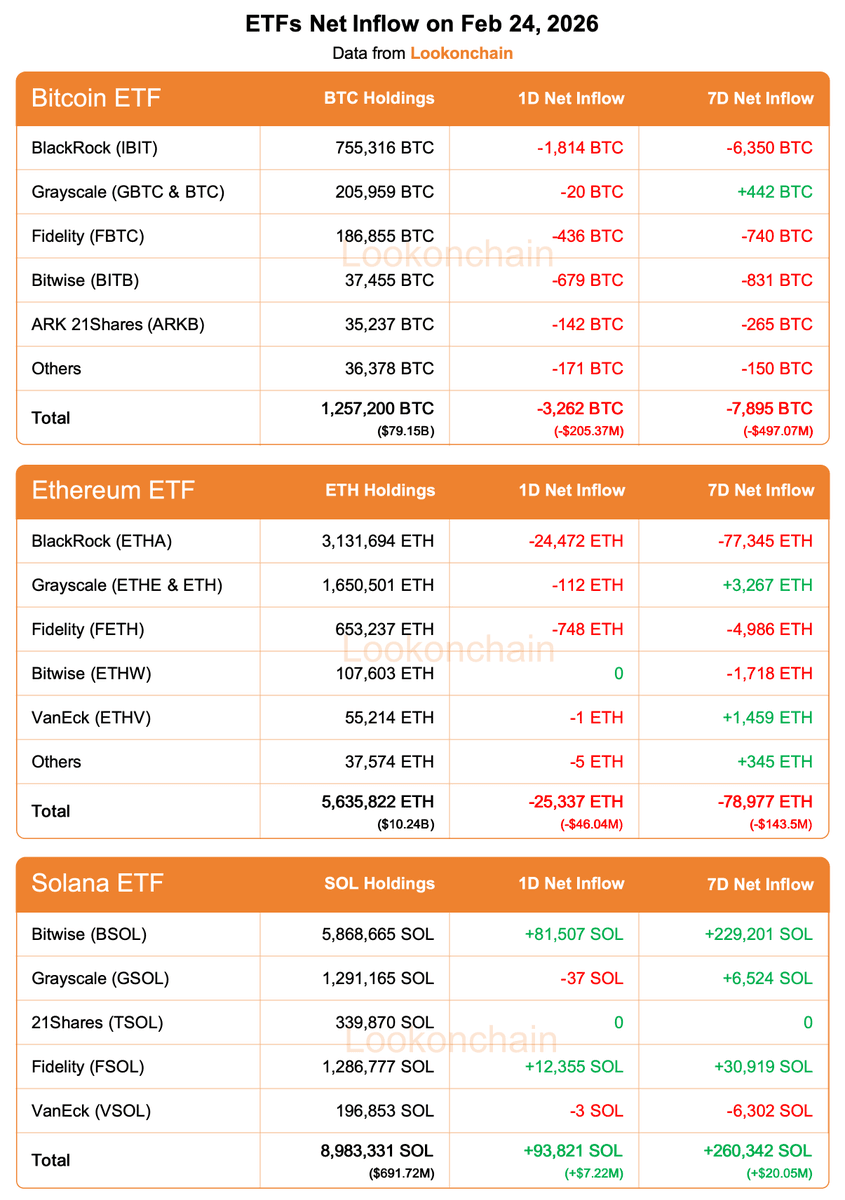
Total outflows from U.S. spot crypto ETFs stand at approximately **–$240.87 million**. Major funds like BlackRock’s Bitcoin spot ETF have liquidated around **3,010 BTC**, valued roughly at **$203.8 million**—a clear sign of institutional liquidation amid turbulent times.
- **Contrasting Inflows and Outflows:**
After a significant withdrawal phase in late 2025—totaling **around $4.57 billion** in November and December—there have been episodes of renewed investor interest. For example, **January 2, 2026**, saw **$471 million** flow into Bitcoin ETFs and **$174 million** into Ethereum ETFs, driven by signs of macro stabilization and positive regulatory signals. Yet, these inflows are often short-lived; within days, sector funds experienced **net outflows of approximately $243 million**, prompted by weaker macroeconomic data, Bitcoin slipping below **$90,000**, and rising volatility.
- **Institutional Selling and Market Fear:**
Industry data reveals significant institutional liquidations. Bloomberg ETF analyst James Seyffart indicated that **Bitcoin ETF holders sold about 25,098 BTC in Q4**, worth roughly **$497 million**. Wall Street firms reduced their Bitcoin ETF holdings by over **$1.6 billion** during the same period, reflecting a cautious stance amid ongoing turbulence.
- **Extreme One-Day Movements:**
The sector experienced **single-day outflows nearing $818 million** amid declining prices, alongside **$257 million** flooding into Bitcoin ETFs on a different day. This highlights the **intraday volatility** and **fragility of investor sentiment**.
- **Market Sentiment Fluctuations:**
On **February 18**, Bitcoin ETFs faced **$133.3 million in outflows**, indicative of **"extreme fear"** among investors. Conversely, mid-January saw **weekly inflows** reaching **$1.42 billion**, the strongest since late 2025, signaling that **long-term confidence persists** despite short-term turbulence.
**In essence**, capital flows remain **highly sensitive to external shocks**, often resulting in **rapid, large movements exceeding $790 million within days**, emphasizing the **reactive and volatile** nature of investor sentiment in the crypto ETF space.
## The "Yield War" Accelerates with Institutional Innovation
A defining feature of 2026 has been the **intensified competition among ETF providers** to embed **yield-generating features**, as traditional assets continue to offer **persistently low yields**.
- **Emerging Income-Driven Products:**
Major firms like **Grayscale** have announced plans to **distribute Ethereum staking rewards totaling approximately $9.39 million** directly to ETHE ETF holders, creating **passive income streams** that boost ETF appeal. Similarly, **21Shares** pays **distributions of $0.010378 per share** on its Ethereum ETF (TETH), reflecting a sector-wide shift toward **income-oriented strategies**.
- **Institutional and Retail Interest in Yield:**
Firms such as **Morgan Stanley** have filed S-1 registration statements for **Bitcoin, Ethereum, and Solana** funds with embedded yield features, aiming to **offer regulated, institutional-grade crypto products**. The Ethereum staking ecosystem continues its expansion—**around 35.9 million ETH are staked**, roughly **30% of the total supply**—offering **notable income opportunities** for ETFs and investors.
- **Altcoin Yield Initiatives:**
Recent launches include **SUI (Sui)** ETFs from Canary (TSUI) and Grayscale (GSUI), both incorporating **staking rewards into distributions**. These offerings demonstrate the sector’s push toward **income-generating crypto assets**, especially appealing to **conservative and income-seeking investors**.
- **Operational Constraints and Distributions:**
The Ethereum staking backlog has surged to an estimated **$8 billion**, primarily due to infrastructural bottlenecks and capacity limits. These operational hurdles **reduce staking yields** and **disrupt income distributions**, potentially **dampening investor enthusiasm** and injecting **uncertainty** into income expectations.
## Ethereum Staking Expansion Encounters Capacity Constraints
Ethereum’s **staking ecosystem** remains a key growth driver but faces **capacity limitations** that could **temper expansion and income potential**:
- **Staking Volume and Infrastructure Bottlenecks:**
Nearly **36 million ETH** are staked, with institutional players like **BitMine** investing **$110 million**. The **staking backlog**—ETH waiting to be staked—has ballooned, constraining further capacity expansion. This bottleneck **reduces staking yields**, thereby **dampening income streams** for ETFs and investors.
- **Impact on Investor Confidence and Income:**
These operational constraints **undermine confidence**, as decreased distributions and increased volatility become more frequent. **Scaling infrastructure** remains a slow process; however, recent strategic moves aim to address this.
- **Bitwise’s Strategic Acquisition:**
A notable development is **Bitwise’s acquisition of Chorus One**, a leading staking infrastructure provider. This move aims to **expand Bitwise’s staking capabilities** and **facilitate the launch of more regulated, scalable staked ETFs**, directly tackling capacity limitations. Industry insiders suggest this could **pave the way for more reliable income streams** and **restore investor confidence**.
## Product & Infrastructure Advancements
Despite operational hurdles, **product and infrastructural progress** continues to shape the landscape:
- **New Listings and Altcoin ETFs:**
**VanEck** listed the **first U.S.-listed Avalanche (AVAX) ETF** on January 26, signaling growing confidence in alternative blockchain ecosystems. **Grayscale** has also filed to convert trusts into ETFs for **BNB** and **AAVE**, expanding institutional access.
- **In-kind Creation & Redemption Approvals:**
Regulatory approvals such as **NYSE Arca’s SEC authorization** for **in-kind creation and redemption** of the **Grayscale Ethereum Staking Mini ETF** enhance **market liquidity** and **efficiency**. Additionally, **Crypto.com** secured **initial approval for a U.S.-regulated crypto custodian bank**, marking a significant step toward **robust custody infrastructure** and **market stability**.
- **Broader Product Diversification:**
Firms like **Bitwise** now offer **model portfolios** tailored for financial advisors. **Ark Invest** combines assets like gold and Bitcoin into **inflation-hedge ETFs**, positioning as **protection against monetary debasement**.
## Regulatory Developments and Sector Impact
Regulatory clarity remains **a central concern**, with ongoing efforts to streamline approval processes:
- The **SEC** and **CFTC** scheduled a **joint meeting on January 27** to **coordinate oversight** and **clarify ETF approval pathways**.
- Legislative delays persist: a **Senate Banking Committee** postponed a **crypto bill markup** amid winter storms.
- Recent guidance on **tokenized assets as securities** and **stablecoin regulation** signals a **trend toward increased transparency**, which could **expedite ETF approvals** and **stabilize markets**.
### The CLARITY Act’s Significance
Recent analyses highlight the importance of the **CLARITY Act**:
> **"Why the CLARITY Act Exists"**
> The Act aims to **establish clear, consistent regulatory frameworks** for digital assets, **reducing ambiguity** hampering innovation. It seeks to **define token and security classifications**, streamline compliance, and **foster legal certainty**—all critical for **accelerating ETF approvals** and **mainstream adoption**. Without such clarity, market participants face **legal risks**, and regulators grapple with **inconsistent policies**, prolonging **uncertainty**.
Recent guidance from the **SEC Division of Trading and Markets**, including updates on **crypto asset trading rules** and **stablecoin treatment**, are steps toward **greater transparency**, potentially **accelerating ETF approvals**.
## Latest Filings and Disclosures
A notable recent development is the **[10-K] filing for the Grayscale Ethereum Staking Mini ETF**, which highlights several key risks:
> **"Prices of Ether may be affected due to stablecoins (including Tether and USDC), the activities of stablecoin issuers, and related factors."**
> The filing underscores that **stablecoins' stability** and **issuance activity** can influence Ether prices, adding an **additional layer of risk** for ETF investors. The document also notes potential **disruptions in staking operations**, **liquidity constraints**, and **price sensitivity** stemming from operational and regulatory uncertainties—factors that could **impact income distributions** and **market stability**.
## Broader Sector and Future Outlook
The **digital asset ETP sector** has surged past **$250 billion** at its peak, driven by **institutional demand** and **mainstream interest**. ETFs serve as **key gateways** to regulated exposure, and ongoing **product innovation** signals a **sector in transition toward maturity**.
### Current Status and Implications
The **2026 U.S. crypto ETF landscape** remains **a market in flux**, marked by **episodic inflows and outflows**, **technological breakthroughs**, and **regulatory evolution**. While **volatility persists**, recent trends in **product innovation**, **infrastructural investments** (notably Bitwise’s acquisition of Chorus One), and **regulatory progress** suggest a move toward **greater stability and maturity**.
**Key implications include:**
- **Scaling Ethereum staking infrastructure** is **crucial** for **sustaining income strategies** and **building investor confidence**.
- **Regulatory clarity**, especially if driven by the **CLARITY Act** and **SEC/CFTC coordination**, could **reduce uncertainty** and **expedite approvals**, fostering a **more stable environment**.
- The sector’s **high sensitivity to macroeconomic and geopolitical shocks** continues to produce **large, rapid capital swings**, sometimes exceeding **$800 million within days**.
## **Conclusion**
The 2026 U.S. spot crypto ETF landscape remains **a market at a pivotal crossroads**—reactive, innovative, and increasingly complex. Episodic inflows and outflows reflect **market fragility**, but **product diversification**, **infrastructural investments** (like Bitwise’s acquisition of Chorus One), and **regulatory advancements** are laying the groundwork for **greater resilience and maturity**.
Recent milestones—including **Ethereum staking capacity expansion**, **new altcoin ETF launches like TSUI**, **SEC and NYSE approvals for in-kind creation/redemption**, and **regulatory guidance on stablecoins**—highlight an industry actively **addressing operational and regulatory challenges**. While **uncertainties** persist, these developments suggest **a move toward increased stability and maturity**.
### **Implications for the Future**
- **Scaling Ethereum staking infrastructure**, especially with strategic moves like Bitwise’s acquisition of Chorus One, is **vital** for **long-term income strategies** and **investor confidence**.
- **Regulatory clarity**, driven by the **CLARITY Act** and ongoing **SEC/CFTC efforts**, could **accelerate approvals** and **reduce market uncertainty**.
- The **sector’s high sensitivity to macro and geopolitical shocks** will likely continue to produce **large capital swings**, requiring **cautious navigation**.
**In sum**, while **volatility persists**, ongoing **product innovation**, **infrastructure improvements**, and **regulatory progress** are positioning the crypto ETF industry for **greater resilience and mainstream adoption**, transforming it into a **more mature asset class** capable of attracting broader investor participation and supporting **sustainable growth**. Until then, investors must **balance opportunity with risk** in this dynamic landscape.