# 2026: The Pivotal Year for Advances in Agentic and Multimodal AI—From Innovation to Geopolitical Tensions
The year **2026** has proven to be a watershed moment in the evolution of **agentic, multimodal AI systems**, transforming from experimental prototypes into **robust, scalable ecosystems** that influence industries, geopolitics, and societal norms. This year marks a convergence of rapid technological innovation, expanding developer ecosystems, hardware breakthroughs, and mounting policy and ethical debates. As these systems become more capable and integrated into daily life, the landscape is simultaneously shaped by geopolitical tensions and high-stakes control disputes, highlighting both the immense potential and the profound risks inherent in autonomous, multimodal AI.
---
## From Demonstrations to Production Ecosystems
One of the most striking trends of 2026 is the **maturation of tooling, platforms, and developer ecosystems** that enable widespread deployment of multi-agent systems:
- **SkillForge** has revolutionized how routine tasks are automated by **automating the conversion of screen recordings into reusable agent skills**, empowering non-expert developers to contribute.
- **Mato**, a *tmux*-like workspace environment, facilitates **visual orchestration** of multiple agents, simplifying complex automation pipelines across sectors such as manufacturing, customer service, and research.
- **Google’s Opal platform** accelerates **workflow design and deployment** through **automated reasoning**, significantly boosting efficiency in sensitive fields like **healthcare, finance, and manufacturing**.
- **Portkey**, backed by a **$15 million investment**, is establishing itself as a comprehensive **LLM operations (LLMops) platform**, offering deployment, monitoring, and governance tools that emphasize **resilience, compliance, and safety**.
Despite these advances, industry voices—such as **@mattturck**—caution that **many agent demonstrations remain far from industrial readiness**. Critical challenges include **scalability, explainability, safety, and governance**, which must be addressed before these systems can be reliably adopted in **safety-critical sectors**.
---
## Hardware and Performance Breakthroughs
Performance improvements are central to enabling **real-time, multi-agent interactions**:
- The **Stagehand Cache** deployment framework has reportedly **accelerated AI agents on Browserbase by 99%**, facilitating **low-latency responses** essential for autonomous robots, virtual assistants, and interactive applications.
- Rumors and leaks about **Nvidia’s upcoming N1 and N1X chips** suggest a new wave of **edge-optimized hardware** capable of **high performance with low latency**, suitable for **autonomous vehicles, consumer robotics, and edge devices**.
However, **geopolitical tensions** are heavily influencing hardware supply chains:
- **Export restrictions** on Nvidia’s **H200 AI chips** to China exemplify the geopolitical friction shaping hardware availability.
- In response, regional alliances—most notably **Meta** and **AMD**—are collaborating on **next-generation AI chips** aimed at fostering **regional hardware sovereignty** and **performance scalability**, underscoring a strategic shift toward **technological independence**.
---
## Evolving Tooling, Evaluation, and Regulatory Landscape
The **tooling ecosystem** continues to evolve rapidly:
- Platforms like **SkillForge** and **Mato** are lowering barriers for **building multi-agent workflows**.
- **External tool integration** is gaining momentum through models like **Toolformer**, which enables agents to **dynamically leverage external databases, APIs, or simulation tools** for **reasoning and decision-making**.
- On the evaluation front, initiatives such as **NIST’s "AI Agent Standards"** are developing **benchmarks for interoperability, safety, and transparency**. The **EU AI Act**, effective from August 2026, emphasizes **transparency, explainability, and fairness**, especially in **high-stakes domains**.
### Safety, Ethics, and Policy Challenges
As autonomous multi-agent systems become more widespread, **safety and governance** are at the forefront:
- **Monitoring tools** like **CanaryAI** and **AIRS-Bench** are now essential for **detecting undesirable behaviors**, **model drift**, and **security breaches** such as **model theft** or **malicious manipulation**.
- The **EU AI Act** enforces stricter standards, demanding **greater transparency and fairness** in deployment, particularly in sectors like **healthcare, finance, and defense**.
---
## Political and Ethical Tensions: The Pentagon–Anthropic Dispute
A significant development in 2026 is the intensifying **dispute over military uses of AI**:
> **"Anthropic says it can't agree to the military's AI use terms — then it got slammed by an official"**
> Anthropic, a leading AI firm renowned for its safety-centric models, has entered negotiations with the **U.S. Defense Department** over **terms of military deployment** of its frontier models. Despite offers to collaborate, **Anthropic has refused to remove its safety safeguards**, citing concerns over **misuse and escalation of autonomous weapons systems**.
This stance led to **public criticism and political fallout**. An official from the Pentagon publicly **slammed Anthropic**, emphasizing the urgency of **integrating autonomous AI into national security operations**:
> **"The Pentagon is pushing for unrestricted access to advanced AI, and companies like Anthropic are obstructing progress"**, said a senior defense official.
> The dispute underscores a broader **battle over control and regulation of AI**, with **industry leaders, policymakers, and military strategists** divided over **the balance between innovation and safety**.
Adding fuel to the fire, **over 200 employees from Google, OpenAI, and others** have signed an **open letter** advocating for **limits on military AI applications**, warning of **escalating risks** associated with **unchecked autonomous systems**.
---
## Advances in Multimodal and Coding Agents
The capabilities of **multimodal models** continue to expand:
- The **Qwen3.5 Flash**, a **multimodal model** that processes **text and images efficiently**, is now available on platforms like **Poe**, demonstrating **speed and versatility** in complex tasks such as **visual reasoning and real-time analysis**.
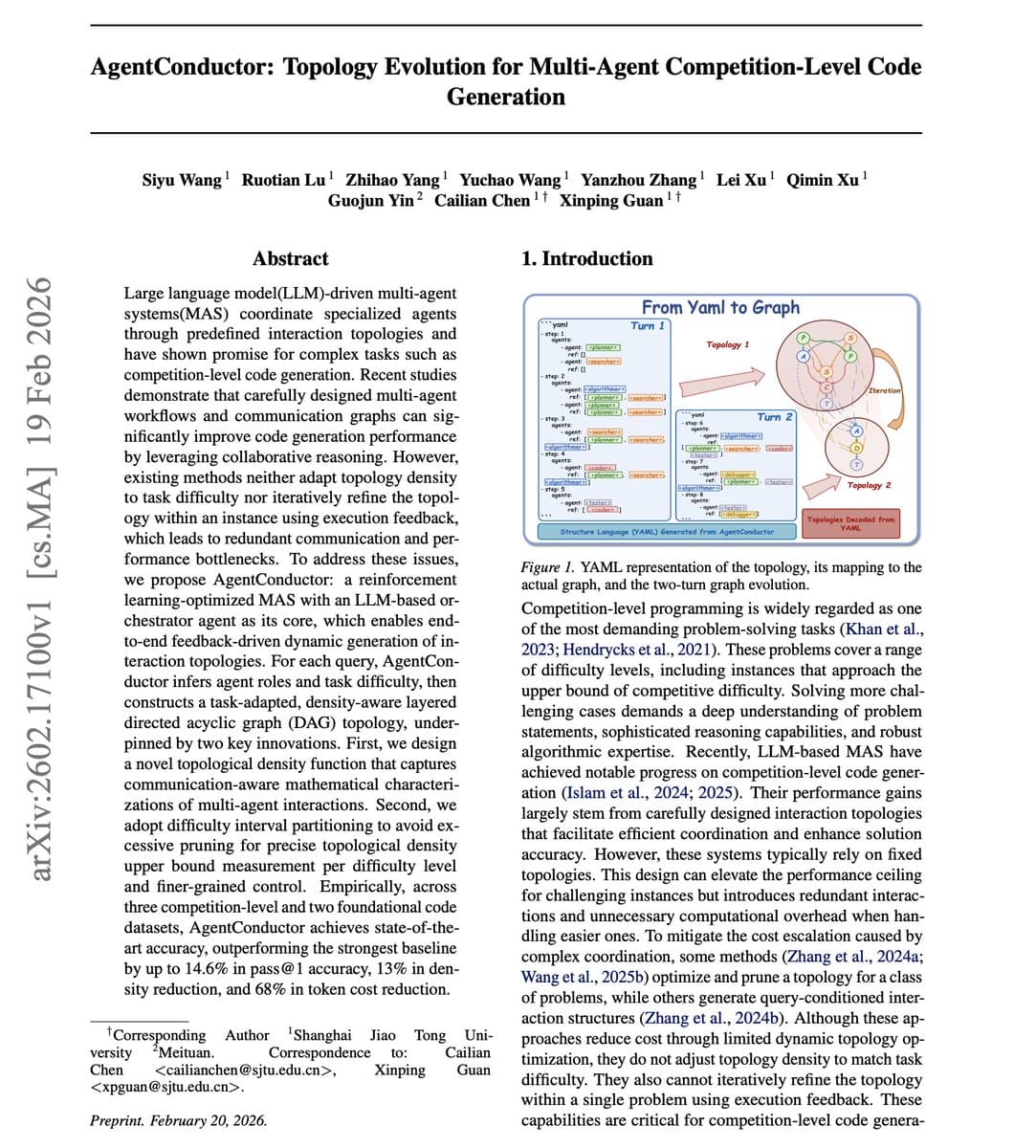
- Research into **structuring coding agents** using **graph approaches** promises **more coherent multi-agent code workflows** and **collaborative programming**, pushing autonomous coding to new heights.
---
## Sectoral Impact and Future Outlook
**2026** has seen **multi-agent, multimodal AI** permeate various sectors:
- **Robotics**: Companies like **AI² Robotics** are embedding multi-agent systems into **manufacturing**, **logistics**, and **autonomous vehicles**, drastically accelerating automation.
- **Edge Devices**: Smartphones such as the **Samsung Galaxy S26** now feature **Perplexity-powered agents** capable of **context-aware reasoning** directly on-device, bolstering **privacy** and **responsiveness**.
- **Finance and Healthcare**: Autonomous research agents are conducting **literature reviews**, **hypothesis generation**, and **automated experiments**, democratizing access and accelerating innovation.
---
## Current Status and Broader Implications
While technological momentum is undeniable, **safety, explainability, and interoperability** remain significant hurdles. The **geopolitical landscape**, exemplified by **hardware export restrictions** and **military disputes**, complicates global deployment strategies.
**2026** has solidified its place as **the pivotal year**—a year marked by **breakthroughs and tensions** that will shape the future of **agentic, multimodal AI**. The trajectory now hinges on **collaborative efforts among industry, academia, and policymakers** to **harness AI’s transformative potential responsibly**.
### **The road ahead** involves a delicate balance:
- **Innovation with regulation**
- **Technological progress with safety**
- **Global competitiveness with ethical standards**
Achieving this balance will be crucial to **building trustworthy, beneficial, and aligned autonomous systems** that serve society’s best interests, ensuring that **2026’s advances** translate into **long-term societal benefits** rather than unintended consequences.