# The Cutting Edge of Large Language Models in 2024: Deepening Understanding, Enhancing Efficiency, and Expanding Capabilities
The landscape of large language models (LLMs) in 2024 continues to accelerate at an extraordinary pace, driven by groundbreaking innovations that are fundamentally transforming AI’s potential. From deciphering the internal mechanics of models to pioneering multimodal, embodied, and agentic systems, researchers and industry leaders are pushing the boundaries of what AI can achieve. Concurrently, critical challenges surrounding privacy, safety, and scalability are being addressed with novel solutions, signaling a mature phase where models are becoming more sophisticated, efficient, and trustworthy.
---
## Advancements in Understanding Model Internals and Knowledge Dynamics
### Unlocking Long-Tail Knowledge, Memorization, and Privacy Risks
A persistent challenge remains: **how do LLMs acquire, retain, and access rare or specialized information?** Studies like **"Long-Tail Knowledge in Large Language Models"** have confirmed that models follow a **power-law distribution**—performing well on common facts but struggling with niche knowledge crucial for domains like **medicine** and **scientific research**. To combat this, **targeted data augmentation** and **domain-specific fine-tuning** have been employed to improve accuracy and reliability in specialized fields.
Beyond knowledge retention, **memorization phenomena** are under intense scrutiny. For example, **"Tuning and Clinical Application of Large Language Models in Healthcare"** demonstrates that **fine-tuning** not only boosts diagnostic accuracy but also enhances **interpretability**, fostering **trust** in sensitive applications like **medical diagnostics**.
However, as models become more capable, **privacy concerns** have escalated. The landmark study **"Hacking AI’s Memory: How 'In-Context Probing' Steals Fine-Tuned Data"** (NDSS 2026) reveals that **adversarial in-context techniques** can **extract sensitive proprietary data** from models—raising alarms about **data security**. This underscores the urgent need for **privacy-preserving methodologies**, including **differential privacy** and **robust fine-tuning protocols**, to safeguard against malicious extraction.
### Innovative Approaches to Memory and Context Management
Recent breakthroughs have introduced **hypernetwork-based techniques** to address the limitations of active context windows. As discussed by **@hardmaru**, instead of forcing models to hold all relevant information within a fixed context window, **hypernetworks** enable models to **dynamically generate parameters** that access external or stored knowledge, thereby **reducing the burden on the active memory**. This approach allows for **more scalable and flexible knowledge integration**, especially important for **long-horizon reasoning** and **complex tasks**.
In parallel, **memory-augmented exploratory agents** are emerging as a promising avenue. The **"Exploratory Memory-Augmented LLM Agent via Hybrid On- and Off-Policy Optimization"** explores how agents can **actively seek, store, and retrieve relevant information** during problem-solving, leading to **improved reasoning and adaptability**.
### Measuring Progress and Ensuring Ethical Safeguards
Benchmarking tools like **"SAW-Bench"** continue to reveal **gaps in model understanding**, especially in **reasoning** and **decision-making in complex scenarios**. These benchmarks are critical for guiding systematic improvements.
Furthermore, **neural decoding** techniques, which translate neural signals into language, are advancing to enhance **brain-computer interfaces**. However, these methods also introduce **privacy risks** such as **model fingerprinting**, emphasizing the need for **ethical safeguards** to prevent misuse and protect individual privacy.
---
## Embodied, Multimodal, and Domain-Specific Models: Expanding AI’s Horizons
### Specialized and Embodied AI Systems
The development of **domain-specific LLMs** is gaining momentum. Models like **CancerLLM** demonstrate significant improvements in **diagnosis accuracy** and **treatment planning**, accelerating adoption in clinical settings.
In robotics and embodied AI, innovative frameworks are enabling **zero-shot transfer** and **personalized control**:
- **Language-Action Pre-Training (LAP):** Facilitates **zero-shot adaptation** across different robots and environments.
- **EgoScale:** Utilizes **diverse egocentric human data** to support **dexterous manipulation**.
- **SimToolReal:** Advances **object-centric policies** for **zero-shot tool manipulation**, critical for **industrial automation** and **space robotics**.
### World Modeling, Action Generation, and Multimodal Integration
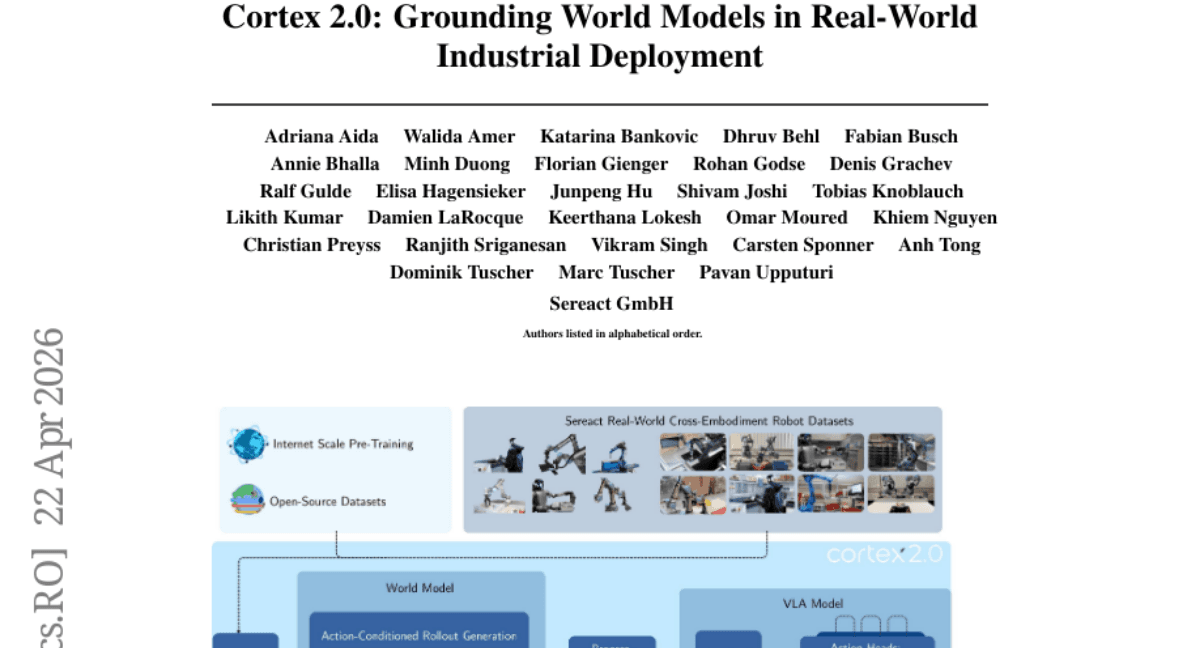
Emerging systems like **"World Guidance: World Modeling in Condition Space for Action Generation"** empower models to **predict and generate complex actions** within **dynamic environments**, moving closer to **autonomous decision-making**. These capabilities are integrated into **vision-language-action (VLA)** frameworks, enabling **more natural human-robot interaction**.
On the multimodal front, models such as **ReMoRa** exemplify the **fusion of refined motion understanding with language processing**, supporting **video comprehension**, **gesture recognition**, and **scene analysis**—applications vital for **robot perception**, **virtual reality**, and **security**.
The **resurgence of generative modality alignment techniques**, like **"Generative Modality Alignment for Generated Image Learning,"**, leverages **diffusion priors** and **VAE-based models** to produce **high-fidelity images** and **efficient compression**. Researchers such as **@jon_barron** have demonstrated that **combining diffusion priors with encoders** enhances **scalability** and **fidelity in multimodal synthesis**, enabling richer and more accurate **creative and scientific visualization**.
---
## Robotics, Autonomous Agents, and Safety: Progress and Challenges
### Space Robotics and Autonomous Manipulation
Frameworks like **"SimVLA"** are establishing **scalable baselines** for **vision-language-robotic manipulation**, supporting **robust, adaptable systems**. Space robotics is experiencing rapid growth with projects such as **"AstroArm,"** designed for **satellite servicing** and **autonomous on-orbit maintenance**, vital for **long-term space infrastructure**.
### Ensuring Safety and Multi-Agent Collaboration
AI safety remains a core priority. Techniques like **"Certifying Hamilton-Jacobi Reachability"** enable **formal safety verification**, indispensable for **autonomous vehicles** and **medical robots**. Additionally, research such as **"Evaluating Collective Behavior of Hundreds of LLM Agents"** explores **multi-agent cooperation**, laying the groundwork for **complex ecosystems** capable of **distributed problem-solving**.
### Agentic Search, Exploration, and Optimization
Innovative methods like **"Search More, Think Less"** reimagine **long-horizon agentic search**, emphasizing **efficiency and generalization**. Combined with **reward optimization techniques**—such as **"TOPReward,"** which utilizes **token probabilities** for **zero-shot reward signals**—these approaches foster **more autonomous, adaptable agents** capable of **self-guided exploration** even in **ambiguous or novel environments**.
---
## System Optimization and Inference Efficiency
### Speed, Compression, and Large-Scale Training
Enhancing inference speed and deployment efficiency remains a key focus. Novel techniques include:
- **KV-cache–busting with DualPath:** Addresses **cache bottlenecks** by **bypassing traditional cache limitations**, leading to **faster inference**.
- **Hybrid data/pipeline parallelism** for diffusion models accelerates **training and inference**, enabling **scalable deployment** of large models.
- **veScale-FSDP:** A flexible **distributed training framework** supporting **large-scale models** with **improved scalability**.
**Test-time training** approaches like **"tttLRM"** now facilitate **long-context reasoning** and **3D reconstruction** from limited data, critical for **digital twins**, **urban modeling**, and **AR/VR** applications.
**Retrieval-augmented generation frameworks** such as **DRAG** incorporate **external knowledge bases**, significantly **enhancing response accuracy and speed**, making **real-time, scalable AI** increasingly practical.
### Data Engineering and Scalability
High-quality **data curation** and **training pipelines** remain foundational. As highlighted in **"On Data Engineering for Scaling LLM Capabilities,"** effective data strategies directly influence models’ **generalization** and **reliability** at scale.
---
## Breakthroughs in Video and Multimodal Generative Priors
### Long-Horizon Video Synthesis
The **"Rolling Sink"** method extends autoregressive **video diffusion models** to generate **long, coherent videos** by **bridging short training horizons** with **open-ended reasoning**. This addresses traditional limitations, enabling **more realistic, sustained video generation** over extended durations.
### Benchmarking and Evaluation
The **"A Very Big Video Reasoning Suite"** provides a **comprehensive platform** for evaluating **video understanding**, **reasoning**, and **synthesis**, fostering the development of **robust models** capable of **handling complex scene dynamics** in **long-duration videos**.
### Multimodal Generative Priors via VAE and Diffusion
The **resurgence of VAEs**, especially through **co-training diffusion priors with encoders**, significantly improves **compression efficiency**, **fidelity**, and **scalability** in **multimodal generative tasks**—paving the way for **high-quality synthesis** in **virtual environments**, **scientific visualization**, and **media production**.
---
## Industry Momentum and the Future Outlook
A landmark development is the merger of **Intrinsic Innovation LLC**, a company spun out from Alphabet’s **moonshot factory**, with **Google**. As **Intrinsic’s CEO** states, **“Just five years after spinning out from Alphabet’s moonshot factory, Intrinsic is joining Google to accelerate innovation in physical AI, robotics, and autonomous systems.”** This move underscores a **strategic industry commitment** to **embodied intelligence** and **real-world deployment**, promising a future where **AI seamlessly integrates into physical environments**, from **space exploration** to **domestic robotics**.
---
## Current Status and Implications
The developments of 2024 underscore a **paradigm shift** toward **more capable, embodied, and context-aware AI systems**. These models now excel in **long-horizon reasoning**, **multimodal integration**, and **autonomous operation** in diverse, dynamic environments. Notable trends include:
- The deployment of **specialized models** like **CancerLLM** for healthcare.
- The integration of **tri-modal diffusion** and **generative priors** for perception and creativity.
- Advances in **world modeling**, **agentic search**, and **safety verification**.
- System-level innovations for **speed**, **compression**, and **scalability**.
- Emphasizing **ethical AI**, **privacy safeguards**, and **trustworthy deployment**.
- Expansion of **multi-agent ecosystems** and **space robotics initiatives**.
These innovations are poised to **transform industries**, **accelerate scientific discovery**, and **enhance everyday life**—all while reinforcing commitments to **safety**, **fairness**, and **societal benefit**. As 2024 unfolds, it is clear that the internal understanding, scalability, and versatility of large language models are converging to unlock **unprecedented possibilities** for AI’s role in shaping our collective future.