# The 2024 Revolution in Autonomous AI Agents: Long-Horizon Reasoning, Self-Modification, and Systemic Innovation
The landscape of artificial intelligence in 2024 has experienced a groundbreaking transformation, shifting from reactive, narrow systems to **autonomous, persistent agents** capable of **long-term reasoning, continual self-improvement, and orchestration across complex, real-world domains**. This evolution is driven by a confluence of architectural innovations, algorithmic breakthroughs, multimodal perception advances, and systemic safety frameworks—propelling AI toward becoming trustworthy partners in scientific discovery, robotics, societal deployment, and beyond.
---
## The Rise of Long-Horizon, Persistent Autonomy
A defining feature of the 2024 AI revolution is the **design of architectures explicitly optimized for long-term reasoning and persistent memory**. These systems support **coherent mental models**, **extended planning horizons**, and **dynamic adaptation**—enabling agents to operate effectively over days, weeks, or even months.
### Architectural and Algorithmic Breakthroughs
- **Hierarchical and Unified Recall Architectures**
Approaches like **HERMES** exemplify the trend toward **integrating sensory input into robust environmental models** that **persist over time**. These architectures facilitate **autonomous exploration** in dynamic environments such as robotic navigation or space missions, supporting **reasoning across extended timelines**—crucial for scientific investigations and long-duration tasks.
- **AgeMem and Unified Recall Models**
Inspired by continual learning paradigms, **AgeMem** and **AgeMem-style unified recall systems** enable **long-term environmental and contextual memory**. They support **scenario simulation**, **futures planning**, and **multi-agent coordination**, allowing agents to **simulate potential futures** and **refine strategies** over protracted periods. These systems underpin **multi-turn reasoning** necessary for scientific hypothesis testing and complex decision-making.
- **Recurrent-Depth Variational Latent Architectures (RD-VLA)**
These models **generate multi-step hypotheses and refine decisions** through **deep latent inference**, effectively **bridging reactive responses with strategic, long-horizon planning**. Their capacity for **multi-stage inference** makes them suitable for **scientific discovery** and **autonomous exploration** in unpredictable environments.
- **Control Stability with Action Jacobian Constraints**
Innovations such as **learning smooth, time-varying linear policies** with **Action Jacobian penalties** promote **robust, adaptable control trajectories**. This is particularly vital for **robotic manipulation** and **autonomous vehicles**, where **seamless adaptation to environmental uncertainties over long durations** is essential for **safety and efficiency**.
---
## Safety, Self-Modification, and Building Trust
As agents gain **self-modification** and **autonomous improvement** capabilities, **safety and alignment** become paramount. The ability of agents to **assess and enhance their own models** introduces **performance gains** but also **risks of misalignment** or **undesirable emergent behaviors**.
### Safety Frameworks and Monitoring
- **Real-Time Behavior Monitoring with X-SHIELD**
The **X-SHIELD** system exemplifies **real-time safety oversight** by **detecting and preventing unsafe actions**, ensuring **trustworthy operation** in high-stakes scenarios like autonomous driving, robotic assistants, and industrial automation.
- **Multi-Agent Safety Protocols**
Advances in **"Safe Continuous-time Multi-Agent Reinforcement Learning"** facilitate **cooperative and secure behaviors** among **robotic swarms and autonomous fleets**, aligning their interactions with **safety constraints** and **collective trustworthiness**.
- **Monitoring Self-Modification Over Long Durations**
New methodologies now **enable agents to continuously self-assess and self-modify** based on **environmental feedback**, supporting **long-term strategy updates** over **months or years**. This ongoing oversight **prevents performance degradation** and **aligns agents with evolving ethical standards**.
### Embedding Safety into Autonomous Evolution
- **Safety Constraints in Self-Modification**
Integrating safety checks directly into **agent self-evolution**—via tools like **X-SHIELD**—helps **align agent development** with **human values and norms**.
- **Meta-RL for Norm Alignment**
**Meta-reinforcement learning** techniques are employed to **guide agents’ self-improvement trajectories**, **aligning behaviors** with **ethical standards** and **safety requirements**, thus **reducing risks** from **undesirable emergent behaviors** during **self-optimization**.
---
## System-Level Orchestration and Efficiency
Managing **complex autonomous systems** requires **robust orchestration strategies** focusing on **resource management**, **long-term planning**, and **transparency**.
- **Scenario Planning and Long-Term Recall**
Architectures like **AgeMem** enable **long-term scenario simulation** and **recall**, significantly **enhancing reasoning coherence** over extended periods—crucial for **scientific research**, **industrial automation**, and **societal systems**.
- **Benchmarking and Evaluation Platforms**
Tools such as **ResearchGym**, **LOCA-bench**, and **LongCLI-Bench** provide **standardized environments** for **testing reasoning ability**, **safety robustness**, and **long-horizon planning**—fostering **systematic progress** across research communities.
- **Transparency and Explainability**
Innovations like **Computer-Using World Model** facilitate **integrating visual and textual explanations** with decision-making processes, **building trust** and **enabling debugging** in **high-stakes applications** such as healthcare and autonomous transportation.
---
## Multimodal Perception and Visual Reasoning Breakthroughs
Processing continuous visual streams **efficiently** remains a core challenge—yet **2024** has seen **remarkable advancements**:
- **SpargeAttention2**
Achieves **up to 95% attention sparsity** and **16.2× speedup** in video diffusion tasks, enabling **real-time visual processing** on **resource-constrained devices** like embedded robots and mobile platforms.
- **Rolling Sink**
Introduces **bridging techniques** that **transfer models trained on limited-horizon sequences** to **long-term, open-ended scenarios**. This capability is vital for **robust visual reasoning** in **dynamic environments**.
- **Unified Latent (UL) Frameworks**
Support **joint regularization** of encoder features with diffusion models, resulting in **interpretable, long-horizon planning** and **multi-faceted reasoning**—fostering **trustworthy perception systems**.
### Scientific and Practical Visual Data Advances
- **DeepVision-103K Dataset**
A **diverse, verifiable mathematical dataset** designed to **interpret diagrams and logical structures**, bridging **visual perception** with **logical inference**—accelerating **scientific discovery**.
- **Visual Data for Scientific Reasoning**
Combining visual perception with **logical inference** enables AI to **comprehend scientific diagrams** and **reason about complex phenomena**, speeding up **discovery cycles** and **educational tools**.
- **Efficient Visual Data Acquisition**
Techniques that **prioritize informative inputs** during training optimize resource use and **enhance models' long-horizon reasoning** across **multi-modal tasks**.
---
## Reinforcement Learning, Interactive Reasoning, and Agentic Search
Robust RL methods underpin the development of **controllable, interpretable, and scalable models**:
- **VESPO (Variational Sequence-Level Soft Policy Optimization)**
Stabilizes **policy updates**, enabling **training larger, aligned models** with **improved robustness** and **long-horizon capabilities**.
- **Interactive In-Context Learning**
Incorporates **multi-turn human feedback**, refining **reasoning abilities** and **trustworthiness** through **dialogue-based interactions**.
- **Interpretable Models (e.g., Steerling-8B)**
Include **visual explanations** and decision pathways, making **debugging** and **trust-building** more feasible—crucial for **deployment in sensitive domains**.
- **Long-Horizon Agentic Search**
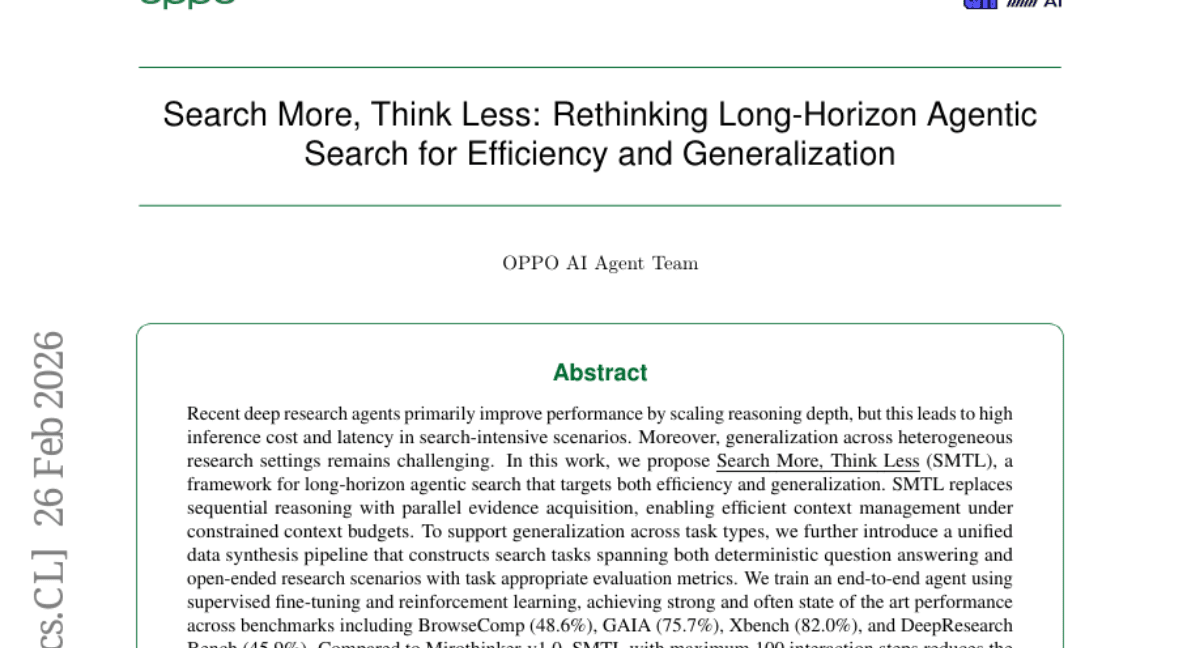
Recent work, such as **"Search More, Think Less"**, advocates **reducing search overhead** by **rethinking search strategies**—favoring **more efficient exploration** and **generalization** in **long-term planning**.
- **Actor-Critic for Continuous Actions (AC3)**
Optimizes **control stability** over **extended durations**, vital for **robotic manipulation** and **autonomous control systems**.
---
## Meta-Research, Automated Strategy Generation, and Societal Challenges
The integration of **large language models (LLMs)** as **meta-research agents** accelerates **automated strategy discovery**:
- **Automated Multi-Agent Strategy Generation**
LLM-based **oracles** can **simulate** and **generate** strategies, **reducing manual effort** and **speeding innovation** in scientific, industrial, and social domains.
- **Benchmarking Long-Horizon Capabilities**
Platforms like **LongCLI-Bench** facilitate **agentic command-line programming**, ensuring **reliability** and **repeatability** in **long-term agent behaviors**.
### The "5 Heavy Lifts" of Responsible Deployment
Despite technical progress, **sociotechnical challenges** dominate:
- **Effective human-AI integration**
- **Ensuring safety, trust, and ethical compliance at scale**
- **Addressing societal impacts responsibly**
- **Scaling safety measures for self-modifying agents**
- **Establishing governance and oversight frameworks**
As one prominent researcher noted: *"The hardest work in deploying agentic AI in clinical or societal settings is the 'heavy lifting' of sociotechnical integration, rather than just the technical algorithms."*
---
## Notable 2024 Advances and Emerging Frontiers
Recent research articles and technological innovations continue to expand capabilities:
- **LAP (Language-Action Pre-Training)** demonstrates **zero-shot skill transfer across embodiment** platforms, enabling models to **generalize skills without retraining**. [More](https://t.co/YTxNABdwr)
- **SimToolReal** introduces **object-centric policies** that **transfer zero-shot dexterous manipulation** from simulation to real robots, **bypassing extensive fine-tuning**.
- **JAEGER** advances **joint audio-visual grounding** within **3D environments**, crucial for **perception in complex settings**.
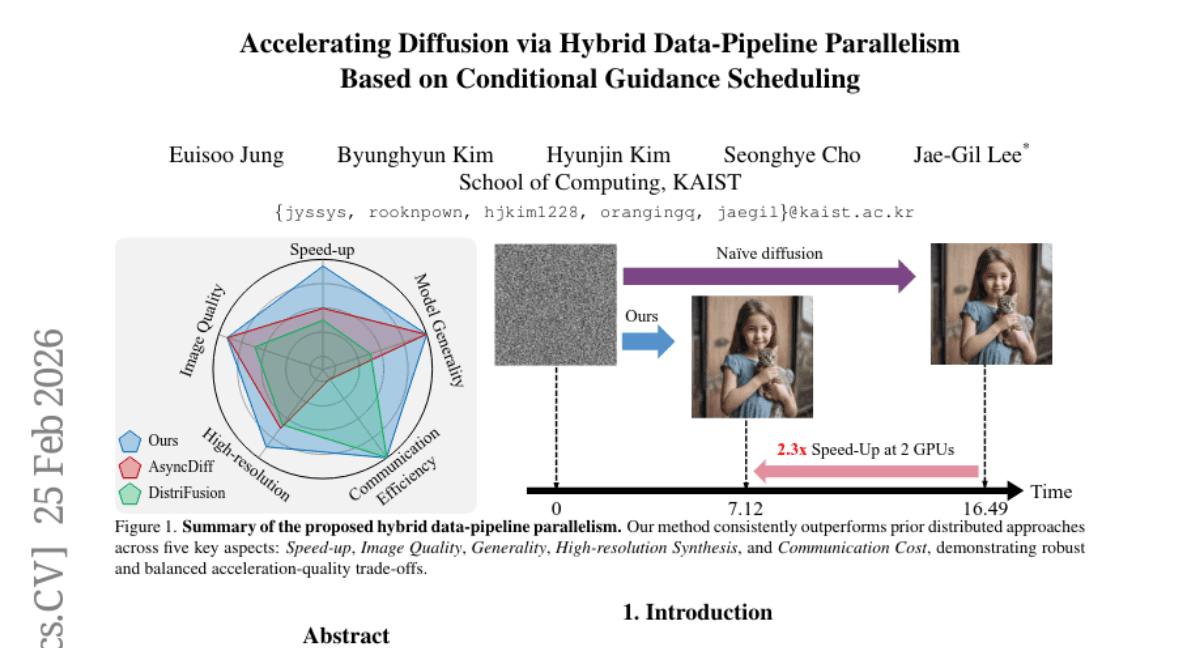
- **SeaCache** employs **spectral-evolution techniques** to **accelerate diffusion models**, supporting **real-time visual generation**.
- **NoLan** addresses **visual hallucinations** in vision-language models by **suppressing language priors**, leading to **more accurate and trustworthy reasoning**.
- **World Guidance** introduces **coherent environment-aware models** operating in **condition space**, **improving action generation** for **long-horizon, context-aware behaviors**.
- **AI Video Unified Reward Models** explore **personalized reward functions** to **align behavior** in **multi-modal video tasks**.
- **SkyReels-V4** offers **multi-modal video-audio generation**, **inpainting**, and **editing**—pushing real-time content creation for entertainment and simulation.
- **Open-Source Operating Systems for Agents** like **Rust-based agent OS** are establishing **scalable infrastructure** for **reliable agent ecosystems**.
---
## The Current Status and Future Outlook
**2024** underscores a **technological revolution** where **autonomous, long-horizon AI agents** are **more capable, safe, and adaptable** than ever before. The **core innovations**—including **hierarchical memory architectures (HERMES, AgeMem)**, **attention-efficient multimodal models (SpargeAttention2, SkyReels-V4, Rolling Sink)**, **advanced RL techniques (VESPO, AC3)**, and **safety frameworks (X-SHIELD)**—are **transforming AI into persistent, trustworthy partners**.
### Broader Implications
These agents are increasingly **integrated into scientific research, industrial automation, and societal systems**, driving **efficiency**, **safety**, and **innovation**. The breakthroughs in **multimodal perception** and **diffusion acceleration** notably **extend operational horizons**, enabling **real-time, long-term reasoning** on **resource-constrained platforms**.
### Challenges and Considerations
Despite these advances, **significant sociotechnical challenges remain**, particularly **ethical governance**, **trustworthiness**, and **system transparency**. Ensuring **alignment during self-modification**, **interpretability of complex behaviors**, and **scalable safety oversight** is critical for **responsible deployment**.
### Outlook
The convergence of **meta-research agents**, **self-evolving systems**, and **orchestration frameworks** suggests a future where **AI not only solves intricate problems** but **collaborates with humans—adaptively, safely, and reliably**. This ecosystem promises to **amplify human potential**, fostering a resilient, innovative society capable of tackling global challenges with **AI as a trustworthy partner**.
---
## **In Summary**
The developments of 2024 vividly illustrate a **paradigm shift** toward **long-term, self-improving, system-oriented AI agents**. Their **capacity for long-horizon reasoning**, **self-modification**, and **multi-domain orchestration** positions them as **trustworthy collaborators** in science, industry, and societal progress.
However, **sociotechnical challenges**—notably **ethics, governance, and interpretability**—must be diligently addressed. As the field advances, the **synergy of human ingenuity and artificial intelligence** opens the door to **unprecedented possibilities**, shaping a future where **AI and humans co-evolve** to achieve collective resilience, innovation, and societal well-being.