# Invasive Motor Brain Implants: A New Era of Control for Fully Paralyzed Individuals and Beyond
The landscape of neurotechnology is undergoing a transformative revolution. Once confined to the realm of science fiction, invasive motor brain implants are now rapidly transitioning into practical, life-changing tools that not only restore mobility and communication for individuals with complete paralysis but are also paving the way for unprecedented human augmentation. Recent breakthroughs in hardware, surgical methods, neural decoding, and industry initiatives underscore a pivotal moment—one where brain-computer interfaces (BCIs) are poised to redefine human potential, societal norms, and the future of medicine.
## From Experimental Milestones to Real-World Impact
Over the past year, the progress in invasive BCIs has accelerated dramatically, crossing critical thresholds from experimental prototypes to clinically viable devices with profound societal implications:
- **Neural Signal Stability Over Years**
Research across China, Europe, and North America has demonstrated that neural signals captured via invasive implants maintain **high fidelity and stability over multiple years**. This addresses longstanding concerns about immune responses, device degradation, and signal drift. The result is **long-term, reliable interfaces** capable of supporting **everyday mobility**, **social participation**, and **independent living** for individuals with paralysis.
- **Real-World Device Control Demonstrations**
A landmark achievement involved a **completely paralyzed individual** successfully controlling a **robotic dog** that could **fetch objects, navigate obstacles, and perform complex behaviors**. Such demonstrations exemplify how BCIs are moving beyond laboratory settings into **functional, real-life applications**, significantly **enhancing mobility** and **social integration** for those with full paralysis.
> *“Our integrated BCI platforms have crossed the threshold from experimental setups to clinically practical tools that restore agency to those immobilized by paralysis,”* said leading researchers, emphasizing that these innovations are **making tangible differences in patients' lives**.
- **First Fully Implantable Interventional BCI for Limb Movement**
A groundbreaking milestone introduced **the world’s first fully implantable interventional BCI** capable of enabling **volitional limb movement** in a **paralyzed person** through a **closed-loop neural interface**. This system combines **advanced neural decoding** with **neurostimulation**, allowing **restoration of voluntary movement** without external assistive devices. This **paradigm shift** hints at a future where **full motor recovery** and **human augmentation** become feasible.
## Hardware Innovations Accelerating Deployment
To support **safe**, **durable**, and **scalable** neural interfaces, developers are pioneering a suite of hardware breakthroughs:
- **Vascular and Minimally Invasive Implants**
The **Stentrode**, developed by Chinese scientists, exemplifies a **vascular implant** designed for **minimally invasive, outpatient procedures**. By leveraging blood vessels for electrode placement via **neurointerventional surgery**, it significantly **reduces surgical risks** such as hemorrhage and infection. This approach makes **long-term neural interfaces** more accessible and safer.
- **High-Channel-Count and Scalable Devices**
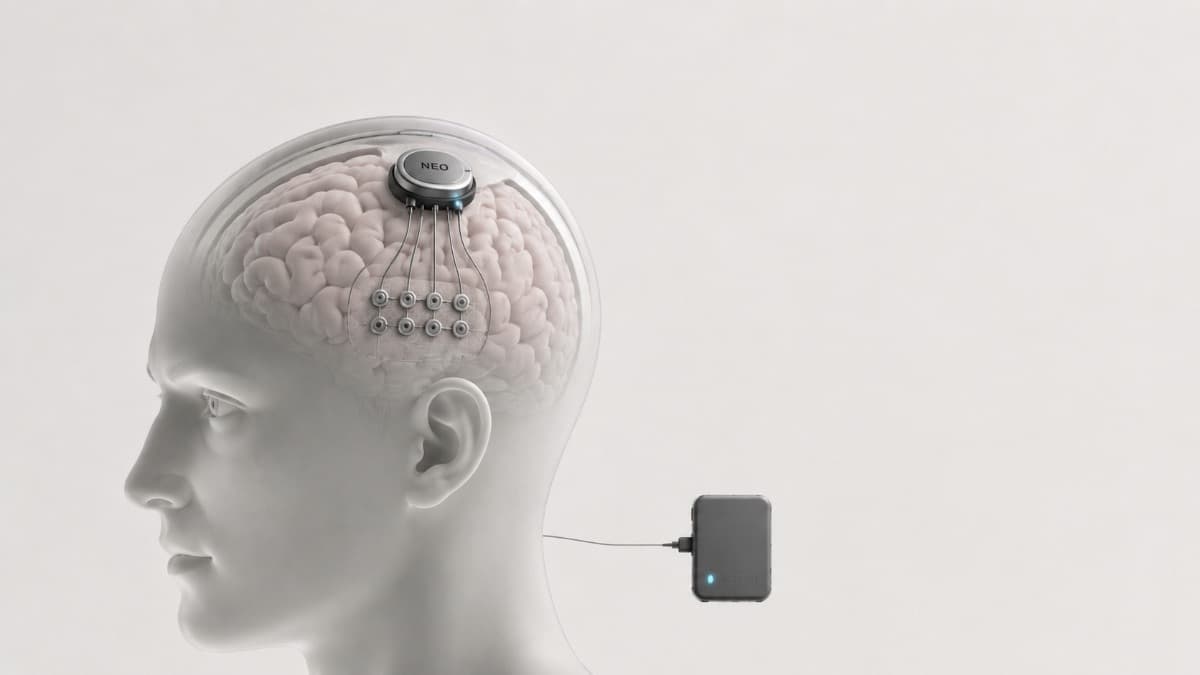
Industry leaders like **Neuralink** are pushing toward **scaling up** production of **high-channel-count implants**, targeting **hundreds to thousands of electrodes** by 2026. These devices aim to facilitate **motor control**, **sensory feedback**, and **memory augmentation** across large user populations. Similarly, **Nia Therapeutics** has developed a **validated 60-channel implant** emphasizing **cost-effectiveness** and **broader accessibility**, signaling a move toward **consumer-grade neural interfaces**.
- **Innovative 'Floating' Origami Implants**
A remarkable innovation from Chinese researchers involves a **soft, stretchable, origami-inspired brain implant**. This **"floating" architecture** dynamically **adapts to brain movements**, **preventing thread retraction and migration**, problems common with rigid devices like Neuralink. This design **extends device lifespan**, **reduces risks**, and **enhances safety**, addressing critical limitations of earlier invasive implants.
## Expanding Functional Horizons: Movement, Speech, and Cognition
The capabilities of invasive BCIs continue to expand beyond simple motor control:
- **Restoring Mobility**
These systems enable users to **control prosthetic limbs** and **robotic assistants** with **high precision**. Demonstrations include controlling **robotic canines** capable of **fetching objects**, **navigating obstacles**, and **performing lifelike behaviors**, thereby **significantly augmenting independence** and **quality of life**.
- **Neural Decoding for Speech and Silent Communication**
Advances in **AI-powered neural decoding** have led to systems like **Vivan-BCI**, a **silent-speech interface** that **produces natural speech without overt movements**. This technology revolutionizes communication for individuals with **locked-in syndrome** or severe speech impairments. By leveraging **large language models (LLMs)**, these systems **enhance decoding accuracy and fluidity**, enabling **more natural, effortless interaction**—bringing speech closer to normalcy.
- **Memory and Cognitive Augmentation**
Cutting-edge research focuses on **restoring and enhancing memory** via **closed-loop neurostimulation** that **combines brain signals** with **spinal or cortical stimulation**. Early results are promising for **supporting voluntary movement**, **neuroplasticity**, and **accelerating recovery** after strokes or traumatic injuries. Future directions include **augmenting human cognition**—faster learning, complex problem-solving, and creative thinking—potentially **blurring the boundary between natural intelligence and augmentation**.
### Brain-Computer Interfaces as Direct Neural Output Channels
A **paradigm shift** is emerging:
> **"BCIs are increasingly viewed as direct neural output pathways, bypassing damaged circuits and enabling non-muscular communication."**
This perspective allows for **more natural, effortless control** over devices and environments, integrating BCIs into **everyday routines**—from **thought-driven communication** to **environmental control**—with **minimal latency** or effort.
## Industry Progress and Path to Commercialization
The industry landscape is intensifying, driven by **successful clinical trials**, **technological breakthroughs**, and **substantial funding**:
- **High-Resolution, High-Channel-Count Implants**
Devices like **CAS N1** exemplify **multi-site, durable neural monitoring** suitable for long-term deployment. Companies such as **Neuralink** aim to **scale high-channel-count implants** by 2026, targeting **motor**, **sensory**, and **memory functions** across large populations. **Nia Therapeutics’** validated **60-channel implant** underscores efforts to **reduce costs** and **expand market reach**.
- **Regulatory and Clinical Milestones**
Increasingly, regulatory agencies are approving **clinical trials**, a critical step toward **widespread adoption**. These are coupled with initiatives to **lower costs** and **broaden access**, ensuring these technologies serve **diverse patient populations**.
- **China’s Rapid Advancement: Wireless Implants and Funding**
China is emerging as a dominant force. Recent reports highlight **the development of wireless, minimally invasive implants**, supported by **over $165 million in funding**. Chinese researchers are executing comprehensive **roadmaps** to **outpace firms like Neuralink**, with ambitious goals for **mass production**, **clinical trials**, and **market entry**. Their **national strategy** involves integrating BCIs into **healthcare, military, and consumer sectors**, positioning China as a **neurotechnology powerhouse**.
## Supporting Research and Emerging Technologies
Recent advances include:
- **Motor Imagery Dynamics**
Studying **temporal patterns of motor imagery signals** has led to **more accurate, responsive decoders**, improving **control fidelity**.
- **AI and Large Language Model (LLM) Integration**
Combining **deep learning** with **LLMs** has **revolutionized neural decoding**, enabling **real-time speech translation** and **natural language interaction** directly from neural signals.
- **Brain–Spinal Stimulation for Rehabilitation**
Devices that integrate **brain–spinal interfaces** show promise in **restoring voluntary movement** and **supporting neuroplasticity** after injuries like stroke or spinal trauma.
- **Materials and Design Innovations**
The **floating origami implant** addresses **thread migration**, offering **durable, safe interfaces** suitable for **long-term use**.
## Recent Breakthroughs and Ethical Considerations
A **landmark achievement** is the **world’s first fully implantable interventional BCI** that **enabled a paralyzed individual to move his limbs** through an **integrated neural interface** combining **decoding** and **neurostimulation**. This **sets a new standard** for **restorative neuroscience**.
> **"This demonstrates the potential to restore voluntary movement without external devices, marking a new chapter in human neural restoration,"** said researchers.
Simultaneously, advances in **less-invasive stimulation modalities**—such as **nanoparticle-mediated stimulation**, **focused ultrasound**, and **transcranial magnetic stimulation**—aim to **reduce risks**, **increase accessibility**, and **complement invasive implants** for conditions like **epilepsy**, **depression**, and **neurodegenerative diseases**.
### Ethical and Societal Challenges
As neural interfaces become more **integrated into daily life**, several **ethical and societal issues** demand attention:
- **Biocompatibility and Device Longevity**
Ensuring **materials remain safe and functional for decades** is critical for **safety and efficacy**.
- **Cybersecurity and Data Privacy**
With neural data increasingly embedded in everyday routines, **robust cybersecurity measures** are essential to **protect personal neural information** from breaches or malicious manipulation.
- **Equity and Access**
Addressing **cost barriers** and **disparities in availability** is vital to **prevent societal inequalities** in **neural augmentation** and **restorative technologies**.
- **Regulatory and Ethical Frameworks**
Developing **comprehensive guidelines** for **safety**, **informed consent**, and **human augmentation** is fundamental to **public trust** and **responsible development**.
- **Oversight and Transparency**
Recent critiques emphasize the importance of **rigorous safety assessments**, **transparent reporting**, and **independent oversight**—particularly as companies like Neuralink advance toward **human trials**.
## Current Status and Future Outlook
The transition from laboratory research to **clinical and consumer applications** is rapid and evident. Demonstrations such as controlling **robotic assistants**, **neural speech interfaces**, and assistive devices like **Vivan-BCI** exemplify this momentum. Hardware innovations—particularly **flexible, origami-inspired implants**—are overcoming safety and longevity hurdles, paving the way for **durable, biocompatible neural interfaces**.
The integration of **AI-powered decoders**, especially **large language models**, is dramatically improving **neural signal interpretation**, making **natural, effortless communication** increasingly feasible. Industry collaborations—such as **Science Corp. and Neurosoft Bioelectronics**—are fostering the development of **scalable, safe, and effective BCIs**.
### Broader Societal Implications
As neural interfaces become more **ubiquitous**, society faces critical questions regarding **ethics**, **privacy**, and **equity**. While challenges remain—particularly in **long-term safety**, **cybersecurity**, and **regulation**—the pace of innovation suggests that **neural interfaces** could become as commonplace as smartphones, fundamentally transforming **human–machine interaction**, **medical rehabilitation**, and **human augmentation**.
**Invasive motor brain implants** are no longer confined to experimental labs; they are **powerful tools** capable of **restoring independence**, **enhancing human abilities**, and **redefining societal norms**. With responsible development, transparent oversight, and equitable access, these technologies hold the promise to **empower humanity** in ways previously unimaginable—where **thoughts** can **directly command devices**, **speak through neural speech interfaces**, and **augment cognition** beyond natural limits.
---
### **Latest Development Highlight: Motor Neuroprosthesis via Neurointerventional Surgery**
A particularly notable advancement involves the **use of neurointerventional procedures** to implant **wireless, minimally invasive BCIs** in a patient with paralysis. Using a **novel endovascular Stentrode BCI**, surgeons successfully **implanted the device in the superior sagittal sinus** through an **outpatient procedure**, avoiding open-brain surgery. This approach **reduces surgical risks**, **shortens recovery times**, and **broadens the potential user base**. The **wireless design** further enhances **comfort** and **ease of use**, signaling a new direction for **neural interface deployment** that balances **safety, longevity**, and **scalability**.
---
**In summary**, the convergence of hardware innovation, sophisticated neural decoding, and expanding clinical evidence marks an era where **paralysis may become a condition of the past** for many, and **human potential** can be **augmented** in ways that redefine what it means to be human. As these technologies progress, **ethical oversight**, **public engagement**, and **equitable access** will be critical to ensure they serve the common good while respecting individual rights and societal values.