# How Tariffs, Subsidies, Trade Missions, and Technological Innovation Are Reshaping Global Agricultural Markets in 2026
The global agricultural sector in 2026 is experiencing a profound transformation driven by a convergence of protectionist policies, geopolitical tensions, technological bottlenecks, and strategic economic initiatives. These forces are not only reshaping trade flows and regional alliances but also accelerating innovations in supply chain resilience and technological sovereignty. Amid mounting concerns over food security, climate resilience, and dependence on critical materials, nations are adopting multifaceted strategies—ranging from regional production hubs and location-aware AI to strategic stockpiling—to secure their agricultural futures in an increasingly fragmented yet resilient global system.
---
## Continued Protectionism and Strategic Diplomatic Initiatives
Protectionist measures remain central to national strategies, with countries deploying tariffs, subsidies, and diplomatic trade missions to safeguard domestic industries and influence geopolitical alignments.
- **United States**: The U.S. maintains its extensive subsidy programs, channeling over **$45 billion** into key crops like soybeans, corn, and wheat. Additionally, the U.S. has stepped up **trade missions** across **Africa, Southeast Asia, and Latin America** to diversify export markets and reduce reliance on traditional allies amid sanctions and supply chain vulnerabilities. These diplomatic efforts aim to establish resilient, regional supply networks capable of buffering against global shocks.
- **India**: Its recent move to impose a **30% tariff** on imported agricultural machinery and select food products exemplifies a strategic push to bolster domestic manufacturing. While supporting local industry, this tariff complicates international procurement, especially affecting trade relations with the U.S. and Australia, and risks fragmenting global supply chains further.
- **Mexico**: Pursuing regional self-reliance, Mexico has enacted **tariffs up to 60%** on Chinese processed foods and electronics, aligning with broader Latin American efforts to strengthen local supply chains and diminish dependency on distant, geopolitically sensitive sources.
- **Philippines**: Facing volatile global rice markets, the Philippines increased **rice tariffs from 15% to 25%**, aiming to prioritize local farmers and incentivize domestic production. This move seeks to buffer against international supply shocks and stabilize local markets.
- **European Union**: Reinforcing import restrictions on commodities linked to deforestation—such as beef, soy, and timber from Mercosur countries—the EU has curtailed certain import flows. This stance has heightened diplomatic tensions but also reflects a broader shift toward sustainability-linked trade policies.
- **China**: While reducing tariffs on select agricultural imports to expand market access, China has invested over **$14 billion** into domestic seed, fertilizer, and equipment industries. This dual approach seeks **technological sovereignty** and **less reliance on global supply chains**, which influences both supply and demand patterns worldwide.
### Recent Diplomatic Advances: Strengthening Supply Chains
A notable diplomatic development in early 2026 is the **U.S.-Taiwan Economic Prosperity Partnership Dialogue** held on January 27. Led by Under Secretary Jacob Helberg, the dialogue underscores the importance of **semiconductor cooperation** and **supply chain security**. The partnership emphasizes:
- **Advancing chip manufacturing capabilities**
- **Diversifying critical component sources**
- **Mitigating geopolitical risks surrounding Taiwan and China**
This alliance is strategic for **securing the technological backbone** essential for modern agriculture—particularly **autonomous machinery**, **AI sensors**, and **precision irrigation systems**—ensuring supply chain resilience amid escalating geopolitical tensions.
---
## Geopolitical Disruptions: Rising Input Costs and Material Scarcity
Conflicts and infrastructural vulnerabilities continue to disrupt input supplies and material availability:
- **Black Sea and Ukrainian Ports**: Ongoing conflict, with targeted attacks on Ukrainian port infrastructure, hampers **grain and fertilizer shipments**, causing **delays**, **higher transportation costs**, and rerouted trade flows. Countries heavily dependent on Ukrainian exports, notably in Africa and the Middle East, face increasing scarcity and soaring prices.
- **Caspian Pipeline and Energy Supplies**: The **shutdown of the Caspian Pipeline Consortium** constrains energy supplies, elevating costs for nitrogen-based fertilizers—crucial for crop productivity—and complicates logistical operations.
- **Venezuela’s Oil Sector**: US sanctions and operational hurdles have reduced domestic fertilizer manufacturing capacity given its reliance on crude oil. Meanwhile, **Indian refiners** continue navigating enforcement complexities to secure Venezuelan crude, reflecting broader geopolitical resource management strategies.
- **Russian Tanker Congestion**: Rerouting around sanctions has caused **congestion among Russian tankers**, escalating logistical costs across fertilizer and commodity supply chains. These disruptions further exacerbate input cost surges and reveal vulnerabilities in global logistics networks.
### Critical Materials and Export Restrictions
Adding to input challenges are **export bans on critical materials**, notably **antimony**, essential for sensors, autonomous machinery, and renewable energy components. China’s recent **ban on antimony exports** amid strategic stockpiling has raised alarms about potential **delays in deploying precision agricultural technologies** and **autonomous systems**, which are vital for efficiency and sustainability.
---
## Technological Bottlenecks and Supply Chain Vulnerabilities
The sector continues to face **semiconductor shortages** and **scarcity of critical materials**, threatening to slow the deployment of advanced agricultural technologies.
### Chips and Geopolitical Risks
Taiwan remains the **primary global producer** of approximately **90% of advanced chips**, making its supply highly susceptible to regional conflicts and military tensions. Rising **regional militarization** and **conflicts** threaten to disrupt **precision agriculture technologies**—including **autonomous tractors**, **AI crop management systems**, and **sensor networks**—potentially delaying productivity gains and hindering the shift toward sustainable farming.
### Export Controls on Rare Earths and Dual-Use Materials
China’s **export bans** on **rare earth elements** and **dual-use materials** continue to threaten sectors reliant on electronics and renewable energy, including **advanced agricultural machinery**. In response, China has invested over **$10 billion** into **domestic critical material industries** and is establishing **regional manufacturing hubs** in Southeast Asia to diversify supply sources.
### Impact on Agricultural Innovation
These shortages hinder the deployment of **autonomous machinery**, **precision irrigation**, and **sensor networks**. Countries are increasingly **developing domestic supply chains**, **regional manufacturing hubs**, and **strategic reserves** to **mitigate risks** and **maintain technological progress**.
### Semiconductor Tariffs and Policy Movements
Proposals for **additional semiconductor tariffs**, including under **Section 232** of the Trade Expansion Act, threaten to **further disrupt supply chains**. Such policies risk **inflaming geopolitical tensions** and **exacerbating input shortages**, especially if employed as **negotiation tools**.
---
## Resilience Strategies: Regionalization, Digital Innovation, and Strategic Reserves
To counteract mounting disruptions, nations and corporations are adopting **resilience strategies** centered on **regional production**, **digital transformation**, and **strategic reserves**:
- **Regional Production Hubs**:
- **India** has allocated over **$5 billion** toward **fertilizer plants**, **energy infrastructure**, and **agricultural processing facilities**.
- **Brazil** is developing a **$3 billion food processing corridor** to reduce reliance on imports.
- **Southeast Asia** is establishing **regional fertilizer production facilities** as buffers against global shocks.
- **Strategic Reserves**: Countries are expanding **reserves of fertilizers**, **seed stocks**, and **critical materials** to **buffer future shocks** and **enhance food security**.
- **Digital Automation & AI Adoption**:
- Deployment of **autonomous tractors**, **AI-powered crop management**, and **sensor networks** accelerates to mitigate labor shortages and supply disruptions.
- The integration of **physical AI**—robots and automated logistics—enhances **adaptability**, **reduces handling errors**, and **boosts efficiency**.
### AI-Driven Risk Management and Location-Based Data
A transformative trend in 2026 is the **shift toward AI-driven supply chain resilience**, emphasizing **location-aware AI systems**. Industry experts highlight:
> **"Supply chain resilience and AI readiness start with location-based data. Organizations are shifting from reactive analytics to proactive, location-aware strategies that enable real-time risk assessment and rapid response."**
This approach allows stakeholders to **predict disruptions**, **optimize logistics routes**, and **manage inventories** with unprecedented precision. **Geospatial intelligence** enables **monitoring infrastructure vulnerabilities**, **anticipating geopolitical risks**, and **coordinating regional responses**, thereby **reducing delays and costs**.
---
## Diplomatic and Industrial Responses to Critical Material Risks
In response to critical material shortages, several diplomatic initiatives are gaining prominence:
- **UK and Japan**: Announced a joint initiative early 2026 to **protect rare earth supplies** by **developing alternative supply chains**, **investing in domestic processing**, and **coordinating strategic reserves**. This includes **advanced recycling technologies** and **regional processing hubs** designed to **reduce dependency on China**.
- **U.S.-Taiwan Cooperation**: The partnership continues to strengthen, focusing on **diversification of critical inputs** for both **agricultural** and **high-tech sectors**. This underscores the strategic importance of **semiconductor manufacturing** and **supply chain security**.
- **UK’s Critical Mineral Surge**: The **rare earth plant in Yorkshire** exemplifies efforts to **extract and process rare earths domestically**, reshaping **electric vehicle (EV) supply chains** and positioning the UK as a regional leader in **critical mineral processing**.
- **Canada’s Diversification Strategy**: Recognizing vulnerabilities in over-reliance on the U.S. and China, Canada is investing in **domestic resource development**, **new trade partnerships**, and **regional processing facilities** to bolster resilience.
---
## The Strategic Stockpiling Initiative: "Project Vault"
One of the most significant recent developments is the U.S. government's bold move to **secure critical mineral supplies** through a new strategic reserve program.
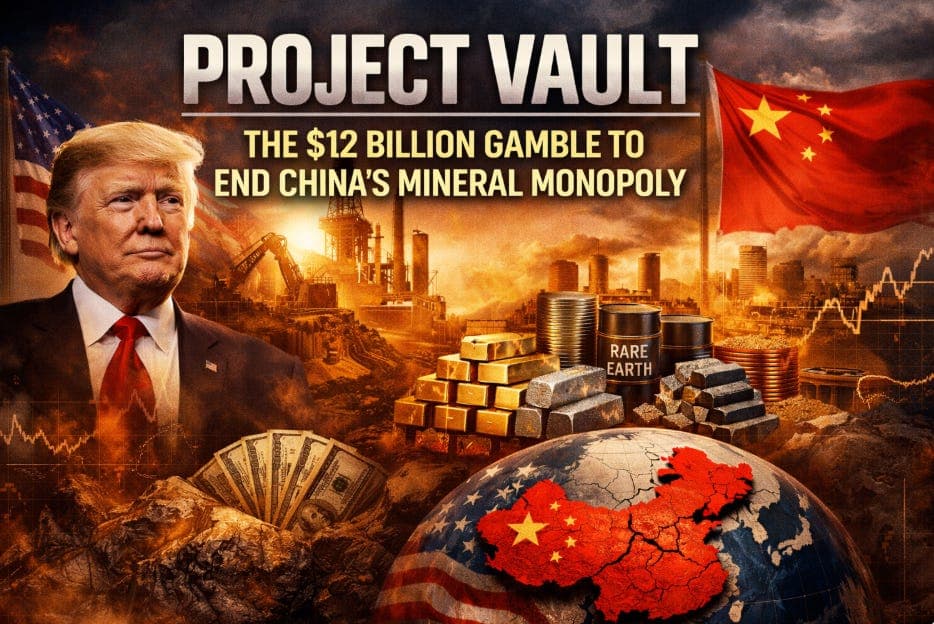
### **Title: Trump Announces “Project Vault,” a $12 Billion Critical Minerals Reserve**
On **February 2, 2026**, President Donald Trump formally announced **“Project Vault,”** a **$12 billion initiative** aimed at establishing a **comprehensive stockpile of critical minerals** essential for modern agriculture, renewable energy, and high-tech manufacturing. This initiative involves:
- **Creating a national reserve** for key materials such as **antimony**, **rare earth elements**, **lithium**, and **cobalt**.
- **Developing domestic processing facilities** to reduce dependence on foreign sources.
- **Forming international partnerships** to **secure supply chains** and **recycle critical materials**.
This move underscores the U.S. commitment to **technological sovereignty** and **supply chain resilience**, directly impacting **agricultural technology deployment**—from autonomous machinery to AI sensor networks—by **ensuring stable access to essential inputs**.
### **Implications**
- The **$12 billion** reserve, termed **"Project Vault,"** aims to **buffer future disruptions** and **support domestic industries**.
- It signals a **shift toward resource nationalism** and **strategic self-reliance**, influencing global markets and supply chain dynamics.
- The initiative encourages **regional partnerships** and **public-private collaborations** to **expand critical mineral extraction and processing**.
---
## Outlook: Fragmentation, Resilience, and Innovation
As 2026 unfolds, the global agricultural landscape is characterized by **ongoing fragmentation paired with resilience strategies**. Countries that **prioritize regional production**, **develop domestic critical industries**, and **harness advanced AI systems** are better equipped to navigate geopolitical tensions and environmental challenges.
- **Regionalization** persists, with nations establishing **domestic** and **regional manufacturing** and **processing hubs** to reduce reliance on distant, geopolitically sensitive sources.
- **Technological sovereignty** is a central goal, with investments in **domestic semiconductor industries**, **critical mineral processing**, and **autonomous systems**.
- The deployment of **location-aware AI** for **supply chain risk management** is transforming logistics, enabling **real-time risk assessment**, **predictive analytics**, and **adaptive responses**—significantly enhancing **food security** and **market stability**.
The synergy of **protectionist policies**, **technological innovation**, and **diplomatic efforts** is forging a **more resilient yet complex global agricultural system**—one that emphasizes **regional strength**, **technological independence**, and **strategic diplomacy**.
**In sum**, 2026 marks a pivotal year where the interplay of tariffs, subsidies, trade missions, and technological advancement is reshaping the global agricultural order. Success hinges on **integrating regional production**, **securing critical inputs**, and **leveraging AI-driven supply chain management** to sustain agricultural productivity amid geopolitical and environmental uncertainties. The future of global agriculture will depend on how effectively nations can **balance protectionism with innovation** and **strategic resilience** in an increasingly interconnected yet divided world.