# High Court Limits Trump’s Tariff Powers, Sending Shockwaves Through Trade and Markets
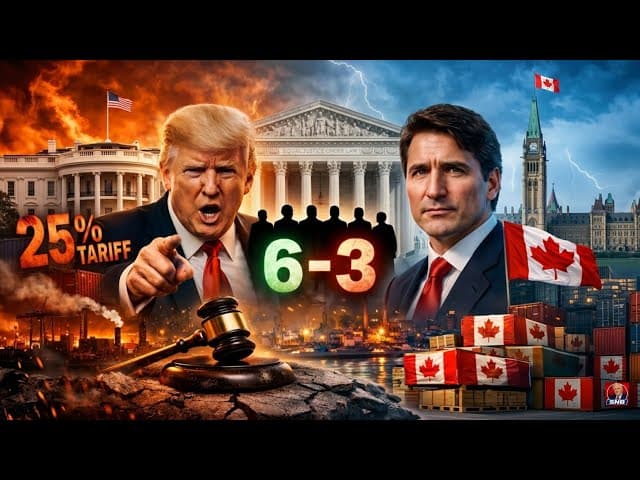
The U.S. trade landscape has entered a transformative phase following the Supreme Court’s landmark 6–3 ruling that significantly curtails President Donald Trump’s authority to unilaterally impose broad tariffs under emergency powers. This decision not only redefines the legal boundaries of executive trade authority but also triggers a cascade of economic, diplomatic, and strategic shifts. As stakeholders grapple with these new constraints, recent developments—including ongoing legal battles, policy recalibrations, and international responses—highlight the complex and volatile trajectory of U.S. trade policy.
## The Supreme Court’s Decision: A Pivotal Legal Turning Point
At the core of recent developments is the Supreme Court’s decisive ruling that **effectively invalidates most tariffs imposed under the International Emergency Economic Powers Act (IEEPA)** during Trump’s tenure. The Court emphasized that **presidents cannot unilaterally impose sweeping tariffs using emergency declarations without explicit congressional approval**, asserting that **statutory clarity is essential** for such significant trade measures.
**Key implications include:**
- **Narrowed presidential authority:** The ruling constrains the executive’s ability to use broad emergency powers for tariffs, demanding that future tariffs be **grounded explicitly in statutory law**.
- **Financial and legal fallout:** Companies that paid tariffs under these now-invalidated measures are questioning if they can recover the amounts paid. Several ongoing lawsuits are examining **tariff refund eligibility**, with potential for **substantial financial consequences** for both the government and importers.
- **Strategic legal responses:** Despite the setback, the Trump administration is **exploring alternative legal routes**. It plans to **implement a 10% global tariff scheduled for 2026**, aiming to **bypass IEEPA restrictions** by utilizing different statutes such as **Section 122 of the Trade Act**. This approach, however, raises **questions about compliance with WTO rules and international commitments**.
## Market Reactions and Sector Dynamics
In the immediate aftermath, **financial markets experienced brief relief**, with **equities edging higher** as traders welcomed a temporary respite from uncertainty. Nonetheless, **investor caution persists**, given the ongoing legal disputes and geopolitical tensions.
- **Safe-haven assets** like **gold and silver** surged as investors sought refuge from trade policy volatility.
- **Bond yields** climbed slightly, reflecting expectations of **potential policy shifts or new trade initiatives**.
- **Market focus** now turns to upcoming statements from President Trump and administration officials, whose guidance could significantly influence **market sentiment**.
**Sector impacts are mixed:**
- **Beneficiary sectors** include **energy** and **pharmaceuticals**, which may see tariffs lifted or limited.
- **Export-dependent industries**, especially in states like California, face ongoing **volatility and uncertainty**, with threats of retaliatory tariffs from trading partners influencing performance.
## Legal Battles Over Tariff Refunds and Authority
A critical unresolved issue is whether **companies that paid tariffs under invalidated measures are entitled to refunds**. Several legal cases are underway, scrutinizing the **extent of the Court’s decision** and its implications for **tariff recovery**. The outcomes could **set important legal precedents** and **shape future executive authority**.
## The Administration’s Strategic Maneuvers
Despite legal restrictions, the Trump administration remains **resolutely committed to asserting trade leverage**:
- **Planning a 10% global tariff in 2026**, asserting that it will **be enacted through alternative legal channels**—notably **Section 122 of the Trade Act**—to **circumvent IEEPA limitations**.
- **Considering flat-rate proposals**, such as a **15% duty**, and **exploring broader legal justifications** to defend these measures.
- **Seeking to reconcile new tariffs with WTO rules**, though concerns about **international compliance and potential disputes** persist.
Recently, a statement from Trump’s trade representative **emphasized** that “the US tariff policy *hasn’t changed*,” signaling ongoing resolve to deploy **aggressive trade tactics** despite legal constraints.
## Diplomatic and Global Supply Chain Repercussions
The ripple effects extend beyond U.S. borders, affecting diplomatic relations and global supply chains:
- **India** has **canceled or postponed a high-profile trade mission to the U.S.**, citing frustrations over **unpredictable and restrictive tariff policies**.
- **China** and the **European Union** are **monitoring developments closely**, wary of retaliatory measures that could further destabilize **global trade flows**.
### China’s Position and Negotiating Leverage
Analysts suggest that **the Court’s restrictions may bolster China’s negotiating stance** in upcoming U.S.-China trade talks. With **limited capacity to impose broad tariffs**, China could **use this legal constraint as leverage** to **delay concessions** or **seek more favorable terms**, thereby **prolonging bilateral tensions**.
### Diplomatic Escalations and Retaliation
Countries like **India** are **escalating responses**—including **cancelling trade missions, issuing retaliatory threats**, and **protecting their economies** from fallout. The EU is **considering retaliatory duties** but continues to favor **diplomatic engagement** to de-escalate tensions.
## Supply Chain Disruptions and Future Trade Patterns
A significant concern is the **planned implementation of a 10% global tariff in 2026**, which experts warn could **reshape international supply chains**:
- **Manufacturers and exporters** are already **reevaluating sourcing strategies**, seeking to **diversify supply chains** away from tariff-heavy regions.
- **Potential consequences include:**
- **Increased consumer prices** across a broad spectrum of goods.
- **Disruptions in sectors** like **technology, manufacturing, and agriculture**.
- **Shifts toward countries** such as **Brazil, Vietnam, and India** as **alternative sourcing hubs**.
### Evidence from Recent Data
A recent study titled *“Tariffs Paid by Midsized US Firms Tripled Last Year”* underscores tangible economic impacts:
- **Tariffs paid by such firms** rose from **1.2% in 2024** to over **3.6% in 2025**.
- Many companies are **absorbing costs or passing them onto consumers**, which **impacts competitiveness**.
- **Supply chain reorganization** is already underway, with firms **reshoring** or **sourcing from less tariff-affected countries** to mitigate costs.
This trend illustrates that **tariffs are increasingly viewed as economic burdens rather than strategic tools**.
## The 2026 Tariff Proposal and Market Outlook
The **planned 10% global tariff in 2026** continues to generate concern:
- **Experts warn** it will **disrupt global supply chains** and **increase consumer prices**.
- Countries like **Brazil**, **Vietnam**, and **India** are **poised to benefit** from shifts in trade flows, potentially **redefining global manufacturing and sourcing landscapes**.
### Market Indicators and Sentiment
Recent signals include **rising bond yields** and **market volatility**, as investors digest the potential impacts of policy shifts. The **upcoming speeches** by Trump and other policymakers are **highly anticipated** as potential catalysts for **market direction**.
## Media and Public Response
Adding a new layer to the discourse, recent media coverage captures **public and expert reactions** to Trump’s tariff stance:
- A notable example is a YouTube video titled **“Carney RESPONDS to ‘Accept Higher Tariffs’ Comment by Trump”**, which has garnered **over 134,000 views** and nearly **3,900 likes**. The video offers **critical analysis** of Trump’s remarks and their **implications for U.S. trade policy**.
- The video’s commentary highlights **public skepticism** about the efficacy of tariffs as a strategic tool and underscores concerns about **trade tensions escalating further**.
## Current Status and Forward Outlook
As of now, **legal restrictions have curtailed the President’s ability to impose broad tariffs under IEEPA**, but the administration’s **plans for a 2026 global duty** suggest that **trade tensions are poised to persist or intensify**. The **ongoing legal disputes over tariff refunds**, coupled with **diplomatic frictions**, indicate that **U.S. trade policy remains in flux**.
**Key questions include:**
- Will the administration successfully implement its planned 10% global tariff through alternative legal routes?
- How will international partners respond diplomatically and economically?
- What will be the legal rulings on tariff refunds, and how might they influence future executive authority?
### Implications for the Future
The Supreme Court’s decision marks a **significant legal milestone**, but the broader **trade environment remains uncertain**. The **resilience of the Trump administration’s strategy**—particularly its focus on **alternative legal mechanisms and planned future tariffs**—suggests that **trade conflicts will likely continue or escalate**.
**Stakeholders—businesses, policymakers, and international partners—must stay alert and adaptable**. The coming months will be crucial in determining whether the U.S. moves toward a **more predictable and stable trade framework** or triggers **further conflicts and disruptions**.
---
**In summary**, the Supreme Court’s ruling profoundly limits presidential tariff powers, yet strategic responses and international reactions indicate that **trade tensions are far from over**. The combination of legal constraints, policy maneuvers, and diplomatic fallout paints a picture of an **uncertain and dynamic global trade environment**, with significant implications for markets, supply chains, and international relations.
The question remains: **Will these legal and strategic constraints lead to a more stable trade environment, or will they ignite new tensions and disruptions?** The upcoming legal rulings, political signals, and diplomatic responses will be decisive in shaping the future of U.S. trade policy.