# The 2026 Milestone in Practical AI Agents: A New Era of Trust, Scalability, and Innovation
The year **2026** marks a transformative milestone in the evolution of **practical AI agents**, signifying their full transition from experimental prototypes to **trustworthy, scalable, and collaborative systems** seamlessly embedded into both personal routines and enterprise workflows. This shift stems from a **confluence of industry standards**, **community-driven innovation**, **powerful tooling ecosystems**, and **resilient deployment practices**. Today, **autonomous, multi-domain AI systems** operate reliably and ethically, fostering a new era of **human-AI synergy** that is more natural, dependable, and impactful than ever before.
---
## Foundations: Establishing Trustworthiness, Safety, and Interoperability
A cornerstone of this maturation has been the **establishment of comprehensive industry standards** that emphasize **trustworthiness, safety, and interoperability**. Initiatives like **"Agent Skills with Anthropic"**, championed by industry leaders such as @eschoppik, have set **benchmarks** that prioritize **scalability**, **shared vocabularies**, and **ethical safeguards**.
Key advancements include:
- **Real-world applicability**: Clear definitions for **agent architecture**, **lifecycle management**, **multi-agent orchestration**, and **safety protocols** have been widely adopted, enabling deployment across sensitive and mission-critical environments.
- **Modular and reusable skills**: The focus on **composability** with **shared vocabularies** has **reduced development friction**, enabling rapid deployment and iteration.
- **Cost and safety management**: Learning from high-cost incidents—such as an AI agent incurring **over $12,000 in operational costs**—organizations now implement **stringent safeguards**, **cost controls**, and **ethical principles** to mitigate financial and reputational risks.
- **Community collaboration**: An active ecosystem where practitioners **share innovations**, **refine standards**, and **establish benchmarks** has fostered **interoperability** and **continuous improvement**.
This **shared foundational framework** has **greatly increased trust** across sectors, empowering organizations to **integrate autonomous systems** confidently, assured of their **safety**, **predictability**, and **ethical operation**.
---
## Democratization and Tooling Ecosystem: Accelerating Adoption
The **vibrant ecosystem of development tools** in 2026 **lowers barriers** and **accelerates widespread adoption**:
- **Foundry Local**: An **offline development environment** that allows developers to **build, test, and deploy AI agents locally**. A detailed **YouTube walkthrough (14:32)** demonstrates how to **securely develop and debug agents offline**, addressing **privacy concerns** and **resilience**, especially vital for **sensitive applications**.
- **Claude Code Ecosystem**: Facilitates **modular skill assembly** and **rapid customization**. The article **"How I use Claude Code: Separation of planning and execution"**—which received **147 points on Hacker News**—illustrates how **decoupling planning from execution** enhances **flexibility**, **debugging**, and **efficiency**.
- **Agent-Browser**: Now a **robust web automation platform**, capable of handling **complex online interactions** and **real-time data extraction**, crucial for applications relying on **live online information**.
- **Clawdbot**: An **optimized tool** for **context window management**, enabling agents to **process large datasets efficiently**, forming a backbone for **scalable automation**.
- **Reusable Skill Repositories**: Resources like **"Building Claude Skills for Any Agent"** provide **interoperable templates**, significantly **boosting productivity**.
- **Voice and IDE Integrations**: Tutorials such as **"Vibe Code"** demonstrate how **voice-to-text systems** can be **built in just 10 minutes**, lowering technical barriers. Additionally, **"Claude Code Tips"** from @svpino offer **best practices** for **coding, debugging**, and **workflow optimization**.
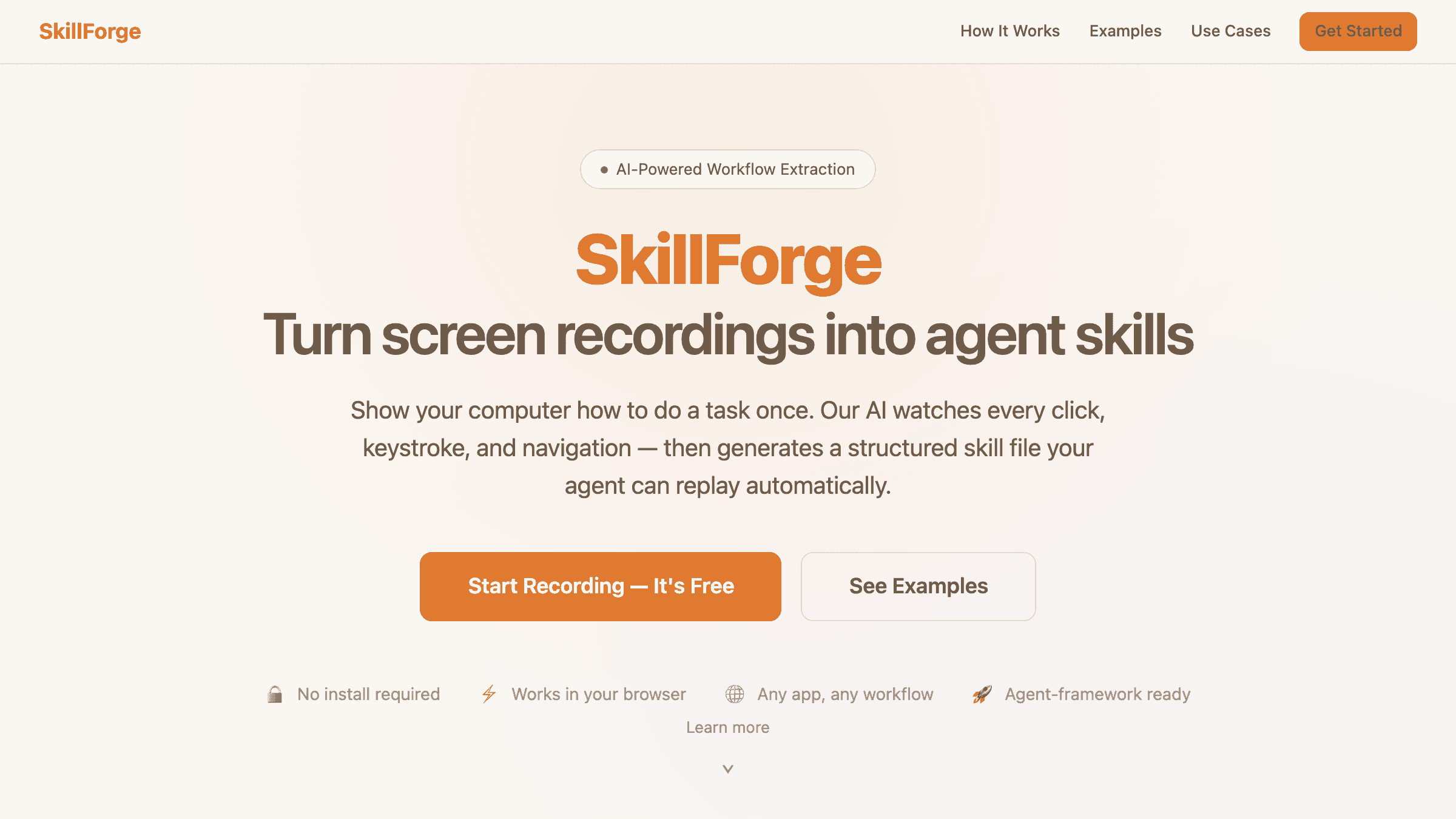
- **SkillForge**: A **revolutionary tool** that **transforms screen recordings into deployable agent skills**, enabling **rapid automation creation** without manual scripting—**redefining skill development**.
- **Claude Cowork**: A **persistent workspace** supporting **task management**, **file storage**, and **collaborative workflows**—now available on **macOS** for **$20/month**—making **AI-powered project management** accessible.
- **Multilingual and Localized Content**: Efforts like **"Membuat AI Assistant dengan OpenClaw"** (an Indonesian tutorial) broaden **global participation**, empowering **non-English speaking communities** to innovate with AI.
This **rich toolkit** has **accelerated innovation**, fostering a **global community** of creators developing **tailored, reliable AI agents** for applications spanning **personal productivity** to **enterprise automation**.
---
## Practical Deployments and Multi-Agent Collaboration
The ecosystem’s maturity is evidenced by **community projects**, **step-by-step tutorials**, and **real-world deployments**:
- **"65 Lines of Markdown, a Claude Code Sensation"**: Demonstrates how **compact code snippets** can **streamline workflows**, illustrating that **powerful automation** doesn’t require complexity.
- **"My AI Agent Runs 3 Newsletters"**: Showcases **offline, personalized automation** managing **multiple newsletters**, highlighting **robust configuration** and **reliability**.
- **Notion’s Custom Agents Demo**: A **popular showcase** where **everyday productivity tools** embed **custom AI agents** directly into **workflows**. A **14-minute YouTube video** illustrates how users **automate action items**, **organize tasks**, and **amplify productivity**.
- **NotebookLM + Gemini 3 ("Second Brain")**: A **6:19 YouTube tutorial** demonstrates how **large language models** integrated into **personal knowledge management** enable **efficient retrieval** and **insights**.
- **"Stop Copy-Pasting Notes"** and **"Stop Chasing AI Hype—Build A Real Workflow"**: These tutorials promote **practical, time-saving AI pipelines** within **Obsidian** and advocate for **reliable automation** over fleeting trends.
- **PC Management Automation**: An emerging frontier where **AI agents** **organize files**, **manage system settings**, and **perform cleanup routines**, illustrating **advanced local automation**.
- **Personalized Scheduling & Note-Taking**: Tools like **Notion-based scheduling agents** and **AI-powered note pipelines** are **streamlining routine tasks**, reducing manual effort, and **enhancing organization**.
- Recent tutorials such as **"How I Use Obsidian + Claude Code to Run My Life"** and **"Claude Code + NotebookLM + Obsidian: The Research Stack Nobody's Using"** demonstrate **end-to-end personal productivity stacks**, combining **knowledge management**, **automation**, and **AI insights**.
---
## Advancements in Multi-Agent Collaboration and Orchestration
A **defining feature of 2026** is the **shift toward multi-agent systems**, where **specialized agents** **collaborate seamlessly**:
- The **"Claude AGENT TEAMS"** framework enables **building resilient, task-oriented agent groups** that **delegate**, **coordinate**, and **respond adaptively**—mirroring **human organizational structures**.
- **Orchestration frameworks**, such as **Gian Luca’s "The Orchestrator’s Workflow"**, provide **blueprints** for designing **complex multi-agent networks** capable of **handling multifaceted workflows**.
- The pursuit of **"Autonomous Super Agents"**, discussed by Atal Upadhyay, aims to develop **AI entities** capable of **managing operational, strategic, and creative functions**, edging toward **artificial general intelligence (AGI)**.
- **Enhanced IDE support** in **VS Code v1.109** facilitates **multi-agent management**, transforming the development environment into a **central hub** for orchestrating **complex ecosystems**.
This **multi-agent orchestration** is **scaling AI capabilities** from **single-task agents** to **collaborative networks**, capable of **handling large, multifaceted workflows** with **minimal human oversight**.
---
## Transitioning to Production: Ensuring Safety, Scalability, and Resilience
Deploying AI agents into **production environments** now emphasizes **safety**, **scalability**, and **resilience**:
- **Monitoring and logging** are **industry standards**, providing **real-time oversight**, **troubleshooting**, and **continuous improvement**.
- The **"over $12,000" incident** underscored the **urgent need for safety safeguards**. Organizations now implement **automated safety checks**, **cost controls**, and **fail-safe mechanisms**.
- Resources like **"Build Your Own MCP Server for Claude Code"** empower organizations to **deploy Claude-based systems** with **greater security and control**.
- **Multi-agent orchestration frameworks** support **workflow scaling**, exemplified by Gian Luca’s **"The Orchestrator’s Workflow"**.
- The vision of **"Autonomous Super Agents"** continues to evolve, aiming to **manage complex operational, strategic, and creative tasks**, bringing us closer to **AGI**.
- **Offline and local development environments** like **Foundry Local** ensure **privacy**, **control**, and **resilience**, particularly vital for **sensitive applications**.
---
## Recent Innovations and Community Contributions
The **community’s vibrancy** persists through **multilingual tutorials** and **interoperability initiatives**:
- **"Membuat AI Assistant dengan OpenClaw"** (Indonesian tutorial) broadens **global participation**, fostering **inclusive AI innovation**.
- Projects like **"Run Claude Code with ANY AI Model"** demonstrate **model interoperability**, allowing builders to **choose models** such as MiniMax, Gemini 3, or Kimi based on **specific needs**.
- **"Build a Secure, Local AI Agent with Claude Code & Obsidian"**: A **YouTube tutorial (5:58)** showcases how to **create privacy-preserving AI agents** that **manage files and notes locally**.
- **Moltis**, a **Rust-based AI assistant**, exemplifies **high-performance, lightweight, and secure AI development**, emphasizing **platform-agnostic approaches** suitable for **resource-constrained environments worldwide**.
These efforts emphasize **security**, **interoperability**, and **accessibility**, reinforcing **AI’s inclusive global growth**.
---
## Future Directions: Toward Multimodal, Trustworthy, and Interoperable AI
Looking ahead, the **AI landscape** is poised for **further breakthroughs**:
- **Multimodal interfaces**—combining **text, voice, images**, and **structured data**—are becoming **mainstream**, enabling **more natural, intuitive interactions**.
- **Broader linguistic support** and **localized tutorials**, such as **"Membuat AI Assistant dengan OpenClaw"**, will **expand accessibility** to **non-English communities** worldwide.
- **Standards for interoperability** are fostering **seamless integration** across **platforms** and **models**, creating **platform-agnostic ecosystems**.
- Continued emphasis on **safety**, **transparency**, and **observability** remains vital for **trustworthy AI systems** that **operate ethically** and **resiliently**.
- The development of **multi-agent collaboration frameworks** and **orchestration tools** will **scale AI capabilities** toward **autonomous super agents**, bringing us closer to **AGI**.
---
## Current Status and Implications
As of **2026**, the **AI ecosystem** exemplifies a **mature, vibrant, and community-driven environment** where **trustworthy**, **scalable**, and **safety-conscious AI agents** are **integral** to **daily life and enterprise**. From **offline development environments** like **Foundry Local** to **multi-agent orchestration frameworks**, these innovations **transform workflows**—enabling **personal assistants**, **enterprise automation**, and **complex multi-domain management**.
**AI agents** now **manage complex, multi-step tasks**, **coordinate across domains**, and **operate with minimal human oversight**, supported by **industry standards**, **safety practices**, and **community knowledge-sharing**. The trajectory promises **more natural multimodal interactions**, **expanded linguistic inclusion**, and **interoperability**, establishing **trustworthy AI partners** that are **accessible, responsible, and integral** to societal and economic progress.
---
## Notable New Resources and Articles
- **"Embedding Memory into Claude Code: From Session Loss to Persistent Context"**: Demonstrates how **memory layers** like **Mem0 (MCP Server)** are **embedding persistent context** into AI workflows, overcoming session limitations.
- **"Claude Code Remote Control Keeps Your Agent Local and Puts it in Your Pocket"**: Introduces **remote control** for AI agents, enabling **local operation** and **on-the-go accessibility**, vital for **privacy** and **resilience**.
---
## The Path Forward: Toward Autonomous, Trustworthy, and Inclusive AI Ecosystems
The future involves:
- **Multimodal interaction** blending **text, voice, images**, and **structured data** for **more natural communication**.
- **Global linguistic diversity** and **localized tutorials** to **broaden participation**.
- **Interoperability standards** that facilitate **seamless cross-platform and cross-model integration**.
- Continued focus on **safety**, **transparency**, and **cost management** to **build trust**.
- The evolution of **autonomous super agents** capable of **multi-domain management**, **creative problem-solving**, and **strategic decision-making**, edging toward **AGI**.
---
## Final Reflection
In 2026, the **AI community** exemplifies a **mature, resilient, and collaborative environment** where **trustworthy AI agents** are **central** to societal and enterprise transformation. Built upon **industry standards**, **cutting-edge tooling**, and **global cooperation**, these systems **enhance workflows**, **protect user safety**, and **expand accessibility**.
From **offline development environments** to **multi-agent orchestration**, the **AI ecosystem** continues to **redefine human-AI collaboration**, managing **complex tasks** with **minimal oversight**. The **trust, scalability**, and **safety consciousness** embedded in this landscape **set the stage** for **further breakthroughs**, **progress toward AGI**, and a future where **AI acts responsibly, inclusively, and as a partner in societal progress**.
---
**In sum**, 2026 signifies a **culmination** of **community effort**, **technological innovation**, and **standardization**—laying a **robust foundation** for **ongoing advancements** in **practical, trustworthy AI systems** that **amplify human potential** and **foster a resilient, inclusive future**.