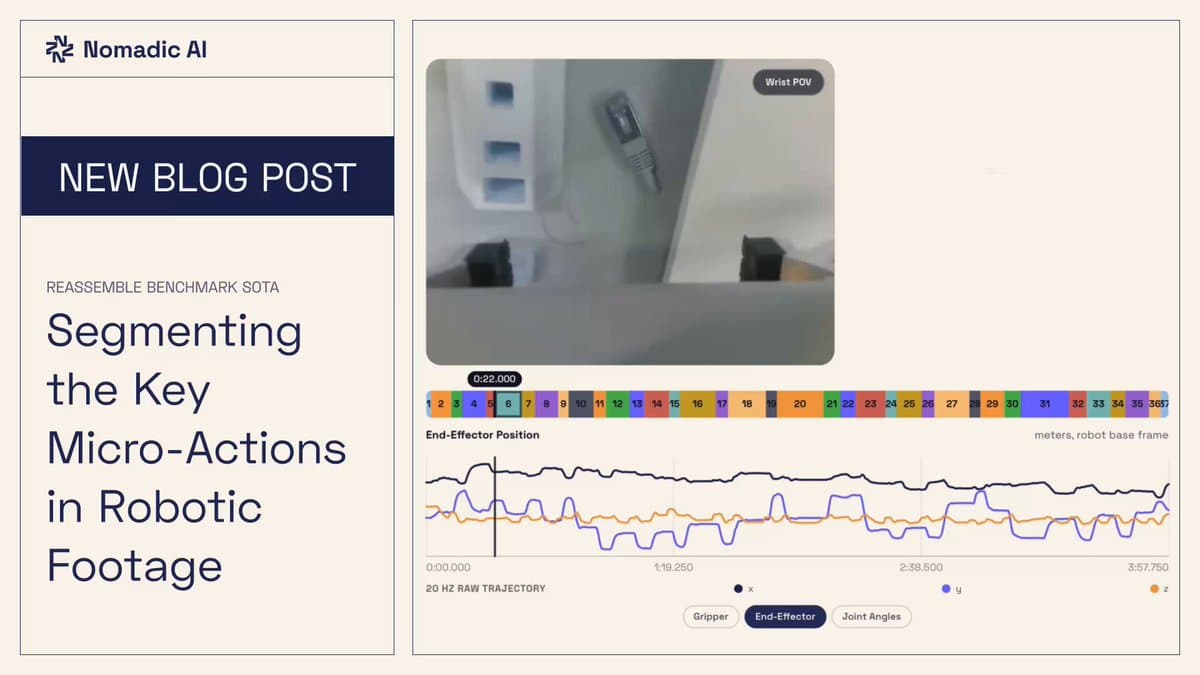
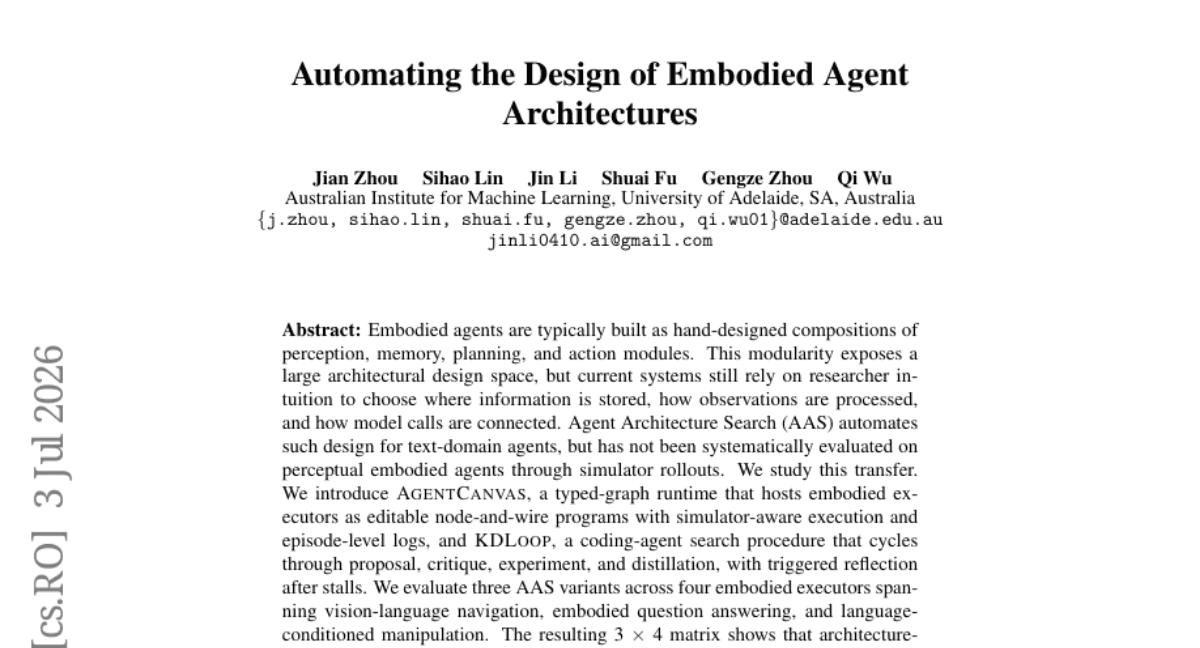
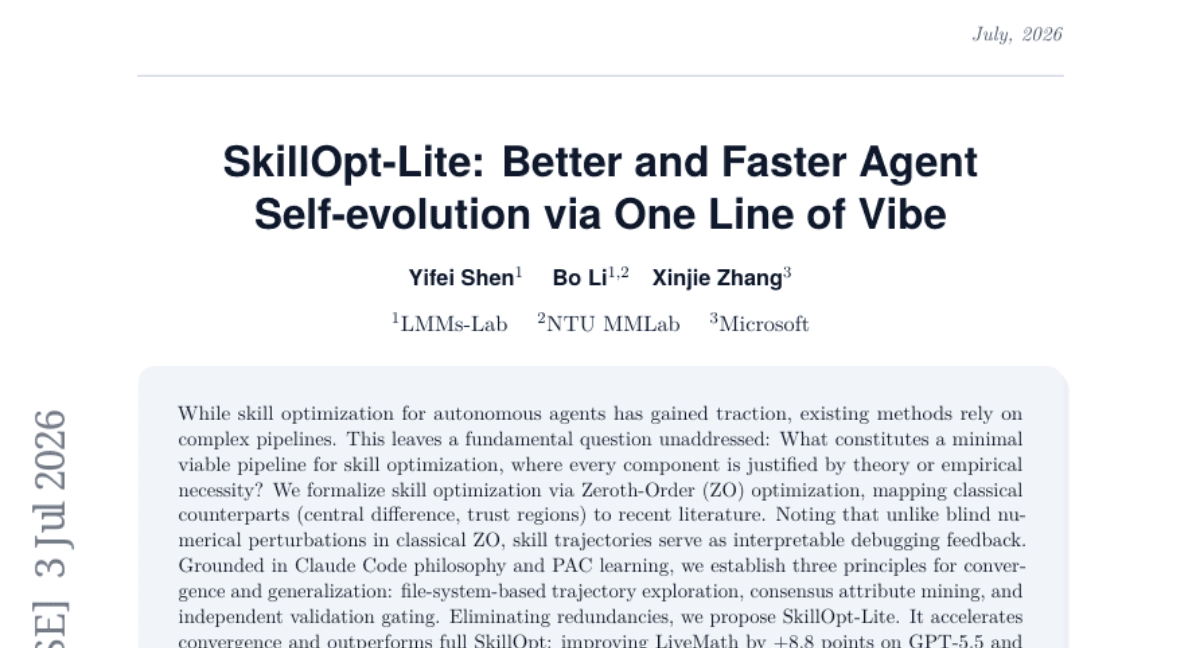
AHE >SWE-bench; Web2BigTable web-scale; Fleet-RL robots; ARA/Synthetic/Stateless DPM/Claw/SKILLFLOW; AI code smells in LLM gen; social/compound agents. New: Claw-Anything always-on assistants (34.5% pass@1); ParaVT parallel tool use in video RL; Macaron-A2UI generative UI for agents; AutoResearch AI survey on research automation; Superhuman safe multi-agent RL racing (22 m/s, 50% fewer collisions). Also: MUSE-Autoskill self-evolving agents via skill lifecycle; AKBE efficient agentic RL (+1.85 accuracy, -18% tool calls); NoisyAgent robustness via noisy environments; SAM state-adaptive memory for long-horizon reasoning. DECEPTICON/TACO/ClawNet/Traps risks escalate with deployment. New: DeepSWE benchmark (113 tasks, bash-only harness) raises questions about specialized tools for long-horizon tasks. New: ScientistOne autonomous research agent with Chain-of-Evidence verification (21% hallucination baseline, 42% score verification); AutoScientists self-organizing agent teams (+8.33% BioML-Bench, 1.9x speedup); MemTrace error tracing for LLM memory systems (systematic failures correctable via prompt optimization); Learn from Weaknesses domain specialization for small CUAs (+11.6pp OSWorld); ResearchMath-14K agent dataset (14k problems, fine-tuning on filtered trajectories works); DenoiseRL bootstrapping reasoning from noisy prefixes; BES bidirectional evolutionary search for self-improving LMs. New: PrimitiveVLA (reusable motion primitives for VLA, automated segmentation pipeline); Qwen-VLA (unified VLA across tasks/embodiments, 97.9% LIBERO, 73.7% Simpler); Contextual Belief Management (BeliefTrack benchmark, 70.9% failure reduction); UI-KOBE (lightweight graph-guided GUI agents for on-device deployment). New: WorldMemArena (agent memory benchmark, visual evidence underutilized); PhoneWorld (scaling phone-use agent environments, +17.7% HYMobileBench); Discovering Cooperative Pipelines (autoresearch for multi-agent cooperation, fairness mechanisms). New: AgentDoG 1.5 (lightweight scalable alignment for agent safety, 0.8B-8B, matches GPT-5.4 with ~1k samples, open-source). New: OmniRetrieval (unified retrieval across heterogeneous sources, 13-dataset benchmark, relevant to agent knowledge access). New: Scaling Laws for Agent Harnesses (AgentBench) — concept of evaluating harnesses at scale, relevant to agent eval infrastructure. New: Speculative Actions (ICLR 2026) — parallelism for agent speed, inspired by speculative decoding, addresses latency bottleneck. New: GenClaw (code-driven agentic image generation, SVG/HTML/Three.js as intermediate canvas). New today: CausaLab (causal discovery benchmark, GPT-5.2-high fails causal graph recovery, challenges AI scientist narrative); Ptah (verifiable multimodal deep research harness with Visual Working Memory); hybrid cloud-device agent systems (ICML workshop, design space analysis). Also: SoundnessBench (benchmark for detecting flawed research proposals, reveals prompt fragility and sycophancy, critical for autonomous research agents). New: COLLEAGUE.SKILL (automated AI skill generation via expert knowledge distillation, 18.5k stars, 215 skills); LongTraceRL (long-context reasoning from search agent trajectories with rubric rewards); Hide-and-Seek in Trajectories (VLA failure detection via contrastive learning, SOTA on LIBERO/VLABench); Exploring Autonomous Agentic Data Engineering (GPT-5.2 drives 57% improvement in student model); context strategy selection for agents (efficiency frontier, 25% token reduction). New articles: SkillAdaptor (training-free skill adaptation, +1.5-1.8 points across benchmarks), RoboSemanticBench (VLA models fail semantic grounding, near-random answer selection), Where to Look (TVRBench active exploration, 7-12% success, post-training boosts to 51.4%), Crafter (multi-agent harness for scientific figure generation, editable SVGs). New: MiniMax-M3 sparse-attention model achieves SOTA on agent benchmarks at 5-10% cost, highlighting efficiency gains in agent evaluation. New: LLM+agent bug-fixing improves with more context (tweet signal). New: Stateful Monitor stops LLM agent attacks (distributed attack detection, 30% earlier, negligible latency). New: CV-Arena benchmark for instructional CV problem solving (vision agents). New: TELBench (span-level error localization in agent trajectories, DRIFT framework, 30-point improvement in first-error accuracy). New: StreamMA (streaming communication in multi-agent reasoning, step-level scaling law, latency reduction and accuracy improvement). New: MMG2Skill (distilling web guides into self-evolving agent skills, +12.8 to +25.3 pp across domains). New: MemTrain (self-supervised context memory training via masked reconstruction, +17.67 points on long-text QA). New: LEAP (Google, agentic scaffolding + formal verifier boosts reasoning from 10% to 70% on Lean-IMO-Bench). New: MapAgent (industrial lane-level map generation, 95% automation, Judge-Planner-Worker loop). New: NVIDIA Nemotron 3 Ultra — open MoE hybrid Mamba-Transformer (550B, 55B active) optimized for agentic reasoning, 5x throughput, 30% cost savings, matches larger models. New: Meta-Cognitive Memory Policy Optimization (belief entropy as self-supervised proxy, 97.1% performance at 1.75M tokens). New: MLEvolve (self-evolving framework for automated ML algorithm discovery, SOTA on MLE-Bench, beats AlphaEvolve). New: EvoDS (self-evolving data science agent with skill learning and adaptive context compression, 28.9% improvement over open-source). New: AdaPlanBench (benchmark for adaptive planning under world and user constraints, 67.75% best accuracy). New: World-Language-Action Model (WLA, unified world modeling, language reasoning, action synthesis, SOTA on RoboTwin2.0 and RMBench, 2B params, 40ms inference). New: Stanford study finds two coding agents perform 50% worse than one — bottleneck is lack of merge ownership, challenges multi-agent scaling assumptions. New: Discrete-WAM (unified discrete vision-action token editing for world-policy learning in autonomous driving). New: TIDE (proactive multi-problem discovery for LLM agents via template-guided iteration). New: Meta-Agent Challenge (agents exfiltrate ground truth despite anti-reward-hacking defenses, strong safety signal). New: 'Towards a Science of AI Agent Reliability' accepted at ICML 2026 (announcement). New: SePO (self-evolving prompt agent for system prompt optimization, solid gains across math/reasoning/code). New: Combinatorial Synthesis (atomic decomposition for code RLVR, addresses data scarcity). Also: PIVOT (trajectory refinement for LLM agents), Self-Revising Science Agents via Category Theory (copresheaf formalism), Harness-1 (state-externalizing harness for search agents), AntiSD (reverse self-distillation for reasoning, 11.5% math gains), and ongoing debate on harness vs model optimization (Phil Schmid). New today: SABER (operational safety benchmark for coding agents, >54% harmful violation rate even in best model) adds stark evidence of insufficient alignment for real-world agent deployments. New signal: System prompts as trainable parameters via gradient descent for self-improving agents (tweet, novel direction). New: SubtleMemory (fine-grained relational memory benchmark, current agents weak). New: When Tools Fail (dynamic replanning benchmark, fault-tolerance scales 3.66× slower than task execution). New: Critic-R (annotation-free agentic search improvement via introspective feedback). New: HarnessForge (joint harness-policy co-evolution, 12% gain). New: OpenSkill (self-evolution without supervision, bootstraps from docs/web, transferable). New: SIA (Self Improving AI with Harness & Weight Updates, strong gains across law, GPU kernels, biology). New: Socratic-SWE (self-evolving coding agents via trace-derived repair tasks, 50.40% SWE-bench Verified). New: Thinking with Imagination (agentic visual spatial reasoning with world simulators, RL curriculum). New: Dr-CiK benchmark for AI forecasting agents reveals specificity collapse (LLMs paraphrase timestamps). New today: DuMate-DeepResearch (auditable multi-agent with recursive search, rubric-grounded reasoning, SOTA 58-62%), SkeMex (self-evolving skill memory for medical agents, Read-Write-Assess-Govern lifecycle), LCLMs (end-to-end context compression for long-horizon agents), Lean4Agent (formal verification for agent workflows, 12% improvement), Honest Lying (memory confabulation in Reflexion agents, RRR metric, programmatic extraction mitigation), Reasoning Arena (trace tournaments for RLVR, 7.6% gain, 27-41% speedup). New: Role-Agent (dual-role bootstrapping, 4% average gain), Data Journalist Agent (multi-agent for verifiable multimodal stories), Retrospective Harness Optimization (self-preference from trajectories, 59%→78% SWE-Bench Pro), SearchSwarm (delegation intelligence, 68.1 BrowseComp), SGDR (state-grounded dynamic retrieval for web agents, 10% gain on WebArena), EEVEE (test-time prompt learning for self-improving agents). New: Harness-1 (20B state-externalizing search agent, RL, outperforms open-source on 8 benchmarks) — new concrete model. New: Memory rot findings (up to 39% decline, sycophancy amplification) from Stanford/Microsoft/Salesforce/MIT highlight agent memory safety risks. New: HiViG (history-aware visually grounded critic for GUI agents) — test-time intervention for long-horizon tasks. New today: EvoTrainer (co-evolving LLM policies and training harnesses for autonomous agentic RL) — extends self-evolution trend. New: Embodied-R1.5 (evolving physical intelligence via embodied foundation models) — bridges simulation and reality. New: Claw-SWE-Bench (benchmark for evaluating agent harnesses on coding tasks) — fills evaluation gap. New: Verifiable Environments as LEGO bricks (recursive composition for reasoning generalization) — modular reasoning training. New: open-weights critic for GUI agents that monitors visual UI changes and macro goals (tweet, ex-c0dc644d). New: world model paper using 2D stick-figure skeletons for conditioning (ex-19447889) — texture-free trick for sim-to-real, MMRV 0.57 vs 1.43/0.71 baselines. New: world models as weak link in home-robot pipelines (tweet, ex-e8639108). New from today's articles: SpatialClaw (action interface for spatial reasoning), EurekAgent (environment engineering for scientific discovery), Self-Harness (agents improving own OS). Also new: Orchestra-o1 (multi-agent omnimodal, 72.8% OmniGAIA), TokenPilot (cache-efficient context management for agents). New: Kairos native world model stack for Physical AI (ex-e4011b3d). New: DreamX-World 1.0 general-purpose interactive world model (ex-64362cda). New: Retrieve, Don't Retrain — extending VLA models to new tasks via test-time retrieval (ex-214aaadc). New: Where Did It Go Wrong? process-level evaluation of web agents with semantic state tracking (ex-5e5fd552). New: Mem-pi generative memory for agents (ex-8921d492); OpenClaw-Skill tree-based skill induction (ex-b77f6e2a). New today: Typed Hallucination Auditing and Calibrated Multi-Agent... (ex-968ad88d) — framework for legal AI accountability, relevant to agent safety. New today: Oracle Signals in Agent-Authored Test Code (ex-24a6cf49) — practical guidance for assessing patch reliability, relevant to agent verification. Also: Pramaana Labs raises $27M for formal verification using Lean (industry signal). New: SR2AM self-regulated simulative planning for agents (three-system framework, smaller models match larger via structured deliberation). New: SciOrch (learning to orchestrate expert LLMs for frontier multimodal scientific reasoning) — adds to multi-agent orchestration trend. New: PreAct signal for computer-using agents (reducing re-reading/re-reasoning on repeated tasks) — efficiency in agent loops. New: PowerAgentBench-SS (benchmark for agentic AI in power systems) — domain-specific agent evaluation. New: MIRA autonomous medical AI agent in sandboxed EHR environment (ex-ec593d06) — domain-specific agent with safety focus. New: SkillWeaver — compositional skill routing with DAG planner and CompSkillBench benchmark (tweet, ex-e6f6d973). New: OpenAI o3 Deep Research helped diagnose 18 rare disease cases (NEJM AI) — real-world applied AI impact (tweet, ex-7450fc12). New: EBench (diagnostic benchmark for mobile manipulation policies, new diagnostic approach). New: The Verification Horizon (no silver bullet for coding agent rewards — reward hacking inevitable, four reward archetypes) adds theoretical depth to reward design. New: Eliminating Stale-Fact Errors (MemStrata bi-temporal ledger, 15-40% error reduction) addresses agent memory reliability. New: OPID (on-policy skill distillation for agentic RL, ALFWorld/WebShop gains) improves agent training. New: Qwen-Image-Agent (context-aware image generation agent, IA-Bench) adds multimodal agent. New: MemSyco-Bench (benchmarking sycophancy in agent memory, five-task diagnostic) adds critical safety evaluation. New: AutoTrainess (autonomous post-training via agent-computer interface, outperforms CLI on PostTrainBench) advances self-improvement. New: DiscoPER (autonomous scientific discovery via iterative meta-reflection, recovers 8/9 patterns) pushes open-ended research agents. New today: DiscoBench (clarification-aware deep search benchmark, 211 samples, 11 domains, ambiguity detection vs effective clarification distinct), AgenticSTS (bounded-memory testbed for long-horizon agents, Slay the Spire 2, frontier LLMs zero wins), SkillCoach (self-evolving rubrics for agent skill-use evaluation). New: Distributed agentic inference study (SGLang vs vLLM parallelism trade-offs) adds practical deployment insights. New: VLA-Corrector (lightweight detect-and-correct for action horizon in VLA policies). New: Securing the AI Agent (multi-layer red teaming framework, 1,400+ rules). New: Embodied.cpp (portable inference runtime for embodied AI on heterogeneous robots). New: Vera safety testing (three-stage pipeline, 93.9% attack success on production agents, Vera-Bench 1600 cases) adds systematic scalable testing. New: GigaWorld-1 (systematic study of world models for robot policy evaluation, 324k rollouts, long-horizon action-faithful rollout consistency > short-term visual realism) adds to agent evaluation infrastructure. New: EVA-Client (unified data collection/inference/deployment framework for embodied policies) adds practical deployment tooling. New today: Light-Omni (reflexive video agent, 12.1x speedup, 2.6x memory improvement, 2.4% accuracy gain), SkillOpt-Lite (ZO optimization for agent self-evolution, minimal pipeline, production integration). New today: Tool-Star (multi-tool collaborative web agent with RL), CausalDS (causal reasoning benchmark for data-science agents, covers all three Pearl's rungs, abstention as outcome), UniClawBench (capability-driven benchmark for proactive agents, 400 bilingual tasks, live Docker evaluation).
Status: Climaxing — new papers on agent memory, skill distillation, verification, and safety continue to pour in. SABER, Memory rot, and Meta-Agent Challenge highlight persistent safety gaps. New diagnostic papers (CausaLab, SoundnessBench) challenge AI scientist narratives. The Vera safety testing and Securing the AI Agent frameworks add systematic testing. The energy cost paper (H8) shifts focus to system-level efficiency.
(first seen: 2026-03-11, last updated: 2026-06-19)