# Europe’s Strategic Shift: Toward Greater Defense Autonomy and NATO Rebalancing in 2026
Europe’s defense landscape is undergoing a transformative evolution, marked by deliberate moves toward enhanced military independence, operational sovereignty, and a significant rebalancing within NATO’s command structure. Building on earlier momentum, recent developments—ranging from NATO’s command reforms and high-level political commitments to operational demonstrations and industrial initiatives—highlight an emerging European strategic posture aimed at asserting its own security agency amid a complex geopolitical environment.
---
## NATO’s Command Reforms: Delegating Leadership and Strengthening Regional Capabilities
A pivotal element in Europe’s pursuit of strategic autonomy is **NATO’s ongoing command reform process**. Notably, **authority over two critical Joint Force Commands**—located in **Brunssum, Netherlands**, and **Naples, Italy**—has been **delegated from U.S. oversight to European military leadership**. This **signifies a major step toward operational independence**, reflecting growing confidence in Europe’s military capabilities.
- **Impacts on Transatlantic Dynamics**:
- The **shift underscores Europe’s increasing strategic self-reliance** and **trust in its military professionalism**.
- It **reduces reliance on U.S. dominance**, fostering **more balanced NATO leadership**.
- These reforms are **further supported by enhanced NATO–EU cooperation**, including **joint planning exercises**, **information sharing**, and **operational integration**, aimed at **bolstering Europe’s autonomous operational capacity**.
In addition, NATO is **advancing regional defense initiatives** such as **Arctic Sentry**, focusing on **monitoring and responding to emerging security challenges in the Arctic and High North**. This region's strategic importance is rising due to **climate change, resource competition, and regional tensions**. NATO’s strengthening of Arctic defenses aims to **ensure resilience and preparedness** in a geopolitically sensitive and resource-rich area.
Another notable development is the **deployment of U.S.-made MEROPS counter-drone systems** to NATO’s eastern flank. This **layered defense capability** enhances **protection against asymmetric aerial threats**, particularly **unmanned aerial systems**, which are increasingly used in hybrid warfare tactics. Europe’s **investments in unmanned systems and cyber resilience** further demonstrate its **modernization efforts** to address hybrid, cyber, and emerging threats.
**In sum**, these command reforms and operational initiatives **embolden Europe’s capacity to lead collective defense efforts independently**, contributing to a **more balanced and resilient NATO structure**.
---
## Political Momentum: Europe’s Strategic Autonomy at the Forefront in 2026
The **Munich Security Conference 2026** served as a critical platform where European leaders **reaffirmed their commitment to strategic autonomy**. A **unified European stance** emerged, emphasizing **greater responsibility for security and defense**, driven by concerns over hybrid threats, technological dependencies, and resilience.
- **Key Statements and Debates**:
- **Ursula von der Leyen** emphasized the **necessity for Europe to “take responsibility for its security”**, advocating for **self-reliance in defense technology, industrial capacity, and strategic planning**.
- **Emmanuel Macron** called for **a European Defence Union**, promoting **joint military development, shared procurement, and technological sovereignty**. He warned that *“We must still face an aggressive Russia even if Ukraine war ends”*, stressing **the importance of enduring resilience**.
- **German Defence Minister Boris Pistorius** cautioned against **U.S. pursuit of a “go-it-alone” policy**, emphasizing **European–American cooperation**.
- **UK Prime Minister Keir Starmer**’s speech, however, drew scrutiny due to **a lack of firm commitments to increased defense spending**, sparking debates on **European unity and military readiness**.
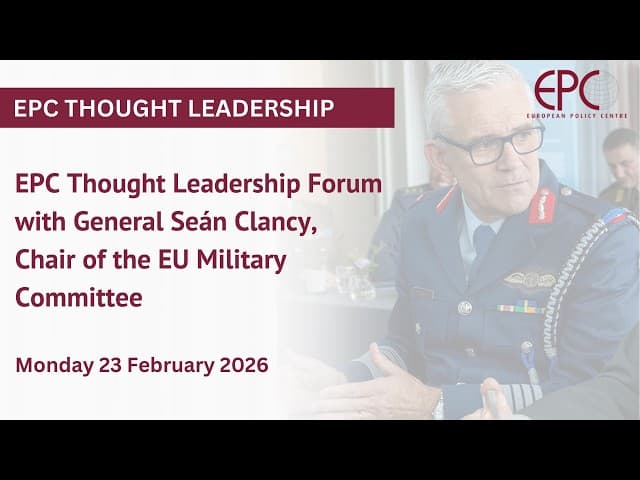
Adding weight to this political momentum, **European military and strategic leaders** have reinforced these commitments. **General Seán Clancy**, Chair of the European Union Military Committee, has been particularly vocal, emphasizing **the shift from ambition to endurance**. In recent interviews and forums—including the **EPC Thought Leadership Forum** (February 2026)—Clancy highlighted the importance of **developing sustainable, long-term military capabilities** that **outlast political cycles**. His leadership underscores **a collective push for Europe to move beyond aspirational goals** toward **building resilient, operationally capable forces**.
The **2025 NATO summit in The Hague** further cemented **burden-sharing commitments**, with member states pledging to **contribute proportionally** in personnel and capabilities. This political consensus **aims to foster long-term investment** in **military capacity, technological innovation, and strategic independence**, positioning Europe as a **more autonomous actor within NATO**.
---
## Operational Demonstrations and Military Maturation
Europe’s **military capabilities have visibly advanced** in recent months, with several notable events reflecting **growing independence and confidence**:
- The **Swedish participation in NATO’s air policing over Iceland** marked a historic milestone, as **Swedish fighter jets operated within NATO’s framework** despite Sweden not yet being a NATO member. This **symbolizes increasing operational trust and integration**.
- The **Arctic Sentry initiative** has been **expanded and fortified**, enhancing **monitoring and response capabilities** in the Arctic region, a **strategic frontier** amid **climate change, resource competition, and regional tensions**.
- **High-intensity NATO exercises**, such as **STEADFAST DART 26**, involved **over 10,000 troops from 11 nations** and focused on **large-scale strike operations, interoperability, and rapid deployment** in complex scenarios. These drills **highlight Europe’s ongoing efforts to bolster military readiness** for high-demand situations.
- Europe is **channeling substantial resources into unmanned systems and cyber defenses**. The **deployment of NATO’s MEROPS counter-drone system** on the eastern flank **significantly enhances layered defenses** against small, inexpensive aerial threats—**a critical evolution in hybrid warfare defense**. Europe’s **advancements in UAV technology** and **cyber resilience measures** continue **modernizing its military posture**.
---
## Industrial and Policy Initiatives: Building Sovereign Capabilities
Recognizing that **military independence depends heavily on industrial strength**, Europe is **pursuing comprehensive industrial reforms and supply chain resilience**:
- **Supply Chain Resilience**:
- Forums like MSC 2026 have emphasized **reducing dependence on external suppliers**, especially for **electronics, missile components, and cybersecurity equipment**.
- Efforts are underway to **secure supply networks**, particularly to **mitigate vulnerabilities stemming from reliance on China, Russia, and other external sources**.
- **Joint Procurement and Development**:
- The push for **shared military assets**, **standardization**, and **economies of scale** is accelerating, fostering **interoperability** and **technological innovation**.
- **Arms Industry Reform and Innovation**:
- Discussions focus on **expanding Europe’s arms manufacturing capacity** and **reforming export rules** to **foster technological sovereignty**.
- An upcoming article titled *"How Europe's defence push is testing existing arms-export rules"* explores **the potential for Europe to become a self-sufficient industrial power**.
---
## Addressing Risks and Ensuring Cohesion
Despite significant progress, **disparities in defense spending and industrial policies** among member states **pose risks to European cohesion**. The pursuit of **greater autonomy** must be balanced with **maintaining NATO unity**.
- **Divergent national approaches** and **uneven rearmament efforts** **risk fragmenting collective efforts**.
- **Interoperability challenges**, particularly in deploying advanced systems like counter-drone platforms and cyber defenses, require **standardized protocols and joint training**.
**European leadership**, including voices from General Clancy and the European Military Committee, continues to **advocate for sustained investment and strategic planning**. Their message underscores **the importance of transforming ambitions into enduring capabilities** through **long-term commitment, coherent policies, and unified action**.
---
## Current Status and Future Outlook
Europe’s **strategic trajectory remains focused** on **greater military independence, technological sovereignty, and NATO command rebalancing**. The confluence of **command reforms, political consensus, operational demonstrations, and industrial initiatives** signals a **robust acceleration of European strategic autonomy**.
- **NATO’s command reforms** and **European-led operational leadership** are **reshaping alliance structures**, enabling **Europe to assume more autonomous military roles**.
- Political leaders across Europe **continue to articulate a vision of resilience and strategic self-reliance**, reinforced by **military exercises, technological investments, and industrial reforms**.
- The **military maturation** is evident in **deployments, interoperability drills, and modernization efforts** that **solidify Europe’s defense capabilities**.
**Implications for the future** include a **shift in transatlantic relations**, with Europe **taking on more leadership within NATO** and developing **independent strategic capabilities**. The continent’s focus on **hybrid threats, cyber resilience, unmanned systems, and industrial sovereignty** signals a **modern, adaptable defense posture**.
Looking ahead, **Europe appears poised to sustain its push for strategic autonomy** within a **rebalanced NATO command structure**, shaping the security landscape **for decades to come**. The ongoing efforts to **build resilience, technological independence, and operational capability** mark a **transformative phase in European defense**, transforming ambitions into **lasting strength and stability**.
---
### Recent Contextual Updates:
- **Russian Offensive Campaign Assessment (Feb 25, 2026)** highlights ongoing Russian military activity, underscoring **the urgency for Europe to bolster its defense resilience**.
- Discussions around **Europe’s nuclear deterrent**, especially France’s arsenal and its role within NATO, continue to influence strategic debates. France’s nuclear capabilities **remain a cornerstone of Europe’s independent deterrence**, while debates persist on **NATO’s collective nuclear posture**.
- The recent statement by **Polish Foreign Minister Sikorski**, emphasizing **Poland’s loyalty to the U.S. but cautioning against being a “sucker,”** reflects **the delicate balance** European nations seek between **transatlantic partnership and strategic independence**.
**In conclusion**, Europe’s concerted efforts—anchored in command reforms, political resolve, operational maturation, industrial resilience, and strategic debates—are shaping a **more autonomous, resilient, and capable continent**, poised to play a **leading role within the evolving security architecture** of the 21st century.