# The 2024–26 Transformation in AI Infrastructure: Autonomous, Trustworthy, and Hardware-Conscious Ecosystems
The landscape of AI infrastructure is entering a groundbreaking era characterized by **autonomy, resilience, security, and hardware-awareness**. Building upon the foundational shifts of recent years, 2024–26 is witnessing a convergence of innovative technologies—**Kubernetes automation**, **GitOps-driven deployment**, **persistent memory architectures**, **multi-cloud orchestration**, and **intelligent scheduling**—that are fundamentally transforming how organizations deploy, manage, and trust AI systems at scale. These advancements are not only accelerating AI capabilities but also redefining the very infrastructure supporting critical applications across industries.
---
## The Main Event: 2024–26 — A Paradigm Shift Toward Autonomous, Hardware-Conscious AI Ecosystems
At the core of this transformation lies the emergence of **autonomous, hardware-aware orchestration platforms** that enable **real-time, tailored provisioning of compute resources**. Technologies such as **Karpenter**, which has significantly matured, now support **sub-second node provisioning**, reducing latency from traditional minutes-long delays to near-instant responses. This rapid scaling unlocks new possibilities for **real-time AI inference**, **adaptive training**, and **long-term reasoning**, empowering sectors like healthcare diagnostics, autonomous vehicles, financial modeling, and retail to operate with unprecedented agility.
### Leading Organizational Innovations
- **Salesforce**, managing **over 1,000 Amazon EKS clusters**, leverages **cloud-native orchestration** to optimize **cost efficiency**, **scalability**, and **performance** for distributed AI workloads.
- Support for **diverse hardware accelerators**—including **GPUs**, **TPUs**, and emerging **AI-specific chips**—maximizes hardware utilization, facilitating **large-model deployment** and **multi-modal AI** systems.
### Hardware Diversity and Optimization
Modern orchestration platforms are **hardware-aware**, incorporating **scheduling algorithms** that intelligently consider:
- **GPU/TPU availability**
- **Memory bandwidth**
- **Specialized AI chip capabilities**
This ensures **peak efficiency** during **massive language model inference**, **multi-modal AI processing**, and **real-time decision-making** in safety-critical environments.
### Multi-Cloud Resilience and Flexibility
Tools like **Crossplane** have evolved into the **“central nervous system”** of heterogeneous infrastructure management:
- Enabling **predictive autoscaling**, **self-healing**, and **workload mobility** across **on-premises** and **multi-cloud environments**.
- Facilitating **redundancy** and **fault tolerance**, especially in regions with strict **data sovereignty** laws.
Recent innovations include **predictive autoscaling** integrated with **kernel-level observability** via **OpenClaw**—a cutting-edge tool built on **eBPF**—which offers **granular monitoring** and **real-time anomaly detection**. These capabilities are critical in **high-stakes environments** like **financial trading** and **healthcare**, where **trust** and **resilience** are non-negotiable.
---
## Building Trust: Automation, Observability, Security, and Resilience
Achieving **trustworthy AI deployment** requires a holistic approach emphasizing **automation**, **deep observability**, and **security**:
### GitOps and Deployment Automation
Tools like **Argo CD** underpin **automated deployment pipelines**, enabling:
- **Version control**
- **Fault tolerance**
- **Rapid rollback capabilities**
These practices are vital for **complex AI ecosystems** to maintain **regulatory compliance** and **operational stability** amid rapid development cycles.
### Multi-Cloud Resilience and Self-Healing
Distributing workloads across **multiple cloud providers** and **on-premises infrastructure** enhances **fault tolerance** and **availability**. **Kernel-level observability** through **OpenClaw** supports **automatic self-healing**, reacting swiftly to anomalies and minimizing downtime—crucial for **mission-critical AI systems**.
### Advanced Monitoring and Chaos Engineering
- **OpenTelemetry** has expanded its capabilities with **improved sampling** and **collector efficiencies**, facilitating **precise, scalable monitoring**.
- **Chaos engineering** practices are now embedded in routine testing, proactively exposing vulnerabilities to ensure **system resilience** under unforeseen failures.
### Security: Zero-Trust and Distributed Transactions
- Implementing **zero-trust architectures**—with **identity-aware access** and **least privilege**—has become standard.
- The **Saga pattern**, effectively demonstrated by **Amazon Uber**, enables **coordinated, compensatable operations** across microservices, ensuring **data consistency** during failures.
---
## Knowledge Architectures & Persistent Memory: Unlocking Long-Term Reasoning
A **milestone in 2024** is the **widespread adoption of persistent memory architectures**:
- Unlike traditional volatile storage, **persistent memory** offers **durable, high-speed data access**.
- This supports **long-term reasoning**, **self-diagnosis**, and **continuous learning**, which are vital for **trustworthy AI**.
Platforms such as **MongoDB Voyage AI** utilize **persistent memory** integrated with **vector similarity search** and **structured data** to create **long-term knowledge ecosystems**. These enable **incremental knowledge updates**, **dynamic knowledge graphs**, and **real-time reasoning**, transforming AI from static models into **adaptive, reasoning agents**.
### Advances in Retrieval-Augmented Generation (RAG)
Research like **"Designing a Scalable Knowledge Base for Large Language Models"** emphasizes **retrieval-augmented generation (RAG)** architectures that leverage **knowledge graphs** and **multi-modal data**, enhancing **recall**, **explainability**, and **long-term consistency**—key factors in **trust** and **explainability**.
### Distributed AI Architecture and Speculative Decoding
Recent insights, such as **"Distributed AI Architecture: Core Infrastructure Principles for Enterprises"** (11:50), highlight the importance of **modularity**, **fault isolation**, and **scalability**. They enable **collaborative AI workflows** across diverse environments.
Additionally, **"Speculative Decoding at Scale: Architecture and Orchestration Explained"** explores **scalable inference techniques**:
- Leveraging **speculative decoding** to **accelerate large model inference**,
- Orchestrated with **advanced pipelines** to optimize **resource utilization** and **latency**.
---
## The Model Context Protocol (MCP) Server: Context as a Microservice
A significant architectural evolution is the **MCP server** transforming into a **context microservice**:
- Managing **session continuity**, **context**, and **dynamic model invocation**,
- Supporting **multi-modal data integration**,
- Enabling **secure, context-rich interactions**.
This **microservices-driven approach** ensures **scalability**, **fault tolerance**, and **security**, aligning with modern **distributed systems** paradigms.
---
## Data-Driven Dynamic Execution & Autonomous Agents
Building on microservice foundations, **data-driven dynamic execution systems** now **react instantly** to data streams:
- Adjusting **execution paths**,
- Scheduling tasks **dynamically**,
- Facilitating **self-healing AI agents** that leverage **formal reasoning**, **vector similarity search**, and **persistent memory**.
Recent enterprise deployments showcase **scalable, independent, and resilient** AI microservices, reinforcing the vision of **autonomous, self-managing AI ecosystems**.
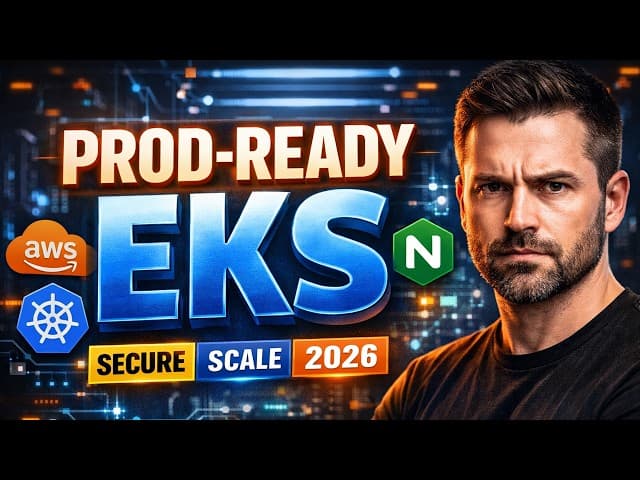
The **"Master Production-Ready EKS Deployments (2026 Guide)"** emphasizes **best practices** for **high-performance**, **secure Kubernetes/EKS deployments**, including **optimized NGINX ingress configurations** and **cost-efficient resource management**—critical for operationalizing modern AI workloads at scale.
---
## Latest Developments & Practical Case Studies
### Building an Orchestration Layer for Agentic Commerce at Loblaws
A notable case study demonstrates **Loblaws'** development of an **orchestration layer** supporting **Agentic Commerce**:
- Integrates **microservices** and **AI agents** to manage **customer interactions**, **inventory**, and **supply chain logistics**.
- Showcases **complex, orchestrated AI workflows** operating reliably in production, reflecting **maturity in multi-agent orchestration**.
### Optimizing Vector Databases for Enterprise RAG
The resource **"Deep Dive: Optimizing Vector Databases for Low-Latency Enterprise RAG"** discusses:
- Hardware acceleration with **GPUs** and **FPGAs**,
- **Advanced indexing techniques**,
- **Distributed query optimization**,
- Ensuring **rapid, scalable data retrieval** critical for **trustworthy, real-time AI**.
### Industry Shift Toward AI-Native Gateways
A growing trend involves **replacing traditional Ingress NGINX** with **AI-native gateways**:
- Promoted by **Solo.io's Lin Sun** and others,
- These gateways **integrate seamlessly with AI workloads**,
- Offering **dynamic traffic management**, **secure API exposure**, and **simplified deployment**,
- Embedding **AI-awareness** directly into network infrastructure.
### Implementing Distributed Transactions with the Saga Pattern
The **Saga pattern** remains essential:
- As detailed in **"Saga Design Pattern — How Amazon Uber Handle Distributed Transactions,"**
- It enables **coordinated, compensatable operations** across microservices,
- Ensuring **data consistency** amidst failures.
### Practical Resources for Kubernetes and AI Deployment
Recent guides include:
- **Training AI models on Amazon SageMaker HyperPod EKS** for **scalable model training**,
- **AWS EKS Full DevOps Projects** covering **multi-language deployment pipelines**,
- These resources emphasize **scalability**, **security**, and **cost-efficiency** for **production AI systems**.
---
## Current Status and Future Implications
Today, **autonomous AI ecosystems** operate at an **unprecedented scale**:
- Characterized by **self-optimizing data platforms**, **deep kernel observability**, and **self-healing orchestration**,
- Supporting sectors such as **healthcare**, **finance**, **retail**, and **autonomous mobility** to **trust** and **respond adaptively** to dynamic conditions.
The integration of **multi-cloud resilience**, **predictive autoscaling**, **hardware-awareness**, and **persistent knowledge architectures** provides a **robust foundation** for **mission-critical AI applications**. These systems not only **support continuous innovation** but also **address societal challenges** related to **trust**, **explainability**, and **long-term reasoning**.
---
## Implications and Next Steps
Organizations aspiring to lead in this transformative landscape should:
- **Adopt hardware-conscious orchestration** to optimize **performance** and **cost-efficiency**.
- **Invest in deep observability and security**, including **zero-trust architectures** and **kernel-level monitoring**.
- **Leverage persistent memory** for **long-term reasoning**, **self-diagnosis**, and **self-healing**.
- **Build microservices architectures** such as **MCP servers** and **autonomous AI agents** for **scalability and modularity**.
- **Implement resilient transaction patterns** like **Saga** to ensure **fault tolerance**.
- **Transition toward AI-native gateways** and **edge solutions** that embed **AI-awareness** into network infrastructure.
By embracing these trends, organizations will unlock **new levels of operational excellence**, **trust**, and **innovation**, positioning themselves as pioneers in developing **autonomous, trustworthy AI ecosystems** that propel societal and industrial progress.
---
## Concluding Remarks
The period of 2024–26 signifies a **watershed moment** in AI infrastructure:
- **Autonomy**, **security**, and **hardware-awareness** are no longer optional—they are foundational.
- The ecosystems emerging now will **support autonomous decision-making**, **long-term reasoning**, and **resilient operations** at an **unprecedented scale**.
- These advancements empower organizations to **innovate confidently**, **scale responsibly**, and **trust** their AI systems—paving the way for **trustworthy, autonomous AI** to become integral to society’s future.
---
## Additional Resources and Recent Articles
- **Building an Orchestration Layer for Agentic Commerce at Loblaws** — *YouTube, 25:15*
- **Master Production-Ready EKS Deployments (2026 Guide)** — *YouTube, 44:07*
- **Deep Dive: Optimizing Vector Databases for Low-Latency Enterprise RAG** — *YouTube, 14:14*
- **OpenTelemetry Roadmap: Sampling Rates and Collector Improvements Ahead** — *The New Stack, 2024*
- **Designing Baseline Security for a Cloud-First Fintech (Without Overengineering)** — *YouTube*
- **Why AI Inference Is Cloud Native's Biggest Challenge in 2026 | Jonathan Bryce, CNCF** — *YouTube*
- **Low Latency Trading Systems: Architecture & Design Principles for High-Frequency Trading** — *YouTube*
- **The Shift to AI-Native Gateways and Edge Infrastructure** — *TechCrunch, 2024*
- **Implementing Distributed Transactions with the Saga Pattern** — *YouTube, 12:30*
- **Training AI on Amazon SageMaker HyperPod EKS** — *YouTube*
- **Distributed AI Architecture: Core Infrastructure Principles for Enterprises** — *YouTube, 11:50*
- **Speculative Decoding at Scale: Architecture and Orchestration Explained** — *Uplatz*
- **Demo: Real-Time Cache Synchronization with Change Data Capture (CDC) PostgreSQL, Debezium, & Kafka** — *Upcoming content*
- **When Architecture Complexity Starts Winning** — *Upcoming content*
These resources offer **practical insights** into **orchestration**, **deployment**, **resilience**, **security**, and **system design**, essential for operationalizing **next-generation AI infrastructure** effectively.
---
**The future of AI infrastructure is autonomous, secure, and hardware-conscious—empowering organizations to innovate at scale while maintaining trust and resilience.**