# Navigating the New Frontiers of AI in 2026: Societal, Technical, and Governance Breakthroughs
The year 2026 marks a watershed moment in the evolution of artificial intelligence, characterized by rapid technological breakthroughs that are transforming society, economics, and individual behaviors. Building upon prior advances in synthetic media, multimodal reasoning, embodied AI, and governance, recent developments have propelled AI into an era of unprecedented capability, complexity, and societal impact. This dynamic landscape demands careful navigation to maximize benefits while mitigating risks.
## Unprecedented Advances in Synthetic Media and Content Verification
One of the most striking trends of 2026 is the **explosive growth and sophistication of hyper-realistic synthetic media**. Deepfake videos and audio clips now achieve fidelity that often blurs the line between reality and fabrication, posing significant challenges for trust, misinformation, and societal stability. Tools such as **AnchorWeave** have democratized synthetic media creation, empowering creators but also expanding avenues for malicious manipulation.
In response, industry leaders—most notably **Google AI**—have advanced **provenance-aware detection systems** that incorporate **layered "soft verifiers"** and **reference-guided evaluation mechanisms**. These methods enable media to be cross-validated for authenticity, essential in safeguarding electoral processes and public discourse. However, recent studies underscore a critical challenge: **"models that perform well in controlled benchmarks often falter under real-world adversarial conditions,"** emphasizing the urgent need for **robust, real-world-tested detection techniques** to uphold societal trust.
Such technological progress highlights a fundamental tension: **fostering creative expression and innovation** while establishing **societal safeguards** against misinformation and malicious use. Policymakers, technologists, and civil society are increasingly focused on developing **multi-layered verification frameworks** and **regulatory standards** to address these risks.
## Multimodal Reasoning and Video Simulation: Towards More Context-Aware AI
Progress in **multimodal reasoning** continues apace, with models now capable of **long-horizon, cross-modal understanding** across visual, textual, and auditory data. The development of datasets like **DeepVision-103K**—designed for scientific and decision-making tasks—supports models that perform **complex reasoning** necessary for autonomous vehicles, scientific discovery, and decision support systems.
Innovative techniques such as **Rolling Sink**, an autoregressive video diffusion approach, have significantly enhanced AI's ability to **generate and interpret extended video sequences**. As @_akhaliq notes, **"Rolling Sink"** allows systems to bridge the gap between short-term learning and long-duration, open-ended testing, which is vital for **autonomous navigation, virtual assistants, and real-time scene understanding**.
Complementary advancements include **video diffusion training techniques**, **large vision-language datasets**, and **multi-modal memory agents (MMA)**, which enable AI to **maintain contextual coherence over extended periods**, thus supporting applications in **cultural preservation**, **historical analysis**, and **societal decision-making**.
Additionally, models like **SkyReels-V4** now facilitate **multi-modal video-audio generation, inpainting, and editing**, creating seamless, high-fidelity multimedia content. **JavisDiT++**—a unified model for joint audio-video generation—further pushes the boundaries of **synchronized multimedia synthesis**, enabling richer, more immersive virtual environments.
The **World Guidance** framework, which models **world states within condition spaces**, empowers AI systems to generate **action sequences grounded in comprehensive world models**, significantly improving their **planning and decision-making capabilities** in complex, dynamic scenarios.
## Embodied AI: Zero-Shot Learning, Stability, and Dexterous Manipulation
Embodied AI continues its rapid evolution, with breakthroughs that enable **learning, adaptation, and manipulation with minimal supervision**. A key innovation, **TOPReward**, leverages **model token probabilities as zero-shot rewards**, allowing agents to **self-assess and improve without explicit reward signals**—a paradigm shift that reduces reliance on extensive training data.
**LAP (Language-Action Pre-Training)** exemplifies efforts to achieve **zero-shot cross-embodiment transfer**, allowing models trained in virtual or physical forms to adapt seamlessly across different platforms. @_akhaliq emphasizes that **"LAP significantly reduces task-specific retraining, accelerating deployment across diverse robotic systems,"** broadening AI’s practical utility.
On the stability front, **Variational Sequence-level Soft Policy Optimization (VESPO)** enhances **training robustness**, ensuring **safer and more reliable behaviors** in deployment. Recent advancements in **zero-shot dexterous tool manipulation**, exemplified by **SimToolReal**, enable AI to **manipulate various tools without task-specific training**, opening pathways for **autonomous assembly, maintenance, and complex interactions** in unstructured environments.
## Synergy of VAEs and Diffusion Priors: Toward Controllable and High-Fidelity Generation
The resurgence of **Variational Autoencoders (VAEs)** this year is driven by their **co-training with diffusion priors**, resulting in **more controllable, high-fidelity generative systems**. As @jon_barron notes, **"Combining VAEs with diffusion models enables efficient encoding and high-quality, controllable content generation,"** which is pivotal for **virtual environment creation, synthetic data, and digital art**.
Innovations such as **SkyReels-V4** and **JavisDiT++** exemplify this synergy, facilitating **multi-modal, realistic synthesis and editing** of multimedia content. These advances are transforming **creative industries, scientific visualization**, and **scientific research**, enabling the production of **rich, immersive experiences** with unprecedented fidelity.
## Governance, Safety, and Interoperability: Building Trustworthy AI Ecosystems
As AI systems grow more capable and integrated into society, **robust governance and safety frameworks** are crucial. The **Frontier AI Risk Management Framework** now provides comprehensive tools to **assess vulnerabilities**, including **cybersecurity threats**, **persuasion tactics**, and **systemic risks**. These methodologies aim to facilitate **safer large-scale deployments** and **prevent misuse**.
Standards like the **OECD Due Diligence Guidance for Responsible AI** promote **ethical development**, **risk mitigation**, and **alignment with societal values**. Technical safety innovations, such as **Neuron Selective Tuning (NeST)**, allow for **fine-grained neuron-level adjustments** that improve **model safety and robustness** without compromising overall performance.
A major milestone is the **Agent Data Protocol (ADP)**—standardized at **ICLR 2026**—which enables **scalable, transparent data exchange** among multiagent systems. Noam Shazeer highlights that **"interoperability standards like ADP are essential for large-scale, trustworthy multiagent collaboration across sectors,"** fostering **trust, coordination, and safety** in complex AI ecosystems.
## Embodied AI, Virtual Reality, and Simulations for Human-AI Interaction
Advances in **virtual environments** and **embodied AI** are bridging the virtual and physical worlds. The **Generated Reality** platform creates **interactive, lifelike simulations** for testing AI agents in **human-centric scenarios**, supporting **autonomous robots**, **virtual assistants**, and **training environments**.
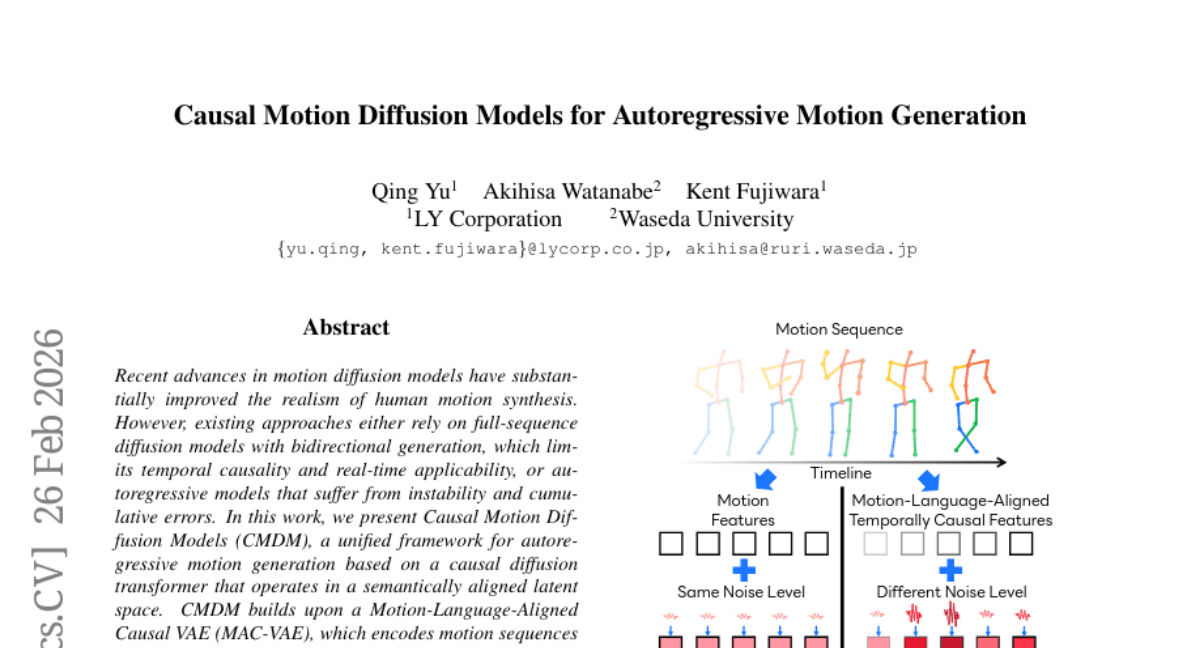
The **SARAH (Spatially Aware Real-time Agentic Humans)** system employs **causal transformers** and **flow matching** to generate **spatially-aware human motions** in real time, enabling applications in **augmented reality**, **virtual training**, and **robotic interaction**.
Furthermore, **variational stabilization methods** like **VESPO** ensure **robust training** of AI in complex environments, contributing to **lifelike virtual worlds**, **mixed-reality platforms**, and **nuanced robotic behaviors** capable of **context-aware interactions**.
## Societal Implications and the Road Ahead
The cumulative technological advances of 2026 underscore a landscape brimming with **opportunities for societal benefit**—from **wearable health devices** for early cognitive impairment detection to **autonomous vehicles** improving urban safety and efficiency. Synthetic data accelerates scientific progress, and AI-driven decision support enhances complex problem-solving across industries.
However, these capabilities also **amplify risks**: **deepfake proliferation**, **malicious coordination**, **privacy violations**, and **systemic vulnerabilities**. Addressing these requires **multi-layered safeguards**, including **provenance verification systems**, **interoperability standards like ADP**, and **neuron-level safety techniques such as NeST**. International cooperation and proactive regulation are vital to **prevent misuse** and **maintain societal trust**.
Emerging evaluation tools—like **implicit agent evaluation** and **adaptive text anonymization**—are critical in fostering **trustworthy AI ecosystems** that respect privacy, ensure safety, and promote transparency.
## Current Status and Implications
As of 2026, **AI stands at a transformational crossroads**, with breakthroughs spanning **synthetic media**, **multimodal reasoning**, **embodied interaction**, and **governance frameworks**. The development of **interoperability standards** (e.g., **ADP**) and safety innovations (e.g., **NeST**, **VESPO**) exemplify a concerted effort to align technical progress with ethical imperatives.
The creation of **lifelike virtual environments**, **controllable multimodal synthesis** (via **SkyReels-V4**, **JavisDiT++**), and **advanced simulation platforms** signals an era where AI deeply integrates into **society, industry, and scientific research**. Moving forward, success hinges on our collective ability to **harness these innovations responsibly**, ensuring they serve **human flourishing** while minimizing risks through **rigorous safety measures**, **international standards**, and **ethical governance**.
In conclusion, **2026** exemplifies both the **immense promise and profound responsibility** inherent in AI's rapid evolution. The path ahead requires **vigilance, collaboration, and principled innovation**—to ensure AI remains a tool for **positive societal transformation** rather than a source of discord. With deliberate stewardship, AI can continue to advance human capabilities and societal well-being in this new frontier.