# The 2026 Milestone: A New Era in Practical AI Coding Agents, IDE Integration, and Secure Workflows
The year 2026 stands as a pivotal juncture in the evolution of AI-driven software development. Building on foundational advances from previous years, this period marks the **maturation of specialized, resilient AI coding agents**, **deep integration within integrated development environments (IDEs)**, and the establishment of **standardized, secure workflows**. These innovations are transforming how code is written, reviewed, and deployed—propelling the industry toward **unprecedented levels of efficiency, safety, and interoperability**.
---
## The Evolution of Autonomous, Specialized AI Coding Agents
### From Generalist Models to Focused, Autonomous Units
A defining characteristic of 2026 is the **transition from monolithic, general-purpose AI models to highly specialized, autonomous agents** tailored for discrete development tasks. These **task-specific agents**—designed for **code review**, **debugging**, **deployment automation**, and **complex reasoning**—are engineered to operate reliably within enterprise environments, adhering to strict safety standards.
For example, **Stripe’s Minions** have become emblematic of this shift. Embedded within an ecosystem of **code-defined blueprints**, they **automate over 1,000 pull requests weekly**, drastically reducing manual effort and accelerating continuous integration/continuous deployment (CI/CD) cycles. Their deployment exemplifies how **automated, autonomous agents** are now integral to **streamlining software pipelines** and **enhancing system reliability**.
### Widespread Adoption and Capabilities
Recent industry insights, including **Anthropic’s economic analyses**, reveal that **approximately 50% of Claude’s agent activity** involves code-related tasks. This statistic underscores AI’s **central role throughout the entire development lifecycle**, from initial coding to deployment and maintenance, while emphasizing the critical importance of **robust safety and security protocols**.
### Multi-Agent Frameworks and Transparent Collaboration
**Fault-tolerant, long-lived multi-agent architectures** have become commonplace, supported by frameworks like **TanStack AI** and **Golem**. These systems feature **self-healing mechanisms** and **visual documentation tools** such as **Miro MCP**, which **enhance transparency** and **collaborative oversight**—vital for managing **complex, mission-critical infrastructure**.
### Democratization Through SkillForge
**SkillForge** has revolutionized automation by empowering **non-programmers** to **convert screen recordings into agent-ready skills**. This democratization allows domain experts—such as QA specialists or operations managers—to **craft workflows** like **debugging**, **deployment**, or **code comprehension** via **multi-shot prompting** and **context engineering**. The trend toward **highly specialized autonomous agents** not only **improves efficiency** but **broadens access**, enabling a wider user base to participate actively in automation processes.
---
## Deepening IDE Integration and Edge AI Capabilities
### Local and Edge Models in Developer Workflows
The proliferation of **local language models**—including **microgpt**, **L88**, and **Alibaba’s Qwen3.5-Medium**—has profoundly impacted developer productivity. These models, capable of **running efficiently on 8GB VRAM**, are integrated into IDEs like **VS Code** via tools such as **Ollama**, allowing **real-time code completion**, **refactoring**, and **debugging** **without reliance on cloud servers**.
**Alibaba’s Qwen3.5-Medium** is a notable breakthrough, delivering **performance comparable to Sonnet 4.5** on local hardware. This development **democratizes access** to high-quality AI assistance, ensuring **privacy-preserving, low-latency support**—a critical requirement for **enterprise environments handling sensitive data**.
### Multimodal and Visual Code Understanding
Advances like **CodeOCR**, a vision-language model, enable **visual code comprehension**, allowing developers to analyze **diagrams, screenshots, or graphical UI prototypes** directly within their workflows. This capability is especially valuable when working with **complex visual artifacts** or **non-textual representations**.
Moreover, **Claude Code** is increasingly used to develop **custom developer tools**, including **frameworks for terminal user interfaces (TUIs)**. As demonstrated by researchers from the **Ring programming language team**, **Claude Code** can **construct TUIs**, facilitating **interactive development** and **rapid prototyping** in environments that demand **visual, command-line, or hybrid interfaces**.
### Automated Agent Generation and Workflow Mapping
Tools like **Agentseed** now support **automatic generation of autonomous agents** from existing codebases, simplifying **deployment**, **iteration**, and **scaling**. When integrated with **visual workflow mapping platforms** such as **Miro MCP**, these tools foster **transparent, manageable multi-agent ecosystems**, which are essential as system complexity continues to grow.
---
## Infrastructure, Interoperability, and Hardware Acceleration
### Standardized Protocols for Multi-Agent Communication
Interoperability remains a central focus. The **Model Context Protocol (MCP)** and **WebMCP** have become **industry standards**, enabling **predictable, scalable communication** among diverse AI modules. Leading providers—including **Claude**, **Anthropic**, and **Nvidia’s NeMo**—have integrated these protocols, allowing **multi-agent workflows** to **coordinate effectively** across different platforms and domains.
At the recent **TWed Talk on MCP**, experts highlighted that **standardized protocols** facilitate **faster development**, **easier integration**, and **robust orchestration**. These protocols underpin the creation of **trustworthy, multi-agent environments** capable of **complex, multi-step, cross-domain workflows** critical for enterprise adoption.
### Hardware and Infrastructure Breakthroughs
The hardware landscape has experienced transformative progress. **NVIDIA’s Blackwell Ultra** now offers **up to 50x performance improvements** over previous generations, supporting **massive parallel processing**, **low-latency inference**, and **real-time autonomous operations**. This hardware enables **scaling AI workloads** to meet demanding enterprise and research needs.
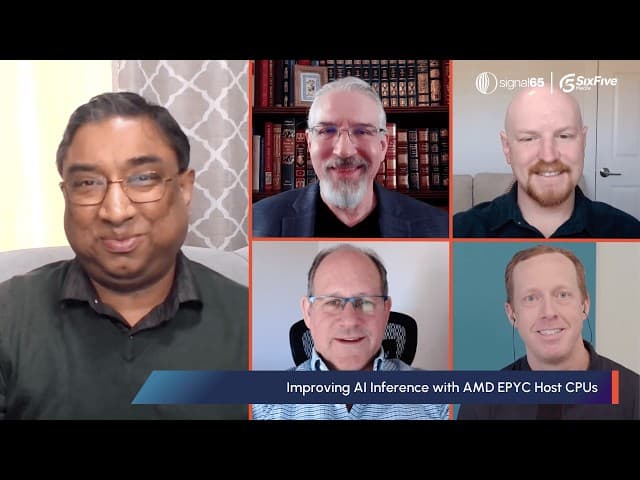
Complementing NVIDIA’s advances, **AMD’s EPYC** CPUs—frequently highlighted in recent **Signal65 Webcasts**—provide **scalable, high-performance infrastructure** for AI inference. These hardware improvements facilitate **efficient deployment of large models**, with **optimized inference pipelines** and **security-enhanced deployment platforms** like **KServe** and **KiteOps**.
### Inference Engineering and Deployment Platforms
**Inference engineering** has matured into a critical discipline. Techniques such as **chunking in Retrieval-Augmented Generation (RAG)** schemes improve **accuracy** and **security**, especially in sectors like **healthcare** and **finance**. Organizations are adopting **Kubernetes-based pipelines**, **containerized inference solutions**, and **scalable deployment frameworks** to **manage large-scale AI inference reliably and securely**.
---
## Safety, Security, and Governance
### Addressing Vulnerabilities and Ensuring Safety
Security remains a top priority. Recent audits of **Claude Code** uncovered **over 500 security issues** in code generated by AI models, underscoring the necessity for **rigorous testing and validation**. Organizations are deploying **runtime safety checks** via tools such as **StepSecurity** and **Strands**, alongside **formal verification methods**, to **harden autonomous systems**.
### Prompt Injection and Exposure Risks
A pressing concern is **prompt injection attacks**, notably when **OpenClaw-based agents** are exposed on the public internet. As highlighted in the advisory **"🙉 Beware prompt injection when releasing your OpenClaw bot on the internet,"** malicious actors can **manipulate prompts** to **alter agent behavior**, **extract sensitive data**, or **cause unintended actions**.
Developers are urged to **implement strict input sanitization**, **authentication mechanisms**, and **continuous monitoring** to **mitigate these risks**—a critical step toward **safe, trustworthy autonomous AI systems**.
### Advanced Safety Features and Responsible AI
Models like **z.ai’s GLM-5** incorporate **built-in safety features**, including **scalable reasoning** and **error-reduction techniques** such as **reinforcement learning with 'RL slime'**. These methods aim to **minimize hallucinations** and **decision errors**, making AI suitable for **high-stakes applications** in healthcare, finance, and public safety.
### Continuous Monitoring and Governance Tools
Tools like **Puter**, **Tapes**, and **AgentRE-Bench** enable **ongoing evaluation** of **robustness**, **reasoning abilities**, and **security vulnerabilities**. Embedding **runtime monitoring**, **audit trails**, and **governance frameworks** ensures **compliance**, **trustworthiness**, and **accountability**, which are vital for **widespread responsible AI deployment**.
---
## Recent Notable Developments and Practical Insights
### Claude Code’s “Remote Control” and Extended Autonomy
A significant addition this year is **Claude Code’s “Remote Control”** feature, allowing users to **monitor and modify autonomous agents remotely**. As detailed on **Hacker News**, this capability **enhances safety, flexibility, and governance**, enabling **real-time intervention**, **workflow rerouting**, or **agent reconfiguration**—particularly critical for **enterprise and mission-critical systems**.
### Shifting Focus: Model Size vs. Engineering and Ecosystem Design
A prevalent industry narrative emphasizes that **“The AI Model Doesn't Matter Anymore—Here's What Actually Does.”** A popular **YouTube** video underscores that **engineering decisions**, **workflow design**, **security protocols**, and **interoperability standards** are **the real drivers of success**. This shift suggests that **building resilient, standardized ecosystems** capable of **scaling across domains** is more impactful than simply enlarging models.
### Practical Autonomous Use Cases: Rebuilding Next.js
An illustrative case is the **entire rebuilding of Next.js**, a popular React framework, **driven entirely by autonomous AI agents within just one week**. Reported on **Hacker News**, **Steve Faulkner** and his team used **autonomous agents** to handle **refactoring**, **optimization**, and **rapid development tasks**, demonstrating **AI’s transformative potential** for **large-scale software projects**.
---
## Current Status and Future Outlook
The developments of 2026 have **solidified AI coding agents**, **IDE deep integrations**, and **secure, standardized workflows** as the **cornerstones of modern software engineering**. The establishment of protocols like **MCP**, along with **hardware advancements** and **safety frameworks**, has enabled the creation of **interoperable ecosystems** of autonomous agents capable of managing **complex, multi-faceted workflows** across industries.
Looking ahead, **AI is increasingly viewed as a collaborative partner**—augmenting human developers rather than replacing them—while **prioritizing safety, security, and trustworthiness**. These principles are driving **widespread enterprise adoption**, **critical infrastructure integration**, and **public sector innovation**.
**In summary**, 2026 marks a milestone: a **mature, integrated, and responsible AI ecosystem** that **empowers developers**, **safeguards systems**, and **accelerates innovation**. The focus has shifted from merely enlarging models to **building resilient, interoperable, and secure workflows**, fundamentally reshaping the landscape of software engineering. As these systems continue to evolve, they set the stage for **more sophisticated, autonomous development paradigms** in the years to come.