# The Transformative Rise of Persistent Multi-Agent Ecosystems: From Prototypes to Industry Mainstays
The landscape of artificial intelligence is undergoing an unprecedented transformation. What once was confined to fleeting prototypes and isolated experiments is now rapidly evolving into **robust, long-horizon, persistent multi-agent ecosystems** capable of sustained reasoning, complex collaboration, and continuous operation across diverse environments. This shift is fueled by breakthroughs in platform architectures, hardware enablement, safety frameworks, developer tooling, and growing industry adoption—paving the way for AI to become a trustworthy, integrated component of societal infrastructure.
---
## From Short-Term Prototypes to Long-Horizon, Stateful Ecosystems
Historically, AI agents were designed for **single-task, stateless interactions**, suitable only for short-lived applications. Today, the focus has shifted toward **building persistent, stateful worlds** that **operate over weeks, months, or even years**. These systems maintain coherence and enable **multi-agent collaboration** in increasingly complex workflows, supporting **long-term reasoning**, **resource management**, and scientific discovery.
Leading platforms such as **OpenClaw**, **AgentRuntime**, and **Base44** are foundational in supporting **scalable, resilient ecosystems**. For example, **Tensorlake’s AgentRuntime** exemplifies infrastructure capable of **fluid operation across cloud, edge, and on-device environments**, making persistent AI accessible for use cases ranging from **industrial automation** to **consumer devices**. These advancements ensure that AI agents are no longer ephemeral tools but **long-term partners** capable of **adaptive, continuous reasoning**—a crucial step toward trustworthy, autonomous systems.
---
## Cross-Environment Runtimes & Hardware Enablement
A key enabler for widespread deployment of persistent AI is the ability for agents to **seamlessly operate across diverse hardware and environments**, reducing costs and enhancing privacy:
- **On-device AI** has made significant strides with models like **Llama 3.1**, supporting **70-billion-parameter models** that run efficiently on **consumer GPUs** through innovations such as **NVMe-to-GPU bypassing**. This dramatically **reduces deployment costs**, **improves privacy**, and **lowers barriers** to local AI solutions.
- **Edge and cloud orchestration systems** ensure **low latency**, **high reliability**, and **scalability**. Notable examples include **Korean Air’s “Work Intelligence”**, leveraging **Google Workspace** and **Google Gemini**, and consumer-facing products like **Samsung’s Perplexity voice assistants**.
- Recent breakthroughs include **L88**, a **local Retrieval-Augmented Generation (RAG) system** capable of **operating on just 8GB VRAM**, representing a significant step toward **ubiquitous, on-device AI** capable of complex knowledge retrieval without reliance on centralized data centers. This development **reinforces privacy and cost-efficiency**, making powerful AI accessible on resource-constrained hardware.
- **Hardware investments** such as **SambaNova’s $350 million funding** and **partnerships with Intel** are fueling the development of specialized **AI chips** optimized for persistent multi-agent systems, improving performance and energy efficiency.
---
## Advanced Orchestration and Standardized Protocols
Managing **long-term, multi-agent workflows spanning weeks or months** requires **sophisticated orchestration frameworks**. The year **2026** marks a pivotal point with the emergence of **system-level orchestrators** employing **hierarchical structures** and **semantic negotiation protocols**:
- **Symplex**, an **open-source standard**, facilitates **shared understanding** and **conflict resolution** among **heterogeneous agents**. Such protocols enable **cooperative reasoning**, **long-term negotiation**, and **dynamic adaptation**, essential for applications in **scientific research**, **industrial automation**, and **societal infrastructure**.
- Research initiatives like **KLong** are pushing boundaries by enabling **autonomous agents** to **synthesize research**, **coordinate complex tasks**, and **dynamically adapt** to environmental changes. These developments lay the foundation for **trustworthy, resilient, long-term collaborations** among AI agents.
---
## Safety, Memory, Identity, and Verification: Foundations for Trust
As AI agents operate continuously over extended periods, **trustworthiness** and **safety** become paramount. Recent innovations include:
- **Persistent memory systems** such as **Reload**, which allow agents to **remember past interactions**, **maintain context**, and **coordinate effectively** over time.
- **Identity verification protocols** like **Agent Passport**, an **OAuth-like system**, ensure **transparent attribution** and **auditability**, vital for **regulatory compliance** and **accountability**.
- **Neuron-level safety tuning frameworks** such as **NeST** enable models to **dynamically adjust safety parameters** without retraining, a crucial feature for **high-stakes applications** like autonomous vehicles.
- **Behavioral monitoring tools** like **Spider-Sense** and **formal verification methods** such as **TLA+ Workbench** are increasingly integrated into development pipelines to **detect anomalies**, **prevent unsafe actions**, and **verify correctness**.
These safety and trust mechanisms are essential as AI agents become embedded within **critical societal functions**, ensuring **reliability**, **regulatory compliance**, and **public confidence**.
---
## Empowering Developers and Ecosystem Maturation
The growth of **persistent multi-agent systems** is supported by **advanced developer tools** designed to streamline **building, managing, and deploying** these complex ecosystems:
- **InsertChat** provides a **unified workspace** compatible with models like **ChatGPT**, **Claude**, and **Google Gemini**, simplifying **multi-agent interaction design**.
- **SkillForge** accelerates **skill development** by **automatically extracting capabilities** from **screen recordings**, reducing manual effort.
- **Grok 4.2** introduces **internal debates** among **specialized agents** sharing a common context, **enhancing answer robustness** through **parallel reasoning**.
- **Mato**, a **tmux-like multi-agent terminal environment**, offers an **orchestrated workspace** for managing intricate workflows, boosting productivity and collaboration.
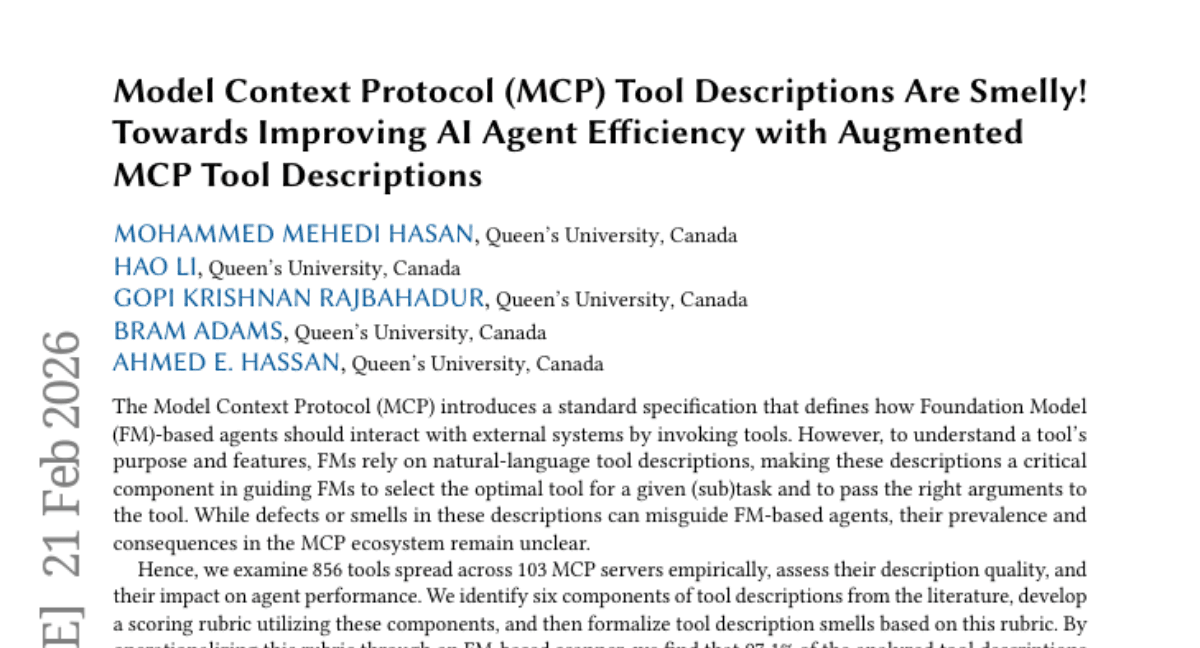
- Recent research, including the **"Improving AI Agent Efficiency with Augmented MCP Tool Descriptions"** paper, explores **optimization of model context protocols (MCP)** to enhance agent performance and reduce resource consumption.
The proliferation of **open SDKs** and **interoperability standards** further lowers barriers for **enterprise integration** and **research deployment**, fueling rapid innovation.
---
## Industry Adoption, Investment, and Regulatory Developments
The momentum toward **enterprise-scale deployment** is accelerating:
- **Korean Air** has integrated **multi-modal, multi-agent systems** to **automate workflows** and **boost operational efficiency**.
- **Anthropic** has launched **enterprise agent plugins** tailored for **finance, engineering, and design**, signaling a focus on **industry-specific solutions**.
- Despite rapid progress, **industry leaders like OpenAI** acknowledge that **AI's penetration into enterprise business processes** remains gradual. A recent COO remarked, *“We have not yet really seen AI penetrate enterprise workflows at scale,”* highlighting both **potential** and **current challenges**.
- **Startups such as Humans&**, which raised **$480 million**, are developing **long-term, persistent agents** aimed at addressing **societal challenges**.
- **Simulation platforms** like **GRASP** are employed to **test agent resilience** through **parallel scenario testing**, ensuring systems are **robust before deployment**.
- The release of **Llama 3.1** enables **cost-effective deployment** of large models on **consumer hardware**, democratizing access to **powerful AI** and fostering **mass adoption**.
**Regulatory frameworks** such as the **EU AI Act** emphasize **transparency**, **safety**, and **accountability**. Industry efforts are increasingly integrating **formal verification**, **explainability**, and **trust mechanisms**—ensuring that **persistent systems** operate reliably within societal norms.
---
## Recent Breakthroughs and Practical Examples
Among the most notable recent developments is the **release of L88**, a **local RAG system** capable of **operating on just 8GB VRAM**. This represents a significant milestone in making **retrieval-augmented agents** accessible on **resource-constrained hardware**, reinforcing the trend toward **ubiquitous, privacy-preserving, on-device AI**. Such systems enable **personalized assistance**, **secure data handling**, and **knowledge retrieval** without reliance on cloud infrastructure, thus **accelerating mass adoption**.
Additionally, **Union.ai**, based in Seattle, raised **$19 million** to advance **AI workflow orchestration platforms**, underscoring growing investor confidence in infrastructure supporting **persistent, long-term agent operations**. Features like **Claude’s scheduled tasks**, allowing **recurring, persistent agent actions**, exemplify how **workflow automation** is evolving to meet the demands of **multi-week or multi-month processes**.
The community's focus on **agent verification tools** continues to grow, with research exploring **formal methods** to **verify safety** and **detect anomalies** in long-running systems. These efforts are crucial for **building public trust** and ensuring **regulatory compliance** as AI systems become integral to **societal infrastructure**.
---
## Current Status and Implications
The ongoing evolution toward **production-ready, persistent multi-agent ecosystems** signifies a **paradigm shift** in AI deployment. These systems are no longer experimental but **reliable, scalable infrastructures** capable of **long-term reasoning**, **multi-environment operation**, and **trustworthy performance**.
**Implications include:**
- **Automation of complex, multi-week workflows** across industries like manufacturing, logistics, and scientific research.
- **Enhanced safety and trust** through advanced safety frameworks, identity verification, and formal correctness proofs.
- **Democratization of AI** via hardware advances and open ecosystems, making **powerful AI accessible at scale**.
- **Regulatory alignment**, ensuring AI systems operate transparently and responsibly within societal norms.
This convergence of **hardware innovation**, **safety protocols**, **standardized orchestration**, and **developer ecosystems** points toward a future where **long-horizon, trustworthy, persistent multi-agent systems** are seamlessly integrated into enterprise and societal infrastructure.
---
## In Summary
The rise of **persistent multi-agent ecosystems** is now an undeniable reality. With **industry momentum**, **protocol maturation**, and **hardware democratization**, AI is poised to become a **long-term, dependable partner** across sectors. These systems will foster **continuous adaptation**, **robust collaboration**, and **safe, scalable intelligence**—fundamentally reshaping how society harnesses AI for decades to come.
As these technologies mature, they will underpin **autonomous scientific discovery**, **industrial automation**, and **societal management**, marking a new era where **long-horizon, multi-agent systems** serve as **trustworthy, resilient agents** shaping global progress.