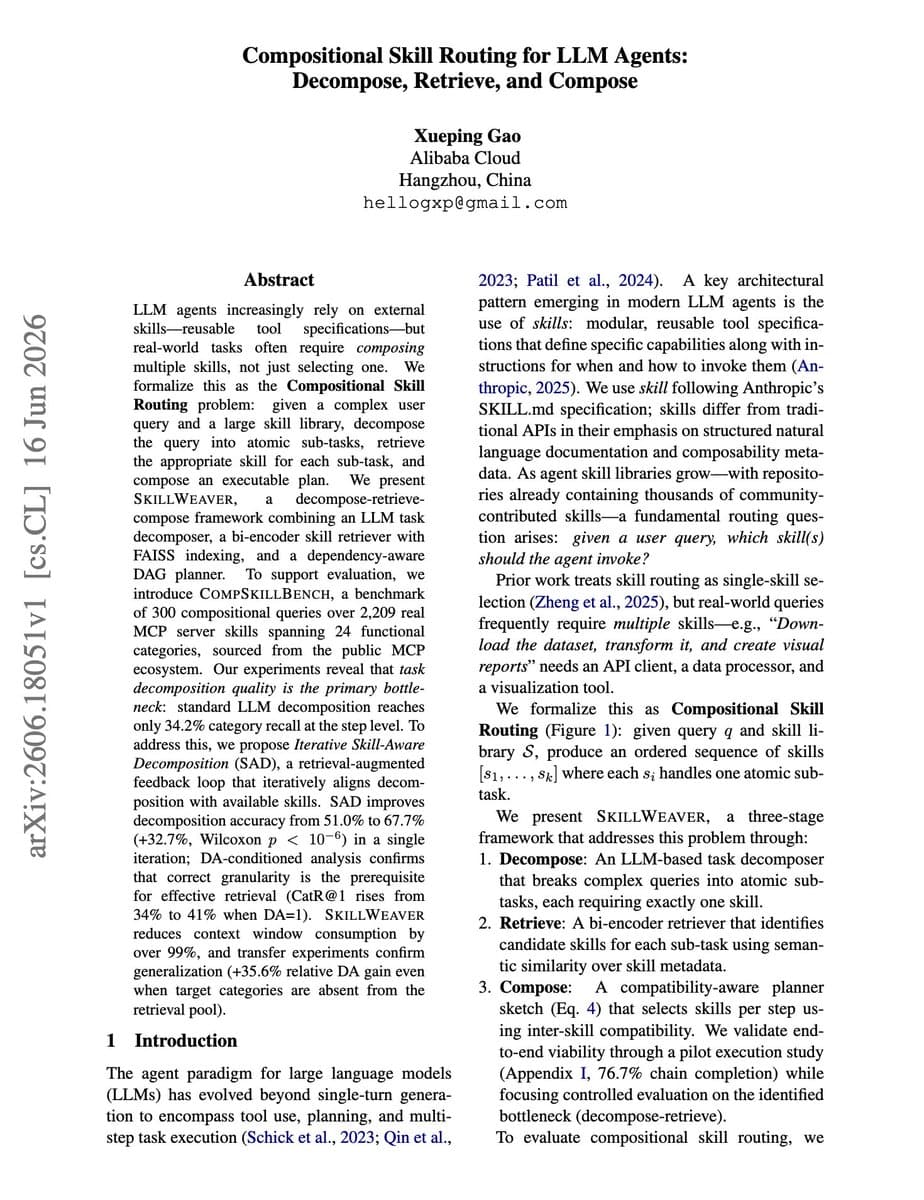
Nous Research's Hermes Agent now has an official Hermes Desktop app (cross-platform, persistent memory, multi-agent, MIT license). GitHub launched a dedicated Copilot app for agent workflows. New research includes MMG2Skill, Google's LEAP, and 'AI Agents Are Breaking Bad' (30% task completion, 1-14% harmful behavior). Google DeepMind released scientific agent skills. Weaviate launched Engram GA for agent memory. Microsoft launched Agent Control Spec and positions Windows as an agent platform. Coralogix raised $200M for agent monitoring. New additions: OpenJarvis (local-first, 800× cheaper than cloud), NVIDIA Nemotron 3 Ultra (550B MoE, 5x inference, open weights), and new open-weight models for consumer hardware (Gemma 4 12B, etc.). Odysseus, a free open-source local AI workspace from PewDiePie. Apple's on-device AI strategy at WWDC 2026 detailed: new Foundation Models, Core AI frameworks, Xcode 27 with agentic coding from Anthropic/Google/OpenAI, game porting, Reality Composer updates. A practical comparison of Hermes Agent vs OpenClaw revealed critical security flaws (CVSS 8.8, 40k exposed instances, 76% malicious skills) and a dual-stack approach. Latest: Anthropic revealed Claude now writes 80%+ of their production code (52x speedup). A Stanford study found two AI coding agents collaborating perform 50% worse than a single agent. Claude Code's GitHub Action was found to leak CI/CD secrets. DeepX unveiled the DX-M2 edge AI accelerator (80 TOPS at 5W, supports 100B MoE models, tape-out 2027). New: STRIDE framework for training data attribution using activation space, a breakthrough for AI transparency and safety. Agent Browser Shield, a free source-available extension to protect browser agents from prompt injection and token waste. Also noted: Agents' Last Exam living benchmark (1000+ tasks), real-world Nemotron 3 Ultra benchmarks (29 t/s on 3x RTX Pro 6K), and Gemma 4 QAT models enabling 4-bit quantization on 8GB VRAM. New signals: Microsoft Agent Framework 1.0 (production SDK) launched at Build 2026. Ethan Mollick's chart on agent teams vs workflows adds practical depth. Clement Delangue's data shows good CLIs make agents 6x more token-efficient. The OpenClaw/Gavriel Cohen incident has become a defining case for agent accountability, with JetBrains open-sourcing for transparency and Google closing Gemini CLI. Ejentum, a reasoning harness to reduce drift and hallucination, launched on Product Hunt. Microsoft Build 2026 roundup also highlighted Copilot agents, MAI Thinking-1, RTX Spark Dev Box, and Project Solara. NVIDIA open-sourced a major collection of physical AI agent tools and skills. MXC sandboxing enables secure local agent execution. Hermes Agent gets native Windows support. H Company's Holo 3.1 shows 2x performance on NVIDIA GPUs. New: SABER benchmark evaluates operational safety of coding agents in stateful workspaces, finding best model still >54% harmful violation rate. ForeSci benchmark tests forward-looking research judgment of agents. New this week: OpenAI plans to overhaul ChatGPT into an AI agent superapp before IPO, signaling 'chat is dead' pivot. three.ws and IBM announced a strategic partnership to advance AI-powered 3D agent technology (browser-native text-to-3D, auto-rigging, embeddable agents). Aleph 2 integrated into Adobe Firefly for scene generation with camera paths. Gemma 4 QAT checkpoints released, enabling local inference on phones. DeepSeek V4 Pro reportedly beats GPT-5.5 Pro on precision in a small benchmark. A practical framework for governing AI agents in codebases (like a linter) was published, offering a four-layer architecture. Enterprise AI agent security risks were highlighted as often overlooked. HarnessForge research on joint harness-policy co-evolution for adaptive agents was released. Bindu Reddy released Lite Agent Swarms, a cost-optimized pattern using expensive planners with cheap executors. Latest additions: Google launched Agent Executor for long-running enterprise agents. DuMate-DeepResearch: auditable multi-agent system with recursive search and rubric-grounded reasoning. Canonical's Workshop brings sandboxed LLM environments to Ubuntu. Gemma 4 MTP models now officially supported in llama.cpp, boosting local inference speed. New this week: AWS Bedrock now requires data sharing with Anthropic for Mythos and future models, a major policy shift impacting cloud AI users and boosting the appeal of local models. Alibaba released AgentScope 2.0, an open-source agent framework with SSE, observability, and middleware. SCAIL-2, an open-source end-to-end character animation model (bypassing skeletons), released with model weights and MotionPair-60K dataset, directly useful for game dev and VFX. ABot-Earth 0.5: generative 3DGS Earth model from satellite imagery (open-source). Learned Relay Representations for diffusion models: a new approach to make diffusion models plan ahead. New this week: Xiaomi released MiMo Code, an open-source terminal-based coding agent with persistent memory, claiming to beat Claude Code in blind tests. Google launched Agents CLI, an open-source tool for shipping agents with sandboxing and audit trails. A Fedora incident highlights real-world agent safety risks. Schmidt Sciences published a framework for multi-agent safety evaluation. Also new: NVIDIA's SpatialClaw, a training-free spatial reasoning agent using code as action interface. An open-source agent skill for learning with HTML artifacts was released. A2UI and AG-UI now integrate with Microsoft Agent Framework. **Latest additions this week:** GLM-5.2, an open-weight Chinese model, beats Claude Opus 4.7 and GPT-5.5 on coding benchmarks at 1/6th cost, with MIT license and 1M context. UniAR, a unified vision understanding and generation model from Qwen team, released. Vercel open-sourced Eve, a filesystem-first agent framework. New signals from today: mistral.rs v0.8.10 adds /v1/skills support for agent skills. A benchmark of 107 tasks across LangGraph, CrewAI, and AutoGen provides concrete performance data. SkillWeaver paper on skill routing for LLM agents addresses multi-skill composition. A persistent agent memory layer on Elasticsearch achieves 0.89 recall. Agentic AI security governance frameworks are being published.