# The 2026 Revolution in Large Agentic Models: A Convergent Era of Innovation and Societal Transformation
The year 2026 marks an extraordinary turning point in the evolution of large, agentic AI systems. Building upon a rapid succession of breakthroughs in previous years, this period is characterized by an unprecedented **convergence of advancements across training paradigms, exploration strategies, hierarchical planning architectures, multimodal world models, and infrastructural innovations**. Together, these developments are not only enhancing the capabilities of autonomous agents but are also reshaping industries, societal workflows, and daily human experiences—heralding an era of **trustworthy, resource-efficient, and versatile AI partners**.
---
## A Confluence of Innovations: From Training Dynamics to Embodied Intelligence
### Enhanced Training Paradigms and Resource Optimization
One of the defining achievements of 2026 is the **maturation of intention-aware, budget-constrained reinforcement learning (RL)** methodologies. These techniques enable large models to **dynamically optimize resource utilization**, adjusting exploration policies in real-time based on current computational and energy constraints. This results in **more sustainable, cost-effective training and deployment**, democratizing access to cutting-edge AI by **reducing reliance on expensive infrastructure**. As @_akhaliq notes, such capabilities **"enable broader participation across academia, industry, and developing regions,"** fostering a more inclusive AI ecosystem.
Complementing this, **language-action pretraining (LAP)** has emerged as a transformative methodology. By leveraging joint datasets of language and physical or virtual actions, LAP trains models to **zero-shot transfer skills across diverse embodiments**. This approach **broadens the scope of embodied agents**, allowing them to function seamlessly across environments—from robotic manipulation and virtual assistants to mixed reality platforms—**without extensive retraining**. As a result, models become **more adaptable, versatile, and deployment-ready**.
### Exploring Robustness and Advanced Exploration Strategies
Persistent challenges—like agents getting trapped in local optima or navigating sparse reward environments—have seen significant progress. Researchers introduced **Implicit Advantage Symmetry (IAS)**, an exploration strategy showing promising results in controlled environments. Meanwhile, efforts to **enhance robustness**—especially in **dynamic and adversarial scenarios**—are yielding agents capable of reliable operation in **real-world applications** such as autonomous navigation, social robotics, and crisis response.
A particularly innovative development is **test-time reflective planning**, inspired by human trial-and-error learning. @_akhaliq highlights that **"test-time training"** permits embodied language models to **perform continual self-assessment and correction during deployment**, leading to **more adaptive, resilient behaviors**. This significantly improves agents' ability to handle **unexpected perturbations, uncertainties, and novel situations**—a critical step toward **trustworthy autonomous systems**.
### Hierarchical Planning and Multimodal Reasoning Architectures
Modern agent architectures increasingly leverage **hierarchical planning frameworks** supporting **multi-level abstraction**—crucial for **long-term reasoning and complex decision-making**. Notable examples include:
- **ThinkRouter**: Incorporates **confidence-aware routing**, enabling models to **select optimal reasoning pathways** based on environmental uncertainty. This supports **long-horizon, multimodal reasoning** vital in domains like autonomous vehicles, industrial automation, and strategic planning.
- **UniT**: Facilitates **iterative multimodal reasoning** across vision, language, and actions, empowering agents to **plan over extended timeframes**, **manage uncertainty**, and **integrate diverse data streams seamlessly**.
### World Models and Embodied Multimodal Agents
The integration of **high-fidelity simulators** such as **MolmoSpaces** and **ScaleEnv** has revolutionized **embodied AI** research. These virtual environments serve as **testbeds for navigation, manipulation, and physical reasoning**, bridging the gap between simulation and reality. They allow agents to **simulate complex physical interactions**, **refine behaviors virtually**, and **reduce costs and risks associated with real-world experimentation**.
#### Robotics & Platforms
Progress in robotics and platform development includes:
- **EgoPush**: Specializes in **multi-object rearrangement** using **egocentric vision**, enabling robots to **dynamically adapt** in cluttered, unstructured environments like warehouses or homes.
- **SARAH**: Uses **causal transformers** and **flow-matching techniques** to **enhance spatially-aware human-robot interactions**, allowing robots to **integrate smoothly into human-centric settings**.
- **RoboCurate**: Employs **action-verified neural trajectories** to **diversify robotic exploration**, improving **learning efficiency and safety** in unpredictable environments.
- **Bazaar V4**: An **agentic video editing and creative suite** that automates content creation—demonstrating how **agentic models are transforming media workflows**, making **content generation more automated, scalable, and accessible**.
- **Chiron**: An **AI production mentor integrated within digital audio workstations (DAWs)** as a VST/AU plugin, **revolutionizing media creation workflows** with **tailored suggestions** and **complex audio editing assistance**.
### Advances in Planning, Optimization, and Inference
**Real-time, multi-step reasoning** has become a hallmark of leading agents. **ThinkRouter** exemplifies this with its **confidence-aware, long-horizon planning**, critical for applications under uncertainty like **autonomous driving**.
Breakthroughs in **inference and model compression** include:
- **SpargeAttention2**: Achieves **up to a 14-fold increase in inference speed** via **hybrid top-k and top-p masking** combined with **distillation fine-tuning**, enabling **large models to operate in real time**.
- **COMPOT**: A **training-free compression framework** using **matrix Procrustes orthogonalization**, allows deployment of **large models on low-power edge devices**, expanding **decentralized AI ecosystems**.
---
## Industry Momentum and Infrastructure Development
### Growing Investment and Ecosystem Expansion
The AI industry continues its vigorous growth, propelled by significant investments:
- **Callosum**: A London-based AI infrastructure company, raised **$10.25 million** to develop **scalable, low-latency AI data centers**, supporting **distributed, resource-efficient deployment**.
- **JetScale AI**: Raised **oversubscribed $5.4 million** in seed funding, focusing on **cloud infrastructure optimization**—crucial for scaling large agentic systems.
- **NODA AI**: Secured **$25 million** in Series A funding, aiming to **accelerate development of AI-powered orchestration platforms** for **complex multi-agent ecosystems**.
- **Callosum** and **JetScale AI** exemplify the push toward **robust, optimized infrastructure** capable of supporting massive AI workloads at scale.
### Hardware and Deployment Platforms
Hardware innovation accelerates with platforms like **Skorppio**, which launched a **self-serve platform featuring NVIDIA Blackwell GPUs**. This enables **low-latency, high-throughput inference at the edge**, fostering **decentralized AI ecosystems** and **real-time deployment outside traditional data centers**.
### Autonomous Economic Agents & New Platforms
- **ZuckerBot**: An **autonomous digital marketing agent** offering an **API and Meta Controller Protocol**, automating ad campaign management and **streamlining digital marketing workflows**—a glimpse into AI-driven economic automation.
- **Chiron**: Integrating **agentic AI** directly into **media production workflows**, transforming **content creation** with **intelligent, autonomous editing and production assistance**.
### Recent Industry Moves
Beyond infrastructure, recent acquisitions and frameworks accelerate progress:
- **Anthropic's acquisition of Vercept**: Enhances **Claude's capabilities** in **coding and repository management**, moving toward **autonomous coding assistants**.
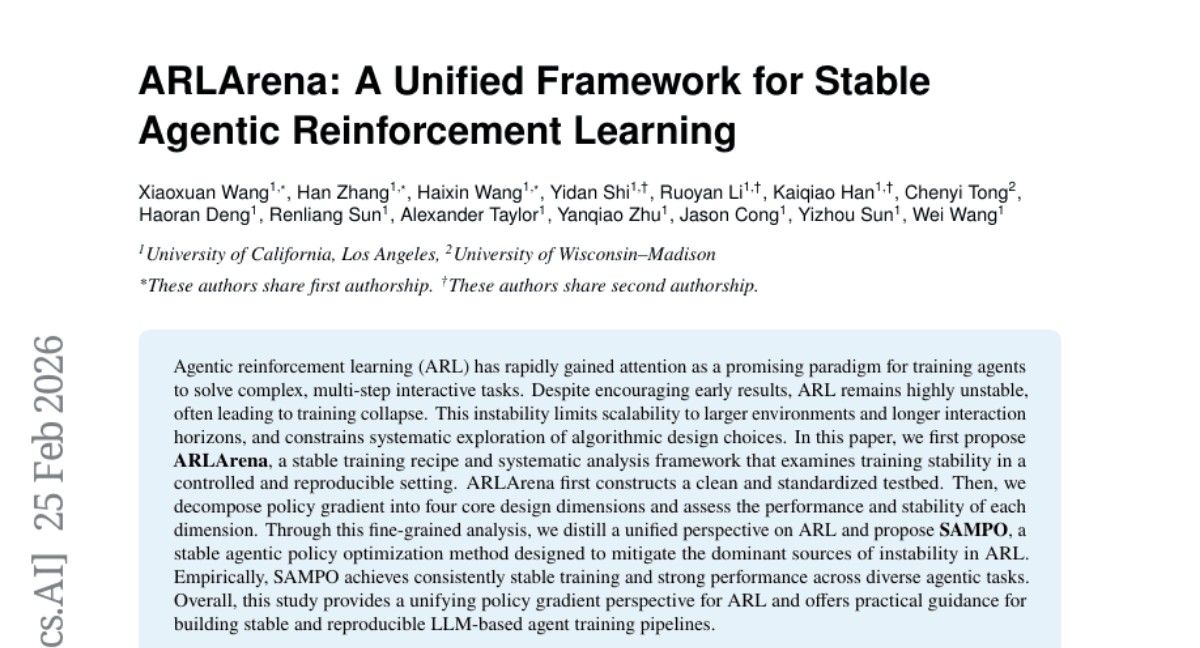
- **ARLArena**: Introduces a **unified framework for stable, reliable agentic reinforcement learning**, addressing **training stability and safety**.
- **IronClaw**: Offers a **secure, open-source alternative** to proprietary frameworks, tackling **credential security** and **prompt injection vulnerabilities**.
- **Trace**: Raised **$3 million** to **streamline enterprise AI adoption**, providing **tooling for seamless integration and management**.
### Safety, Security, and Coordination
As agents become embedded in societal functions, **safety and security** are prioritized:
- **TreeCUA**: Implements **formal safety verification** for complex models.
- **Evoke Security**: Develops **runtime privacy and data integrity tools**.
- **Activation Steering Adapters (ASA)**: Enable **behavioral modifications during runtime** to **align agents with ethical standards**.
- **Coordination Frameworks**: **Cord**, **Kana**, and **Portkey** facilitate **scalable, resilient multi-agent ecosystems**.
---
## Expanding Accessibility and Developer Ecosystems
Platforms and tools aimed at lowering barriers include:
- **Playground by Natoma**: Offers a **no-setup environment to browse and test MCP servers**, fostering **rapid experimentation**.
- **Zavi AI - Voice to Action OS**: Provides **voice-powered multi-modal interfaces** across platforms—**hands-free control for complex workflows**.
- **gpt-realtime-1.5**: Enhances **speech agent reliability**, supporting **robust, real-time voice interactions**.
- **Tessl**: Offers **agent skill optimization tooling**, **tripling agent performance** and **reducing debugging time**.
- **NODA AI**: Raised **$25 million** to develop **AI orchestration platforms** for **multi-agent system deployment**.
Research efforts like **AGENTS.md** continue to establish **best practices for transparency, safety, and coordination**, ensuring **trustworthy development**.
---
## Cutting-Edge Frontiers: New Platforms and Emerging Technologies
**Orbital Data Centers: Sophia Space** secured **$10 million seed funding** to develop **modular orbital data hubs**, promising **global, low-latency AI infrastructure** that can operate in remote or disaster-prone regions. This initiative expands **distributed AI deployment** beyond terrestrial limits.
**Chiron**, as a **digital audio production agent**, exemplifies **agentic tools transforming media workflows**, enabling **professional content creation** directly within **DAWs** with **AI-driven suggestions and automation**.
Emerging research includes:
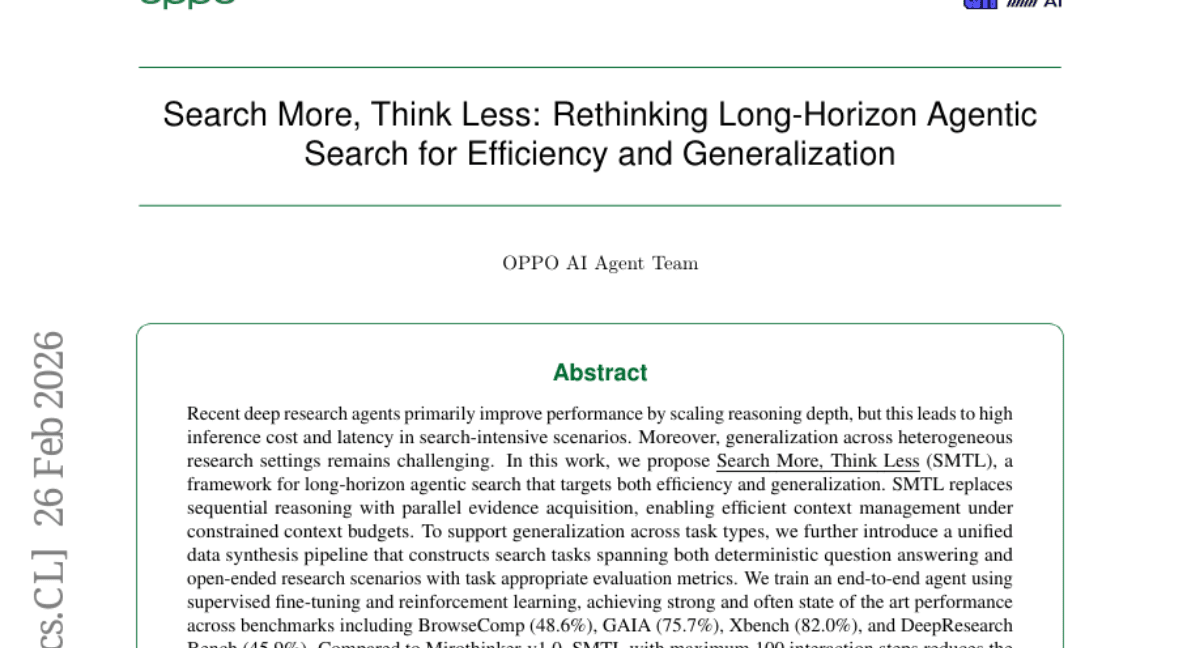
- **Search More, Think Less**: Rethinks **long-horizon agentic search**, emphasizing **efficiency and generalization**.
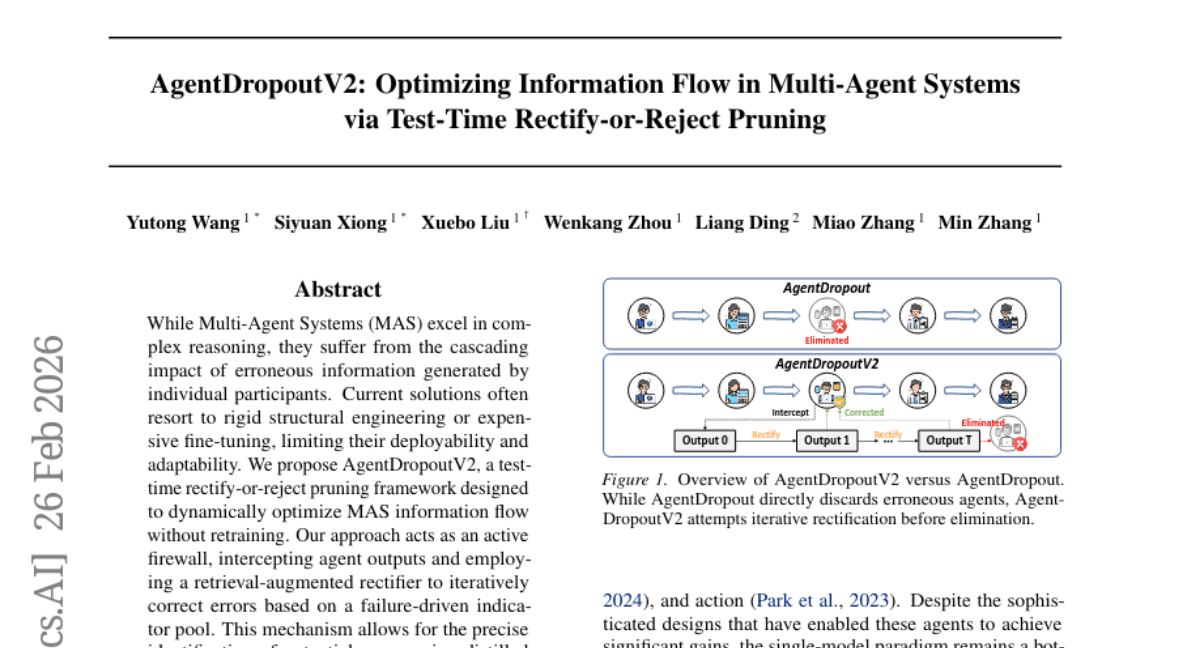
- **AgentDropoutV2**: Optimizes **multi-agent information flow** via **test-time pruning**, improving **scalability and robustness**.
- **Efficient Continual Learning**: Using **thalamically routed cortical columns**, this approach enhances **learning efficiency** in language models.
---
## Societal and Ethical Implications: Toward Responsible Integration
As large agentic models become embedded in societal functions, **safety, transparency, and fairness** are more critical than ever. Efforts like **TreeCUA** provide **formal guarantees**, while **Evoke Security** and **Activation Steering Adapters** ensure **runtime safety and ethical behavior**. **Decentralized coordination frameworks** like **Cord**, **Kana**, and **Portkey** support **resilient multi-agent ecosystems**, fostering **scalable, trustworthy deployment**.
The proliferation of **open standards** like **AGENTS.md** promotes **best practices**, transparency, and community trust—paving the way for **responsible, inclusive AI development**.
---
## Current Status and Future Outlook
By 2026, **large agentic models** are **more capable, resource-efficient, and societally integrated** than ever. Their evolution is driven by **training innovations**, **exploration and planning breakthroughs**, **hierarchical architectures**, and **robust multimodal world models**. Industry giants and startups are investing heavily, cultivating a **vibrant ecosystem of platforms, tools, and infrastructure**.
Key developments include:
- **Sophia Space's orbital data centers** expanding **distributed infrastructure**.
- **Chiron** revolutionizing **media production workflows**.
- **ZuckerBot** automating **digital marketing** at scale.
- **AI orchestration platforms** like **NODA AI** accelerating **enterprise adoption**.
- **New research** on **long-horizon search efficiency**, **multi-agent pruning**, and **continual learning** pushing AI capabilities further.
### Implications for Society and Industry
These advancements promise **unprecedented productivity**, **new forms of collaboration**, and **novel economic models**. Yet, the emphasis on **safety, transparency, and equitable access** remains paramount to **harness AI's full potential responsibly**.
### Final Reflection
**2026 exemplifies a period of extraordinary acceleration**—a **convergence of technological, infrastructural, and societal progress**—where **large agentic models** are no longer distant visions but active partners in shaping our future. Moving forward, a focus on **ethical deployment**, **robust safety mechanisms**, and **inclusive access** will be vital in ensuring AI serves humanity’s best interests in this transformative era.