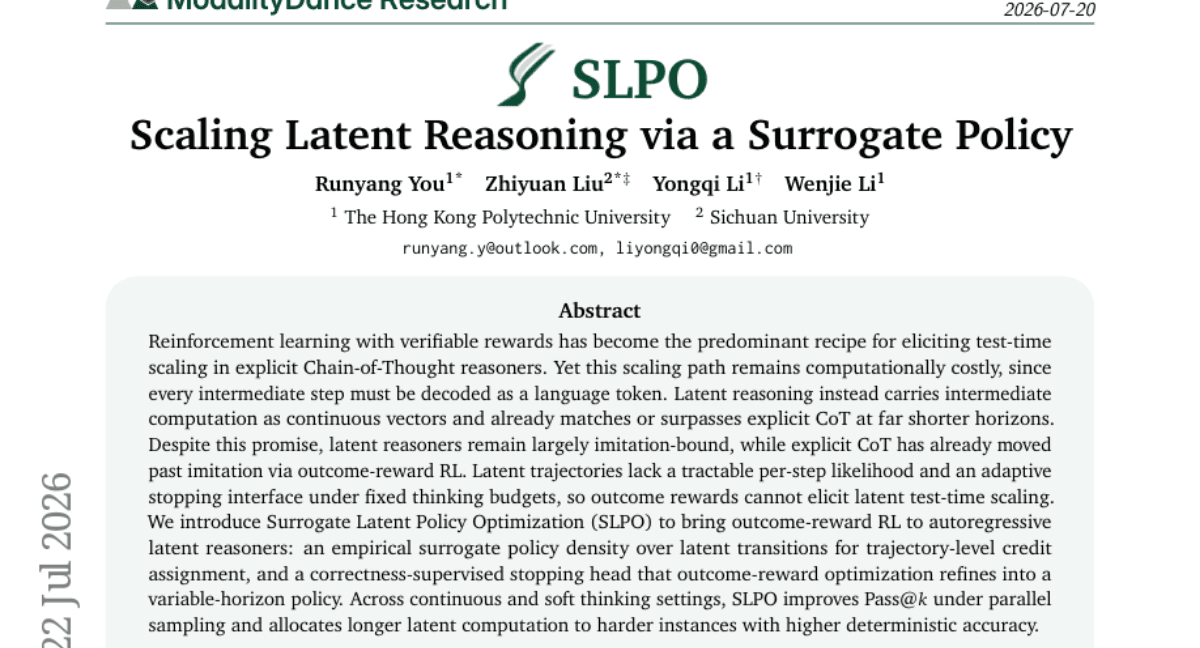
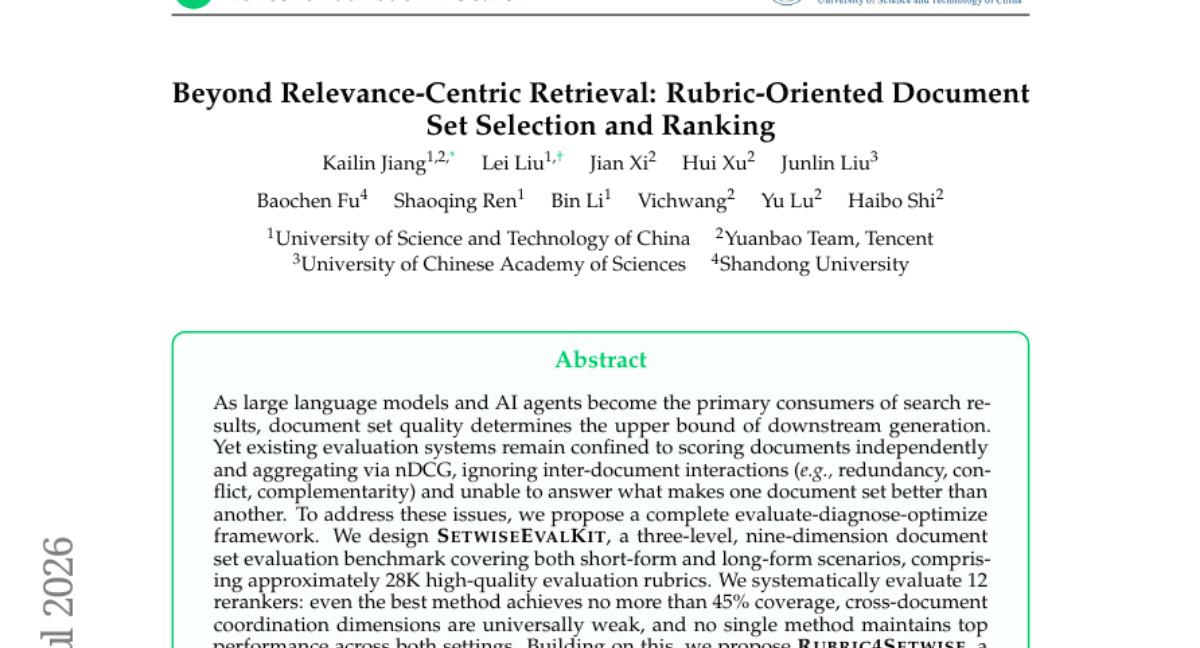
Hybrid solver + agent stacks and budget‑aware planners remain dominant (ADC‑LLM, budgeted value‑tree search, EP122 pillars). Verification‑focused agents (MiroThinker‑1.7, H1) and new grounded scrutiny agent (Claude Opus 4.6) reproduce computational physics papers. Tool‑use advances: TRUST‑SQL. New entries: Ornith Models' self‑scaffolding, Sakana AI's Fugu and Sheaf-ADMM. SkillWeaver achieves 99% token reduction. New empirical finding: clean code makes agents 34% more efficient. New: PAW (compile once, run locally) achieves 73.78% on FuzzyBench at 30 tok/s on MacBook M3. New: EVA-Client — open-source framework for embodied policy deployment on real robots. New: LLM-as-a-Verifier — verification as a new scaling axis using logit expectation, SOTA on agent benchmarks. New: Differentiated Effects of Agent Diversity. New: Ghost memory problem and A-TMA. New: Light-Omni achieves 12.1× speedup and 2.6× memory efficiency in video agents via reflex over reasoning. New: SIEVE achieves better VLA imitation learning with 50% data and 50% training steps via structure-aware data selection. New: TurnOPD makes on-policy distillation turn-aware for efficient long-horizon agent training. New: EvoSOP — iterative tool optimization via SOP synthesis. New: PROBE — proactive problem solving benchmark (frontier models only 40% success). New: LaMem-VLA — dual latent memory tokens for VLA. New: GRAM — training method to make dual-use capabilities removable. New: Harness Engineering for Auditable Enterprise LLM Agents — code-owned control layers, source grounding, validation contracts; evaluated with fault injection and model substitution. New: UniClawBench — universal benchmark for proactive agents on real-world Docker tasks (400 bilingual tasks, step-by-step checkpoints). New: Ideas Have Genomes — IdeaGene-Bench tests scientific lineage reasoning across 10 domains; strongest system only 27.3% exact accuracy, revealing compositional bottleneck. New: OpenCoF — reasoning through video generation (Chain-of-Frame reasoning), bridging video generation and logical reasoning. New: Fine-grained subtask annotations improve VLA performance — SOTA on REASSEMBLE and Amazon Robotics blade insertion, generalizes across embodiments. New: GPT-5-mini rivals frontier LLMs at verifying AI citations, but hidden bias in false positive/negative rates means calibration matters more than model size. New: State-Aware Runtime for Long-Horizon LLM Agents — formalizes ghost memory, state corruption, side-effect governance; coupled-recovery thesis. New: H^2SD — Hybrid Hindsight Self-Distillation for RLVR, treats successes and failures differently, outperforms RLVR/OPSD/RLSD on reasoning benchmarks. New: UnMaskFork — test-time scaling for masked diffusion LMs via multi-model collaboration, improves coding/math. Production benchmarks shifting to multi‑turn, cost‑aware evaluations. New benchmarks: EvoPolicyGym, AgenticDataBench, AgenticSTS. PACE proxy predicts agentic capability. New training method: TAC. New on-device memory: DuoMem, AutoMem. New: Learning to Move Before Learning to Do for VLAs. New: Top Agent Harnesses comparison, ORCA cognitive grammar, LOCOS retrieval heads, GI-Agent code optimization, Uncertainty-Aware Clarification, SRPO, VLA-Corrector, MultAttnAttrib, AGE. KAIST study quantifies AI agent energy cost (up to 136.5x more energy per query). New real-world deployments: ORNL's ARM Data Advisor (ADA) agent and ATLAS framework for scientific data discovery and workflow automation. GitHub closes the agentic loop in VS Code — agents can now browse web, test UIs, run parallel sessions with security isolation. New: on-policy distillation can recover instruction-following after domain-specific SFT (IF-eval drop from 85% to 45% then recovery to 83%). Practical tips: using ripgrep, fd, jq for agent terminal tools improves efficiency. Stateful agents via Tensorlake MicroVMs with suspend/resume. Sakana AI's Picbreeder experiment explores open-ended creativity in agents. Retrieval quality is a defining challenge for agent success. New: Microsoft Research finding — giving agents less context (pruning + summary) improves performance by reducing stale-state errors; aligns with ghost memory problem. New: TRACE — capability-targeted agentic training system that turns recurrent failures into synthetic RL environments; 27B model beats GPT-5.2-Codex on SWE-bench with under 1/4 rollouts. New: GATS — Graph-Augmented Tree Search with layered world models for agent planning. New: Long-Horizon-Terminal-Bench — dense-reward, long-horizon terminal benchmark; best model only 15.2% at 0.95 threshold, mean 4.3%. New: Self-Guided Test-Time Training for long-context LLMs — up to 15% relative improvement via evidence selection. New: KronQ — Kronecker-factored Hessian quantization, 7.93 perplexity at 2-bit on LLaMA-3-70B. New: ReChannel — pixel-space dense prediction from DiT tokens, SOTA on matting/depth/segmentation. New: CoT monitoring vulnerability — adversarial agents can persuade the monitor via scratchpad, raising harmful approvals by 9.5%; cross-family fact-checking cuts violations by 45%. New empirical study: Early adoption of agentic coding tools — median repo 1-2 agentic PRs in 3 months, small projects lead, oversight single-human. New open-source agent harness: SpaceXAI's Grok Build (Rust, Apache 2.0, local-first) — but security incident revealed cloud upload of SSH keys, leading to open-sourcing. New framework: MyAG — graph-based agent design with component/workflow/search graphs, hierarchical composition, efficiency analysis. New paper: context-calibrated monitoring for agent reward-hacking — activation signals alone insufficient, entropy and decision context matter. New: MemoHarness — temporal decomposition into six control surfaces, case-based adaptation, 0.806 vs 0.722 on shell-agent benchmark, lower cost. New: Marginal Tool Utility metric for LLM agents — directly measures useful tool calls via LLM-as-a-Judge, validated on APEX-SWE. New: Survey on LLMs solving open math problems — 20 Erdős problems solved with parallel Codex accounts, strong reasoning capability signal. New: Practical RL result — robot trained on water bottles transfers to unseen objects with improved throughput, challenging narrow task-specific assumptions. New: GPT-5.6 used a prompt to close a 30-year gap in convex optimization (HN discussion, notable signal for LLM reasoning in math). New: Expert-planned function-calling agents improve performance by 20-58% for complex tasks (civil drafting paper). New: SEED (Self-Evolving On-Policy Distillation) — converts agent trajectories into hindsight skills and distills back into policy, improving sample efficiency and generalization. New: SearchOS-V1 — robust multi-agent information seeking with explicit state management and pipeline-parallel scheduling. New: Demystifying On-Policy Distillation — identifies Student-Teacher Mismatch and Length Exploitation pathologies, with lightweight regulations to stabilize training. New: RoboTTT — scales visuomotor context to 8K timesteps via Test-Time Training, enabling one-shot imitation and on-the-fly policy improvement; 87% improvement over single-step baselines. New: Resource2Skill — converts tutorials (videos, spreadsheets, repos) into multimodal agent skills; hierarchical skill wiki with quality control. New: MCP in action — practical tips for managing tool lists to avoid context bloat; aligns with less-context findings. New: Agent harnesses as compositional generalizers (tweet insight). New: Anthropic's Global Workspace paper — challenges assumptions about LLM internals; potentially reshaping understanding of reasoning. New: DiffusionGemma (26B text-diffusion model) announced by DeepMind; self-corrects mid-generation. New: Understanding reasoning from pretraining to post-training — joint scaling law and compute allocation insights. New: SLPO — scaling latent reasoning via surrogate policy, enabling outcome-reward RL for latent reasoners, addressing a key bottleneck. New: Structured outputs (JSON/XML) reduce response diversity — modal answer jumps from 41% to 64%, important for agent pipeline design. New: LLM-based verification used to patch Linux nftables kernel bugs — practical applied LLM use case. Key unknowns: latency/cost tradeoffs, scaling claims, replication, energy mitigation.
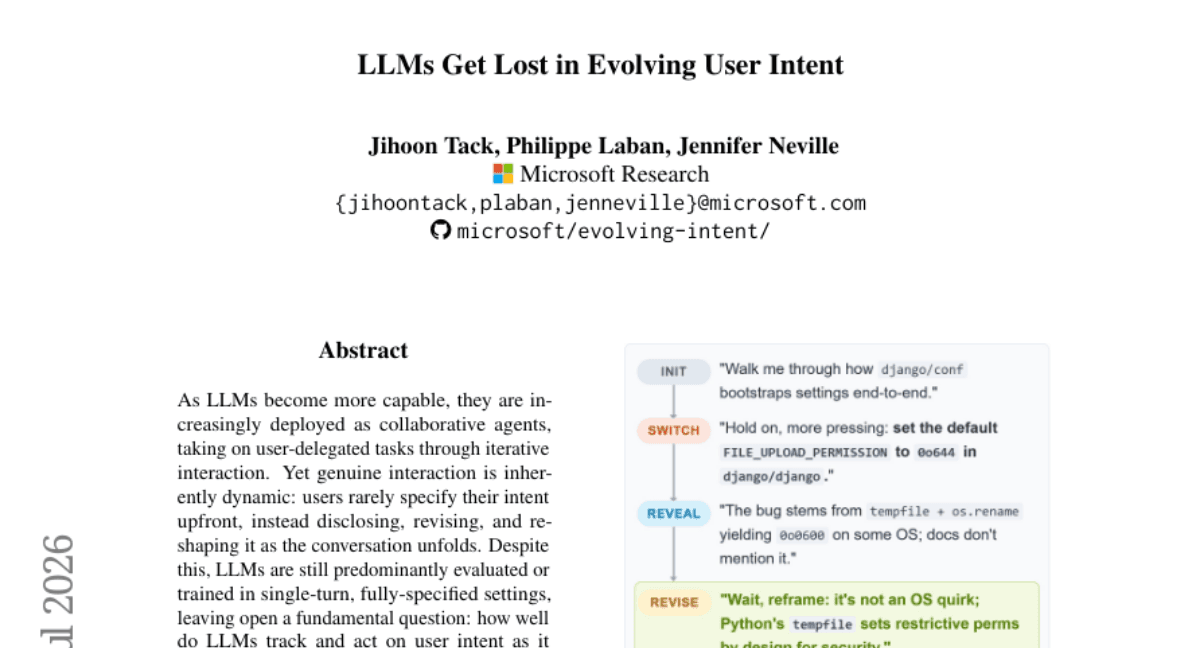
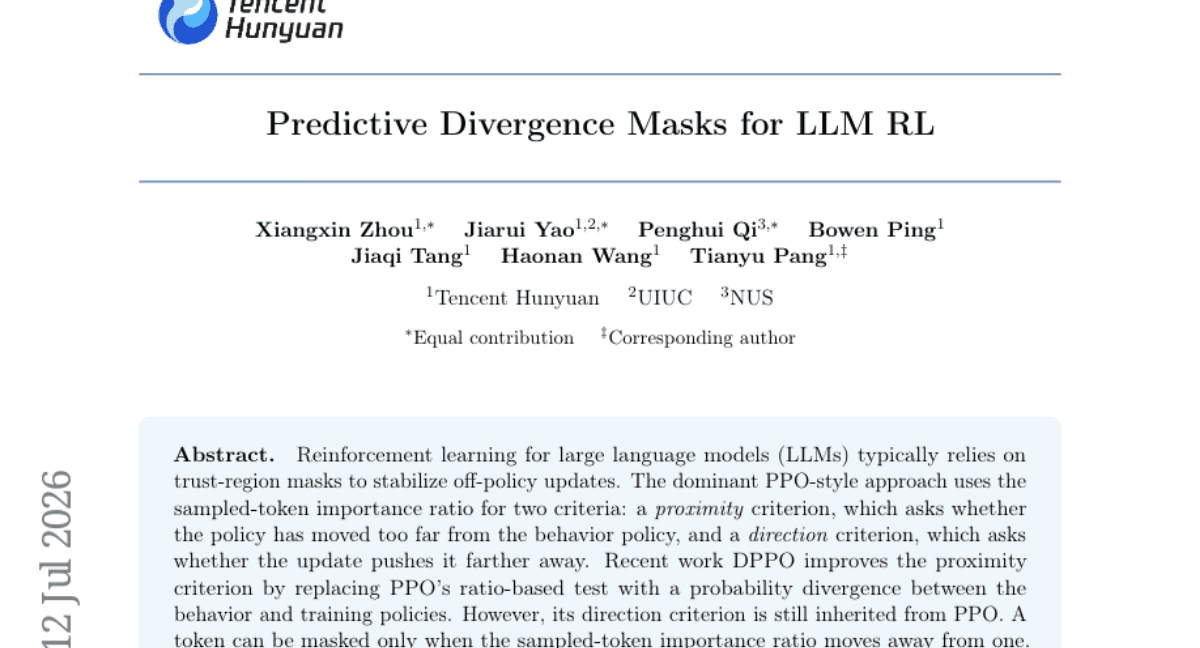
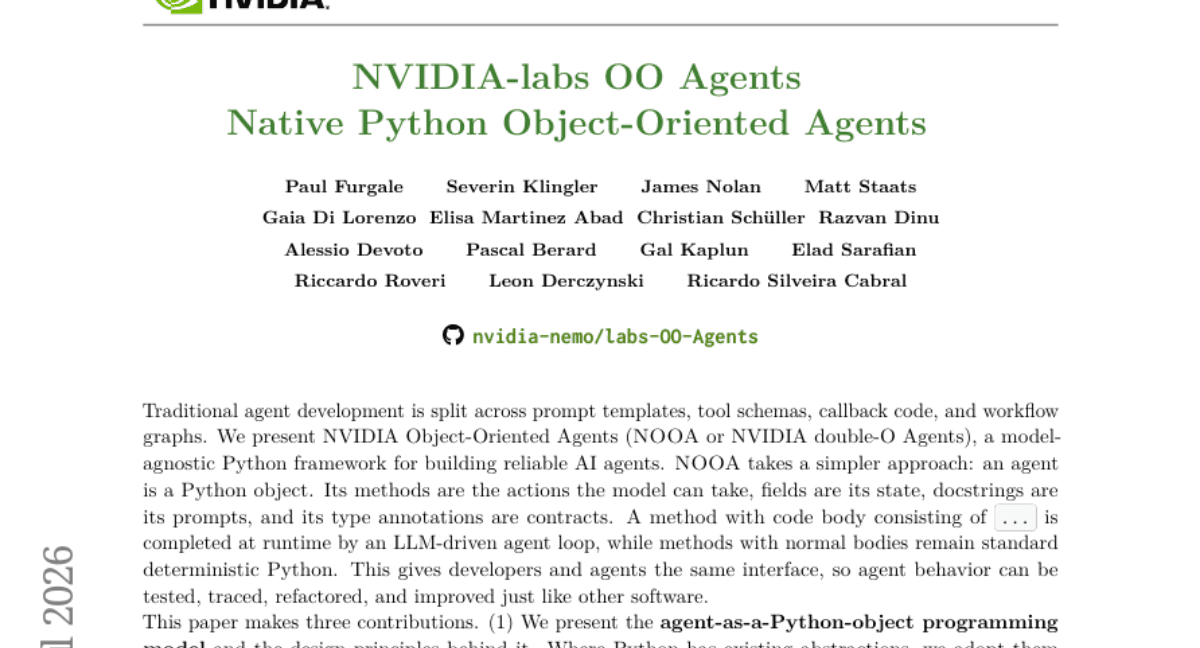
**New from today:** ICAE-Bench (interactive coding agent benchmark), Harness Handbook (self-improving agent harness with BGPD workflow), Tencent WorkBuddy Bench (multi-domain coding-agent benchmark), Predictive Divergence Masks (LLM RL improvement), NOOA (NVIDIA OO Agents), AREX (recursive self-improving agent), Agentic coding without cloud (open-weight models viable for local deployment). Also: LLMs Get Lost in Evolving User Intent (new failure mode), Experience Distillation (sample-efficient agent training), ReferTrack (embodied visual tracking), PRO-LONG (programmatic memory for long-horizon reasoning).