# AI Advances of 2024: Toward Trustworthy, Interpretable, and Multimodal Autonomous Systems
The year 2024 marks a pivotal turning point in artificial intelligence, where the focus shifts from merely enhancing raw performance to ensuring **trustworthiness, interpretability, and reasoning capabilities**. Building upon foundational efforts in mechanistic attribution, latent reasoning, and multimodal data integration, recent innovations are **redefining how models trace data origins, compress complex reasoning pathways, and seamlessly handle multiple sensory modalities**. These breakthroughs are not only advancing research but also **transforming practical applications across high-stakes domains**—emphasizing **explainability, societal alignment, and efficiency** alongside raw capability.
---
## Reinforcing Data Provenance, Reproducibility, and Trustworthiness
A major challenge in deploying large-scale models—especially in sensitive areas such as **healthcare, legal systems, scientific research, and autonomous operations**—remains **understanding how training data influences model decisions**. Recent developments have introduced **powerful tools and frameworks** to **automate data curation, standardize benchmarking, and promote transparency**:
- **DataChef**: This innovative framework employs **reinforcement learning** to generate **optimized data recipes** tailored for fine-tuning LLMs. The recent release of **DataChef-32B** demonstrates how **bias-aware, task-specific datasets** can be constructed, **enhancing model trustworthiness** and **performance consistency**. Such curated data **serve as the backbone of transparent AI development**.
- **The AI Replication Engine**: A dedicated infrastructure for **systematic benchmarking and experiment reproducibility**, this tool **enables researchers** to **verify findings, identify biases, and reproduce results efficiently**. Its widespread adoption **strengthens accountability** and **supports scientific integrity**, especially crucial for **high-stakes deployment**.
- **Standardized Data Recipes and Curation Protocols**: The community now emphasizes **best practices** in data collection and preprocessing—**building models on transparent, controllable, and well-understood datasets**. These protocols are vital for **regulatory compliance** and **scalable, responsible deployment**.
- **Hierarchy-Aware Multimodal Unlearning**: Extending privacy protections, **hierarchy-aware unlearning frameworks**—particularly **HIPAA-aligned unlearning**—allow models to **forget sensitive or outdated information** while **maintaining overall performance**. This approach **strengthens privacy-preserving AI** and **supports regulatory adherence**, especially in **healthcare, legal, and personal data applications**.
**Collectively**, these tools **embed transparency and control into the entire training pipeline**, fostering **trustworthy AI systems** grounded in **well-understood, controllable data foundations**—a **crucial step toward societal acceptance and ethical deployment**.
---
## Deciphering Internal Dynamics: Insights into Model Reasoning
Understanding **how models process, prioritize, and utilize their internal representations** remains a **central pillar of AI interpretability**. Recent advances are **peeling back the layers of internal mechanisms** to **provide granular insights**:
- **Attention Decoding with Contrastive Covariance**: Researchers have demonstrated that **contrastive covariance techniques** can **visualize attention flows** within LLMs, revealing **which tokens or internal features influence decisions**. @_akhaliq emphasizes that this method **offers detailed insights into reasoning pathways**, helping **demystify complex decision-making** and **identify biases or failure modes**.
- **Gated Recurrent Memory (GRU-Mem)**: This architecture **dynamically manages memory** through **text-controlled gating mechanisms**, enabling models to **retain relevant information over long contexts**. Such capacity is **crucial for extended reasoning**, multi-step problem solving, and **long-horizon decision-making**.
- **Activation Steering Adapters (ASA)**: A **training-free technique**, ASA **manipulates internal activations** to **correct and steer language models’ tool-calling behaviors**. This **enables models** to **perform external function calls** with **greater robustness and flexibility**, **without additional retraining**, streamlining **tool integration**.
- **Autograding Frameworks for Multimodal Outputs**: New **automatic evaluation systems** assess models generating **complex, multimodal content**—such as images, text, or their combinations. These frameworks **support scalable, reliable evaluation** of **multimodal reasoning**, facilitating **benchmarking and iterative improvement**.
**These methods** **demystify internal reasoning**, making models **more transparent, robust, and trustworthy**, especially in **multi-input, multimodal scenarios**.
---
## Visualizing and Aligning Internal Representations: Multimodal Interpretability
Progress in **visualizing internal representations** and **aligning sensory modalities** is **revolutionizing interpretability** and **cross-modal understanding**:
- **LatentVision Tools (LatentChem and LatentLens)**: These visualization platforms **reveal internal visual tokens** within language models. @_akhaliq highlights **LatentLens**’s ability to **illuminate interpretable visual tokens**, assisting in **scientific discovery**, **medical diagnostics**, and **reproducibility** by **shedding light on internal processes**.
- **Contrastive Multimodal Learning for Medical Imaging**: Employing **contrastive learning**, recent techniques **align visual and textual representations**, leading to **improved interpretability and diagnostic accuracy**—a breakthrough for **medical AI applications**.
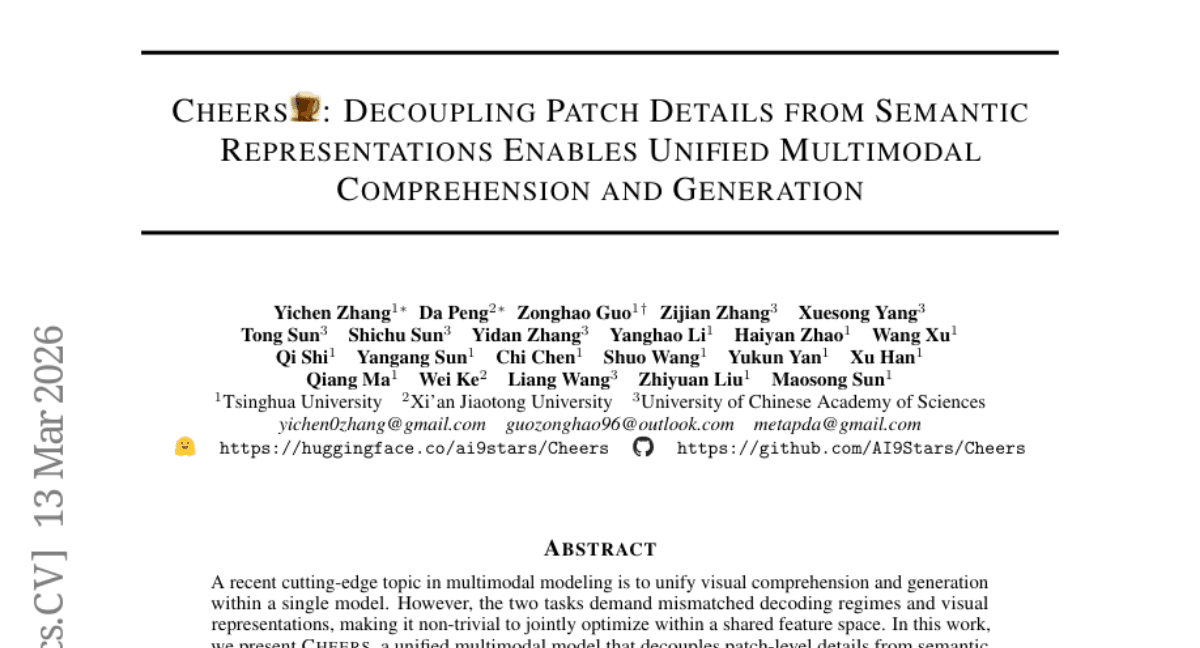
- **OneVision-Encoder**: This architecture **utilizes codec-aligned sparsity** to **align visual and language representations**, fostering **more robust cross-modal understanding**—crucial for **multimedia retrieval**, **robot perception**, and **assistive AI**.
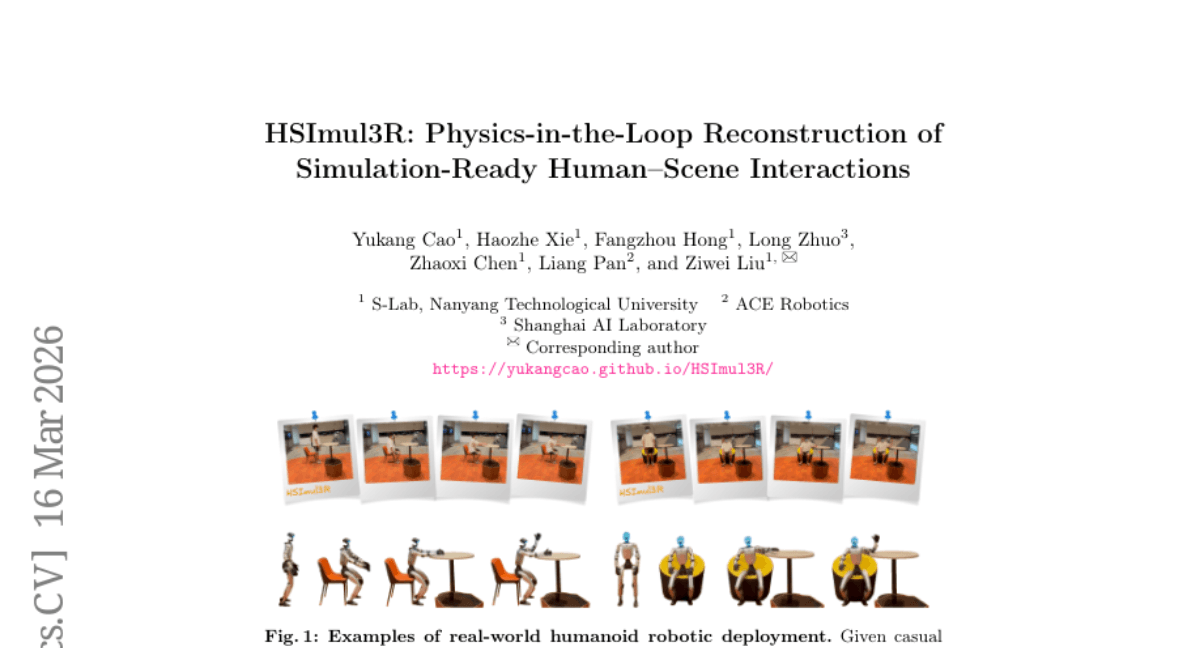
- **DreamDojo**: A **generalist robot world model**, trained on **large-scale human videos**, supporting **multi-task robotic manipulation** and **environment understanding**. Its capacity to **integrate visual, textual, and action data** exemplifies **embodied multimodal modeling**, marking significant progress in **autonomous systems**.
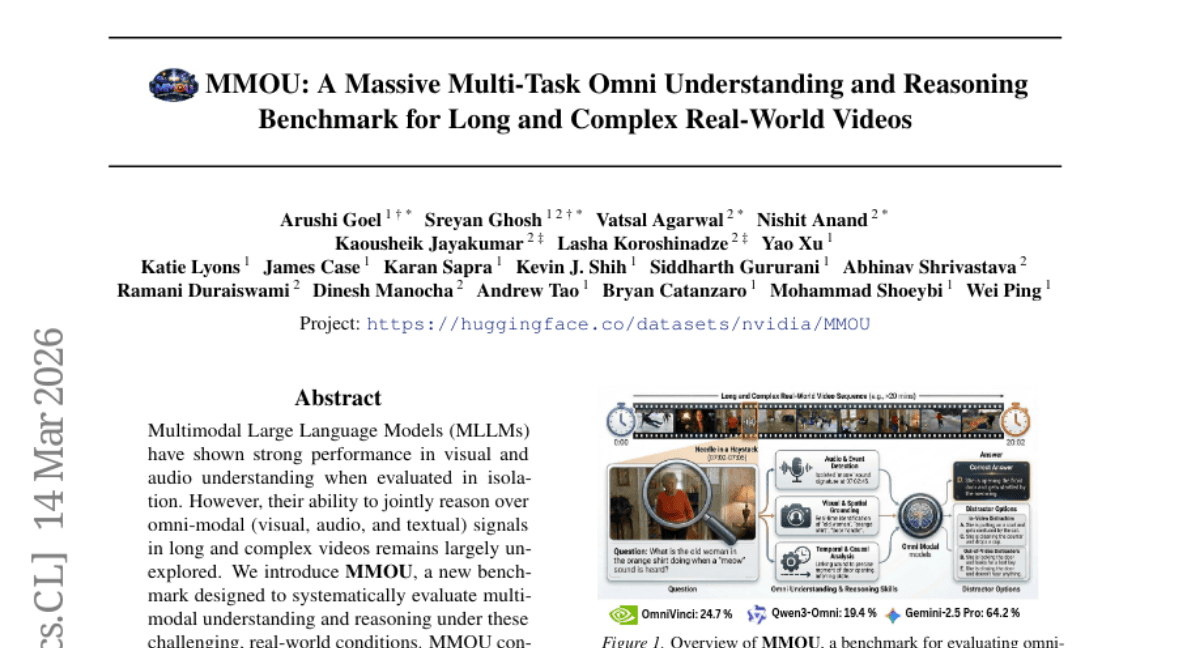
- **A Very Big Video Reasoning Suite**: This **extensive framework** enables models to **reason over extended videos**, supporting **temporal understanding**, **multimodal integration**, and **long-horizon inference**—a vital step toward **holistic perception**.
- **Evaluation Benchmarks**: Standards such as **visual mathematics tests** and **CodeOCR** provide **rigorous evaluation frameworks** for **visual reasoning** and **visual code understanding**, fostering **standardized progress** in multimodal interpretability.
These innovations **illuminate internal representations**, allowing models to **explain decisions** and **integrate sensory modalities seamlessly**, which is **fundamental for building trustworthy, interpretable AI systems**.
---
## Long-Horizon, Adaptive Agents, and World Models
A defining trend in 2024 is the **development of long-horizon reasoning agents** capable of **adaptive planning**, **multi-step decision-making**, and **dynamic environment interaction**:
- **Empirical-MCTS (N2)**: This approach **combines empirical data** with **Monte Carlo Tree Search**, supporting **long-term planning** and **continual learning** in **complex, evolving environments**.
- **Olaf-World**: Advancing **video-based world modeling**, Olaf-World employs **structured latent action spaces** to **support sequence-level control** and **zero-shot transfer** across diverse scenarios, enhancing **embodied AI applications** like robotics and navigation.
- **Gaia2**: A comprehensive **benchmark** designed to **challenge LLM-powered agents** in **complex, asynchronous environments**, encouraging the development of **resilient, autonomous systems** capable of **multi-task execution**.
- **DreamDojo** (reiterated): Beyond multi-task learning from human videos, it **embodies a generalist robot world model** that **supports environmental understanding**, **multi-tasking**, and **adaptive decision-making** in real-world contexts.
- **PhyCritic**: An innovative **multimodal critic** designed to **evaluate physical interactions**, ensuring **robustness and safety** in real-world deployments.
These systems **support extended reasoning**, **environmental interaction**, and **self-improvement**, **paving the way** for **autonomous, reasoning AI agents** capable of **operating effectively in complex, real-world scenarios**.
---
## Algorithmic Innovations and Search Strategies
Alongside architectural progress, **generative optimization techniques** are **revolutionizing problem-solving and heuristic design**:
- **G-LNS (Generative Large Neighborhood Search)**: Leveraging **large language models**, G-LNS **automatically generates heuristics and optimization strategies**, **accelerating solutions** across diverse domains.
- **RelayInference**: This **scalable inference approach** combines **heterogeneous datasets** with **noisy labels**, **reducing computational costs** while **improving deployment efficiency**.
- **Training-Free Adapters (ASA)**: These **internal activation manipulators** **enable external tool integration** **without retraining**, supporting **scalable, flexible deployment**.
- **Medical Data Unlearning and Multimodal Autograding**: New frameworks facilitate **HIPAA-aligned unlearning**, allowing models to **forget sensitive data**, alongside **automatic evaluation** of multimodal outputs—**ensuring trust and privacy**.
**These innovations** **bridge internal reasoning with search and optimization**, supporting **more autonomous, efficient AI systems** capable of **handling complex, diverse tasks**.
---
## Recent Breakthroughs: Test-Time Training and Video Reasoning Suites
Two notable advancements further **advance multimodal reasoning and long-context capabilities**:
- **Reflective Test-Time Planning for Embodied LLMs**: As @_akhaliq describes, this **innovative approach** employs **test-time training** to **dynamically adapt models during inference**, especially for **long-context understanding** and **autoregressive 3D scene reconstruction**. It **empowers models** to **perform high-fidelity 3D reconstructions** from extended visual inputs, **enhancing spatial reasoning**.
- **A Very Big Video Reasoning Suite**: This **comprehensive evaluation framework** assesses models' ability to **reason over extended videos**, supporting **temporal understanding**, **multimodal integration**, and **long-horizon inference**. It **reinforces the importance** of **holistic perception** and **test-time adaptation** for **autonomous AI**.
These advances **enable models** to **operate effectively across long temporal contexts**, **perform detailed spatial reconstructions**, and **adapt dynamically during inference**, **closing the gap** between **perception and reasoning**.
---
## Latest Developments in Cross-Embodiment and Dexterous Manipulation
Building upon these foundational trends, recent articles introduce **noteworthy innovations**:
- **LAP (Language-Action Pre-Training)**: As @_akhaliq elaborates, **LAP** facilitates **zero-shot cross-embodiment transfer**, allowing models trained in one domain or embodiment to **generalize to others**. This method **bridges the gap** between **language understanding** and **embodied action**, key for **versatile autonomous agents**. [Read more](https://t.co/YTxNABdwr)
- **EgoScale**: Focused on **scaling dexterous manipulation**, EgoScale employs **diverse egocentric human data** to **train models capable of fine motor control** in robotic systems. This approach **leverages large-scale naturalistic data** to **improve generalization and dexterity**. [Details here](https://t.co/pak...)
- **Reflective Test-Time Planning for Embodied LLMs**: This framework **integrates reflection and self-assessment** during inference, **enhancing robustness and safety** in **embodied AI**, especially in complex manipulation or navigation tasks. It exemplifies **the trend toward adaptive, self-improving physical agents**.
---
## Current Status and Broader Implications
The innovations of 2024 **embody a paradigm shift** toward **AI systems that are more transparent, interpretable, adaptive, and capable of reasoning over extended, multimodal contexts**:
- **Data Foundations**: Tools like **DataChef**, **AI Replication Engine**, and **standardized protocols** **ensure data quality, bias mitigation, and reproducibility**, establishing **trustworthy foundations**.
- **Internal Explainability**: Techniques such as **attention decoding**, **LatentLens visualization**, **Activation Steering Adapters (ASA)**, and **autograding for multimodal outputs** **demystify internal processes**, **building user confidence**.
- **Multimodal and Long-Horizon Capabilities**: Architectures like **LatentLens**, **OneVision-Encoder**, **Olaf-World**, and **video reasoning suites** **support seamless sensory integration** and **extended reasoning**, essential for **embodied, autonomous systems**.
- **Autonomous, Adaptive Agents**: Frameworks such as **Empirical-MCTS**, **Gaia2**, and **DreamDojo** **enable long-term planning**, **multi-task learning**, and **self-improvement**, **bridging perception and action** in real-world scenarios.
- **Algorithmic and Search Innovations**: Approaches like **G-LNS**, **RelayInference**, and **test-time training** **automate heuristic design**, **reduce inference costs**, and **support dynamic adaptation**.
**In sum**, 2024's advances **favor AI systems that are not only powerful but also aligned, transparent, and trustworthy**—capable of reasoning across complex, multimodal, and long-horizon scenarios.
---
## Broader Implications and Future Outlook
The trajectory of 2024 **signals a future where AI systems are inherently interpretable, reliable, and societally aligned**. Emphasizing **data provenance**, **internal transparency**, and **multimodal integration** directly addresses **trustworthiness and ethical concerns**, especially in high-stakes domains like **healthcare, scientific discovery, and autonomous systems**.
Emerging concepts such as **AI-augmented authenticity verification** and **concept erasure benchmarks** (e.g., **[WACV 2026]**'s comprehensive evaluation of concept erasure in diffusion models) **pave the way** for **digital trust mechanisms** that **counter misinformation and content manipulation**.
Furthermore, the development of **long-horizon, adaptive reasoning agents**, **cross-embodiment transfer techniques** like LAP, and **refined test-time planning** **support resilient, autonomous systems** capable of **safe, effective operation in dynamic environments**—ranging from **robotic manipulation** to **strategic decision-making**.
**Overall**, 2024's innovations **embody a movement toward AI that is transparent, interpretable, adaptable, and reasoning-enabled across modalities and contexts**. These advances **lay the groundwork** for **autonomous systems seamlessly integrated into society**, **supporting scientific progress**, and **ensuring safety and reliability** across numerous domains.
---
### Looking ahead, continued attention to **explainability, privacy-preserving unlearning, regulatory compliance**, and **dynamic inference** will be crucial. As research accelerates, the overarching goal remains clear: **AI systems that not only outperform humans but also justify their decisions, respect user privacy, and operate transparently in complex, real-world scenarios**. The innovations of 2024 **set a promising course toward this vision**, heralding an era of **trustworthy, reasoning-enabled multimodal AI systems**.