# The 2026 Enterprise Evolution of Conversational AI: Unprecedented Advancements in Multimodal Architectures, Real-Time Capabilities, and Industry Deployments
The landscape of enterprise conversational AI in 2026 continues to accelerate at an extraordinary pace, driven by technological breakthroughs, strategic industry adoption, and an increasing focus on trust, privacy, and natural human-AI interactions. Building upon foundational multimodal, intent-first architectures, recent developments have propelled AI systems into new realms—integrating vision, speech, gestures, environmental cues, and contextual understanding seamlessly. These advances are transforming how organizations support customers, automate complex workflows, and extract actionable insights, positioning AI as an indispensable strategic asset across sectors.
## Continued Dominance of Multimodal, Intent-First Architectures in Enterprise Conversational AI
At the core of this evolution are **multimodal, intent-first architectures**—systems capable of perceiving and interpreting **speech, images, gestures, and environmental signals simultaneously**. These architectures have become the standard for enterprise deployment because they enable interactions that are **more human-like, contextually aware, and intuitive**.
Recent demonstrations and deployments highlight their increasing sophistication:
- **SAP’s latest showcase** features an **AI-powered bot** that processes **visual cues and voice commands** in tandem. Their **48 SAP Generative AI** solution exemplifies how enterprises now deploy **visual and auditory multimodal agents** to manage complex scenarios—such as interpreting a user’s gesture while providing voice feedback—resulting in **streamlined operations and heightened engagement**.
- **RingCentral’s integration of OpenAI’s models** has significantly enhanced **voice AI capabilities**, supporting **multi-turn dialogues, improved context retention**, and **escalation workflows**. These improvements lead to **higher customer satisfaction** and **more efficient support operations**.
- **Microsoft’s collaborations with industry partners** have embedded **advanced multimodal AI** into communication suites, creating an **ecosystem** that combines **visual, auditory, and environmental understanding**, enabling **more natural and effective enterprise interactions**.
A notable technological addition has been **speaker diarization**, which distinguishes individual speakers within multi-party conversations. Supported by open-source tools like the **Speechmatics Diarization** toolkit available on GitHub, this capability allows AI to **accurately attribute speech segments to specific individuals**—a crucial feature for **meetings, legal proceedings, customer support**, and other contexts where **speaker identification** enhances clarity and accountability.
## Advances in Real-Time Speech: Structured, Configurable, and Expressive Capabilities
The evolution of **real-time speech recognition and synthesis** continues to revolutionize enterprise communication and automation:
- **Configurable ASR solutions** from leaders such as **Microsoft** and **AssemblyAI** now support **industry-specific vocabularies**, **noise robustness**, and **domain adaptation**. Enterprises can **fine-tune models** for environments like **medical dictation**, **legal transcription**, or **customer service**, ensuring **high accuracy** and **context relevance**.
- **AssemblyAI’s latest offerings** deliver **enterprise-grade, adaptable speech models** capable of **precise transcription even in noisy settings**. Their **robust speaker diarization** enhances multi-speaker scenarios vital for **emergency response** or **legal proceedings**.
- **Live transcription and captioning** have advanced further by incorporating **industry-specific vocabularies**, enabling **instantaneous, contextually relevant captions**. These are crucial for **live customer interactions**, **content creation**, and **regulatory compliance**.
- **Low-latency Text-to-Speech (TTS)** systems such as **KaniTTS-2** now support **emotion-rich, natural speech at scale** and **multilingual synthesis**, allowing **small organizations and developers** to deploy **cost-effective, high-quality voice interfaces** on edge devices.
- The **OpenAI Realtime API** continues to demonstrate **remarkable low-latency performance**, supporting **dynamic prompt customization** for a broad spectrum of enterprise applications—from **interactive virtual assistants** to **automated content generation**.
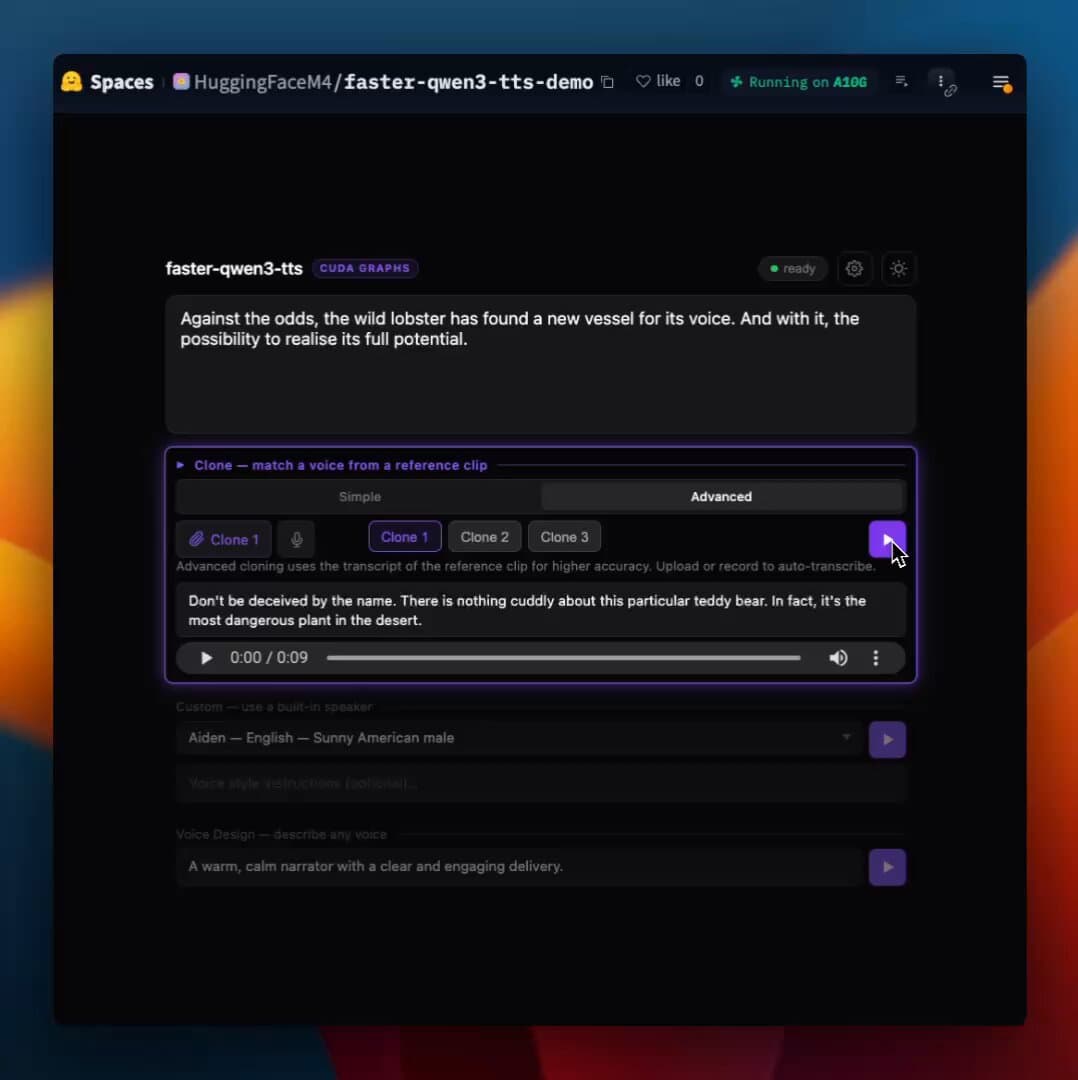
Recent innovations like **Faster Qwen3TTS** further exemplify this progress. As reposted by @lvwerra, **Qwen3TTS** now delivers **realistic voice generation at 4x real-time**, enabling **instantaneous, expressive speech synthesis** that rivals human quality while maintaining efficiency, a boon for scalable enterprise deployments.
## Industry-Specific Deployments and Automation: Transforming Customer Support and Enterprise Workflows
Enterprises are increasingly leveraging **multimodal AI** to automate complex workflows with **high precision and trustworthiness**:
- **Claims Processing and FNOL (First Notice of Loss):** **Genesys Voice AI** now offers **automated FNOL intake**, capturing incident details and evidence via **speech or images**, then seamlessly escalating to human agents when necessary. This results in a **smooth, customer-centric experience** that accelerates claims resolution.
- **Call Center Automation:** Routine inquiries, policy updates, and scheduling are managed by **voice AI systems** supporting **context retention** and **trustworthy escalation**, ensuring **compliance** and **operational efficiency**. These systems incorporate **validation workflows** and **fallback mechanisms** to handle **edge cases** robustly.
- **Domain-Specific Multimodal Assistants:** Sectors like **automotive** and **retail** benefit from AI assistants that interpret **visual cues**—such as **product images**, **vehicle dashboards**, or **AR overlays**—alongside voice commands to deliver **personalized, context-aware interactions** that enhance **user satisfaction** and **productivity**.
### New Industry Platforms Elevate Capabilities
Recent innovations have led to **enterprise-grade platforms** tailored for specific operational needs:
- **FlashLabs’ FlashAI 2.0**: A **comprehensive voice AI platform** designed to **deploy human-level AI agents** in high-volume contact centers, emphasizing **scalability**, **trustworthy automation**, and **seamless escalation** to humans. Its focus is on **revolutionizing customer interactions** at scale.
- **Rootle.ai**: Launched as **India’s first "Institutional Memory Voice AI" platform**, it addresses **enterprise knowledge loss** by enabling organizations to **capture, store, and retrieve institutional knowledge** via **voice interfaces**. This capability reduces onboarding time and ensures **knowledge continuity**—a critical advantage for large, complex organizations.
## Expressive Audio-to-Audio and Persona Control: Creating Human-Like, Relatable Agents
The **frontier of persona customization** and **expressive speech synthesis** has expanded dramatically:
- **Fal.ai’s Personaplex** offers **comprehensive persona control engines**, allowing enterprises to **design distinct voice identities** infused with **emotion expression**, **speech style**, and **personality traits**. These enable **more engaging, human-like AI agents** capable of **building trust** and **fostering rapport**.
- **Speech-to-speech persona engines** facilitate **emotionally nuanced voice modulation** across multiple languages, supporting **emotion-aware synthesis**. Such systems empower virtual assistants to **exhibit empathy, excitement, or calmness**, transforming interactions into **more immersive and authentic experiences**.
## Democratization and Edge Accessibility: Empowering Small Teams and Developers
A defining trend in 2026 is the **democratization of advanced voice AI solutions**, making sophisticated capabilities accessible to **small teams, startups, and individual developers**:
- The article **"How I Built a Low-Latency Voice AI Agent in 2 Hours for $0"** exemplifies this trend, demonstrating how **public APIs like KaniTTS-2**, **OpenAI’s GPT models**, and **off-the-shelf hardware** enable rapid prototyping and deployment of **advanced voice agents** at **minimal cost**.
- **KaniTTS-2** supports **expressive, high-quality speech synthesis** on standard CPUs, making **custom voice cloning** and **emotion-rich speech generation** feasible for **non-experts**.
- The release of **Kitten TTS v0.8**, a **compact CPU-only TTS engine** with a **25MB footprint**, further enhances **edge deployment** possibilities—ideal for **embedded devices and IoT systems**—allowing **natural, expressive speech** generation without requiring powerful hardware. A detailed **deployment guide** demonstrates how **small organizations** and **individual innovators** can **leverage these tools** to **accelerate innovation**.
- The **xAI Voice API** now supports **multilingual, tool-enabled voice agents** capable of **speaking, thinking, and acting** in over **100 languages**, facilitating **complex integrations** like **call tools** and **dynamic voice modulation**—bridging **AI research** and **enterprise deployment**.
## Integration with Hardware and Industry-Specific Ecosystems
Recent developments also emphasize the importance of **hardware** and **industry-specific ecosystems**:
- **Mercury 2**, a state-of-the-art hardware platform, supports **real-time voice AI** with **optimized processing power**. A recent YouTube video titled **"Mercury 2, Realtime Voice, and Why Your AI Stack Needs a Thicker Chip"** explains how **more robust hardware architectures** are crucial for **low-latency, scalable AI solutions**.
- **Autocalls** has expanded its platform to offer **full omnichannel, white-label AI voice solutions**, seamlessly integrating **call, chat, and messaging platforms**—simplifying deployment and branding.
- **Marchex & Solera** announced a strategic partnership to **embed conversational AI into vehicle lifecycle management solutions**, enabling **automotive dealers and service providers** to **automate customer interactions**, **schedule appointments**, and **provide real-time updates**—improving **customer satisfaction** and **operational efficiency**.
- **Flexcar** employs **Voice AI to scale phone support** without increasing staffing costs. A recent case study, **"How Flexcar uses Voice AI to scale phone support without hiring more agents,"** demonstrates how **automated voice agents** handle **routine inquiries** and **support tasks**, freeing human agents for more complex issues.
## Strategic Priorities for Enterprises in 2026
To fully harness these technological advancements, organizations should focus on:
- **Validation and Escalation Workflows:** Developing **robust testing frameworks**, **fallback mechanisms**, and **continuous monitoring** to uphold **trustworthy and reliable AI interactions**.
- **Privacy-Preserving Models:** Emphasizing **on-device processing**, **federated learning**, and **secure data handling** to **protect user privacy** and **meet regulatory standards**.
- **Standards-Based APIs and Ecosystem Integration:** Leveraging **industry standards** such as **Google’s Gemini API**, **OpenAI’s APIs**, and others to ensure **scalability**, **security**, and **interoperability**.
- **Vendor and Community Engagement:** Staying ahead by **monitoring emerging startups** like **Slang AI**, **FlashLabs**, and **Rootle.ai**, and actively participating in **industry forums** to **adopt innovative solutions early** and **maintain a competitive edge**.
## Industry Investment and Momentum
The confidence in this sector is evident through recent funding successes:
- **Slang AI** announced closing a **$36 million Series B round**, focusing on **hospitality-specific voice AI solutions**. This underscores **continued momentum** in vertical-tailored AI platforms that **deliver personalized customer experiences**—a trend resonating across **retail**, **automotive**, **hospitality**, and **financial services**.
Additional notable developments include:
- **Mercury 2**’s hardware innovations emphasizing **robust, low-latency voice processing**.
- **Autocalls’** expansion into **omnichannel voice solutions**.
- **Marchex & Solera’s** partnership integrating **conversational AI** into **vehicle management**.
- **Flexcar’s** success in **scaling customer support** using **voice AI**.
## Current Status & Future Outlook
As of 2026, **multimodal, intent-aware, privacy-conscious voice AI systems** are **deeply embedded** within enterprise workflows, fundamentally transforming **customer engagement**, **automation**, and **knowledge management**. The rapid pace of innovation—fueled by **hardware advances**, **software breakthroughs**, and **strategic investments**—continues to redefine what AI can accomplish.
Looking ahead, organizations are encouraged to:
- **Prioritize multimodal architectures** that integrate **vision, speech, gestures, and environmental cues** with **low latency**.
- **Invest in validation, escalation, and compliance workflows** to uphold **trustworthiness**.
- **Adopt standards-based APIs** to ensure **secure, scalable deployment**.
- **Engage with emerging vendors and the community** to **accelerate deployment** and **maintain a competitive edge**.
## Final Thoughts
The year 2026 marks a **transformational era** where **conversational AI** is no longer experimental but **a core business enabler**. The convergence of **multimodal perception**, **real-time responsiveness**, and **human-like personas** is **redefining enterprise customer support**, **workflow automation**, and **knowledge management**. Organizations that **embrace these innovations**, **prioritize privacy and trust**, and **proactively monitor emerging solutions** will lead this new wave—setting the standards for **natural, effective, and trustworthy enterprise interactions**.
---
**In summary**, from **industry-specific platforms like Slang AI’s hospitality solution** to **democratized edge tools like Kitten TTS v0.8**, the future of **conversational AI** is now accessible for organizations of all sizes. These advancements are unlocking **unprecedented efficiency, personalization, and engagement**, heralding an era where **AI seamlessly integrates into every facet of enterprise operations**.