3h ago
Benchmarking Genomic Models Against SpliceAI
How should researchers benchmark genomic foundation models for splice-site prediction?
SpliceAI serves as the established baseline, relying on a...

Created by Christine Farley
AI-driven biotech breakthroughs, explainers, and learning resources for drug discovery, genomics, imaging
Explore the latest content tracked by AI BioInsights Hub
How should researchers benchmark genomic foundation models for splice-site prediction?
SpliceAI serves as the established baseline, relying on a...
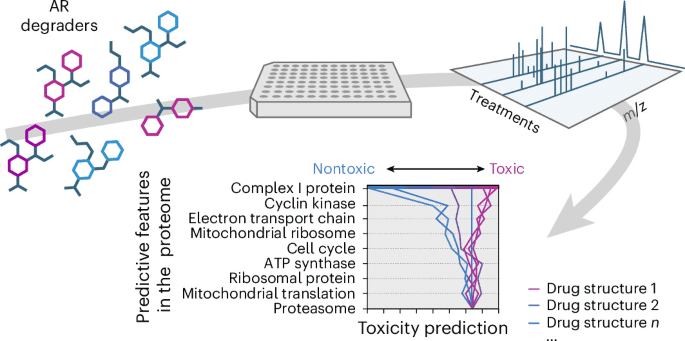
高通量蛋白质组学正将药物发现重点从“寻找有效降解剂”转向“解释并预测全蛋白组毒性”。
LLM无需额外训练即可检测临床试验中的outcome switching,识别主要终点与报告结果的不一致。
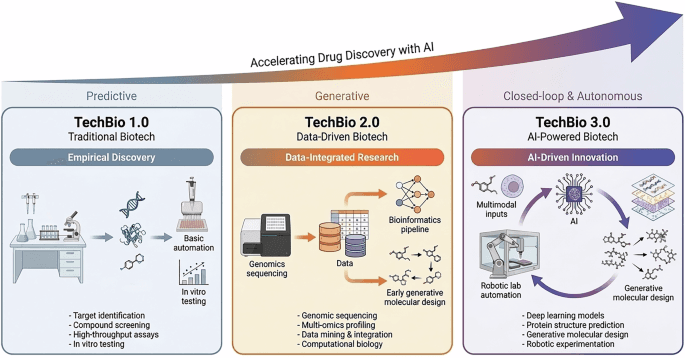
AI药物发现正从“生成分子”转向“生成可合成、可测试并迭代优化的分子”。
突破仍依赖自动化实验平台与全流程验证。
SPARCS combines AI with high-throughput microscopy and genetic screening to link gene perturbations directly to complex cell behaviors across millions...
AlphaFold Server predicts structures in hours that once took months via crystallography, while Schrödinger software generates leads formerly requiring...
Vanderbilt leads a new NIH-backed consortium to turn genomic discoveries into clinical tools, but success hinges on shared infrastructure rather than...
Explainable AI drives marker selection in a hierarchical framework that resolves both continental and fine-scale East Asian population structures for forensic applications.
Rakovina's collaboration with Celvion deploys the EMphora platform to scan clinical outcomes and patient records for biomarkers, drug combinations,...
Medical device trials assess safety and effectiveness through phased studies under FDA IDE, starting with small feasibility trials before pivotal...
人类基因组计划耗时13年、花费27亿美元,如今全基因组测序仅需一天且成本大幅降低。
此转变催生欧洲多国国家基因组计划,生成群体特异性资源并支持精准医疗。
长读长测序与人工智能正共同推动群体基因组学及临床转化。
A critical review maps AI tools across the full DBTL cycle in synthetic biology and directly assesses the strength of their validation and supporting evidence.
Future Health Summit 2026 centers on AI-driven disease prediction through continuous data streams from wearables, genomics and health records, yet...
A systematic survey of 74 AI/ML studies across six data modalities for multiple sclerosis monitoring reveals limited maturity, with critical validation steps appearing in only 5.41% of studies.
BioCopy’s ValidaTe™ platform uses integrated AI and proprietary pHLA datasets to systematically predict and validate off-target interactions across...
Probe-based fixed-cell Perturb-seq eliminates the traditional scale-resolution trade-off in genome-wide CRISPR screens.