# Reinforcement Learning in 2026: Building Trustworthy, Self-Reflective, and Multi-Modal AI Systems
As we move deeper into 2026, reinforcement learning (RL) continues to be a pivotal force shaping the evolution of AI, driving systems that are more reliable, interpretable, and aligned with human values. This year marks a significant leap forward, characterized by groundbreaking innovations in verifiable rewards, stability-focused policy optimization, self-reflection mechanisms, grounded reasoning, embodied multi-agent systems, and advanced infrastructure. These advances collectively forge a new era of AI that is not only powerful but also self-aware, transparent, and capable of continuous self-improvement.
This comprehensive update synthesizes the latest developments, highlighting how they collectively enhance the robustness, safety, and versatility of large models—particularly in language, vision-language, embodied, and multi-agent domains.
---
## Advancements in Factual Accuracy and Trustworthiness: Verifiable Rewards, Grounded Retrieval, and Formal Verification
Ensuring **factual correctness** remains a central challenge for deploying AI in high-stakes environments such as healthcare, autonomous navigation, and scientific research. Traditional RL reward functions, often based on coarse metrics, have been vulnerable to **reward hacking** and hallucination, eroding user trust.
### Key Innovations in Verifiable Rewards:
- **Feature-Based, Verifiable Rewards**: Building on @_akhaliq’s **TOPReward**, researchers have developed **interpretable, feature-based reward mechanisms** that rely on **internal signals** like **token probabilities** to enable models to **self-assess** their outputs dynamically. @_akhaliq states, "Token probabilities serve as hidden rewards, enabling models to self-evaluate and adapt in complex reasoning environments," significantly reducing hallucinations and improving factual grounding. [Read more](https://t.co/K76X84DT54)
- **Synthetic Environment Generation**: Dynamic, synthetic scenarios now allow models to train and test reasoning and decision-making in **safe, controllable environments**, accelerating learning while minimizing real-world risks.
- **Formal Verification & Output Filtering**: Integrating formal verification methods ensures that generated outputs adhere to **logical constraints** and **factual accuracy**, especially vital in domains like medicine or autonomous systems.
- **Grounded Retrieval-Augmented Reasoning (RAG)**: Combining RL with **retrieval mechanisms** enables models to **dynamically access external data**, such as scientific articles, images, or videos, during inference. This **grounds responses in real-world knowledge**, enhances **trustworthiness**, and offers explainability through **answer justifications**.
---
## Stability and Uncertainty-Awareness in Policy Optimization
Training large, complex models with RL involves navigating **high-dimensional, unstable policy spaces**. Recent progress emphasizes **stability** and **uncertainty modeling**:
- **Trust Region RL**: Methods that **limit the magnitude of policy updates** prevent divergence during training, especially in multi-modal, reasoning-intensive tasks.
- **Learning Advantage Distribution (LAD)**: Building on the paper "[2602.20132] LAD," modeling the **distribution of advantage estimates** captures **uncertainty more effectively** than scalar advantages, resulting in **more stable, robust training**—particularly in sequence-level reasoning scenarios.
- **Sequence-Level Variational Techniques**: Approaches like **VESPO** enhance **scalable, resource-efficient RL training**, enabling models to handle noisy or limited data and **accelerate deployment**.
---
## Self-Reflection, Self-Distillation, and Lifelong Learning
One of 2026’s most transformative trends is the rise of **self-aware, self-improving AI systems** that can **critique**, **refine**, and **adapt** autonomously:
- **Self-Distillation Policy Optimization (SDPO)**: This approach allows models to **generate their own training signals**, fostering **continuous, autonomous refinement** of policies without external supervision.
- **Internal Guided Reasoning Policy Optimization (iGRPO)**: Incorporates **internal critique mechanisms** enabling models to **detect reasoning errors**, **refine outputs**, and **adjust strategies** dynamically, significantly boosting **accuracy** and **reliability** across multi-step reasoning.
- **SAGE (Self-Assessment Guided Efficiency)**: Empowers models to **evaluate the quality and necessity** of their reasoning steps, promoting **resource-efficient inference** and supporting **lifelong learning** by continually adapting to new data and tasks. As recent studies note, "Models are no longer passive processors but active self-critics, capable of internal evaluation and iterative refinement."
---
## Grounded, Retrieval-Augmented Reasoning in High-Stakes Domains
To mitigate hallucinations and enhance **factual grounding**, models increasingly leverage **retrieval-augmented RL**:
- **Embed-RL Frameworks**: These integrate **multimodal embeddings** with RL, allowing models to **retrieve relevant external data**—such as scientific texts, images, or videos—during inference, grounding responses in **up-to-date, verifiable information**.
- **Explainability and Justification**: Retrieval mechanisms facilitate **transparent reasoning**, enabling models to **justify their answers**, which is crucial in **scientific**, **medical**, and **autonomous decision-making** contexts.
---
## Embodied, Tool-Using, and Multi-Agent Systems
The scope of RL extends into **embodied AI**, emphasizing **continuous control**, **tool manipulation**, and **multi-agent collaboration**:
- **Actor-Critic for Continuous Action Chunks**: The paper **"[PDF] Actor-critic for continuous action chunks"** introduces methods for **temporally extended control**, empowering robots and simulation agents with **more natural, precise interaction capabilities**.
- **Zero-Shot Dexterous Tool Manipulation**: @_akhaliq’s **SimToolReal** demonstrates **zero-shot learning** in complex tool manipulation, bringing **autonomous robotics** closer to **human-like dexterity**—a significant step toward **autonomous robotic assistants**. @_akhaliq notes, "SimToolReal shows models can manipulate unseen tools in novel scenarios." [Read the paper](https://t.co/...)
- **SkillOrchestra**: This framework enables **skill transfer and routing** among multiple agents, supporting **dynamic skill composition** and **scalable multi-agent ecosystems** capable of **adapting** to diverse, complex tasks.
---
## Infrastructure, Benchmarks, and Evaluation Standards
Supporting this rapid development are **advanced platforms** and **rigorous evaluation protocols**:
- **Forge**: An integrated RL experimentation environment supporting **multi-modal workflows**, **safety guarantees**, and **flexible experimentation**.
- **Standardized Protocols**:
- **Agent Data Protocol (ADP)**: Ensures **robust benchmarking** through standardized data collection.
- **Goldilocks RL**: Promotes **balanced training and evaluation conditions** to prevent overfitting or underfitting.
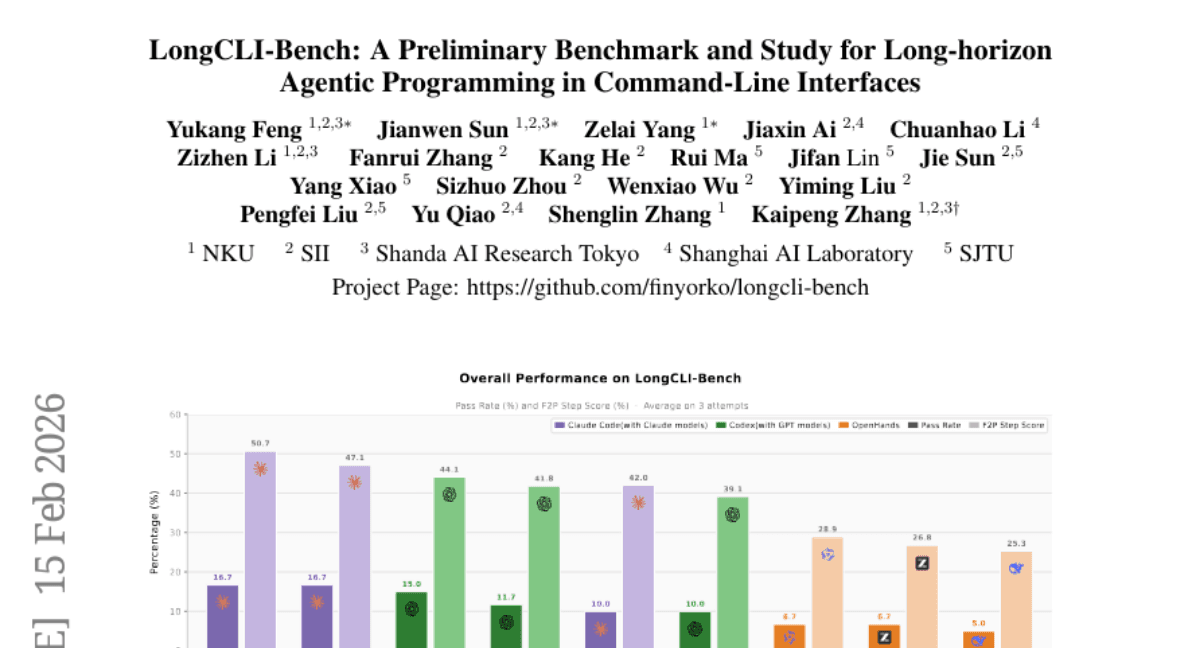
- **LongCLI-Bench**: Focuses on **long-horizon planning and reasoning**, pushing progress in **complex, multi-step tasks**.
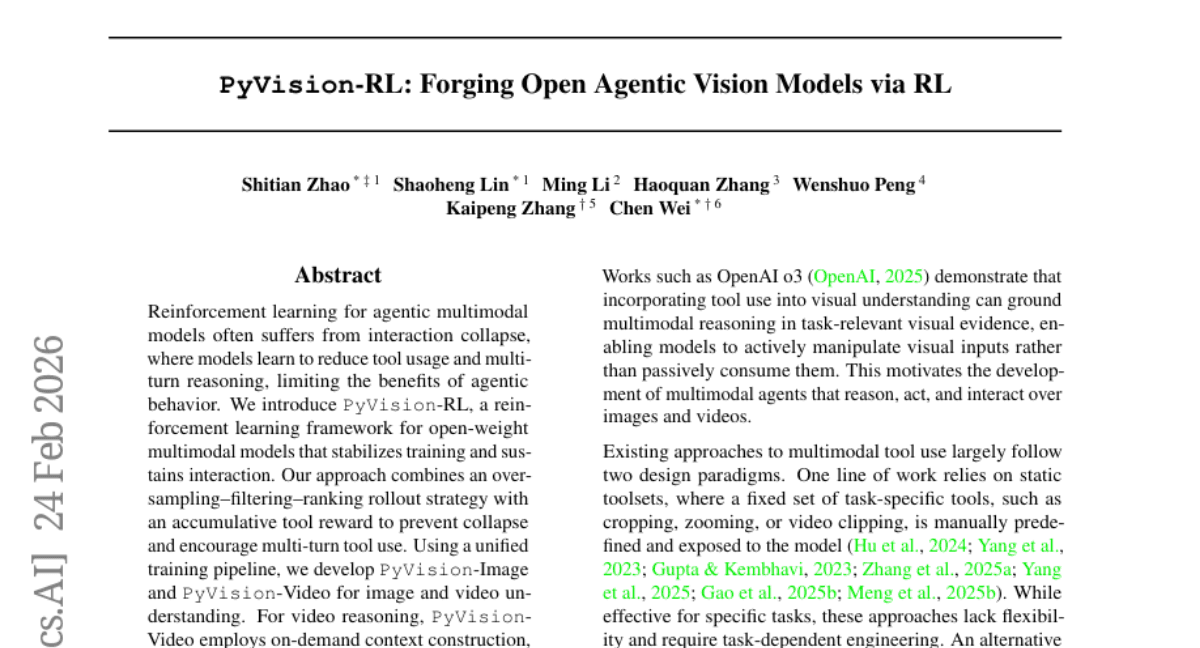
- **PyVision-RL**: An open framework supporting **interactive, vision-based RL agents** that combine perception, planning, and multimodal interactions.
---
## Emerging Frontiers: Partially Verifiable RL and World Modeling
Two exciting recent articles expand the horizon of **trustworthy, scalable RL**:
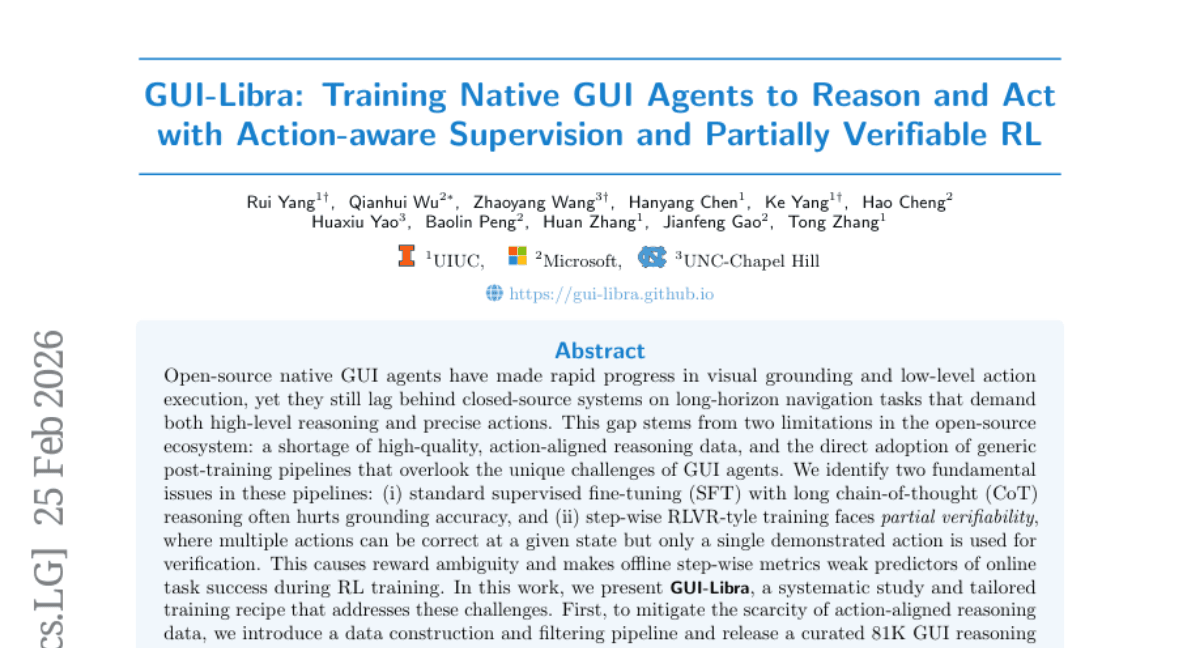
- **GUI-Libra**: Introduces **partially verifiable RL** for **GUI-based agents**, enabling reasoning about and interaction with complex graphical interfaces through **action-aware supervision**. This approach improves **reliability** in environments like software automation.
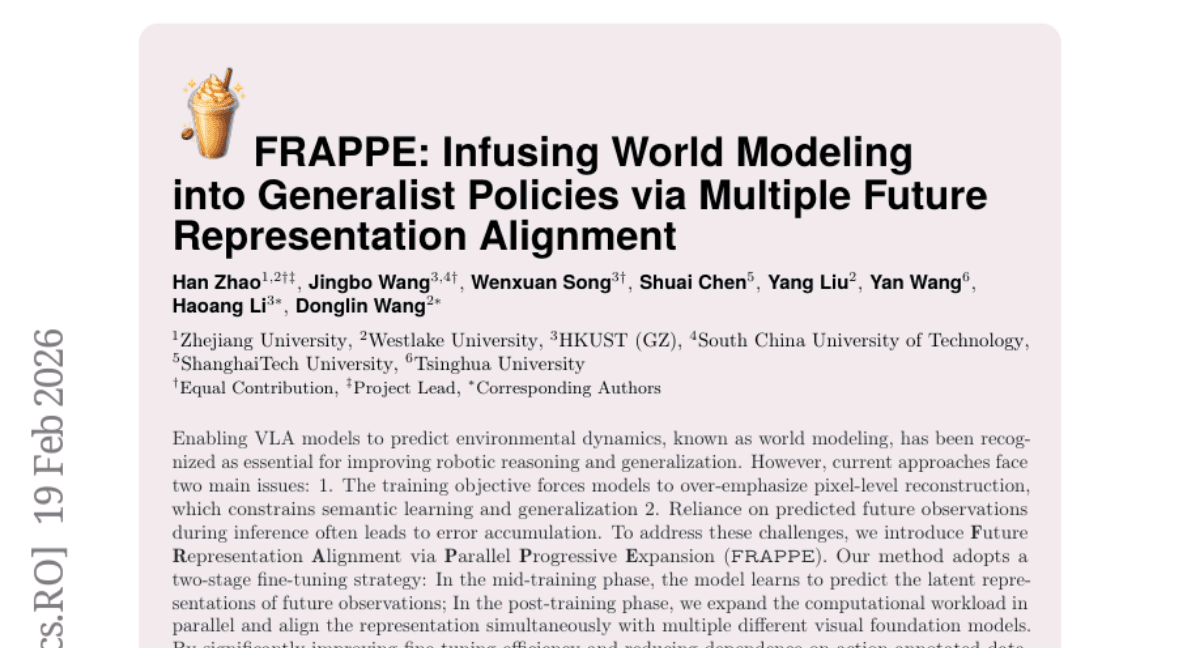
- **World Guidance**: Emphasizes **world modeling** in **condition space**, allowing models to **generate contextually appropriate actions** based on an internal understanding of environment dynamics, thereby enhancing **verifiability** and **robustness** in dynamic scenarios.
---
## Additional Innovations: Enhancing Efficiency and Memory
Two notable developments further enrich the landscape:
- **Adaptive Drafter Model**: This new approach leverages **downtime**—periods of inactivity—to **double the training speed of LLMs** through **self-distillation**. By intelligently utilizing idle periods, models can **accelerate learning** and **reduce training costs**, making large-scale models more accessible and sustainable.
- **Benchmarking Agent Memory in Multi-Session Tasks**: Given the importance of **long-term consistency** and **multi-session robustness**, recent work focuses on **evaluating and improving agent memory** in **interdependent, multi-session environments**. This research aims to **enhance lifelong learning** capabilities, enabling agents to **recall past interactions** effectively and **adapt across sessions**.
---
## Current Status and Future Outlook
The RL ecosystem in 2026 exemplifies an **integrated ecosystem** of **trustworthy, self-reflective, and multi-modal systems**. The convergence of **verifiable rewards**, **uncertainty-aware optimization**, **self-assessment mechanisms**, and **grounded reasoning** forms the backbone of AI that is **not only powerful** but also **safe, transparent, and aligned with human values**.
**Implications include:**
- **Enhanced Reliability**: Through **formal verification** and **feature-based rewards**.
- **Greater Stability & Uncertainty Modeling**: Via **trust regions**, **LAD**, and **variational methods**.
- **Autonomous Self-Improvement**: Enabled by **self-distillation** and **internal critique**.
- **Explainability & Grounded Reasoning**: Supported by **retrieval-augmented frameworks**.
- **Embodied & Multi-Agent Capabilities**: For **complex control**, **tool use**, and **collaborative tasks**.
Looking ahead, innovations like **GUI-Libra** and **World Guidance** are pushing the boundaries toward **partially verifiable and robust world models**, fostering **trustworthy, scalable, and self-reflective AI**. These advances aim to create systems that are **not only powerful but also safe, transparent, and aligned**—crucial for integrating AI into societal functions and everyday life.
---
## In Summary
The landscape of reinforcement learning in 2026 reflects a **holistic integration** of **theoretical rigor, practical robustness, and ethical considerations**. With a focus on **verifiable rewards**, **self-assessment**, and **grounded, multi-modal reasoning**, AI systems are becoming **trustworthy, adaptable, and capable of lifelong learning**. These developments mark a pivotal step toward **AI that is not only intelligent** but also **aligned, transparent, and safe**, addressing critical societal needs and paving the way for **responsible deployment** across diverse domains.