March 19, 2026
AI Theory & Vision Digest · Mar 19 Daily Digest
ML Theory: Optimization Landscapes
- 🔥 Prior-Informed Neural Network Initialization: A Spectral Approach: The choice of initial weights plays a...

Created by Abraham Martin
Daily top-tier AI research papers on theory, robotics, vision, and language
Explore the latest content tracked by AI Theory & Vision Digest
Key trend in NN optimization:
V-Co provides a closer look at visual representation alignment via co-denoising. Key paper for vision self-supervision advances.
Video diffusion transformers enhanced with camera pose representation enable precise action control and long-term 3D consistency in interactive gaming worlds.
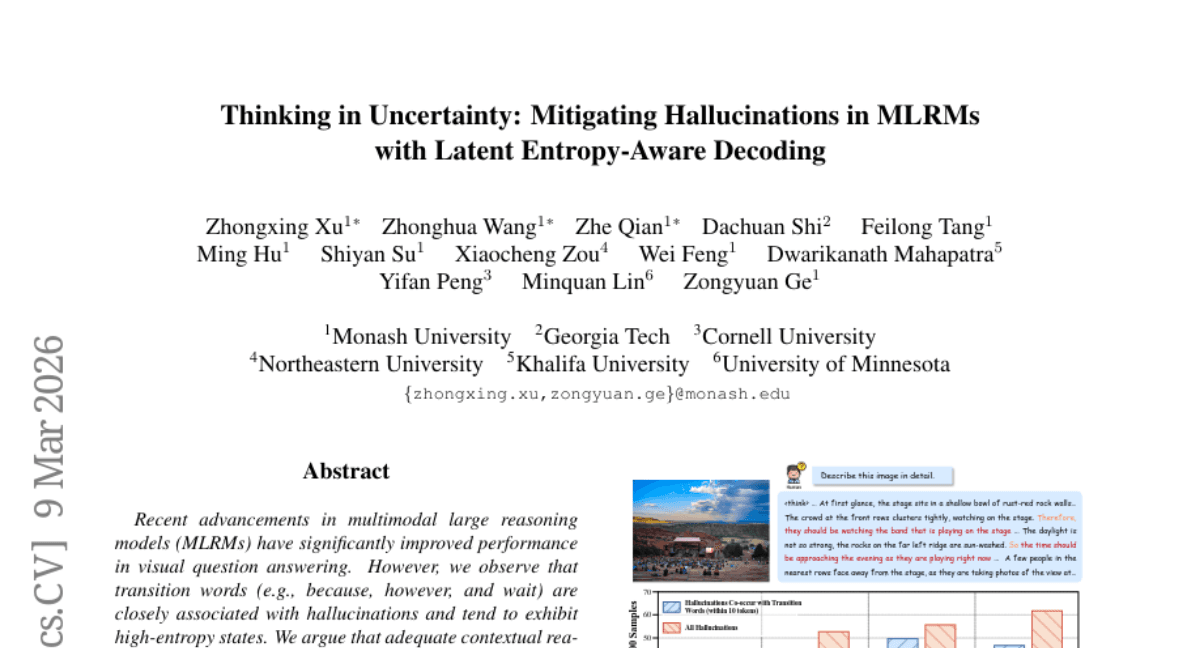
Thinking in Uncertainty introduces Latent Entropy-Aware Decoding to mitigate hallucinations in MLRMs.
FHIBE debuts as the first publicly available, consent-driven, globally diverse dataset for bias testing in computer vision tasks.
Key highlights:
-...
Robust domain adaptation ensures automated damage assessment models stay reliable in previously unseen disaster events, vital for cross-disaster robustness.
This novel framework extrapolates knowledge from conventional pinhole-view images to omnidirectional 360° panoramic scenes, advancing segmentation robustness across view domains.
Layer-wise innovations are emerging for faster transformers:
Optimization-based systems cannot be norm-responsive, enforcing mathematically opposing principles: commensurability (scalar unification of values) and continuous maximization—a core tension for AI alignment.
Efficient Metropolis-Hastings acceptance steps yield reliable uncertainty estimates in deep learning by integrating lightweight methods into neural networks and stochastic gradient Hamiltonian workflows.
Kimi Team's bold Transformer tweak replaces fixed residuals with depth-wise attention for better scaling:
PDE-constrained optimization leveraging diffusion shows promise on controlled synthetic benchmarks and a standard vision dataset, probing conditions for ML training gains.
New paper asks: Can vision-language models solve the shell game? – probing perceptual limits in occlusion and tracking.
Meta-RL with self-reflection brings sequential learning to LM RL, enabling agents to improve from their own attempts instead of restarting from...
ReMA breaks through working memory bottlenecks in video LLMs, enabling persistent multimodal understanding across months.
Key advances for robotics...
9 concrete ways to integrate synthetic data into ML workflows tackle data access delays and imbalances: