# Advancing the Frontier of Smarter, Scalable Machine Learning: New Algorithms, Platforms, and Benchmarks
The realm of machine learning (ML) is experiencing a remarkable acceleration, driven by a confluence of innovative algorithms, expansive evaluation platforms, and sophisticated application frameworks. These developments are not only expanding AI's capabilities across multimodal understanding, robustness, and physical reasoning but also making models more resource-efficient, trustworthy, and adaptable to real-world complexities. As a result, AI systems are increasingly poised to tackle intricate challenges in robotics, healthcare, environmental sciences, and societal applications.
## Cutting-Edge Platforms and Benchmark Ecosystems Fuel Rapid Innovation
A significant catalyst in this advancement is the proliferation of comprehensive platforms and benchmarks that streamline research dissemination, evaluation, and cross-disciplinary collaboration:
- **NeurIPS 2025 App**: An influential community-driven platform consolidating thousands of papers, talks, datasets, and code repositories from the conference. Its user-friendly interface dramatically reduces barriers for researchers worldwide, fostering faster innovation. A researcher noted, *"Having quick, organized access to the latest research accelerates innovation and helps identify promising directions more efficiently."* This tool exemplifies community-driven efforts to nurture an inclusive AI ecosystem.
- **BrowseComp-V³**: This multimodal evaluation dataset challenges models to interpret complex browsing scenarios involving visual, textual, and navigational cues within a **visual, verifiable, hierarchical framework**. It promotes context-aware reasoning vital for developing intelligent assistants and autonomous agents capable of multi-sensory understanding.
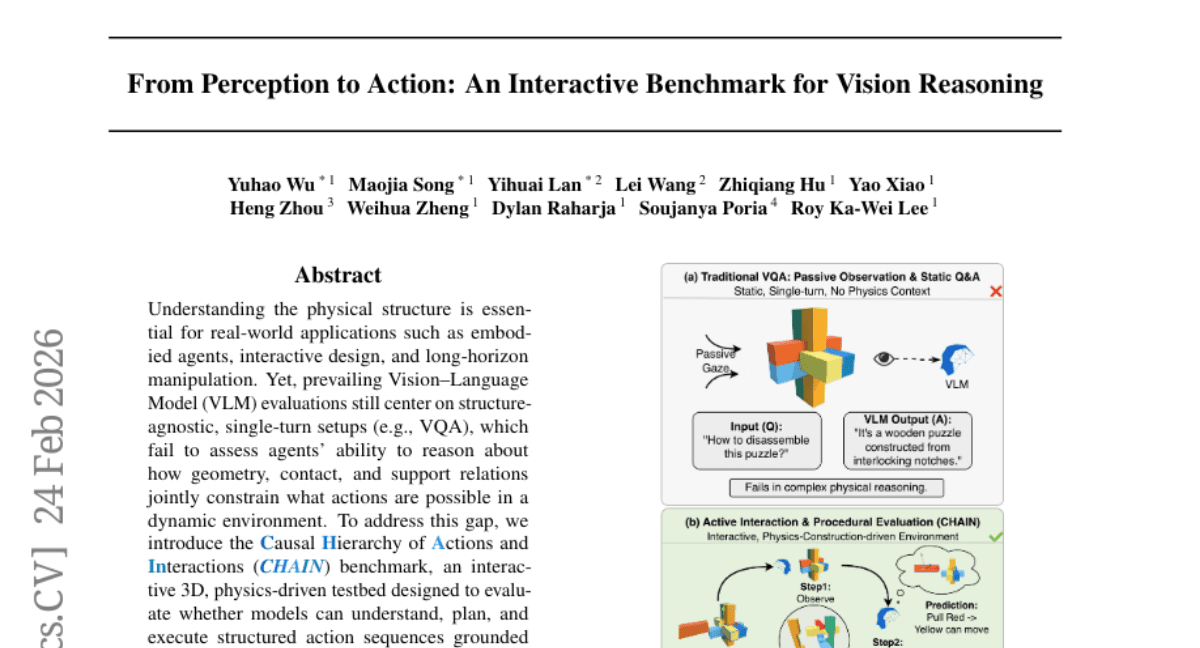
- **BiManiBench**: Focused on robotics, this benchmark assesses multimodal large language models’ abilities to **coordinate bimanual manipulation tasks** hierarchically. It fosters progress in AI-driven robotics, especially for applications demanding fine motor skills and sensory integration in dynamic, real-world environments.
- **TactAlign**: An innovative benchmark enabling **cross-embodiment tactile policy transfer**, allowing tactile demonstrations from humans or other robots to be adapted across different robotic embodiments. Addressing a key gap, it promotes embodiment-agnostic tactile learning—crucial for deploying robots flexibly across diverse operational contexts.
- **Agent Data Protocol (ADP)**: Recently accepted as an oral presentation at ICLR 2026, ADP standardizes **agent-focused data sharing and evaluation**, encouraging reproducibility and collaborative progress in autonomous and multi-agent systems.
- **NTIRE 2026 Robust AI-Generated Image Detection in the Wild**: This emerging challenge introduces datasets featuring real and AI-generated images with “in-the-wild” style transformations. It underscores societal needs for **robust detection methods** to identify AI-generated content amid uncontrolled environments—addressing misinformation, digital authenticity, and security concerns.
- **CVPR 2026’s tttLRM**: A recent standout, **tttLRM** (by Adobe and UPenn) represents a significant step in vision-language models. This advanced model enhances image transformation and understanding, demonstrating capabilities in tasks like style transfer, image editing, and multimodal reasoning within complex visual contexts. Its emergence highlights ongoing progress in integrating vision and language understanding for versatile image manipulation and analysis.
## Algorithmic Innovations Reshape Learning, Generalization, and Reliability
Recent breakthroughs in algorithms are setting new standards for how models learn, adapt, and operate reliably across diverse scenarios:
- **Adaptive Deep Reinforcement Learning (Deep RL)**: New methods enable RL agents to **dynamically adjust exploration strategies** based on environmental feedback, markedly improving learning efficiency in high-dimensional and uncertain settings—crucial for robotics and autonomous navigation.
- **Embed-RL (Multimodal Embeddings Guided by Reasoning)**: By combining reinforcement learning with reasoning cues, Embed-RL produces **semantically rich, cross-modal embeddings**. This enhances tasks like cross-modal retrieval and reasoning, bringing AI assistants closer to holistic understanding of multi-sensory information.
- **The Geometry of Invariant Learning**: Leveraging **information-theoretic** and **geometric analyses**, researchers are uncovering principles that enable models to learn features invariant under distribution shifts. Using bounds based on mutual information, these insights foster models that maintain performance across diverse data domains, strengthening robustness and generalization.
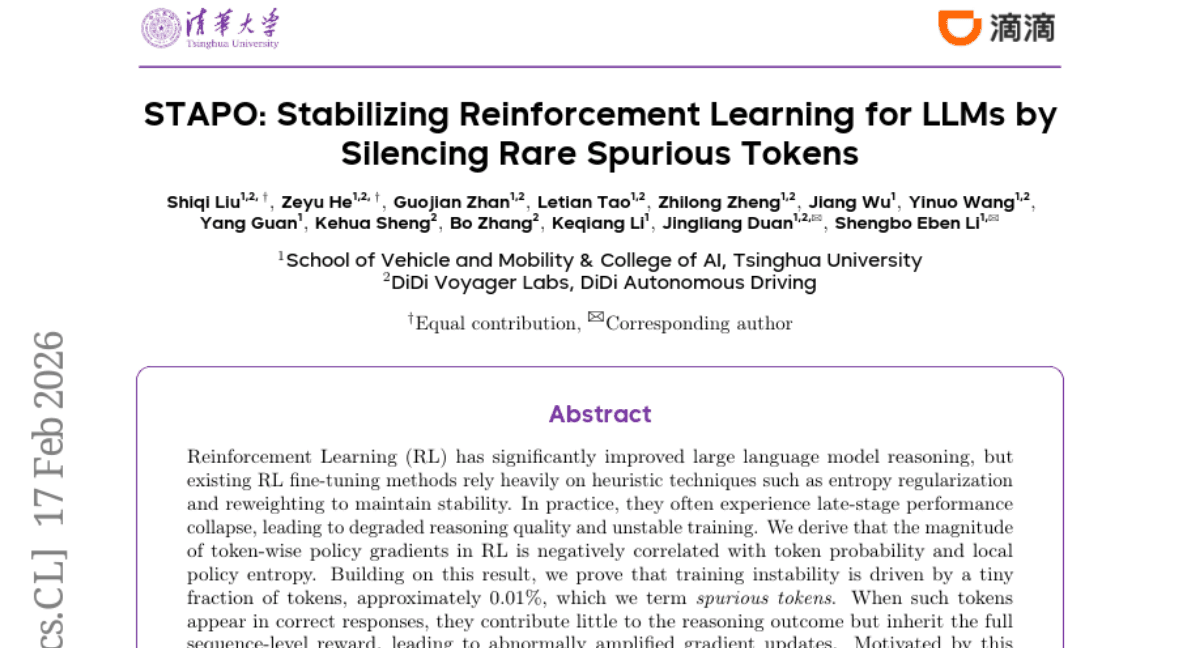
- **Stabilizing Reinforcement Learning with STAPO**: The **STAPO** framework addresses training instability caused by rare spurious tokens in large language models. By **silencing problematic tokens**, it enhances training stability and efficiency—vital for deploying reliable, large-scale models.
- **Optimization via Masking in Adaptive Optimizers**: Introducing **random parameter update masking**, this technique induces beneficial curvature in the optimization landscape, leading to **superior training performance** for large language models. It opens pathways for more effective scaling of neural architectures.
- **SpargeAttention2**: A **trainable sparse attention mechanism** employing **hybrid Top-k+Top-p masking** combined with **distillation fine-tuning**, which reduces computational costs while maintaining or enhancing performance. This innovation is critical for resource-constrained environments and real-time applications.
- **DDiT (Dynamic Patch Scheduling)**: Adaptive adjustment of patch sizes based on content complexity, DDiT improves the efficiency of diffusion transformers, enabling **faster, resource-efficient diffusion-based models** for high-performance tasks.
- **AlphaEvolve**: An automated multi-agent algorithm discovery system leveraging large language models and evolutionary coding techniques. AlphaEvolve accelerates the development of **novel multi-agent learning algorithms**, fostering more collaborative and adaptable AI systems.
- **Unified Latents (UL)**: Employing **diffusion prior regularization** and **diffusion decoding**, UL learns **joint latent representations** across multiple modalities, enabling **robust cross-modal alignment and transferability**—a foundational step toward universal, scalable models.
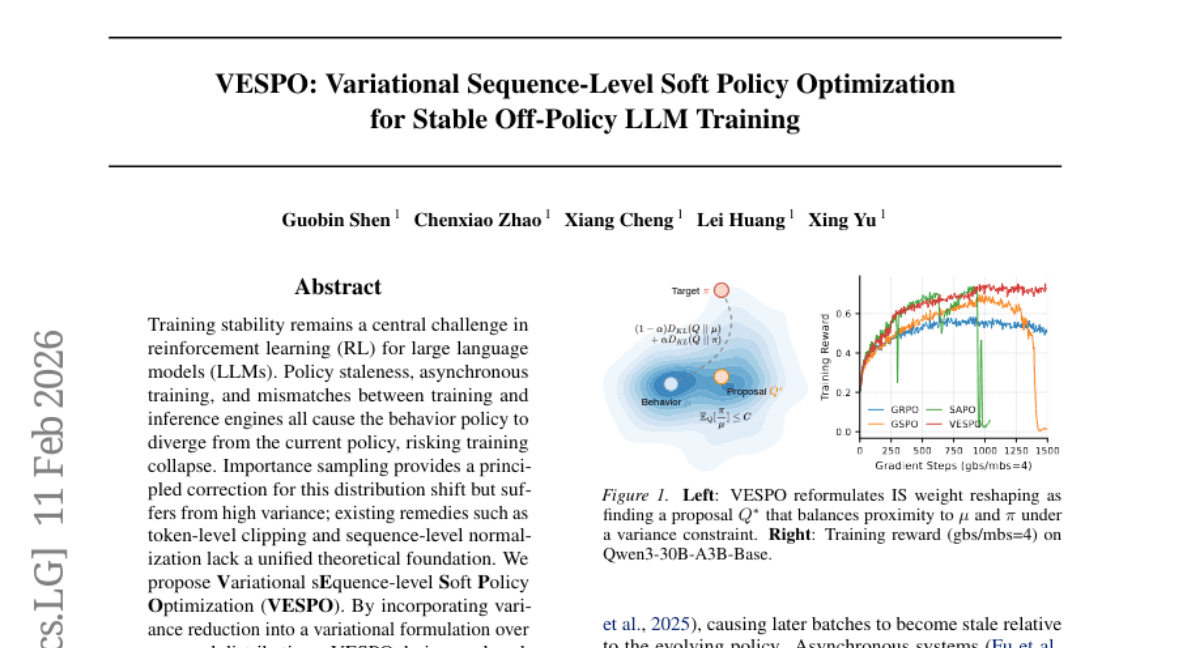
- **VESPO (Variational Sequence-Level Soft Policy Optimization)**: This recent stabilization technique introduces a **variational approach** to sequence-level policy optimization, enhancing the **stability of off-policy large language model training**. It complements methods like STAPO, collectively advancing reliable, scalable training procedures.
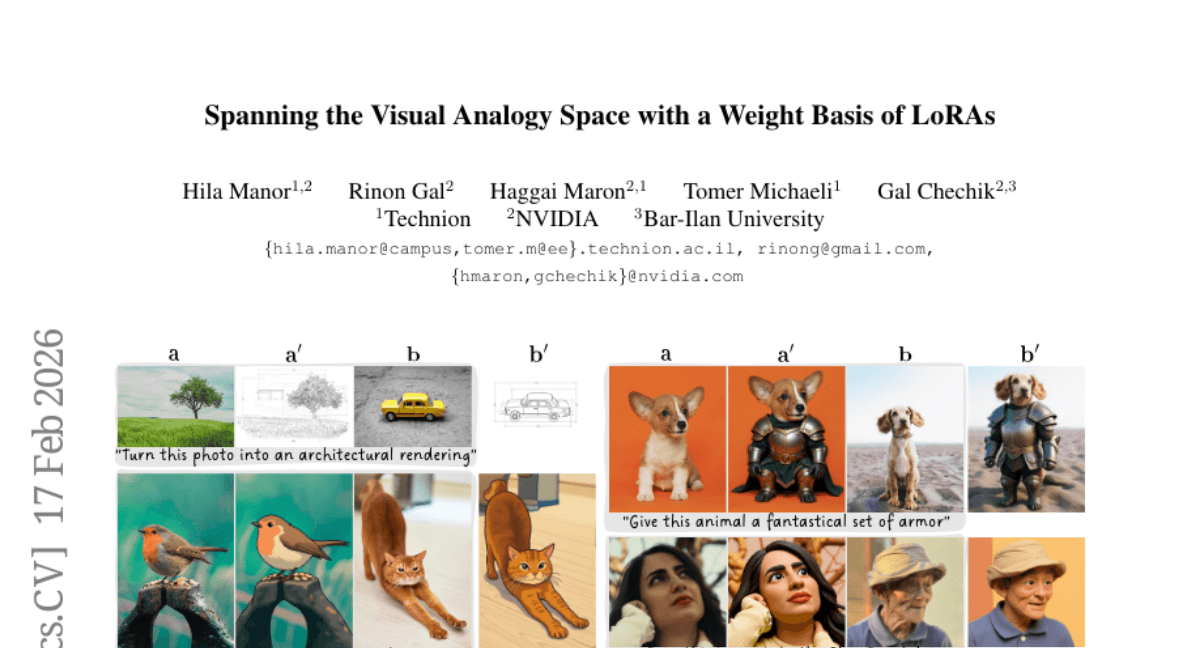
- **Spanning the Visual Analogy Space with a Weight Basis of LoRAs**: This work explores **efficient visual representation transfer** by leveraging a basis of Low-Rank Adaptations (LoRAs), enabling models to **span the visual analogy space** with minimal parameter overhead—crucial for multimodal transferability and efficiency.
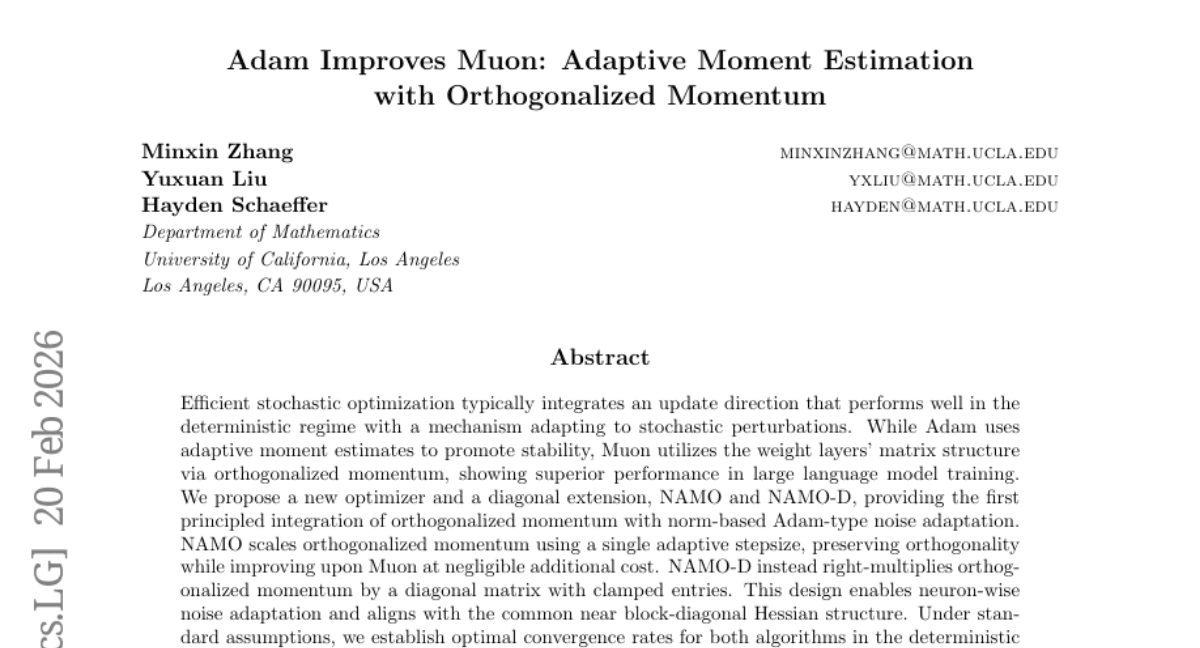
- **Adam with Orthogonalized Momentum**: An enhanced optimizer, **Adam** incorporating **orthogonalized momentum**, improves convergence stability and training efficiency—supporting the development of larger, more reliable models.
## Enhancing Efficiency, Transferability, and Trustworthiness
Addressing resource constraints and deployment realities, recent innovations make models more accessible and adaptable:
- **Time-LLaMA**: Designed for **time-series forecasting**, employing **dynamic low-rank adaptation**, this model enables efficient tuning of large language models for temporal data—applying to finance, climate modeling, and IoT analytics without retraining from scratch.
- **Representation and Transferability via mini-vec2vec**: By exploiting the geometric structure shared by well-trained representations, mini-vec2vec facilitates **scalable, universal geometry alignment**, bolstering robustness and transfer across tasks and domains.
- **Model Compression with COMPOT**: The **COMPOT** framework offers a **training-free, sparse orthogonalization-based compression** method, significantly reducing transformer sizes while preserving performance. This broadens AI's accessibility by enabling deployment in resource-limited environments.
## Building Trustworthy, Interpretable, and Physically Grounded AI Systems
As AI increasingly impacts critical sectors, ensuring **reliability, transparency, and physical reasoning** is paramount:
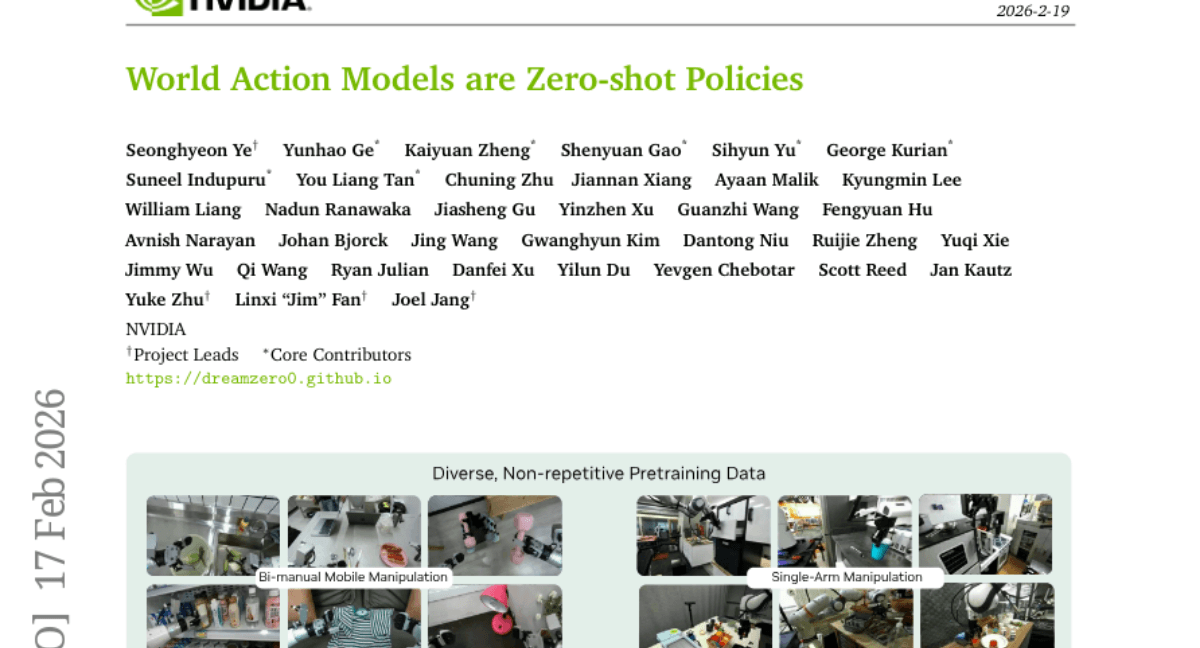
- **DreamZero**: A **World Action Model** utilizing video diffusion, DreamZero generalizes physical motions across unseen environments for **zero-shot policy inference**—a breakthrough for autonomous systems operating in unpredictable, real-world contexts.
- **Causal-JEPA**: Extending masked embedding prediction to **object-centric representations**, Causal-JEPA enables models to learn **robust, object-level causal relationships** in dynamic visual scenes—supporting more trustworthy perception.
- **Uncertainty Quantification & Hallucination Detection**: Incorporating **pre-trained uncertainty heads** into language models enhances their ability to **detect hallucinated or erroneous outputs**, critical for safety and reliability in domains like healthcare and finance.
- **AU-LLM**: Focused on affective computing, AU-LLM improves foundation models’ capacity to **detect micro-expressions**, fostering nuanced emotion recognition and better human-AI interaction.
- **RainShift & Sanity Checks**: Techniques like **RainShift**, which assesses geographic robustness, coupled with sanity checks for autoencoders, ensure learned representations are **meaningful and generalizable** across environments.
- **Synthetic Data & Statistical Inference**: New methods introduce **efficient randomized experiments** with synthetic data under distribution shifts and **hypothesis testing** for mechanistic interpretability—strengthening trustworthiness through rigorous validation.
## Progress in Hierarchical Tasks, Robotics, and Physical Reasoning
AI’s physical interaction and hierarchical reasoning capabilities are advancing rapidly:
- **DreamZero**: Extending physical reasoning, DreamZero generalizes physical motions across unseen environments, functioning as a **world action model** capable of **zero-shot reasoning** in dynamic contexts.
- **Error-Detecting Few-Step Generation**: New self-correcting mechanisms enable models to **identify and rectify errors during generation**, reducing inference steps and improving efficiency—crucial for real-time applications like dialogue systems and autonomous decision-making.
- **BiManiBench**: This benchmark evaluates multimodal LLMs’ ability to **coordinate bimanual robotic tasks** hierarchically, pushing forward AI’s physical manipulation skills.
- **TactAlign**: Facilitating **cross-embodiment tactile policy transfer**, TactAlign broadens tactile learning and manipulation transferability across diverse robot embodiments, vital for flexible robotics deployment.
## Current Status and Future Implications
These recent advancements collectively signify a **transformative phase in AI research and deployment**:
- **Robustness and Evaluation**: Platforms like the NeurIPS app, BrowseComp-V³, BiManiBench, TactAlign, ADP, NTIRE 2026, and tttLRM set new standards for robustness, multimodal reasoning, and adaptability, fostering accountability and continuous progress.
- **Training Stability and Efficiency**: Techniques such as **STAPO**, **optimizer masking**, **COMPOT**, and **VESPO** enable the training and deployment of large, high-capacity models with improved stability and resource utilization.
- **Trustworthy, Generalizable AI**: Advances in **invariant learning**, **uncertainty estimation**, and interpretability frameworks support the development of models that operate reliably across diverse environments with transparent decision-making.
- **Societal and Industrial Impact**: From **zero-shot physical reasoning** to **geographic robustness**, these innovations directly address societal challenges, aligning AI progress with tangible benefits.
- **Emerging Visual and Multimodal Capabilities**: The recent announcement of **tttLRM** at CVPR 2026 by Adobe and UPenn exemplifies the strides in vision-language models, emphasizing capabilities in image transformation, style transfer, and multimodal reasoning. Such models are key to sophisticated image editing, content understanding, and cross-modal applications.
In conclusion, the convergence of **advanced benchmarks**, **scalable algorithms**, and **trustworthy, resource-efficient models** is shaping an era where **AI systems are smarter, more adaptable, and more aligned with human needs**. This integrated progress paves the way for **autonomous agents capable of complex multimodal, physical, and hierarchical reasoning**, underpinning societal benefits with transparency, reliability, and inclusivity.