# The 2024–2026 Revolution in Multimodal AI: Advanced Techniques, Hardware Co-Design, and World-Model Breakthroughs
The years 2024 through 2026 mark an unprecedented epoch in the evolution of multimodal artificial intelligence. Building on prior momentum, this period has witnessed a convergence of **cutting-edge techniques**, **hardware innovations**, and **sophisticated world-model architectures**, fundamentally transforming AI systems into reasoning-capable, scene-aware, resource-efficient, and highly autonomous agents. These advancements are not only expanding AI's capabilities across text, images, audio, and video but are also enabling deployment on **resource-constrained devices**, paving the way for **trustworthy**, **long-horizon**, and **interactive AI** in the real world.
---
## Major Technique and Architectural Innovations
### Dynamic Routing and Mixture of Experts (MoE)
A cornerstone of this revolution has been **dynamic routing mechanisms** within **Mixture of Experts (MoE)** architectures. Notably, models like **OmniMoE** utilize **input-dependent parameter activation**, selectively engaging relevant subnetworks based on contextual cues. This approach drastically reduces computational costs while maintaining or even enhancing reasoning abilities. Tools such as **RelayGen** and **ThinkRouter** now facilitate **real-time inference reconfiguration**, crucial for applications like **live video processing** and **autonomous navigation** where **latency and efficiency** are paramount.
### Hybrid Attention-Convolution Architectures
The integration of **attention mechanisms** with **convolutional neural networks (CNNs)** has led to models that effectively balance **local feature extraction** with **global context understanding**. For instance, **Liquid AI’s LFM2**, with just 1.2 billion parameters, surpasses larger models like **Gemma 3** (1 billion parameters) in **multimodal reasoning** and **scene comprehension**. These **hybrid architectures** demonstrate that **compact, optimized models** can outperform bulkier counterparts in **multimodal understanding**—especially when tailored for **efficiency**.
### Linear Attention and Diffusion Priors
Advances in **linear attention** models (such as **2Mamba2Furious**) now enable **scalable reasoning** with **linear computational complexity**, making them suitable for **edge deployment**. When combined with **diffusion prior regularization** and **joint latent spaces**—exemplified by **Unified Latents UL**—these models foster **semantic coherence** across modalities, resulting in **faster inference** and **more integrated understanding** of complex data streams.
### Unified Multimodal Tokenization
A groundbreaking development has been **unified tokenization schemes** like **UniWeTok**, which leverage **extensive codebooks** exceeding **2^128 entries**. This allows encoding **text, audio, and visual data** within a **single, cohesive token space**, simplifying model architecture and enabling **seamless cross-modal reasoning**. Such schemes are instrumental in **video understanding** and **multi-sensor fusion**, providing a **robust, integrated processing pipeline** capable of handling diverse data formats efficiently.
---
## System-Level Innovations and Hardware Co-Design
### Model Compression and Quantization
To facilitate **on-device AI**, researchers have pushed the boundaries of **model compression** and **quantization**:
- **NanoQuant** now supports **post-training quantization** below **1-bit precision**, drastically reducing **energy consumption**.
- The **COMPOT** framework incorporates **matrix Procrustes orthogonalization**, enabling **weight compression after training**—eliminating retraining overhead and accelerating **deployment**.
- **RaBiT** offers **lightweight neural networks** that maintain **high accuracy** despite significant size reductions, making **real-time reasoning** on **mobile hardware** more practical than ever.
### Runtime Frameworks and Edge Hardware
Next-generation **runtime stacks** and **specialized hardware** are transforming multimodal inference:
- **TensorRT**, **vLLM**, and **OpenELM** now support **high-throughput, low-latency inference** on **NVIDIA GPUs**, powering **real-time multimodal interactions**.
- **Ggml.ai** provides **on-device reasoning solutions** that **prioritize user privacy** by minimizing dependence on cloud services.
- **Dynamic inference optimization tools** such as **RelayGen** and **ThinkRouter** enable systems like **Voxtral Realtime** (by **MistralAI**) to process **live audio and video streams**, making them ideal for **virtual assistants**, **AR/VR**, and **interactive media**.
### Hardware Co-Design and Industry Initiatives
The hardware landscape has seen a surge in **application-specific chips**:
- The **Taalas HC1 chip** exemplifies this trend, achieving **nearly 17,000 tokens/sec** when processing models like **Llama 3.1 8B**, representing a **tenfold speed increase** over traditional hardware.
- The **"Custom ASIC Thesis"** underscores the importance of **hardware-software co-optimization**. Industry giants such as **SambaNova** and **Intel** have secured **hundreds of millions of dollars** in funding to develop **specialized AI chips**, targeting **faster inference**, **energy efficiency**, and **democratization** of large-scale multimodal deployment.
---
## Breakthroughs in Long-Horizon Reasoning and World Models
### Structured Memory and Scene Coherence
Persistent scene understanding over long periods relies on **memory architectures** like **AnchorWeave**, which employs **retrieved local spatial memories** to generate **world-coherent videos**. This is vital for **virtual environment simulation**, **autonomous scene analysis**, and **long-term reasoning**. Enhancements such as **ViewRope**, utilizing **geometry-aware rotary position embeddings**, significantly improve **scene stability** across extended sequences—crucial for **autonomous navigation** and **video comprehension**.
### Advanced World Models and Planning
Recent models like **StarWM** facilitate **long-horizon prediction** of future observations under **partial observability**, enabling **strategic planning** in complex environments such as **StarCraft II**. Reinforcement learning frameworks such as **VESPO** have demonstrated **improved training stability** and **efficiency** for large language models involved in **decision-making** and **action generation**. These architectures, combined with tools like **ViewRope** and **AnchorWeave**, support **long-term planning**, **dynamic interaction**, and **scene coherence**, paving the way for **autonomous, scene-aware agents** capable of **persistent operation**.
### Notable 2024–2026 Innovations
- **ARLArena** introduces a **unified reinforcement learning framework** emphasizing **long-term stability** and **agent adaptability**.
- **JAEGER** advances **joint 3D audio-visual grounding** and **reasoning** within **simulated physical environments**, enabling **multisensory scene understanding**.
- **SeaCache** proposes a **spectral-evolution-aware cache** that **accelerates diffusion models**, reducing **latency** and **energy consumption** during inference.
- **JavisDiT++** enables **joint audio-visual content generation**, supporting **seamless multi-modal content creation**.
- **World Guidance** integrates **world conditioning** into **world modeling**, enhancing **action generation** and **interactive decision-making**.
### Enhancing Efficiency and Trust
Research has focused on **training efficiency** for **large language models**, developing methods to **reduce compute requirements** and **accelerate convergence**. The **Model Context Protocol** has been refined to **maximize reasoning efficiency** across multiple turns, supporting **more effective multi-modal interactions**. Additionally, startups like **t54 Labs** and projects such as **Anthropic + Vercept** are pioneering **trust layers** and **tool-use frameworks** that improve **agent reliability**, **explainability**, and **user trust**—critical for deploying **autonomous, scene-coherent multimodal agents** in real-world settings.
---
## New Developments and Their Significance
### Zavi Voice-to-Action OS
- **Zavi AI** introduces a **Voice to Action Operating System** that enables **voice commands** to **type**, **edit**, **see**, and **take actions** across **all major platforms**—iOS, Android, Mac, Windows, Linux. Unlike typical voice tools that merely transcribe, Zavi allows **interactive multimodal control** in real time, **without requiring credit cards**. This represents a leap toward **naturalistic, on-device multimodal interaction**.
### Risk-Aware World Model Predictive Control for Autonomous Driving
- The **Risk-Aware World Model MPC** integrates **predictive control** with **risk assessment**, enabling **generalizable end-to-end autonomous driving** that accounts for **uncertainty** and **dynamic environments**. This approach enhances **safety**, **robustness**, and **adaptability**—key for **real-world deployment** of autonomous vehicles.
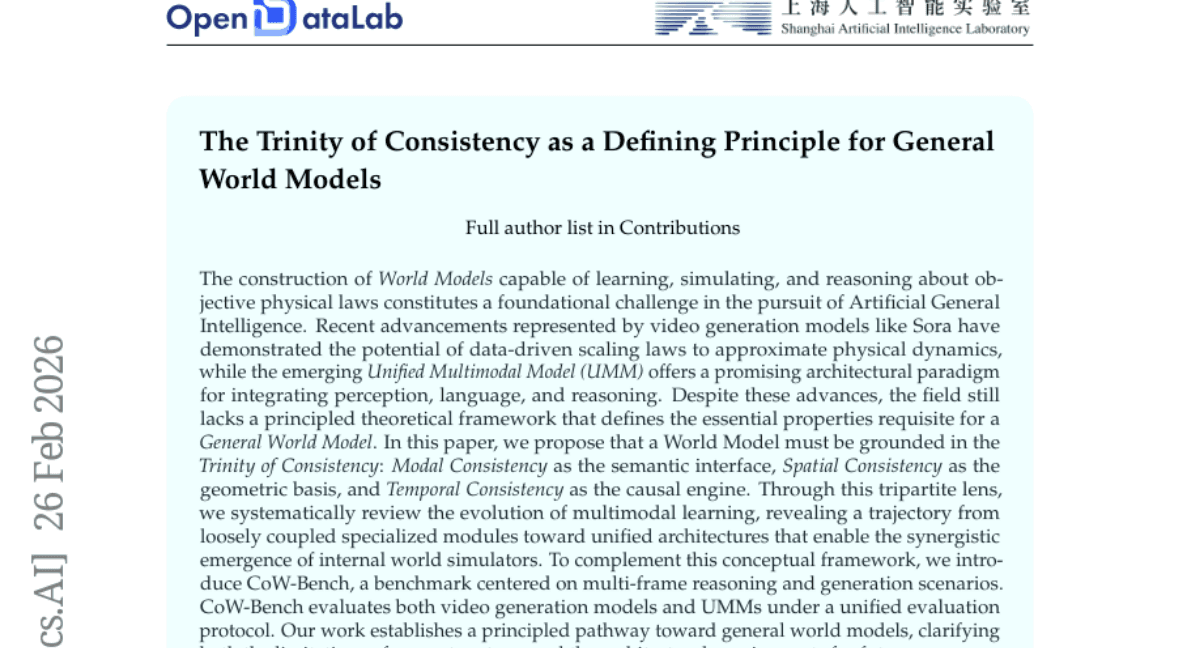
### The Trinity of Consistency in World Models
- **The Trinity of Consistency** underscores a **fundamental principle** for **general world models**: **perceptual**, **temporal**, and **behavioral** consistency. Ensuring these three facets are aligned is crucial for **scene coherence**, **long-term reasoning**, and **trustworthy AI behavior**—especially in complex, unpredictable environments.
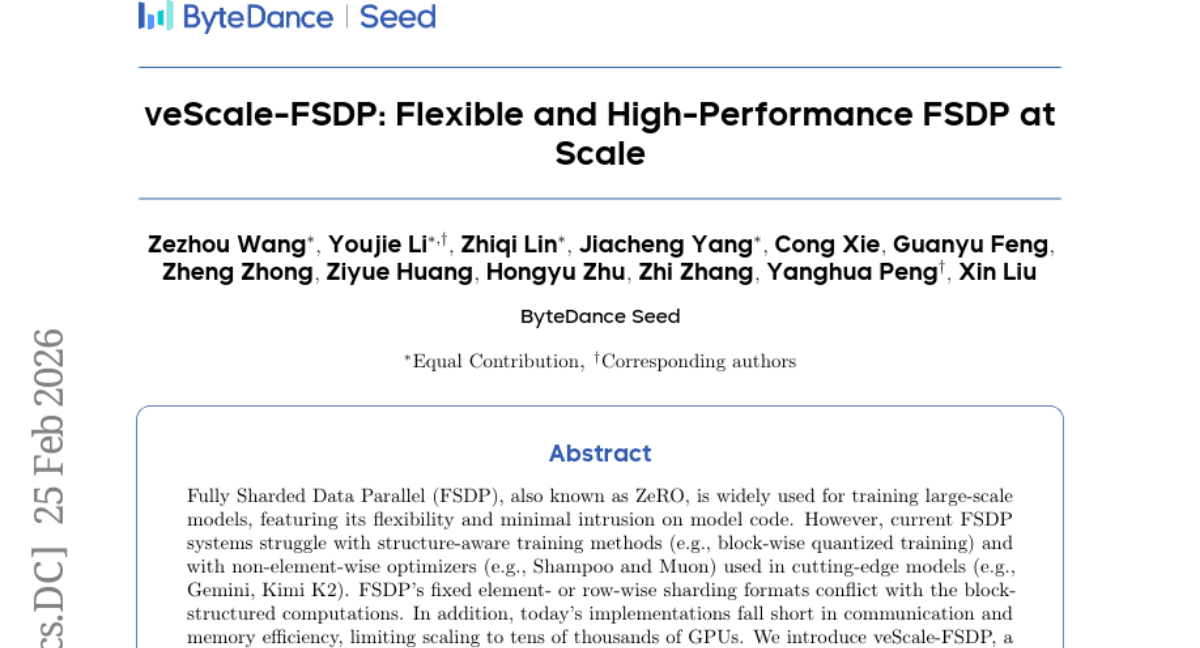
### veScale-FSDP: Scalable, High-Performance Training
- **veScale-FSDP** offers a **flexible, high-performance Fully Sharded Data-Parallel** training framework that scales efficiently, reducing **training time** and **cost** for **large multimodal models**, accelerating **research and deployment cycles**.
### Industry Collaborations and Partnerships
- **ElevenLabs** and **Google Cloud** have expanded their partnership to support **NVIDIA Blackwell GPUs**, enabling **massive-scale AI training and inference**. This collaboration dramatically boosts **speed**, **scale**, and **cost-efficiency** for **multimodal AI development**.
### Implications and Future Trajectory
These developments collectively **accelerate** the **adoption of scene-coherent, energy-efficient multimodal agents** capable of **long-horizon planning**, **multisensory understanding**, and **trustworthy reasoning**. The ongoing **hardware-software co-design efforts**, combined with **advanced world models** and **robust tool-use frameworks**, are positioning AI to operate seamlessly within **complex physical and digital environments**—from **autonomous vehicles** to **personal assistants** and **robotics**.
---
## Current Status and Outlook
The **2024–2026 period** has firmly established multimodal AI as a **holistic ecosystem**, integrating **powerful techniques**, **tailored hardware**, and **robust reasoning architectures**. The focus on **energy-efficient, on-device reasoning** and **long-term scene understanding** underscores a future where **autonomous agents** are **scene-aware**, **trustworthy**, and capable of **long-horizon planning**.
Significant investments, such as **Wayve’s $1.5 billion** funding for autonomous driving and strategic partnerships like **ElevenLabs-Google Cloud-NVIDIA**, highlight the **commercial and societal potential** of these advances. Meanwhile, startups like **t54 Labs** and collaborations across industry sectors emphasize a shared drive toward **building reliable, explainable multimodal AI** capable of **integrating perception, reasoning, and action** in real-world applications.
Looking forward, the bridging of **efficient architectures**, **specialized hardware**, and **long-term world models** will enable deployment of **scene-coherent, resource-conscious multimodal agents** across domains like **robotics**, **AR/VR**, **autonomous systems**, and **personal devices**. These innovations promise an era where **autonomous agents** are **powerful**, **trustworthy**, and **long-horizon**, fundamentally transforming **human-AI interaction** and **world understanding**.
---
## Highlights and Emerging Frontiers
- **Zavi Voice-to-Action OS** exemplifies **naturalistic, on-device multimodal control**, making AI more accessible and integrated.
- **Risk-Aware World Model MPC** enhances safety and robustness for **autonomous driving**.
- **The Trinity of Consistency** provides a **principled foundation** for **general world models**, ensuring **scene coherence** and **reliable reasoning**.
- **veScale-FSDP** accelerates **large-scale multimodal model training**, lowering barriers for researchers and industry.
- Major industry collaborations, such as **ElevenLabs with Google Cloud and NVIDIA**, exemplify the **scaling of AI infrastructure** needed for next-generation multimodal systems.
---
**In conclusion**, the 2024–2026 epoch in multimodal AI is characterized by **integrative breakthroughs**—melding **advanced techniques**, **hardware innovations**, and **world-model architectures** to produce **efficient, trustworthy, and autonomous multimodal agents**. These strides are setting the stage for AI that is not only **more capable** but **more aligned** with human needs, capable of **long-term reasoning**, **scene understanding**, and **trustworthy operation** across a multitude of real-world applications.