# Pioneering Reinforcement Learning, Multimodal Architectures, and Safety Strategies in Large Language Models: The Latest Frontiers
The race to elevate large language models (LLMs) into truly reasoning, multimodal, and trustworthy AI systems is accelerating at an unprecedented pace. Recent breakthroughs are not only refining foundational algorithms but are also redefining how models learn, adapt, and operate in complex environments. This comprehensive update synthesizes the latest advancements—from reinforcement learning techniques that ensure **long-horizon stability**, to architectural innovations enabling **persistent multimodal reasoning**, and new safety and explainability methods—painting a picture of an AI landscape rapidly transforming into more reliable, versatile, and accessible systems.
## Reinforcement Learning: Enhancing Stability, Safety, and Trustworthiness
A core challenge in deploying LLMs for sophisticated reasoning tasks has been maintaining **training stability** and **logical coherence** over extended sequences. The latest developments introduce **refined RL algorithms** and control mechanisms designed to mitigate these issues:
- **Sequence-Level Optimization**:
- **VESPO (Variational Sequence-Level Soft Policy Optimization)** leverages a **variational framework** to enforce **internal consistency** across reasoning chains, significantly reducing gradient divergence and spurious token generation. Its effectiveness in producing **dependable long-term outputs** has been validated across complex reasoning benchmarks.
- **STAPO (Suppression of Token Anomalies during Policy Optimization)** specifically targets **factual inaccuracies** and **logical inconsistencies**, particularly vital in high-stakes domains like scientific research and medicine, by actively suppressing misleading tokens during training.
- **Adaptive Regularization & Control**:
- **GRPO (Generalized Reinforcement Policy Optimization)** utilizes **adaptive entropy regularization** to balance **exploration** and **exploitation**, fostering **diverse yet controlled responses** suited for multi-step, long-horizon reasoning.
- **FLAC (Maximum Entropy RL via Kinetic Energy Regularized Bridge Matching)** maintains **maximal entropy policies** through **kinetic energy-based regularization**, enabling models to **dynamically adapt** to environment complexity and support **robust, extended reasoning**.
- **Filtering and Causal Control**:
- Incorporating **causal filtering** and **Kalman filtering** into inference pipelines has proven instrumental in **reducing variance** and **stabilizing multi-turn reasoning**, especially in **interactive and multimodal settings**, ensuring **trustworthy, coherent outputs** over lengthy sequences.
- **Process Reward Modeling & Consensus Sampling**:
- Researchers like **Brandon Damos** have pioneered **Process Reward Modeling**, which actively **detects and mitigates reward pathologies**, a crucial step toward **safer, aligned models**.
- **Consensus sampling**, championed by safety experts such as **Adam Kalai**, involves aggregating multiple model outputs to **enhance robustness and reliability**, especially critical in **high-stakes applications**.
## Architectural Innovations and Agentization for Persistent Multimodal Reasoning
To support **long-horizon reasoning** and **multimodal understanding**, new architectural paradigms are emerging:
- **InftyThink+** exemplifies models designed for **infinite-horizon reasoning**, employing **recursive reasoning loops** and **persistent context management**. These architectures enable **multi-stage scientific inference**, **long-term planning**, and **multi-faceted problem solving**, pushing the boundaries of what LLMs can achieve.
- **Composition-RL** introduces a **modular reasoning architecture** with **interpretable reasoning units**. This design allows for **flexible assembly** tailored to various domains, promoting **transparency**, **scalability**, and **domain-specific customization**.
- **World Model Reproducibility & Efficient Iteration**:
- Under the leadership of figures like **Yann LeCun**, emphasis on **reproducible world modeling** accelerates **rapid experimentation**, supports **reliable environment simulation**, and is vital for **autonomous decision-making** and **scientific discovery**.
## Multimodal and Perception: Bridging Visual, Auditory, and Textual Data
Recent breakthroughs have pushed the envelope in **perception across modalities**, bringing **vision**, **audio**, and **text** closer together:
- **Closing the Text-Speech Gap**:
- Multimodal models now seamlessly integrate **speech understanding**, enabling **voice-based reasoning** and **real-time interactive dialogue**, broadening AI’s perceptual and communicative capabilities.
- **Audio-Chat and Multimedia Reasoning**:
- **AudioChat** models facilitate **spoken dialogue**, making AI interactions more **natural** and **accessible**. These systems support **context tracking** and **long-term conversational coherence** in multimodal environments.
- **Video and 3D Environment Modeling**:
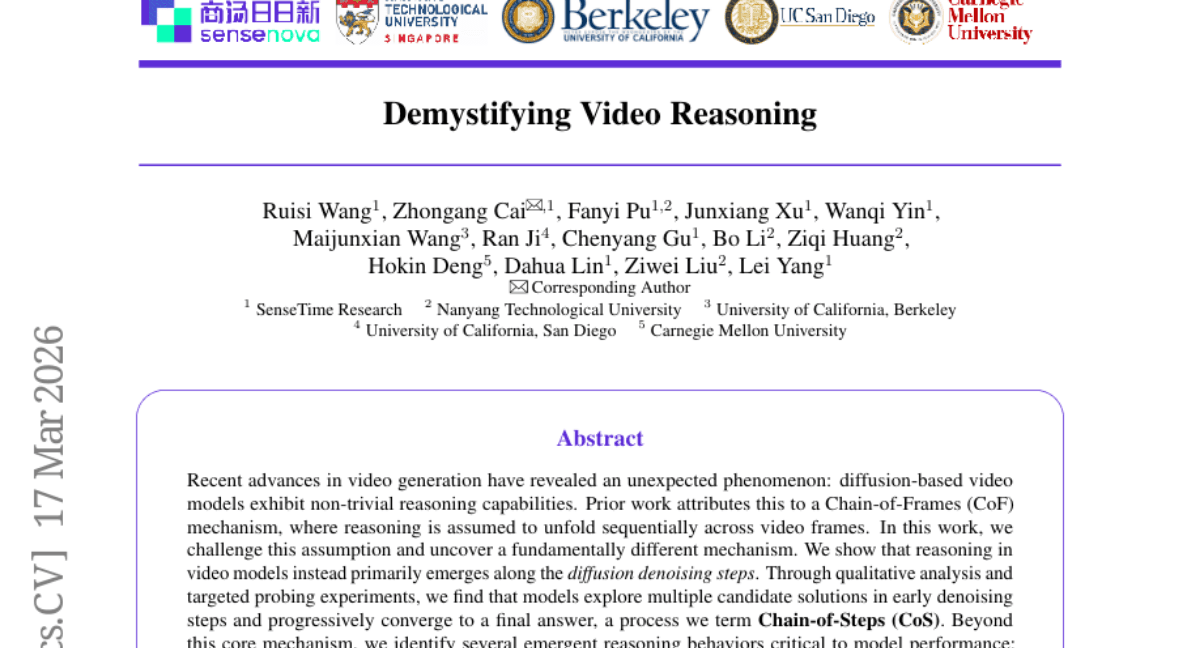
- Frameworks like **Rolling Sink** and the **A Very Big Video Reasoning Suite** handle **continuous video streams** and **long-term temporal data**, empowering models with **occlusion-aware control** and **behavioral analysis**.
- The **tttLRM (Test-Time Training for Long Context & Autoregressive 3D Reconstruction)** approach allows models to **adapt dynamically during inference** and **reconstruct 3D environments**, advancing **scientific visualization**, **autonomous exploration**, and **virtual environment understanding**.
- **SODA Pretraining for Multimodal Extensibility**:
- Building on recent work by **@Diyi_Yang**, **SODA (Self-Organizing Dataset Augmentation)** extends transformer pretraining beyond text, incorporating **vision**, **audio**, and **3D data**. This **multi-modal pretraining** enhances **cross-modal understanding** and **transfer learning**, fostering more **generalized AI systems** capable of processing diverse data types simultaneously.
- **Multimodal Attribution & Explainability**:
- Emerging attribution techniques now enable models to **trace reasoning steps** back to **specific data sources** across modalities, significantly improving **trustworthiness**—crucial in **healthcare**, **scientific research**, and **safety-critical systems**.
## Retrieval, Memory, and Fact Preservation: Building Trustworthy Knowledge Foundations
Addressing **hallucinations** and **factual inaccuracies**, recent innovations emphasize **knowledge retention** and **source-level explainability**:
- **Augmented Retrieval-Augmented Generation (A-RAG)**:
- A-RAG dynamically **retrieves relevant knowledge snippets** during inference, ensuring **up-to-date factuality** and **reducing hallucinations**.
- **AnchorWeave**:
- This architecture embeds **long-term, environment-referenced memory** within a **spatiotemporal framework**, supporting **long-term consistency** and **knowledge updating** over extended periods.
- **Explainability via Multimodal Attribution**:
- Techniques now allow models to **trace reasoning paths** to **specific sources across modalities**, bolstering **interpretability** and **trust** in critical applications like **medicine**, **research**, and **autonomous systems**.
## Efficiency and Deployment: Making Large Models More Accessible
As models grow in size and complexity, efforts focus on **reducing computational costs** and **broadening accessibility**:
- **Quantization & Model Compression**:
- **NanoQuant** achieves **sub-1-bit quantization**, enabling **edge deployment** on resource-constrained devices, making **powerful models** accessible beyond specialized hardware.
- **Sparse Mixture of Experts (MoE)**:
- Architectures such as **Arcee Trinity** utilize **dynamic routing** to **scale capacity efficiently**, dramatically reducing **computational load** while maintaining **performance**.
- **Streaming & Client-Side Deployment**:
- Techniques like **NVMe layer streaming** allow models like **Llama 3.1 70B** to run on **single GPUs**, lowering hardware barriers.
- The recent **TranslateGemma 4B** model, **reposted by @huggingface**, runs **entirely in the browser** using **WebGPU**, **democratizing access** and **empowering users worldwide**.
## Test-Time Training & Embodied Reasoning: Adaptive and Autonomous AI
Innovations in **learning during inference** and **embodied reasoning** are reshaping AI capabilities:
- **Reflective Test-Time Planning for Embodied LLMs**:
- As discussed by **@_akhaliq**, **test-time training with KV (Key-Value) binding** and **linear attention techniques** allow models to **adapt dynamically during inference**, improving **robustness in embodied tasks** such as robotics or virtual agents.
- **Self-Reflective Planning**:
- Incorporating **self-evaluation** and **error correction** during inference, **reflective planning strategies** enable models to **self-improve** and **navigate complex environments** more reliably.
## Reinforcement Learning & Safety: Embedding Control from the Start
A paradigm shift is underway from post hoc RL fine-tuning to **integrating control objectives during initial training**:
- **Early RL Integration & Control**:
- Embedding **RL objectives early** aligns models with **goal-directed behaviors** from the outset, reducing reliance on costly fine-tuning phases.
- **Safety & Alignment**:
- Techniques such as **NeST (Neuron Safety Tuning)** and **Latent.Space** focus on **controlling model behaviors** during training, proactively **reducing risks** associated with **unsafe or unintended outputs**.
- **Process Reward Modeling** actively **detects reward pathologies**, ensuring **safer, more aligned AI systems**.
- **Consensus Sampling & Robustness**:
- Combining multiple outputs through **consensus sampling** further enhances **reliability**, especially critical in **high-stakes applications**.
## Recent Additions and Emerging Directions
This update introduces **notable new research avenues**:
- **NoLan**: *Mitigating Object Hallucinations in Vision-Language Models* — by **dynamically suppressing language priors** that lead to **visual object hallucinations**, **NoLan** enhances **factual reliability** in multimodal image and video tasks. Join the discussion on its paper page to explore its potential impact.
- **NanoKnow**: *Probing and Measuring Model Knowledge* — a framework to **quantify what models truly know**, addressing **factual gaps** and **knowledge calibration** issues, critical for **trustworthy AI**.
- **GUI-Libra**: *Training GUI Agents for Reasoning and Action* — focuses on **native graphical user interface (GUI)** understanding, **training agents** that **reason and act** with **action-aware supervision** and **partially verifiable reinforcement learning**. This paves the way for **intelligent automation** in complex interfaces.
## Current Status and Broader Implications
The convergence of these technological advances signals a **new epoch** in AI development:
- **Long-horizon, reasoning-rich models** like **InftyThink+** and **AnchorWeave** are poised to **accelerate scientific breakthroughs** and **complex decision-making**.
- **Memory-augmented architectures** and **retrieval-augmented models** are **improving factual accuracy** and **explainability**, fostering **trust** in critical domains.
- **Efficiency breakthroughs**, from **quantization** to **browser-based models**, are **democratizing AI access**, making **powerful models available to broader audiences**.
### Final Reflection
The latest developments underscore a collective push towards **trustworthy, multimodal, and scalable AI systems** capable of **long-term reasoning**, **dynamic adaptation**, and **safe deployment**. As models become **more reliable, interpretable, and accessible**, they will serve as **trusted partners** in scientific discovery, industry, and everyday life—heralding a future where **AI truly understands, explains, and acts** in complex, real-world environments.
These advances not only **expand the capabilities** of large language models but also **reshape the AI safety and alignment landscape**, emphasizing **early control**, **factual integrity**, and **robustness**—crucial for societal trust and responsible deployment. The journey ahead promises **even more integrated**, **adaptive**, and **trustworthy AI systems** shaping the next era of technological progress.